

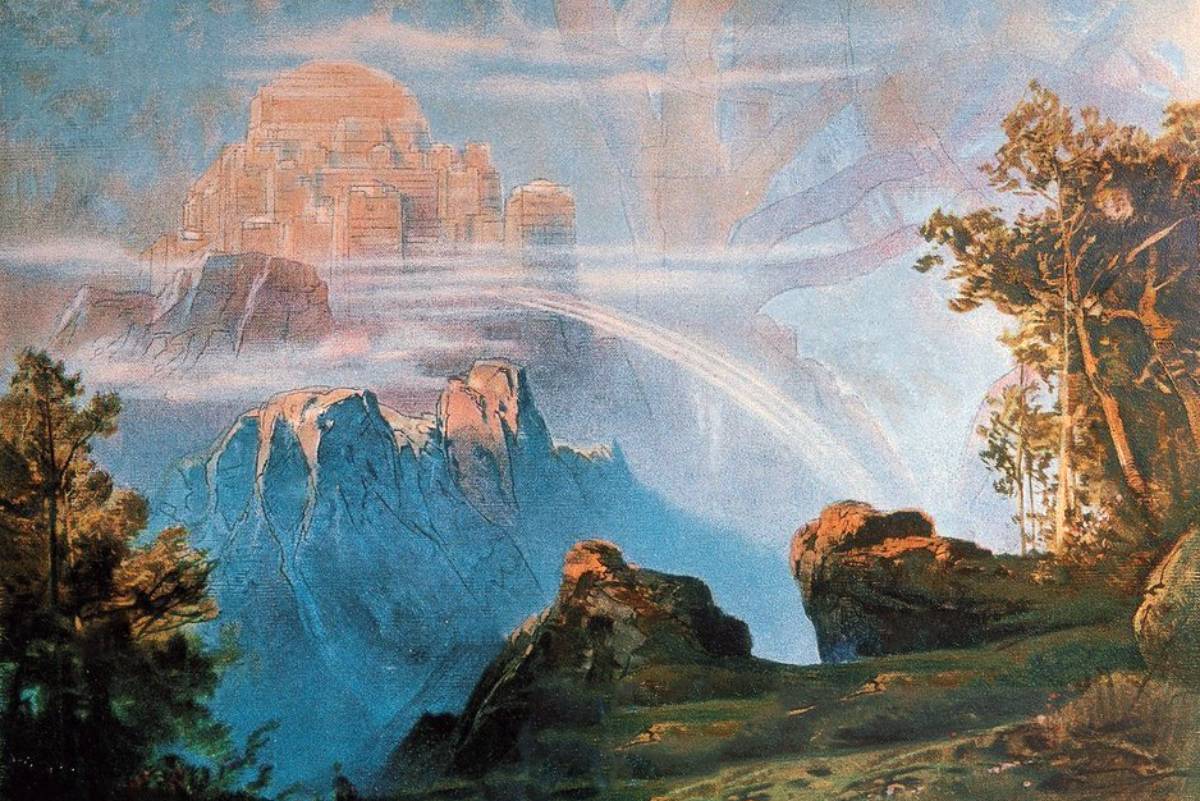
A key modern gripe is that we humans are making a bit of a mess of this world.
With Elon Musk and other billionaires intent on starting a new space race and making a dash for Mars when Earth goes belly up, there could be, in the next century, the tantalizing prospect of that David Bowie song coming true: there will be life on Mars.
If, or when, this happens, humankind will inhabit two worlds.
Despite the possibility of human life on another planet soon, the search for extraterrestrial life trudges on with seemingly no luck. Yet wind the clock back a millennium, and the myths from Viking societies describe a cosmos not limited to this world alone, but to life spread across nine worlds, in nine realms.
The phrase "nine worlds" pops up repeatedly in the rich tapestry of Norse mythological texts, from the Eddic poems to later prose traditions.
For example, in Völuspá (or, in English, "Prophecy of the völva, a seeress"), a poem from the Poetic Edda and the ultimate source of our understanding of Norse mythology and cosmology, we find the magical seeress, a völva, describing the outlay of the Norse universe.
Here, there is mention of "nine worlds" that exist beneath the tree. Using an online version of the 1936 English translation by Henry Adams Bellows, the völva describes how:
"In the days gone by
Nine worlds I knew, the nine in the tree
With mighty roots..." [Stanza 1]
Despite multiple references to these "nine worlds," there is no definitive list to be found anywhere in the surviving Norse sources.
Rest assured, dear reader, that we have pulled out our magnifying glass to do a bit of historical detective work and try to unpack what you need to know about these nine worlds.
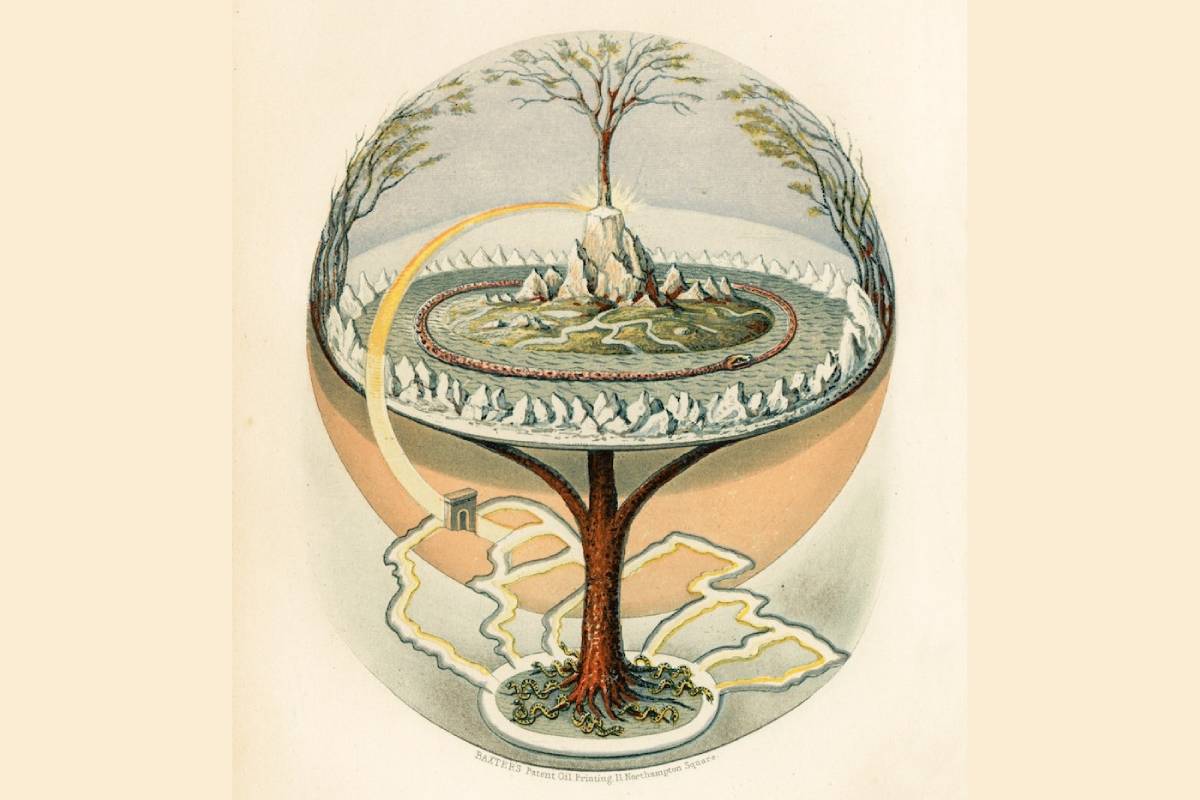
A 19th-century attempt to depict Yggdrasil as described in the Prose Edda. Author: Oluf Bagge (1780–1836)
The nine we know
Whilst Norse mythological texts, from the Eddic poems to later prose traditions, mention "nine worlds," they are sometimes also referred to as realms and, in the modern context, even thought of as separate universes.
Regardless, they are all connected thanks to the great world tree, Yggdrasil, and remain a key component of the Norse cosmological and mythological outlook.
We start first with where we are now – Midgard, the realm of humans, which was created with the eyebrows of the first being, Ymir.
Half of the Norse gods are situated in Asgard, ruled over by Odin, whilst the other half, the Vanir, can be found in Vanaheim.
For those dead who are not selected to join the eternal feasting with Odin in Valhalla or selected by Freyja to Fólkvangr, they are taken by the daughter of Loki, Hel, to her otherworldly realm, Helheim.
The bane of many Norse gods, particularly Thor, is the jötnar (giants), who can be found in Jotunheim.
The realm of Alfheim is where you will find "light-elves," whilst their murky and nefarious opposite, the "dark elves," can be found in Svartalfheim. Somewhat confusingly, this is also the realm where dwarves are said to reside, sometimes placed in Svartalfheim and in other sources associated with Niðavellir.
Finally, there are two worlds which trace their origin back to the very beginnings of the Norse cosmos itself, Niflheim, land of mist and ice, and Muspelheim, land of fire and home of the fiery jötunn, Surtr.
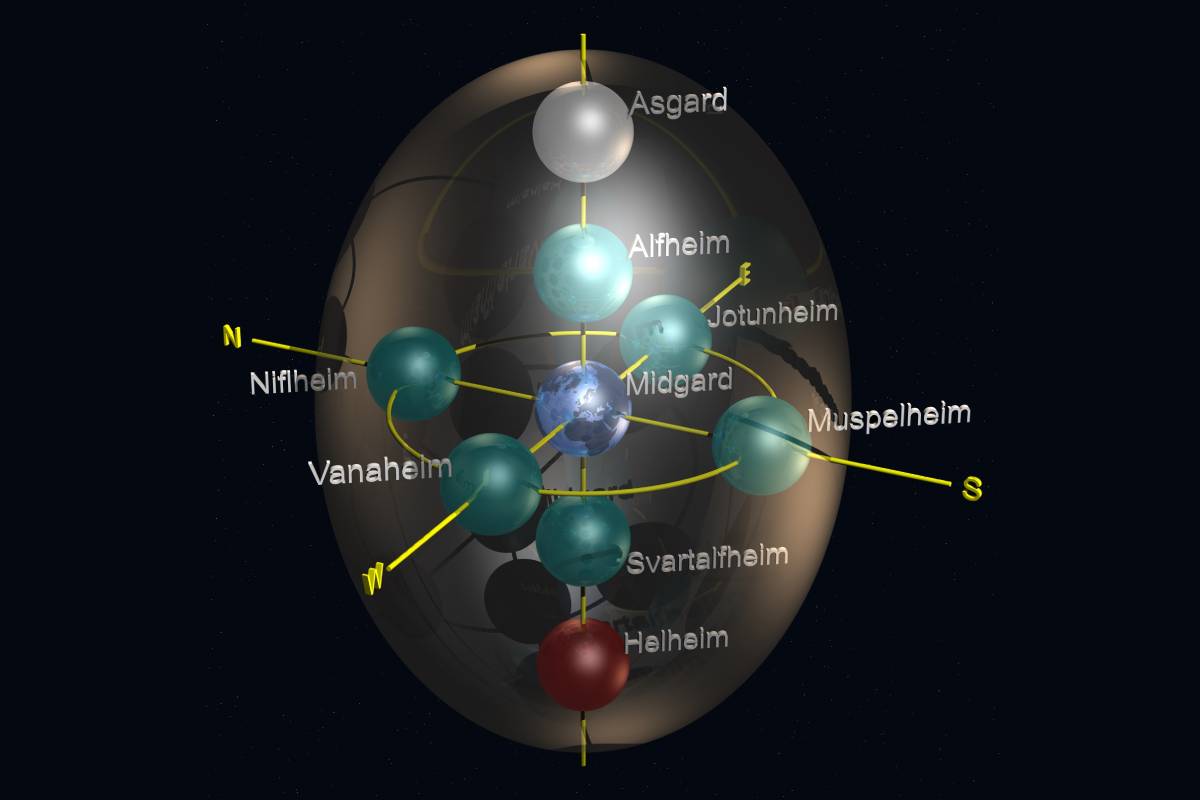
Modern visualization of the nine worlds in Norse cosmology, shown in relation to Midgard. Author: Cush
Trying to craft a list
A glance at the rich tapestry of Old Norse literature reveals that an important part of our written sources for Norse myth and history comes from texts compiled long after the Viking Age, including the works of 13th-century CE Icelandic poet and politician Snorri Sturluson.
The narratives he wrote and retold did have echoes of the past and were based upon oral traditions stretching back to Viking Age societies centuries before.
As such, we do not know how true Snorri's versions were to the stories that people from those societies once told one another.
Modern writers often refer to his mythological handbook, the Prose Edda, as Snorri's Edda, whereas the Poetic Edda is an anonymous compilation.
This situation, as Jens Peter Schjødt writes about in his chapter in the 2008 book The Viking World (available on Amazon here), has left us with the "tips of narrative icebergs."
Due to the heavy hand of Sturluson, we may never know what segments he excluded from his collections and compilations. Perhaps some sagas or stories had a complete list of the nine worlds or even featured more.
Conversely, in the compilation of poems we call the Poetic Edda, which were written anonymously and heavily feature explanations of Norse cosmology and mythology, there are mentions of the "nine worlds," but no clear definition or list.
As there is no definitive list, it can be a bit tricky to exactly decide which locations in the Norse cosmology are on any potential list and which are considered off.
For example, why is Valhalla not considered one of the "nine worlds"? Yes, it is indeed just your average skyward feasting hall, but it is the abode of Odin and all those bravely fallen warriors.
Should Fólkvangr also then be considered a realm, too? It is a realm ruled over by the Norse goddess Freyja and, like Valhalla, it receives fallen warriors.
Another possible addition to the list may also be Bifrost – the bridge connecting Asgard to Midgard – or Ginnungagap, the great cosmic void.
Will continue to entertain well into the future
With no clear definition of what exactly constitutes the nine worlds, we must scratch around in the historical and literary dark and try our best to craft one.
Or we could, more simply, just sit back and admire the rich imagination of people in Viking societies who dreamt up such a diverse multiverse that was an intrinsic part of their cultural and religious beliefs.
This rich imagination is part of the reason why audiences have been drawn to the Norse sagas for over a millennium and will continue to do so well into the future, on whichever planet humans will reside.
For more information on Norse cosmology, visit Science Norway here.
We get to provide readers with original coverage thanks to our loyal supporters. Do you enjoy our work? You can become a PATRON here or via our Patreon page. You'll get access to exclusive content and early access.
Feel free to reach out to discuss potential stories that may be in the public interest. You can reach us via email at hello@thevikingherald.com with the understanding that the information you provide might be used in our reporting and stories.