

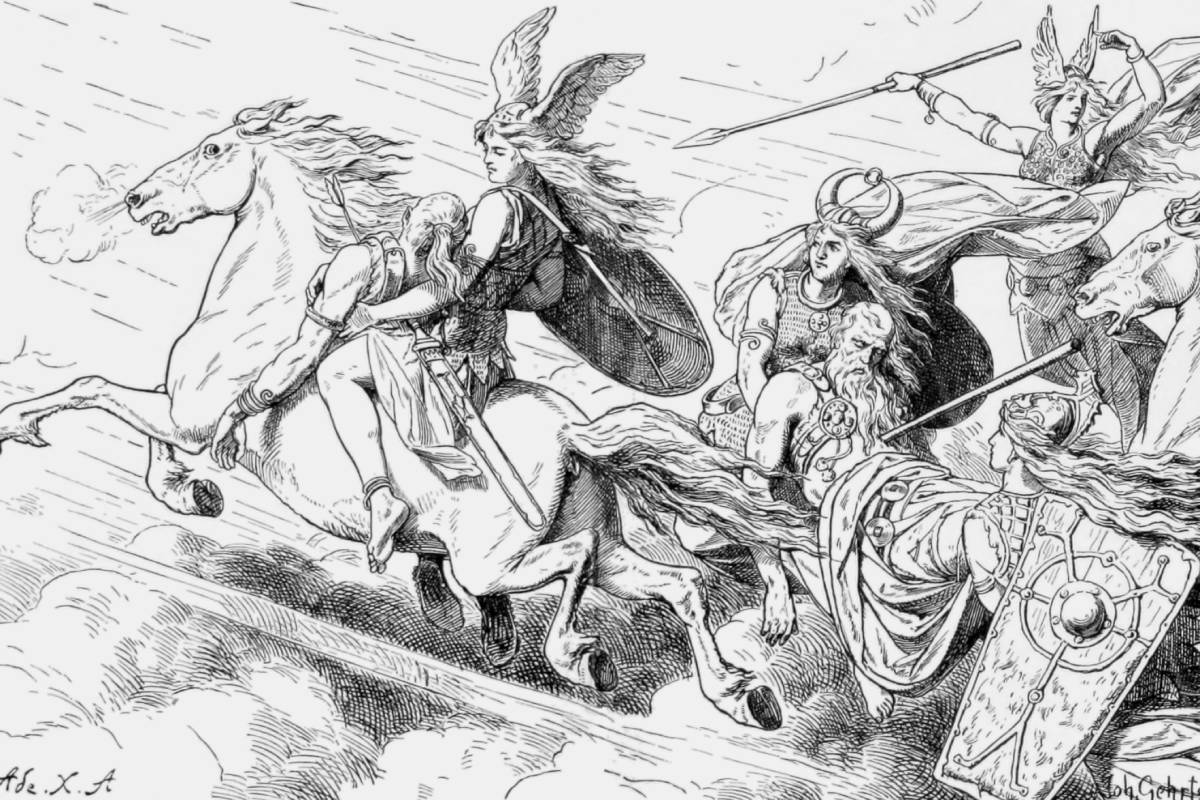
News broke this week that actor Robert Duvall passed away.
Accolades came thick and fast, but it was his turn as a swaggering American colonel, William Kilgore, in the anti-war epic, Apocalypse Now, that secured him iconic status. His character not only "loved the smell of napalm in the morning" but was, it turned out, a bit of an opera buff.
One of the film's most iconic scenes was when Kilgore blasts out Richard Wagner's operatic crescendo, Walkürenritt or Ritt der Walküren (Ride of the Valkyries), over speakers whilst manically strafing a suspected village housing Viet Cong.
The music helps elevate this grotesque violence to an operatic level as war becomes little more than a spectacle.
The director, Francis Ford Coppola, ensured that this piece of music was included to try to mythologize the brutal nature of the Vietnam War by highlighting the unnerving gap between heroic legend and modern warfare.
Here, it is the helicopters that are recast as the Valkyries, swooping in from above as mythic messengers of death to weave the bloody fate of the Vietnamese villagers.
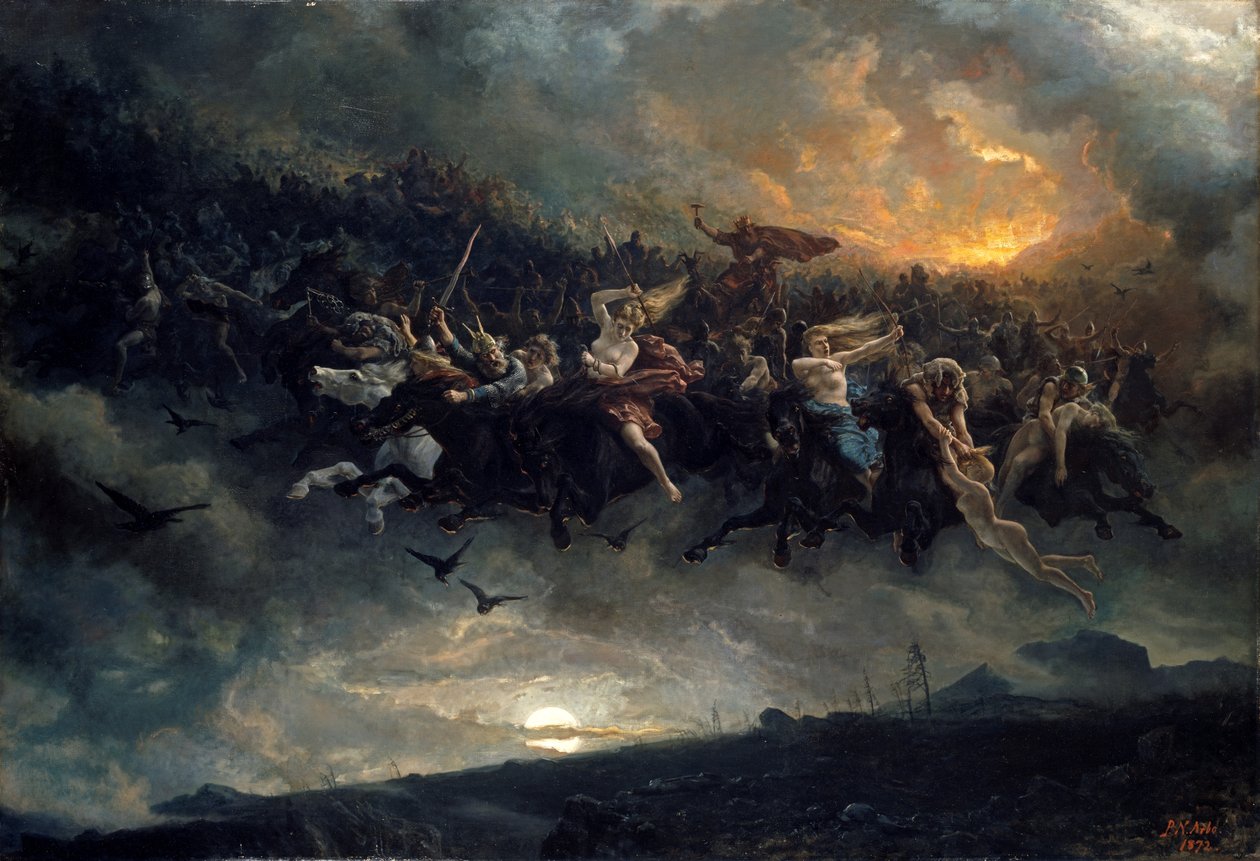
Long before Hollywood, however, it was the Valkyries themselves that straddled this line between spectacle and slaughter.
For people in Viking societies, the Valkyries were battle maidens who authorized death, shaped death through fate weaving, and, as mythic messengers, helped to bridge the mortal with the divine.
Origins of the term
We know that the Valkyries (from the Old Norse valkyrja, which is something akin to "Chooser of the Slain") remain large in the popular imagination, for over a millennium since the age of the Vikings.
Whilst stemming from the early medieval period, and directly from the mythology of people in Viking societies, it is interesting, as Lindsey K. Williams talks about in her 2019 article in the journal Ex Historia, that there are:
"...no written records from the Viking Age fully describe the nature of these beings. Later medieval Icelandic texts provide a mixture of different characteristics and roles for valkyries."
These later medieval Icelandic texts are, of course, better known to us, dear readers, through the sagas and Eddic poetry, and we are indebted to those who first wrote down oral material and traditions that had circulated by word of mouth for centuries.
It is to these sources that we turn now to glean insight into their first role as battle maidens.
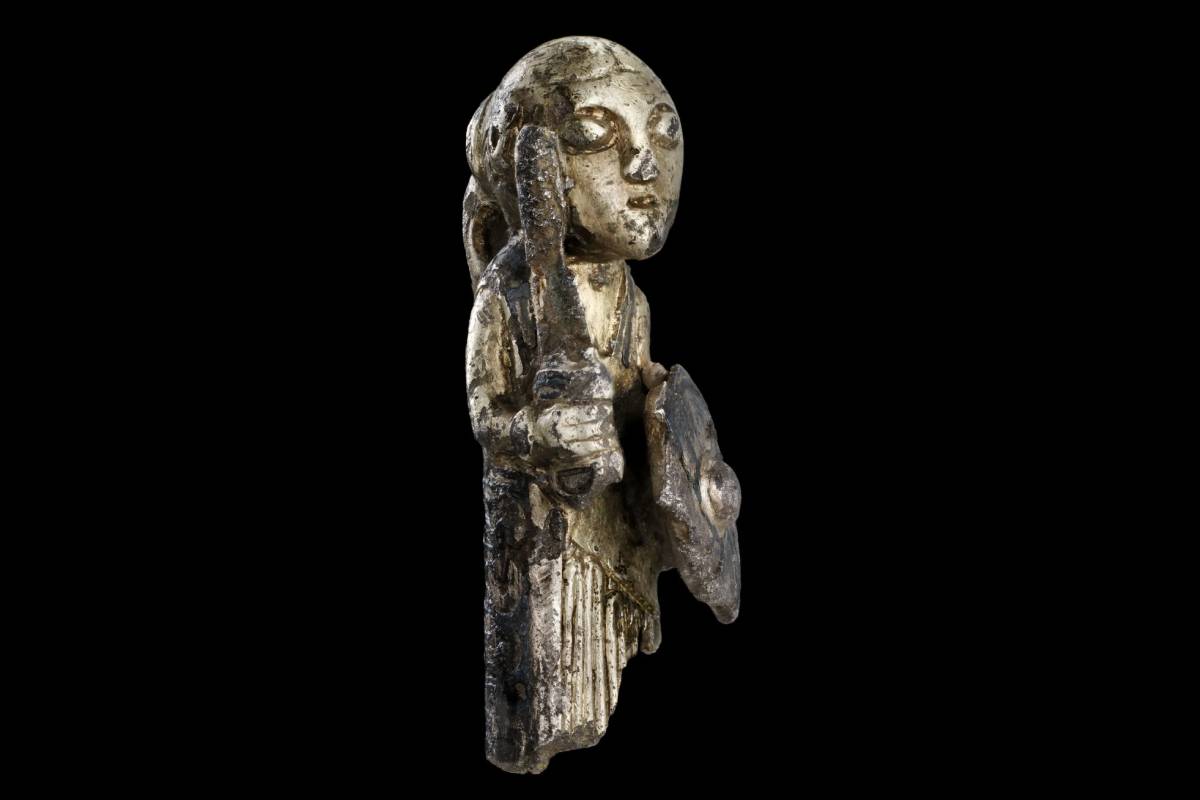
Silver Viking Age figurine from Hårby, Denmark, often identified as an armed valkyrie; height 3.4 cm. Photo: John Lee / Nationalmuseet (CC BY-SA)
Ready for battle
Whilst medieval life was, by our modern standards, deeply misogynistic and sexist, the Valkyries were seen as females (albeit mythic ones) who bestrode that most masculine area of medieval life, the battlefield.
It is their role on the battlefield that they are best remembered for, and they helped determine victory and defeat.
We can safely assume that Francis Ford Coppola must have brushed up on his Norse mythology when directing the famous helicopter scene, as this very well may have been ripped straight from the sagas.
In the Poetic Edda, we find a poem entitled Helgakviða Hundingsbana I (Old Norse for The First Lay of Helgi Hundingsbane). Using an online version of the 1936 English translation by Henry Adams Bellows, we find the Valkyries, like Coppola's helicopters, swooping in on the battlefield:
"Then glittered light from Logafjoll,
And from the light the flashes leaped;
. . . . . . . . . .
High under helms on heaven's field;
Their byrnies all with blood were red,
And from their spears the sparks flew forth." [Stanza 15]
Here, the Valkyries are presented as battle maidens, armed, and whose presence precedes slaughter.
This image of their blood-soaked armor and their flashing of spears speaks to the fact that they are hardly the neutral selectors of the fallen but emerge into the chaos of battle already marked by conflict and violence.
Swooping down from the heavens before the events of battle, the Valkyries' arrival does not respond to death but rather anticipates it. However, these battle maidens were also renowned for their ability to weave fate.
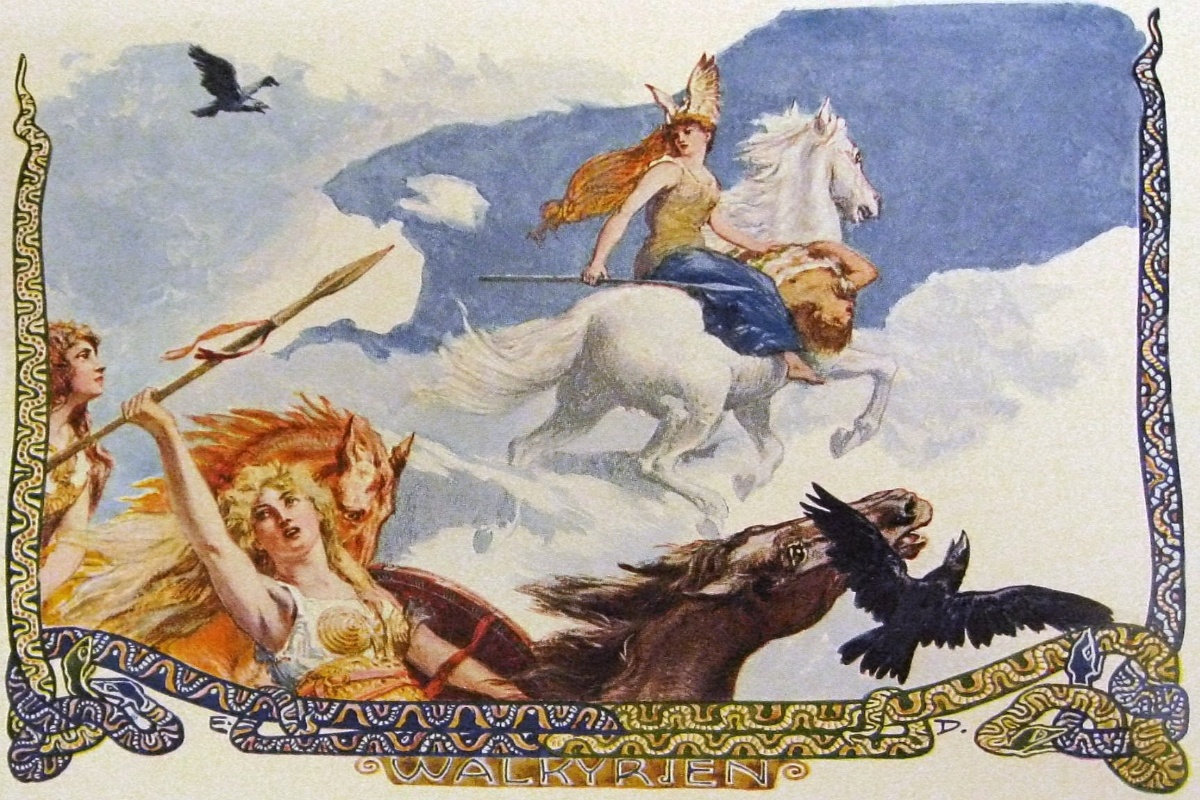
"Valkyrie" (1905), a period image shaped by the late 19th- and early 20th-century revival of Norse themes. Author: Emil Doepler (1855–1922)
Weaving fate and an ode to the Valkyries
Aside from their martial duties, the Valkyries were also seen as fate weavers in a literal and metaphorical sense.
Perhaps the best description of this comes not from a medieval source but rather one from the early modern period. Renowned 18th-century English poet Thomas Gray translated the Old Norse poem Darraðarljóð (The Song of Darts, found in Njáls saga) into English and rendered it as "The Fatal Sisters."
Here, twelve Valkyries are seen actively weaving the fate of soldiers participating in the famous Battle of Clontarf.
In Gray's rendition, we find the Valkyries weaving the fate of soldiers involved in the famous Battle of Clontarf. Using an online version, we find the twelve Valkyries:
"Glitt'ring lances are the loom,
Where the dusky warp we strain,
Weaving many a soldier's doom,
Orkney's woe, and Randver's bane..."
Fate here is woven using a loom, a deeply symbolic instrument associated by people in Viking societies with fate. However, this is a rather gruesome loom with a chilling description:
"See the grisly texture grow,
('Tis of human entrails made,)
And the weights that play below,
Each a gasping warrior's head."
The loom is described here as being constructed of human bodies, showing how this twisting of fate is synonymous with death.
Weaving, which was seen as a domestic and daily occurrence by people in Viking societies (and indeed in the period when Gray was writing), is transformed here into a bloody instrument of death.
Whilst weaving produced cloth to protect human bodies, in this poem, the loom itself is fashioned from human bodies, made from the flesh of those who fall in battle.
Finally, having twisted the fate of the soldiers, the Valkyries take flight as they utter that they have finished weaving the "crimson web of war."
This "crimson web" is a direct result of their weaving the fate of the soldiers on the battlefield, dyed with their blood and death.
- READ MORE: The nine worlds of Norse mythology
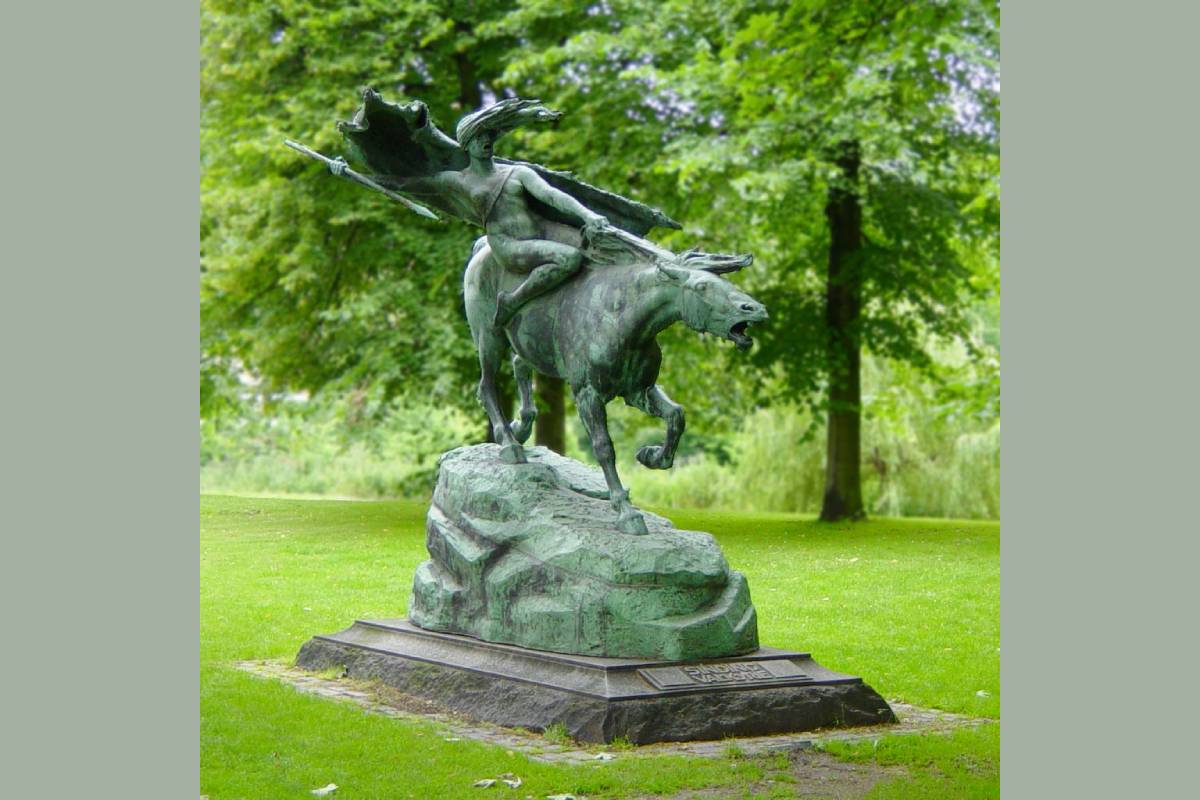
A statue of a spear-bearing Valkyrie on horseback, located in a roadside park in Copenhagen, Denmark. Sculptor: Stephan Sinding (1846–1922)
Mythic messengers and modern warfare
Finally, we turn to the Valkyries' role as mythic messengers. We know that Valkyries have been lauded as messengers for Odin for centuries.
Selecting the brave few who fall on the battlefield to join Odin in Valhalla has inspired not only medieval poets and bards but also, over the centuries, Richard Wagner's operas and the New Hollywood films of the 1970s.
Coppola deliberately used a piece of music associated with Valkyries to mimic his modern distortion of them with helicopters. Like the Valkyries, the helicopters swoop down from above to determine fate in a bloody fashion.
They are the mythic messengers not of a Norse god but of the full might of mid-20th-century American foreign policy, backed by its sophisticated military-industrial complex.
Unlike the Valkyries of Old Norse lore, however, there was no eternal feasting for those killed during the Vietnam War.
It is due to their roles as battle maidens, fate weavers, and mythic messengers that the Valkyries have remained in the popular imagination long since the last Viking ship sailed and will no doubt be a source of artistic inspiration for centuries to come.
For more information on Viking mythology, visit BBC History Extra here.
We get to provide readers with original coverage thanks to our loyal supporters. Do you enjoy our work? You can become a PATRON here or via our Patreon page. You'll get access to exclusive content and early access.
Feel free to reach out to discuss potential stories that may be in the public interest. You can reach us via email at hello@thevikingherald.com with the understanding that the information you provide might be used in our reporting and stories.