

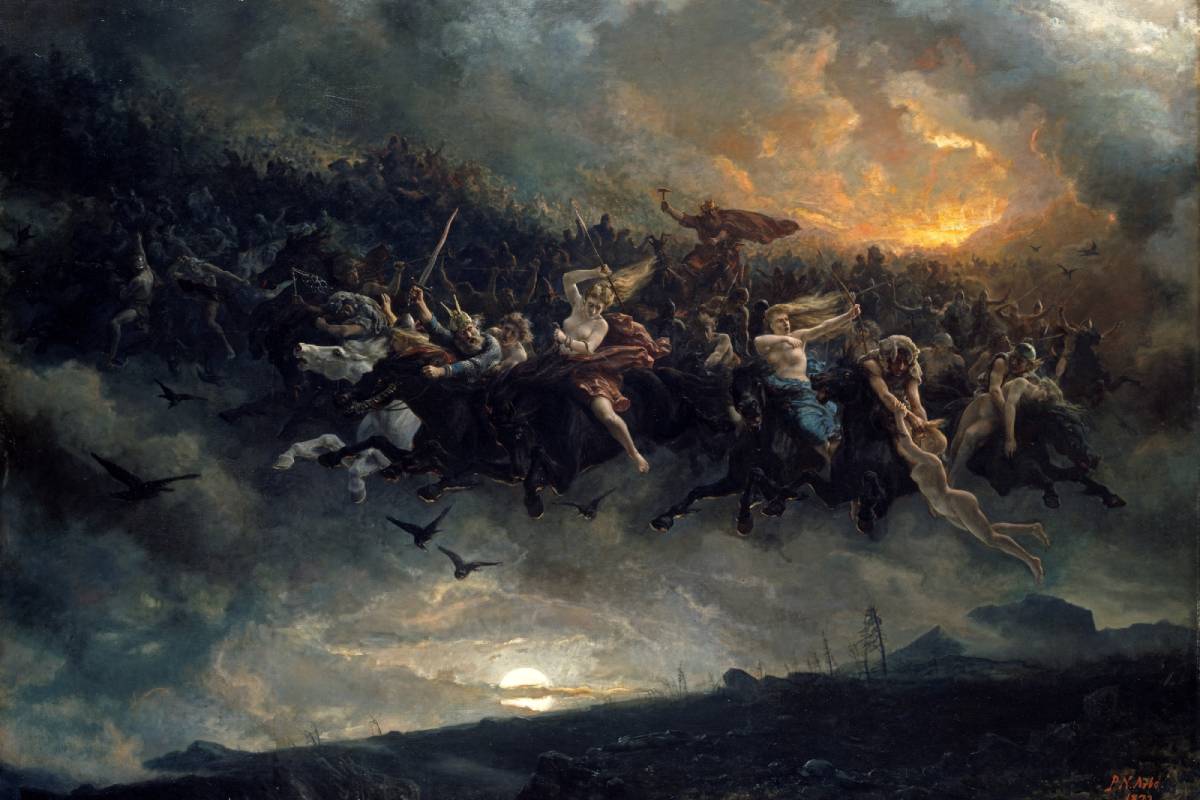
We moderns certainly take many things for granted, not least technology.
In the palm of your hand, you have direct access to the entire combined knowledge of humanity over the course of our entire history. And many of us, the present author included, use our mobile phones for anything other than the cerebral.
Whilst access to this technology—and the science and engineering that underpin it—has made the world around us more visible, it has, perhaps, made it a little less romantic.
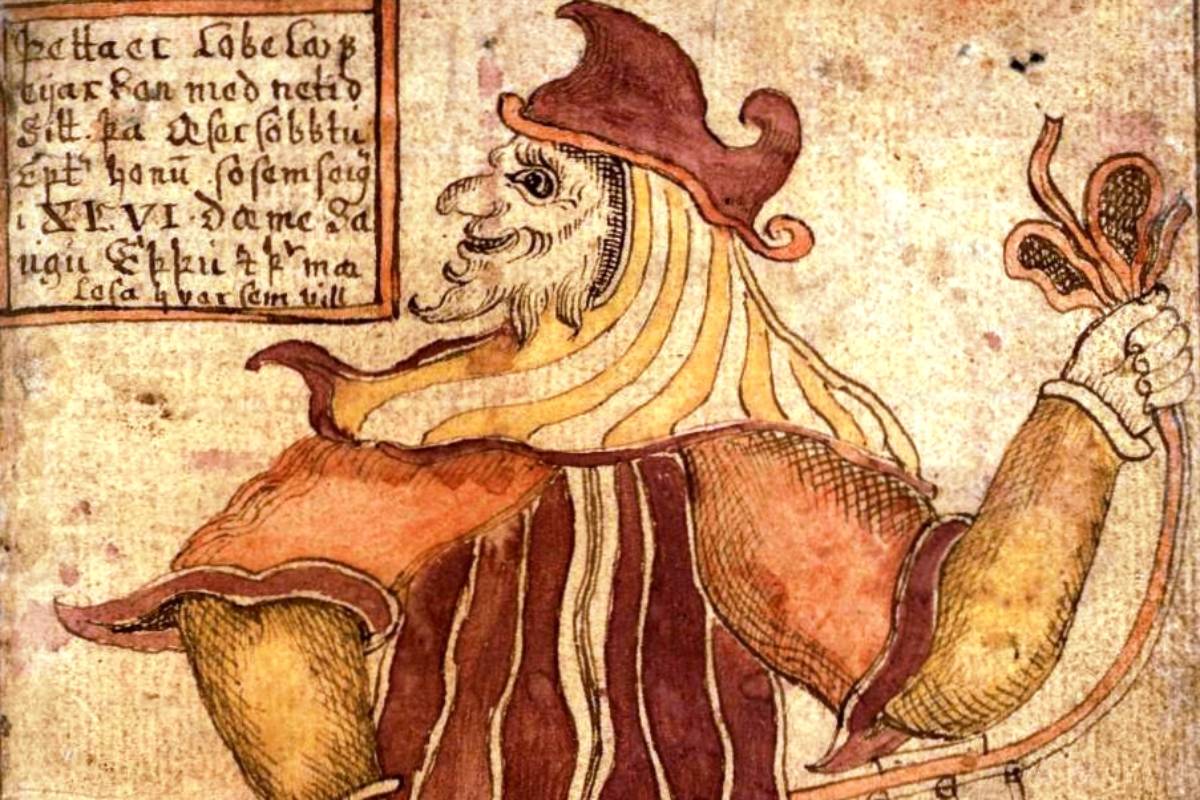
People in Viking societies did not have access to modern science and technology and thus had to make sense of the world the best they could. Turning their gaze upward to the heavens, they described the sky as fashioned from the jötunn (giant) Ymir's skull and upheld by four dwarfs.
In Vafþrúðnismál, a poem from the Poetic Edda, Odin, disguised, challenges the jötunn Vafþrúðnir in a contest of wits and asks about the origin of the earth and the sky.
In Henry Adams Bellows's 1936 English translation available online, the answer invokes Ymir:
"Out of Ymir's flesh was fashioned the earth,
And the mountains were made of his bones;
The sky from the frost cold giant's skull,
And the ocean out of his blood." [Stanza 21]
They also spoke of the great world tree, Yggdrasil, whose branches reach into the heavens and whose three roots extend far away, binding the worlds together.
They pictured the sun pulled across the sky each day by a horse-drawn chariot and pursued by one wolf, while another chased the moon.
More than just products of active imaginations, these mythical characters gave meaning to natural cycles, the passage of time, and had the heavens participate in cosmic destiny.
Shine on
For people in Viking societies, whose religious and spiritual beliefs have largely been clumsily lumped together by modern academics as the Old Norse religion, the sun (Sól, sometimes known as Sunna) was pulled across the sky daily in a horse-drawn chariot.
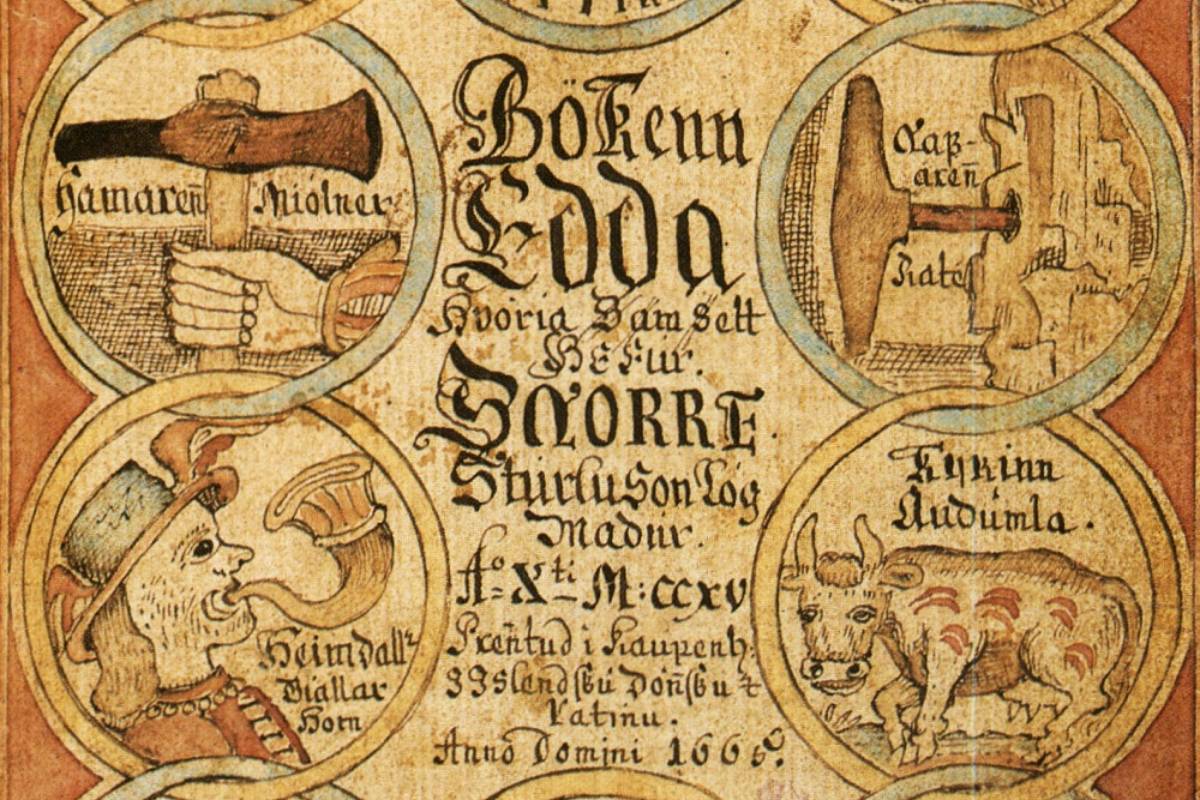
Turning to the Eddas, our best source of Norse cosmology as well as mythology, we find this striking image described in the Poetic Edda.
Here, in the poem Grímnismál (The Ballad of Grimnir, we used an online version of the 1936 English translation by Henry Adams Bellows), we find that:
"Árvakr and Alsvith up shall drag
Weary the weight of the sun;
But an iron cool has the kindly gods
Of yore set under their yokes." [Stanza 37]
The horses' names can be translated into English as Early Waker (Árvakr) and All Swift (Alsvith), which emphasize the urgency and speed of the sun's daily journey.
The "iron cool" mentioned in this stanza is a mechanism by which these horses have been subdued in order to pull the fiery sun across the sky.
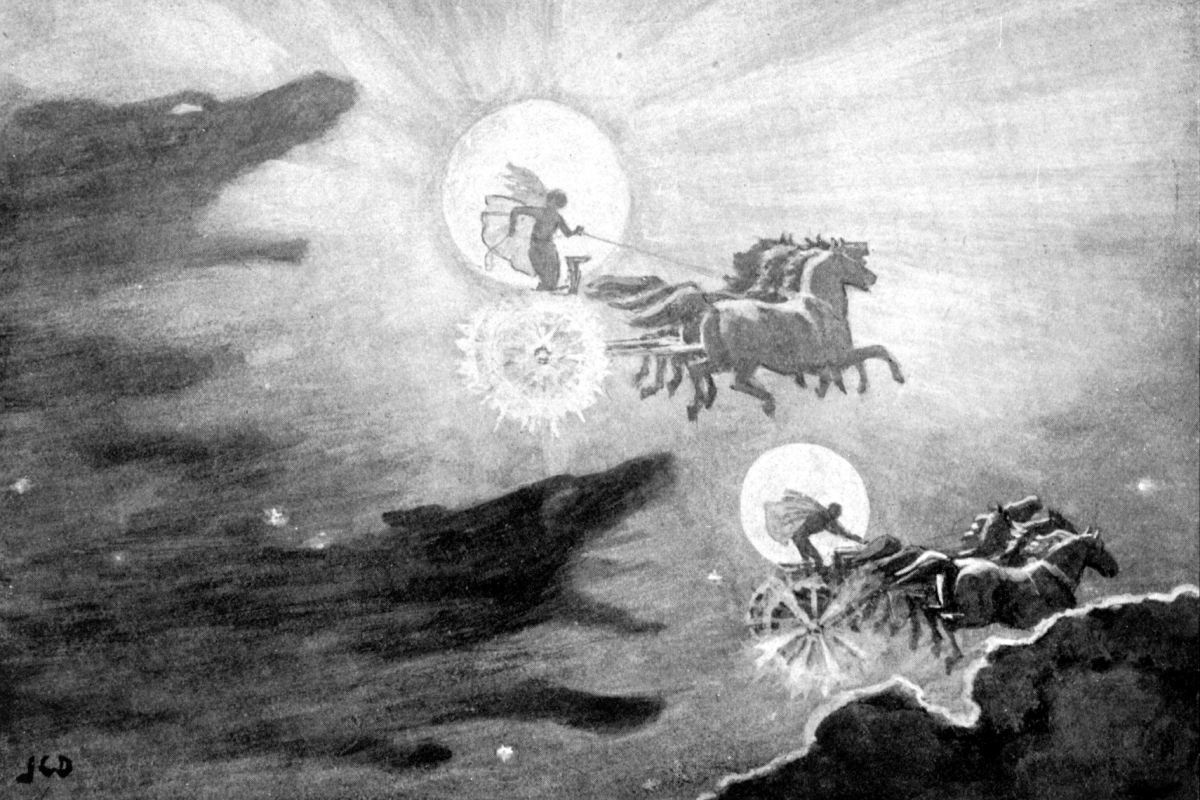
Painted in 1909, "The Wolves Pursuing Sol and Mani" portrays the Norse myth of wolves pursuing the sun and moon. Author: John Charles Dollman (1851–1934)
Hungry like the wolves
The next common sky myth told by people in Viking societies involves a pair of hungry wolves bounding through the celestial heavens on a cosmic chase.
Two wolves, Sköll and Hati, tear through the celestial heavens and pursue the sun and moon (known as Máni), respectively.
Turning to Gylfaginning (The Guile of Gylfi, here we use an online version of the 1916 English translation by Arthur Gilchrist Brodeur), a section of the Prose Edda compiled by 13th-century Icelandic poet and politician Snorri Sturluson, we find this depiction of sky-bound terror described as follows:
"It is two wolves, and he that runs after her is called Sköll; she [the sun, Sól] fears him, and he shall take her. But he that leaps before... he is eager to seize the moon..." [Chapter 12]
However, things only get worse for the sun and moon. Not only will they be terrorized daily by these two wolves, but during Ragnarök—the cataclysmic Norse end times—they will meet their demise and destruction:
"From this race [wolves] shall come one that shall be mightiest of all... and he shall swallow the moon, and sprinkle with blood the heavens... thereof shall the sun lose her shining, and the winds in that day shall be unquiet and roar on every side." [Chapter 12]
Not only will they be chased daily by two wolves, but Ragnarök will see their eventual destruction by one, too.
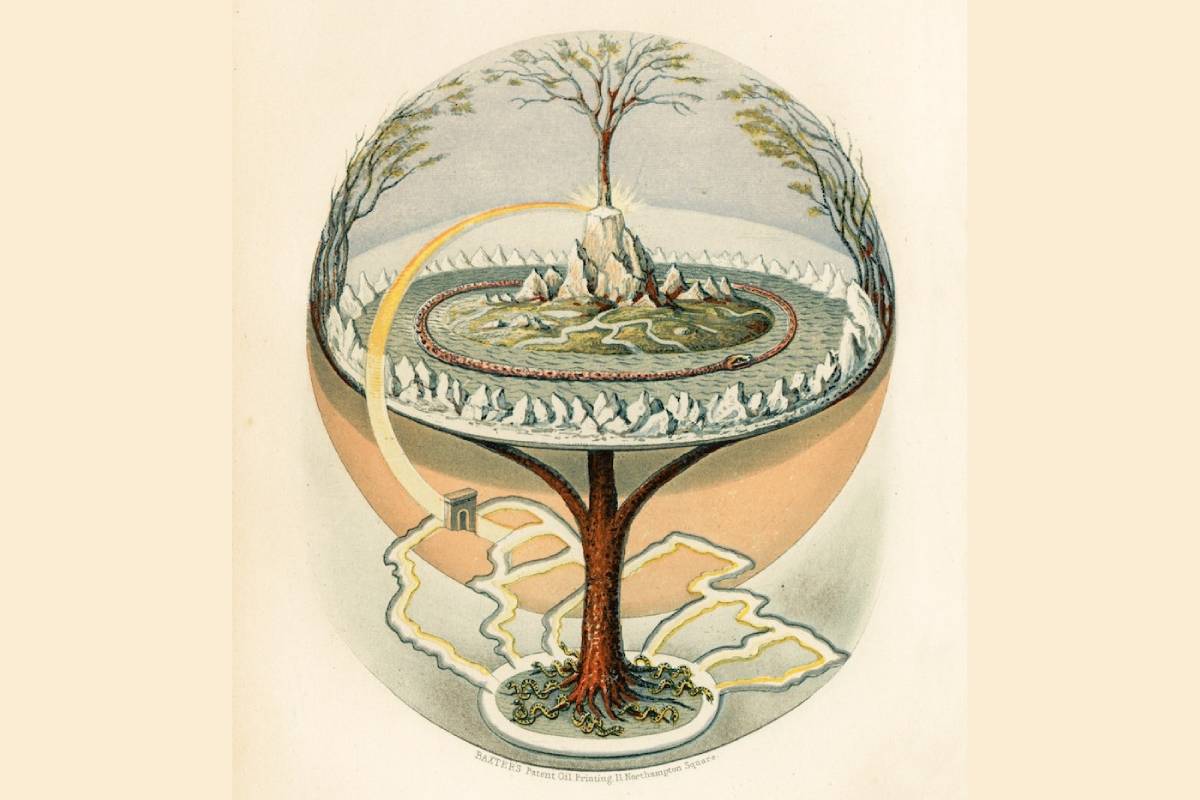
"Yggdrasil, The Mundane Tree" is an illustration from an 1847 English translation of the Prose Edda. Author: Oluf Bagge (1780–1836)
Supporting the sky itself
We now turn to the great world tree of Norse mythology, Yggdrasil. This great ash tree is at the epicenter of the Norse cosmos, as it connects the nine worlds, of which we humans inhabit only one (Midgard).
Whilst its roots reach to three distant places, its mighty branches reach over the world and stand above heaven.
One root reaches to Urðarbrunnr in heaven, the well where the Norns tend Yggdrasil and judge fate. A second root reaches to Mímisbrunnr in Jötunheim, Mímir's well of wisdom. Odin drank there at the cost of an eye.
The third root reaches to Hvergelmir in Niflheim, a primeval spring that feeds many rivers. Serpents, including Níðhöggr, gnaw at that root without cease.
Turning to Gylfaginning again, we find:
"That is at the Ash of Yggdrasill... [the] greatest of all trees and best: its limbs spread out over all the world and stand above heaven." [Chapter 15]
This image, described in Neil Gaiman's 2017 book, Norse Mythology (available on Amazon here), reflects how people in Viking societies conceived of the cosmos as a living, breathing organism, much like a tree. Yggdrasil, the great world tree, connected the realms and sustained life.
Dynamism and action
For people in Viking societies, their conception of the sky was that of dynamism and action.
The sun being drawn across the sky by two steeds and, along with the moon, being hounded by wolves, as well as the great world tree Yggdrasil reaching over the world and standing above heaven, were not just metaphors but part of the Norse cosmological worldview.
In an era before modern science, they made sense of the sky the best way they could, and we are all the richer for it.
For more information on Norse mythology, visit Science Norway here.
We get to provide readers with original coverage thanks to our loyal supporters. Do you enjoy our work? You can become a PATRON here or via our Patreon page. You'll get access to exclusive content and early access.
Feel free to reach out to discuss potential stories that may be in the public interest. You can reach us via email at hello@thevikingherald.com with the understanding that the information you provide might be used in our reporting and stories.