

Drawing arbitrary lines to separate epochs, eras, or periods can be problematic when understanding and analyzing history.
Let's remember that the term Viking was a job description akin to raider or pirate in modern parlance rather than denoting an "ethnicity" or a "people."
The societies that produced the Vikings evolved from earlier Germanic communities in Northern Europe.
When did these older Germanic societies officially become Viking?
There is no doubt that before the first Viking raids across the Baltic (on Salme in 750) and the North Sea (Lindisfarne in 793), Germanic peoples living in Scandinavia sailed to nearby unsuspecting coastal communities to raid, ransack, and ravage.
Modern historians often divide Scandinavian societies between Germanic and Viking around the mid-8th century.
However, for those living in that time, the societal changes between 749 and 750 and indeed between 750 and about 865 would not have been readily apparent.
It was a gradual process, marked by subtle shifts, until more and more young men began to sail across to raid and settle the British Isles.
The societies that produced the feared Viking warriors and the rich tapestry of Norse mythology then evolved from, and are indebted to, what historians call earlier Germanic societies.
Emerging in the early part of the 1st millennium, these societies were characterized by a strong and highly evolved spiritual belief system at their core.
Whilst the worship of the sun was not unique to these societies, it evolved over time to become revered as a Norse deity in its own right, known as the goddess Sól, by the time the first Viking ship set sail.

The Trundholm sun chariot, which was discovered in Denmark and dates back to around 1400 BCE, is a significant artifact that connects the ancient beliefs of earlier Germanic communities in Northern Europe to the veneration of the sun's life-giving properties. Photo: National Museum of Denmark (CC BY-SA 3.0)
Revered in a largely agricultural society
In Norse mythology, Sól was considered the embodiment of the sun.
The followers of the Old Norse religion were not the only ones who worshipped the personification of the sun. This type of worship is believed to have developed from earlier Germanic and Proto-European deities.
Sól is depicted as a radiant goddess who rides across the sky in a chariot drawn by two horses, and it is this journey that is responsible for the passage of day and night in Norse cosmology.
Before we all scoff and roll our eyes at these beliefs, one must remember that people in Viking societies did not have access to the scientific and technological knowledge we have at the tip of our fingers in the 21st century.
Viking societies were premodern, preindustrial, and highly agricultural.
Though some may joke that the sun is rarely seen in the Nordic world, it was essential to the continuation and preservation of everyday life.
Sól's warmth and light were crucial for agricultural endeavors, ensuring the land's fertility and crops' success.
Whilst perhaps not as well known or revered as the two other Norse gods of fertility, Thor and Freyja, Sól was nevertheless an important deity in the Norse pantheon.
Consequently, Sól was sometimes invoked in rituals or prayers for a bountiful harvest and favorable weather conditions.
Adding to her reverence was the fact that she was the most visible Norse deity, as people in Viking societies needed only to tilt their heads up to the heavens to feel her warm embrace every day.
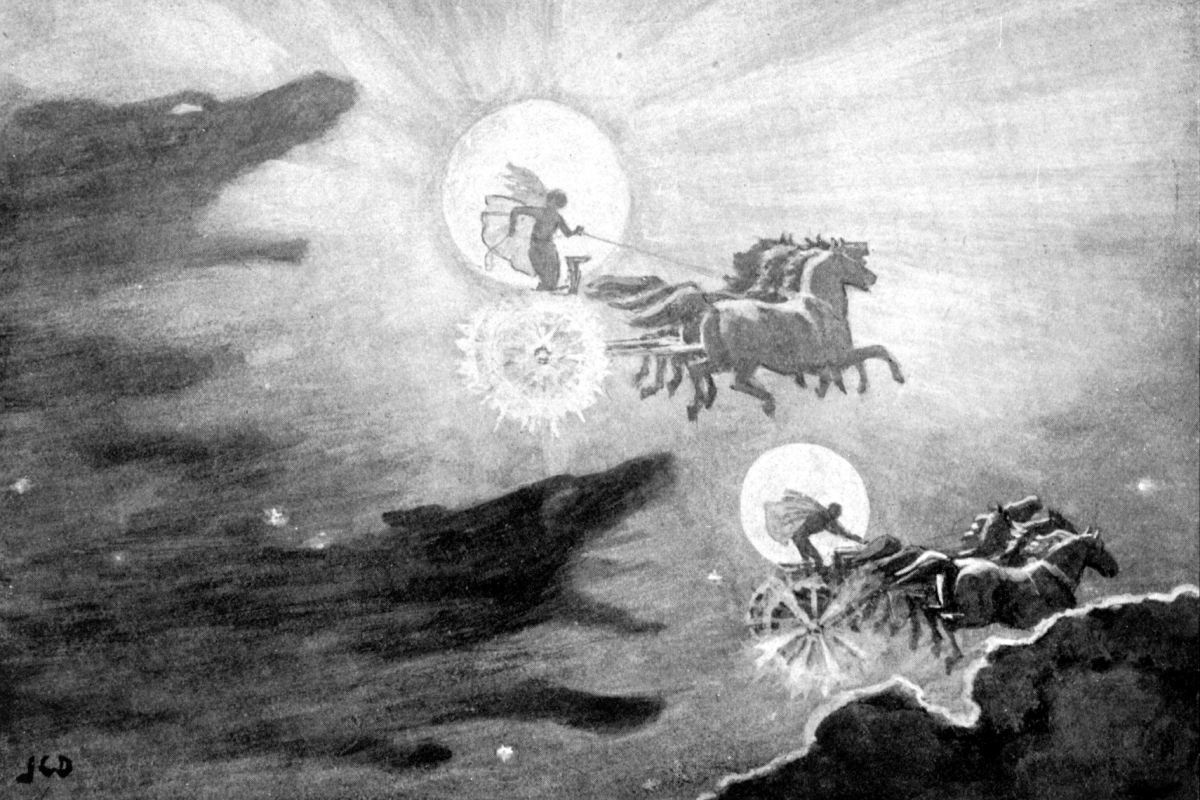
"The Wolves Pursuing Sol and Mani," painted in 1909, illustrates a scene from Norse mythology where wolves chase the sun and the moon. Illustration: John Charles Dollman (1851–1934), Public domain
Attestations and scientific explanations
Sadly, we have only a few scattered nuggets of information about Sól throughout the rich tapestry of the Norse sagas.
Her family origins are somewhat obscure, but she is listed in the Prose Edda as the sister of the personification of the moon, Máni, and both are said to be the children of the even more obscure deity, Mundilfari.
One of the major legends found in the sagas about Sól is an attempt to explain a natural phenomenon: a solar eclipse.
During Sól's daily journey across the sky in her chariot, pulled by two noble steeds, she was constantly threatened with death.
The mythological wolf, Sköll, was said to be constantly chasing and trying to devour her.
This mythological narrative reflects an attempt by people in Viking societies to try to understand the cause of solar eclipses.
When this rare event occurred, it was said that Sköll had temporarily caught her, causing the sun to disappear momentarily from the heavens.
As the driver of this magical chariot, she was said to navigate the heavens with confidence and determination, symbolizing the strength of the sun and her own personal autonomy.
This is just another example of the portrayal of some female deities in Norse mythology as active and independent, which contrasts sadly with the generally dire plight of females in Viking societies.
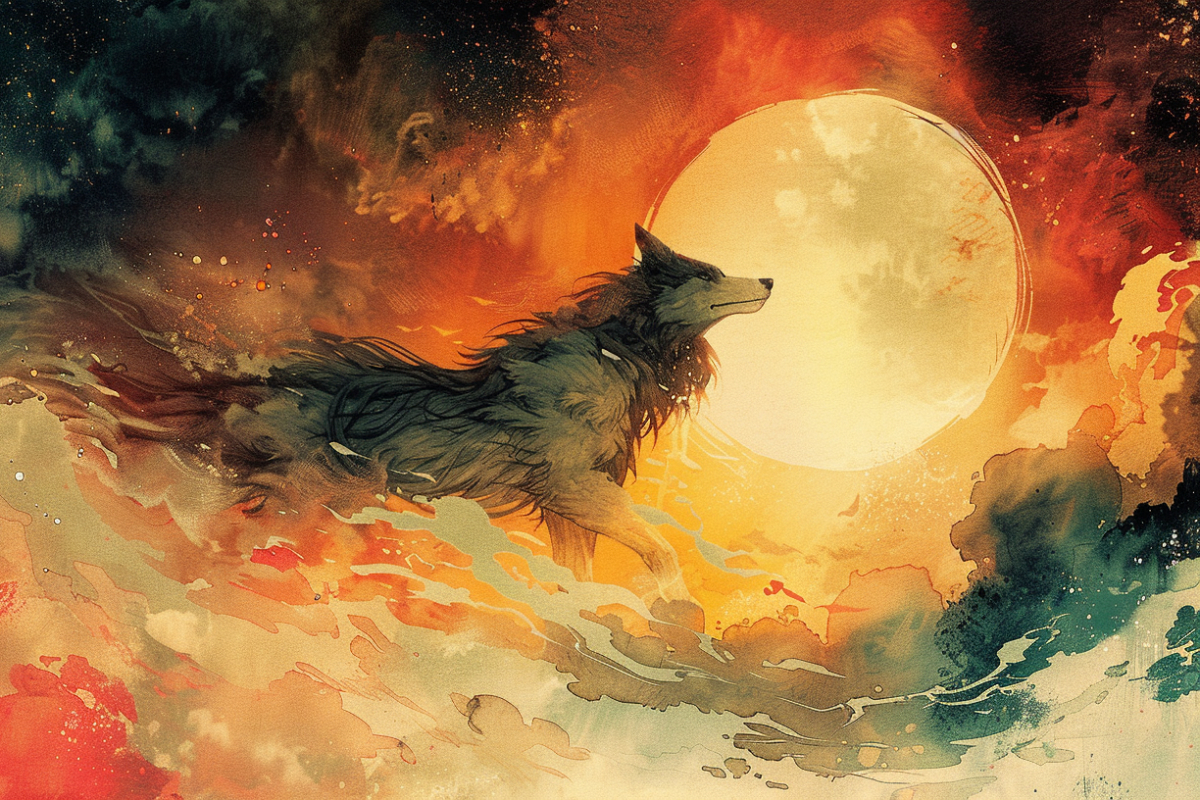
As described in Snorri Sturluson's Prose Edda, Sköll is a wolf known for chasing the Sun, represented as the goddess Sól, as she travels across the sky in her chariot. Illustration: The Viking Herald
Worshipped down through the ages
Due to the harsh climatic conditions in which people in Viking societies lived, they held a special reverence for the sun's life-giving properties.
Sól's presence in the sky was not only a source of wonder and beauty but also a symbol of stability and security in a harsh, unforgiving, and unpredictable environment.
Ultimately, whilst not as well-known as other gods associated with fertility, Sól, the Norse goddess of the sun, held a prominent role in the everyday life of people in Viking societies.
Despite the few attestations we have of her scattered throughout the Norse sagas, she must have remained an important and revered deity for her life-giving properties to all those who lived in the harsh Nordic climes.
With reverence and worship that stretches back to the early stages of the Nordic Iron Age (c. 500 BCE – 500 CE), there is no doubt that the cultural ancestors of the Vikings, the Scandinavians, revered the sun every summer just as much as they did more than a millennium ago.
For more information on the impact of solar eclipses down through the ages, visit the BBC here.
We get to provide readers with original coverage thanks to our loyal supporters. Do you enjoy our work? You can become a PATRON here or via our Patreon page. You'll get access to exclusive content and early access.
Feel free to reach out to discuss potential stories that may be in the public interest. You can reach us via email at hello@thevikingherald.com with the understanding that the information you provide might be used in our reporting and stories.