


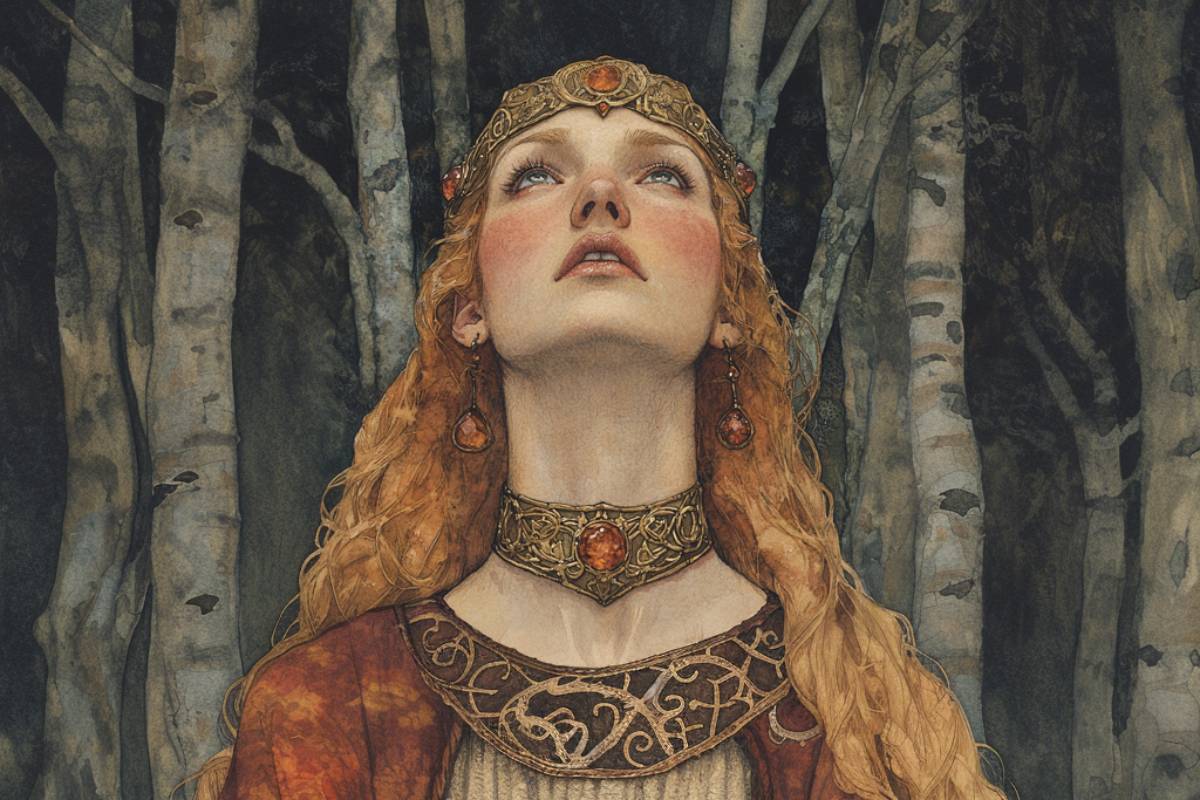
The Museum of the Viking Age, being constructed in Oslo, Norway, is set to be the shiny new jewel in the crown of Norwegian cultural life.
Despite its ongoing teething problems—cost blowouts and construction delays seem almost daily occurrences—it is set to showcase the entire history of Norway's early medieval period through more than 5,500 artifacts and objects.
Some of these archeological treasures will be things that glitter and glow. We know, like the proverbial magpies, Viking warriors took a shine to jewelry; just look at the contents of several Viking hoards.
This obsession with jewelry can not only be found buried underground but also in the sagas and stories that people in Viking societies told one another.
These societies had very, by our modern standards, outdated gender norms and roles. Though much has been made of the relative independence of some women in Viking societies, these societies were permeated with misogyny and sexism that saw them treated as little more than second-class citizens, at best.
For young women, expectations were that they marry and bear children. Then, as now, jewelry was used to enhance beauty, allure the opposite sex, and to serve as symbols of possession, status, and wealth.
Owner and etymology of the "fiery jewel"
This glittery obsession also found its way into the myths of the Norse gods.
The goddess Freyja is sometimes wrongly compared to a Viking version of the Roman goddess Venus. Yet unlike her Roman counterpart, Freyja was not only associated with beauty and fertility but was also a powerful figure linked to Seiðr, a form of magic practiced in Viking societies, and to warfare.
She was also the owner of Brísingamen, a necklace of otherworldly beauty.
As Sara Ann Knutson discusses in her 2019 article in the journal Temenos: The Nordic Journal for the Study of Religion, these seemingly mundane objects are, in the sagas, "...spun with the magic, belief, and narrative traditions that made them icons."
Despite the Old Norse tongue, the language that people from Viking societies spoke, birthing many of the modern Nordic languages (sorry, Finnish, not you), there are many words modern linguists are stumped by.
The name of Freyja's necklace—Brísingamen—is generally understood to mean something like "glittering necklace" or "gleaming torc," though some scholars have suggested alternative renderings such as "fiery jewel."
The second element, -men, clearly means "necklace" in Old Norse, while the first element, Brísing-, is debated and may refer either to a group called the Brísings or to an association with fire or shining.
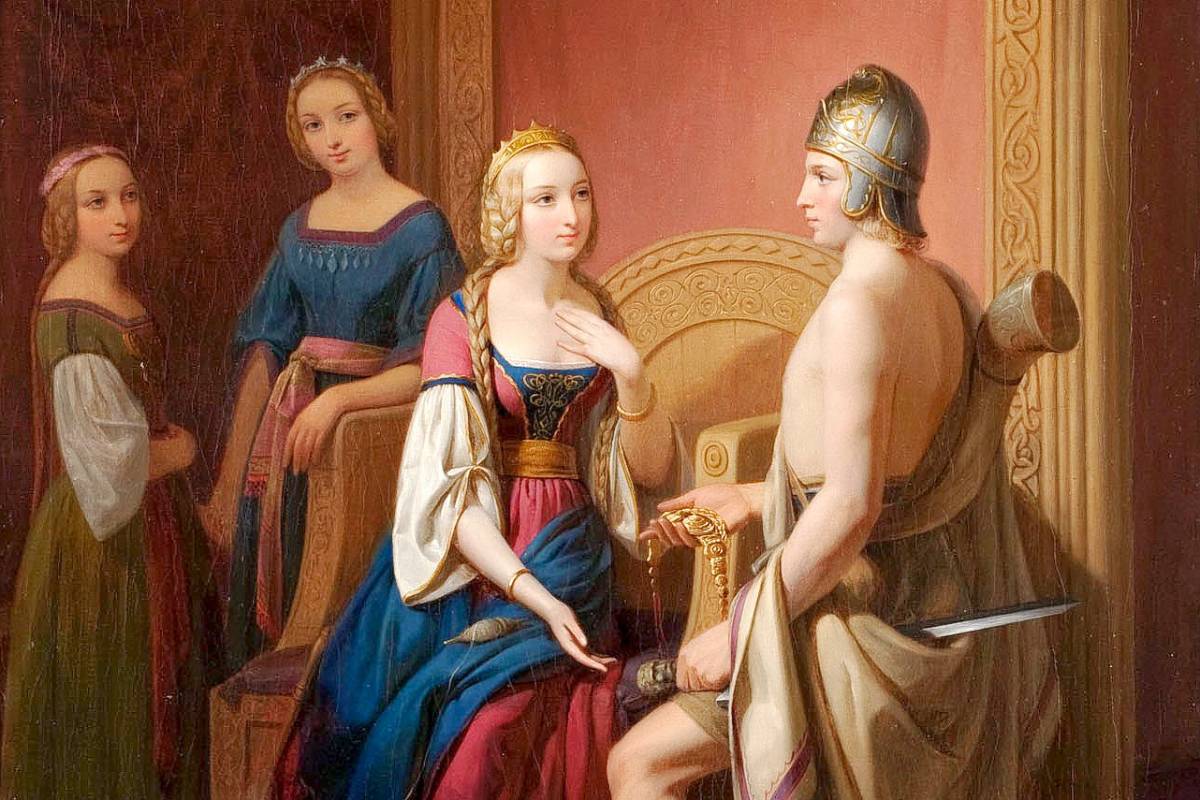
This detail of a 19th-century painting shows Heimdall returning the necklace Brísingamen to Freyja. Author: Nils Blommér (1816–1853)
A sordid tale of four dwarves
The tale of how Freyja acquired this necklace can be traced to a story, Sörla þáttr eða Heðins saga ok Högna (loosely translated in English as "The Tháttur of Sörli"), in one of the largest manuscripts ever compiled, Flateyjarbók.
Put together in the late 14th century CE in Iceland, long after the last Viking ship ever sailed, it contained many sagas and stories not only of Norse mythology but also of semi-historical events like the Norse exploration of North America.
We also find the origin story of this magical necklace with a rather "adults-only" tone.
Using an online version of the 1921 English translation by Nora Kershaw, we learn that Freyja asked four dwarves to make her a necklace. However, as they neared completion, the text continues:
"...one day... Freyja went to the rock and found it open, and the dwarves were forging a gold necklace, which was almost finished. Freyja was charmed with the necklace, and the dwarves with Freyja. She asked them to sell it, offering gold and silver and other costly treasures in exchange for it. The dwarves replied that they did not need money, but each one said that he would give up his share in the necklace... for nothing else except for her to lie one night with each of them..." [Chapter 1]
Following this, the text states:
"And at the end of four nights, they handed it to Freyja. She went home to her bower and kept silence about it as if nothing had happened." [Chapter 1]
We know, unlike people in Viking societies, that dwarves are not real and are figments of an active imagination. However, they were revered and respected nevertheless as skilled artisans and metalworkers.
The fact that Freyja was willing to spend a night with each of these dwarves underscores just how impressive Brísingamen must have been to her.
How Brísingamen was lost
We now turn to a part in the story where a familiar face, for fans of Norse mythology, enters: Loki.
The brilliance and beauty of Brísingamen are such that the mighty Norse All-Father, Odin, wants to acquire it. However, stealing is not in Odin's character, so he sends a man who had "developed a caustic tongue and was alert in trickery and unequalled in that kind of cleverness which is called cunning."
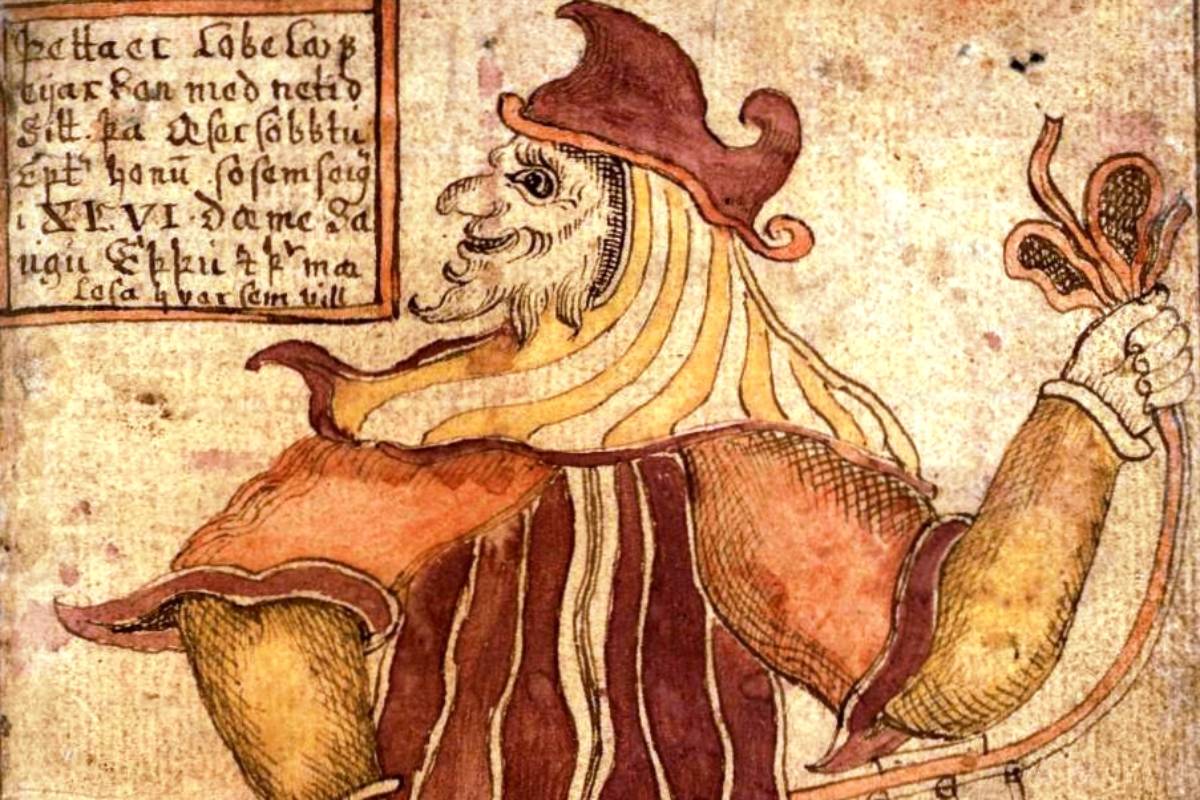
This man was, of course, Loki, known to many as the eternal trickster whose moral compass was, at best, ambiguous to the Norse deities.
Loki traveled to Freyja's home and found it locked. He then transformed himself into a fly and flew into her room. Freyja was asleep, wearing the necklace.
Not content with one transformation, Loki changed into a flea, managed to take the necklace, and brought it back to Odin. When Freyja awoke, she realized there must have been some trickery involved and went to Odin to complain.
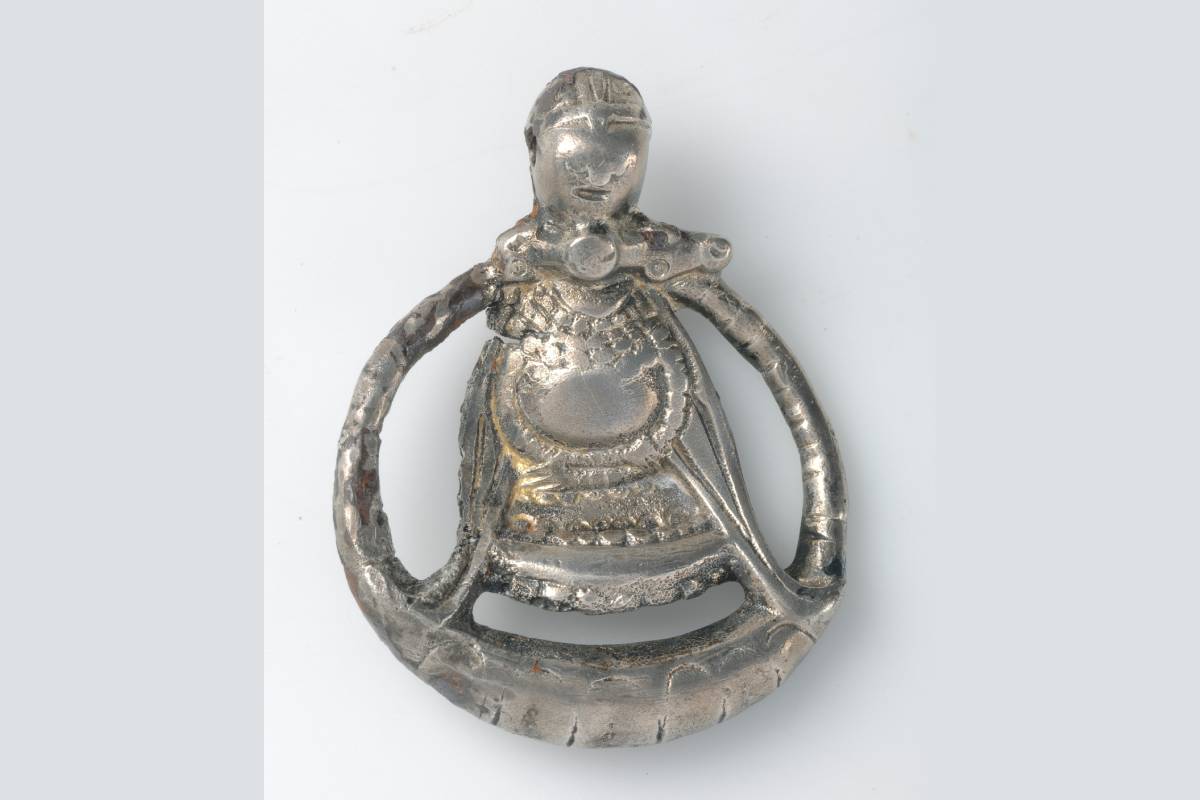
This Viking Age silver pendant from Aska is generally accepted to depict Freyja with the broad necklace Brísingamen. Photo: The Swedish History Museum (CC BY 2.0)
Odin's Christian challenge
Poor old Freyja. Having essentially sold her body to gain such a brilliant necklace, she then loses it thanks to the masterful trickery and transformation skills of Loki.
Heading to Odin, she pleads her case for the necklace to be returned. During Odin's questioning, however, he finds out how she gained the necklace in the first place.
Given that this story was compiled in the late 14th century CE, we can detect a heavy moralizing tone that reflects Iceland's Christian culture by this period.
Whilst these old oral stories were compiled, those responsible had a vested interest in making the Old Norse gods, and indeed the religious and spiritual beliefs they represented, look as morally corrupt as possible.
In fact, as Stephan Grundy discusses in his chapter of the 1997 book The Concept of Goddess, Freyja was seen as "...sexually very free and active. Many of her activities, such as the practice of seiðr (magic), put her firmly outside the sphere of normal society; she might be called the 'wild woman' of Northern myth."
This was anathema to later Christian audiences.
Odin then throws down a challenge to Freyja. He will return the necklace at a time when she orchestrates:
"...a quarrel between two kings, each of whom has twenty kings subject to him; so that they shall fight under the influence of such spells and charms that as fast as they fall they shall start up again and fight on—unless there be some Christian man so brave and so much favoured by the great good fortune of his liege lord that he shall dare to take arms and enter among the combatants and slay them. Then and not till then shall the labours of those princes be brought to an end—whoever may be the chief who is destined to free them from the oppression and toil of their disastrous lot." [Chapter 2]
This speaks to the heavy Christian moral overtone that was likely inserted as this tale was written down and compiled, centuries after first being told orally.
The condition for Freyja to retrieve her necklace—that only a Christian man (later in the tale revealed to be Olaf Tryggvason, who was instrumental in Christianity's adoption in Norway) can end the curse—reflects the Christian worldview not only of the scribes but also of the society that they lived in.
It helps to reframe what was, for them, a "pagan" (i.e., non-Christian) myth into one that shows how Christianity is the only solution and thus salvation. The end of the chapter sees the necklace returned to Freyja as she manages to find a man who can break this curse.
Forged by dwarves and embodied with beauty, magic, and peril, Brísingamen is one of the most memorable accessories in the rich tapestry of Norse mythology.
Its tale—including how Freyja acquired it, lost it, and won it back, and how it was later reshaped by Christian scribes—reveals how Christianity influenced not only hearts and minds but also the stories that Vikings' descendants told one another.
For more information on some of the treasures uncovered in Viking hoards, visit the National Museum of Denmark here.
We get to provide readers with original coverage thanks to our loyal supporters. Do you enjoy our work? You can become a PATRON here or via our Patreon page. You'll get access to exclusive content and early access.
Feel free to reach out to discuss potential stories that may be in the public interest. You can reach us via email at hello@thevikingherald.com with the understanding that the information you provide might be used in our reporting and stories.



.jpg)