


The year 1000 CE proved to be a pivotal point not just in European history but also in the history we love best here at The Viking Herald, that of the Vikings.
In the unstable centuries following the collapse of the Roman Empire in Western Europe, known to us moderns as the "early medieval period," much of Europe was characterized by political fragmentation, religious violence, and large population movements.
To make matters worse, there was the looming and existential threat of persistent Viking raids and incursions deep into the heart of Europe.
Religious fervor was heightened as many Christians – the region's dominant and most violent religious group – believed that the new millennium could initiate the apocalyptic Day of Judgment.
For many, the turn of the second millennium also saw a Viking expansion that was marked by three motives: plunder, profit, and power.
Part of this millennial madness was a region that had suffered through more than two centuries of Viking raids and violence.
Countless river-bound and coastal communities saw their inhabitants killed in predatory raids, their treasures looted, and those lucky enough to survive enslaved.
Concurrently, Viking merchants and traders were helping to rebuild old trade networks and connect Scandinavia to a wider global economy.
Back in Scandinavia, a new type of ruler was emerging, such as Sweyn Forkbeard and Olaf Tryggvason, who not only wielded unchecked power but whose reach could be felt across seas and even into one's soul.
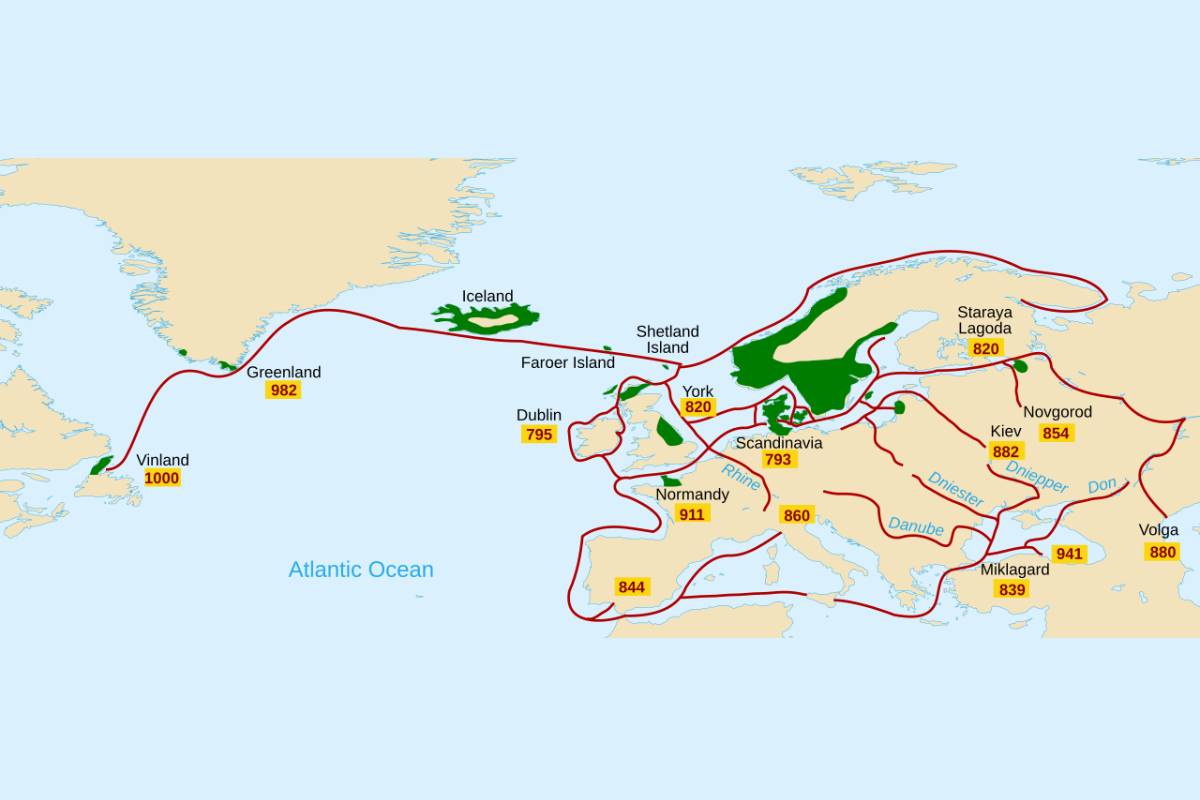
Map that traces Viking expansion by sea and river between the 8th and 11th centuries. Source: Pinpin (CC BY-SA 3.0)
Plunder, pillage, and violence
By the year 1000 CE, much of Europe had been experiencing some two and a half centuries of predatory and violent Viking raids.
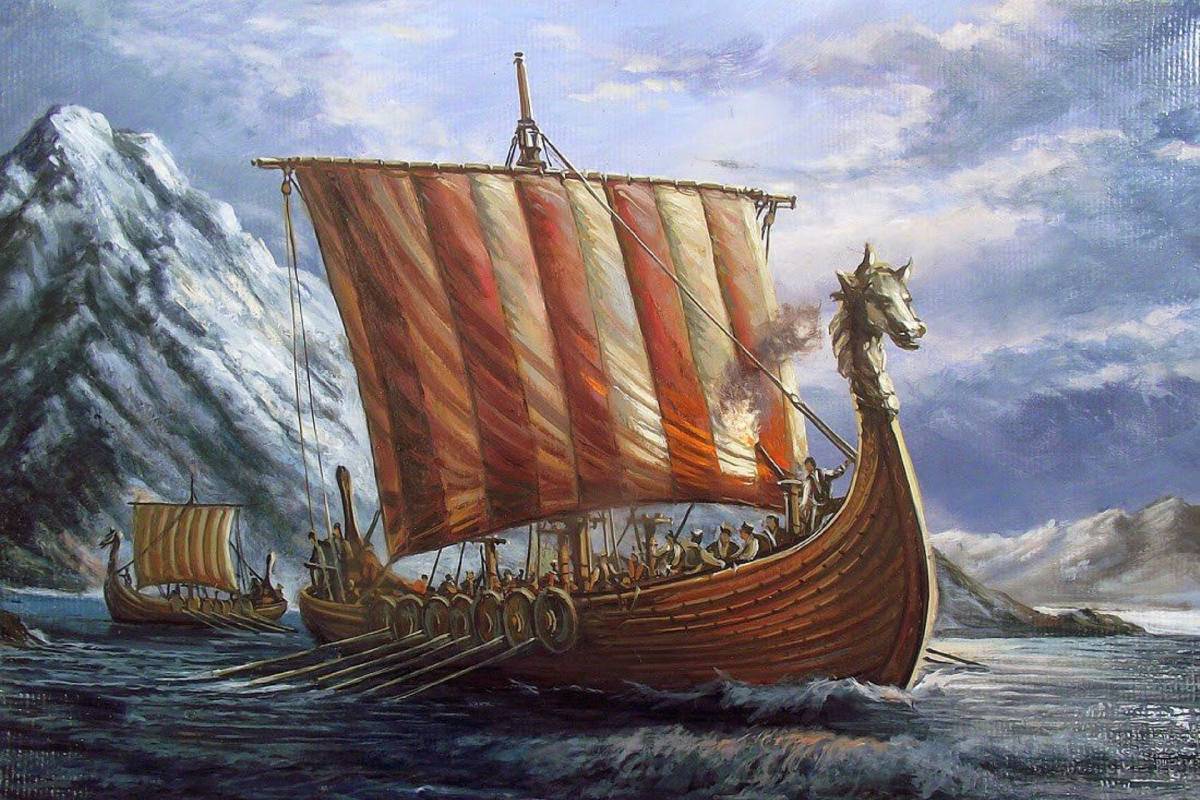
Utilizing their perfect pieces of maritime technology, Viking warriors sailed these sleek longships, which could as easily dart across a sea as down a river, allowing them to launch hit-and-run attacks on unsuspecting targets.
These attacks were, at first, directed at isolated targets – easy prey like the monastery of Lindisfarne or Iona – but soon entire communities, towns, and kingdoms came under siege.
Across the British Isles, the Frankish realms, down the Iberian Peninsula, and across the Baltic Basin, Viking warriors struck with a lethal ruthlessness – slaughtering, setting communities to the torch, and selling those still alive to slave markets, such as Dublin or Constantinople.
Yet from the mid-9th century CE onward, these sporadic and predatory attacks evolved into larger and more permanent campaigns of conquest, most famously those of the Great Heathen Army, which campaigned across Anglo-Saxon England before it dissolved into smaller forces and settler communities.
Viking armies besieged the once political heart of power throughout Europe, be it Aachen, Paris, or York.
After the violence came conquest and settlement, encapsulated by that huge chunk of Anglo-Saxon England that was directly under Viking control and law.
One European ruler, Charles the Simple, bought off the Vikings with a grant of his realm's northern real estate and turned what was an existential threat into a defensive bulwark.
Further east, Viking warriors ravaged communities along the river systems of Eastern Europe and helped lay the foundations of Kievan Rus, a multiethnic, multireligious realm between the Baltic and Black Seas.
By the year 1000 CE, there was a visible Viking presence in a large swath of Europe, from the Iberian Peninsula, up to Scotland, and down across to the Caspian Sea.
The sword and battleaxe were instrumental in this plunder, but it was beginning to yield to more peaceful and profitable means.
Rebuilding old and forging new trade networks
Running concurrently with this Viking violence was economic expansion. We know that it was only a small minority of people from Viking societies who ever took part in a raid.
A more sizable chunk of the population was engaged in more peaceful and profitable ventures, namely commerce and trade. We know that there was a cyclic nature to Viking raiding and trading, and one often quickly followed the other.
Despite this violence, we also know that people from Viking societies were responsible for a more peaceful mission of rebuilding old trade networks that had been severely weakened after centuries of instability in Western Europe.
Scandinavia soon prospered from this linkage to great trade networks that saw a steady stream of supplies – including amber, furs, timber, and slaves – sent southward to the rich markets of the Byzantine and Islamic world.
Flowing northward in return were precious jewels, silks, and other luxury goods, as evidenced by the contents of Viking hoards uncovered in the centuries since, from Galloway to Gotland.
As their reach expanded, so too did the sophistication of Viking merchants and traders in turning a profit.
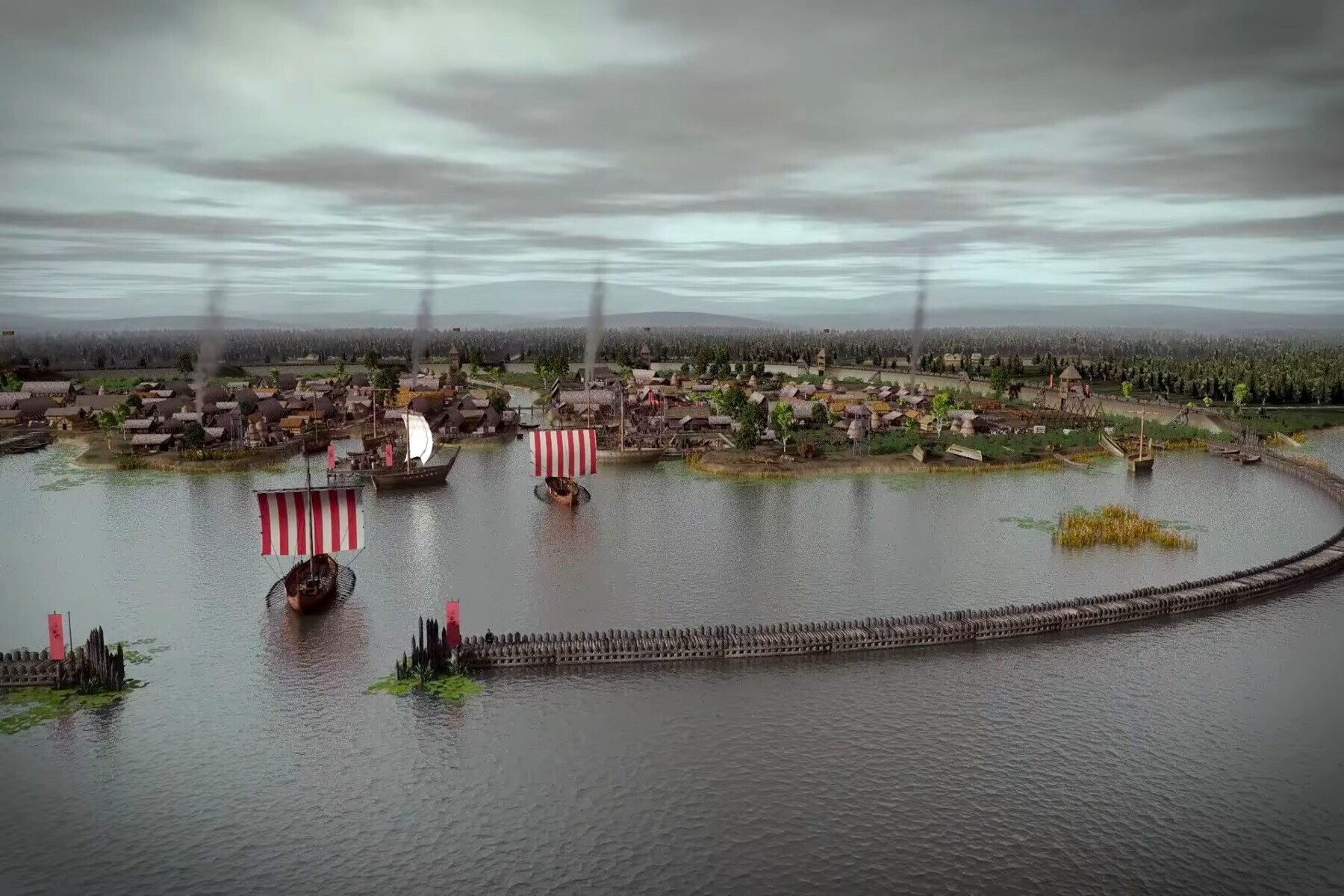
Trading towns like Hedeby, Birka, and Kaupang had been established in the Viking homeland due to a booming trade in exotic goods. The silver coins of the Islamic world flowed into Scandinavia by the millions, fueling even more economic expansion.
Natural resources and goods were sought out even in remote parts of the globe, be it timber from Newfoundland or walrus ivory from Greenland, in a bid to sate the burgeoning medieval economy.
By the year 1000, Scandinavia had been integrated into larger regional and indeed global economies, and Viking merchants were known to have trodden the lucrative Silk Roads that linked eastern Asia with Europe.
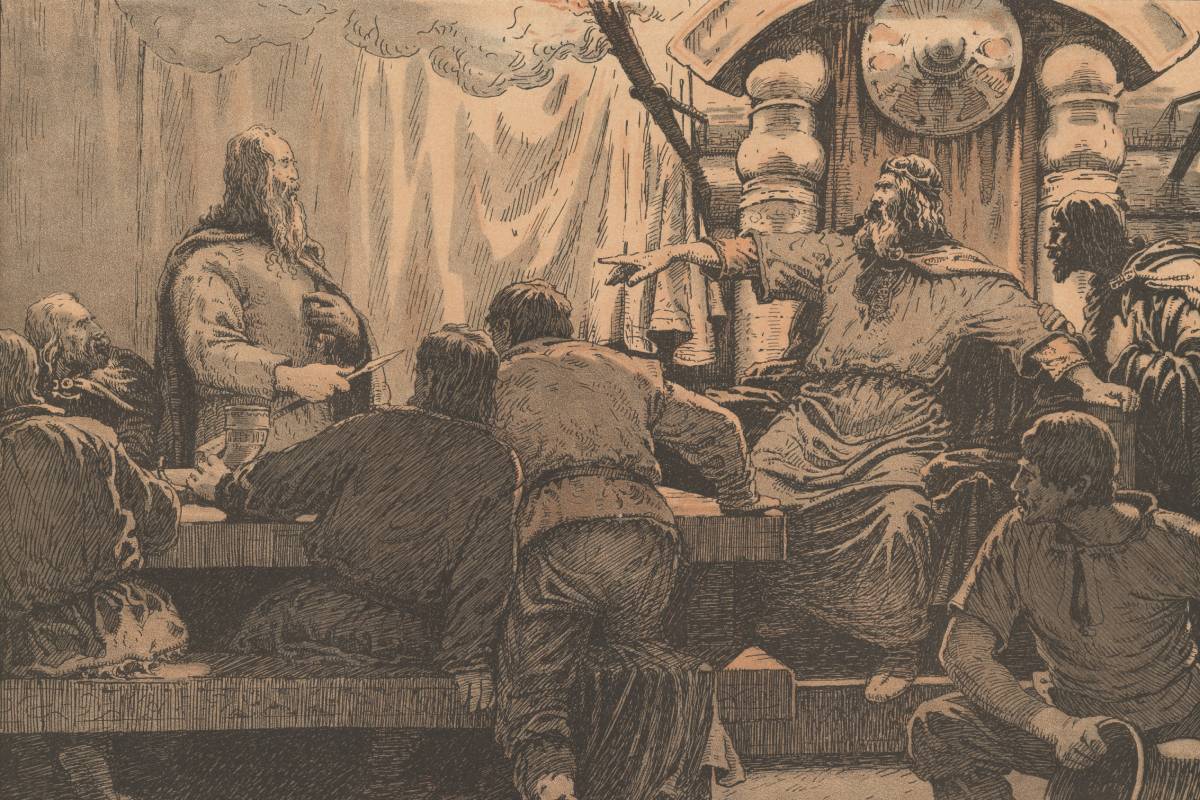
A 19th-century illustration of Sweyn Forkbeard at a royal council in Denmark. Author: Louis Moe (1857–1945)
Control, conversion, and power
The final characteristic of the Viking world in 1000 CE was one of the rapid accumulation of power by a select few.
We turn now to two key figures of this age who represent this accumulation and centralization of power: Olaf Tryggvason and Sweyn Forkbeard.
The high point of Viking rulership came with Sweyn Forkbeard's reign. Having centralized power in his native Denmark by usurping the throne from his father, Harald Bluetooth, he soon spread his influence across the seas to Norway and England, forging a true Viking empire bound by the North Sea.
The empire was won by the sword but carefully administered and supported by skillful alliances. In gaining this empire, he set off the last Viking invasions of the British Isles and founded a short-lived dynasty of English kings.
This power was gained through great wealth secured by trade and tribute.
Across the Skagerrak, Tryggvason's rise to power in Norway was meteoric and fueled by a religious fervor. After years abroad doing what Vikings do best – pillaging and plundering – he came back to seize the throne of Norway in 995.
However, his rule was marked by a divine mission, as he was a recent convert to Christianity. He was instrumental in spreading his faith in his kingdom, responsible for the construction of the first church and the foundation of a new capital, Nidaros.
This was not, however, a peaceful transition for his subjects to Christianity, because his conversion tactics were markedly un-Christian; he baptized his realm in fire and blood.
This left a sizable, powerful elite unhappy with this heavy hand and overreach into their souls, and he was ambushed by a coalition of rulers, including Sweyn Forkbeard, off the Danish coast in 1000 CE.
Despite his dramatic death, Tryggvason had ensured that Christianity had gained a foothold at least among the elite in Norway.
End of an era?
It was his death in 1000 CE that symbolized the end of the true Viking rulers in Scandinavia.
From then on, power was not measured by the raids a chieftain could organize, or the treasure looted, but by a priestly coronation and how effectively a monarch could rule a centralized and Christian realm.
At the turn of the new millennium, the history of Scandinavia would be dominated less by seafaring Viking warriors and more by the crowned heads of Christian nations.
For more information on the world events of the year 1000 CE, visit The Conversation here.
We get to provide readers with original coverage thanks to our loyal supporters. Do you enjoy our work? You can become a PATRON here or via our Patreon page. You'll get access to exclusive content and early access.
Feel free to reach out to discuss potential stories that may be in the public interest. You can reach us via email at hello@thevikingherald.com with the understanding that the information you provide might be used in our reporting and stories.




_-_cropped.png)