

Historians have a rough job sometimes. Scouring through the archeological or literary record, they spend their lives trying to bring the past, ancient history, back to life.
When they do, they are often criticized today, as the characters, people, and stories they help revive are viewed through contemporary attitudes, norms, and morals.
Magic is one such historical notion that we moderns dismiss as a sign of a backward and ancient society, the stuff of make-believe for civilizations, cultures, and societies that were technologically and scientifically primitive.
Nothing, however, could be further from the truth for Viking societies. For them, magic was an integral and intrinsic part of everyday life.
Magic was used not only for protection – such as ensuring personal safety, healing, or a successful harvest – but also for punishment, like placing curses on a troublesome neighbor or enemy.
In addition, the runic alphabet itself was believed to be endowed with magical properties. It quite literally put the "spell" in spelling.
Magic was also strongly associated with Norse cosmology, from Odin to Thor and Freyr.
As Stephen A. Mitchell explains in his 2001 book, Witchcraft and Magic in the Nordic Middle Ages (available on Amazon here), the most striking example of magic in Viking society was the literal embodiment of magic: the "völva."
This female sorcerer, seeress, and prophetess could not only communicate with the spiritual world but also held a position of high importance within her community.
Echoes of an ancient origin
In his 2020 book, The Children of Ash and Elm: A History of the Vikings (available on Amazon here), Neil Price masterfully discusses the origins of the societies that produced the Viking warriors.
What we now call Viking societies grew out of earlier ancient Germanic societies that spanned much of the Nordic Iron Age (c. 500 BCE – 800 CE).
These more ancient societies, upon which early medieval Scandinavia was built, were unique in that they not only had shamans and seers but that the most respected and revered of these ancient sorceresses were women.
By the time the first Viking raid was said to have taken place on the British Isles (the traditional start of the Viking Age), the role of these female seers had evolved into what people in Viking societies called a völva.
The name "völva" is believed to be derived from the Old Norse word for "staff bearer," and it was the use of wands – little more than shaped sticks – for divination and spell-casting that connected these female seers to their earlier Germanic incarnations and continued into the early medieval period.
Völvas were seasoned practitioners in the Norse form of magic – seiðr – that drew on shamanic practices to enter altered states of consciousness in order to contact the Norse gods for divination.
This allowed them to foresee and influence future events, offer spiritual guidance, and seek favor from specific Norse gods.
Their magic was often performed through rituals that included chants, spells, the use of magical staffs, or herbs and plants that may have induced altered states of consciousness. These rituals involved the völva entering a trance.

Norse mythology viewed the Norns as divine beings who spun the threads of fate, influencing the lives of gods and mortals. Source: The Viking Herald
Prophetic wisdom and cosmological insight
Part of the intrinsic nature of magic, which permeated every aspect of Viking societies, was a deep-seated belief in wyrd (Old Norse for "fate").
This was a concept that was predetermined not by human actions but by great mythological beings, the Norns. Quite literally spinning the past, present, and future, the Norns were widely revered and respected.
As part of their divination and magical abilities, a völva could become an intermediary between mere mortals and the Norns and was said to be able to interpret the will of the Norns.
This spiritual interpretation was of immense importance to people in Viking societies. Völvas were seen as capable of fortune-telling and possessed great prophetic insight.
It was this prophetic insight that inspired Viking-era skaldic poets and authors.
One of the most famous poems in all of the rich tapestry of Norse literature – the Völuspá – centers on the prophetic vision of a völva.
In these visions, the entire lifespan of the Norse universe, from creation to its eventual destruction and rebirth following Ragnarök, is recounted.
This highlights the völvas' role as not only possessing prophetic insight and knowledge but also helping to unlock some of the mysteries of the Norse cosmological universe.

Völvas performed their magic through rituals that often involved herbs, spells, and entering deep trances. Source: The Viking Herald
Held in high societal regard
Whilst we must not overstate things and pretend that Viking societies were anything but deeply misogynistic and indeed dangerous for women, a völva was an example of a woman who held a degree of power, influence, and authority.
Her prophecies, magic, and wisdom were often much sought after in times of crisis or warfare.
A steady stream of rulers, nobles, or military leaders might call upon her abilities and insight – ensuring that she was widely revered and respected in Viking societies.
Conversely, the form of magic she was said to perform – seiðr – was seen as feminine.
Males who practiced this form of magic – and there were male seers and what we might now call "wizards" (not a term used in Viking societies but the closest modern interpretation) – were deeply stigmatized and discriminated against.
Whilst Viking societies were very much a "man's world," women, as völvas, were seen as occupying a special position of magical wisdom and ability.
- READ MORE: Women and power in the Viking Age - A primer
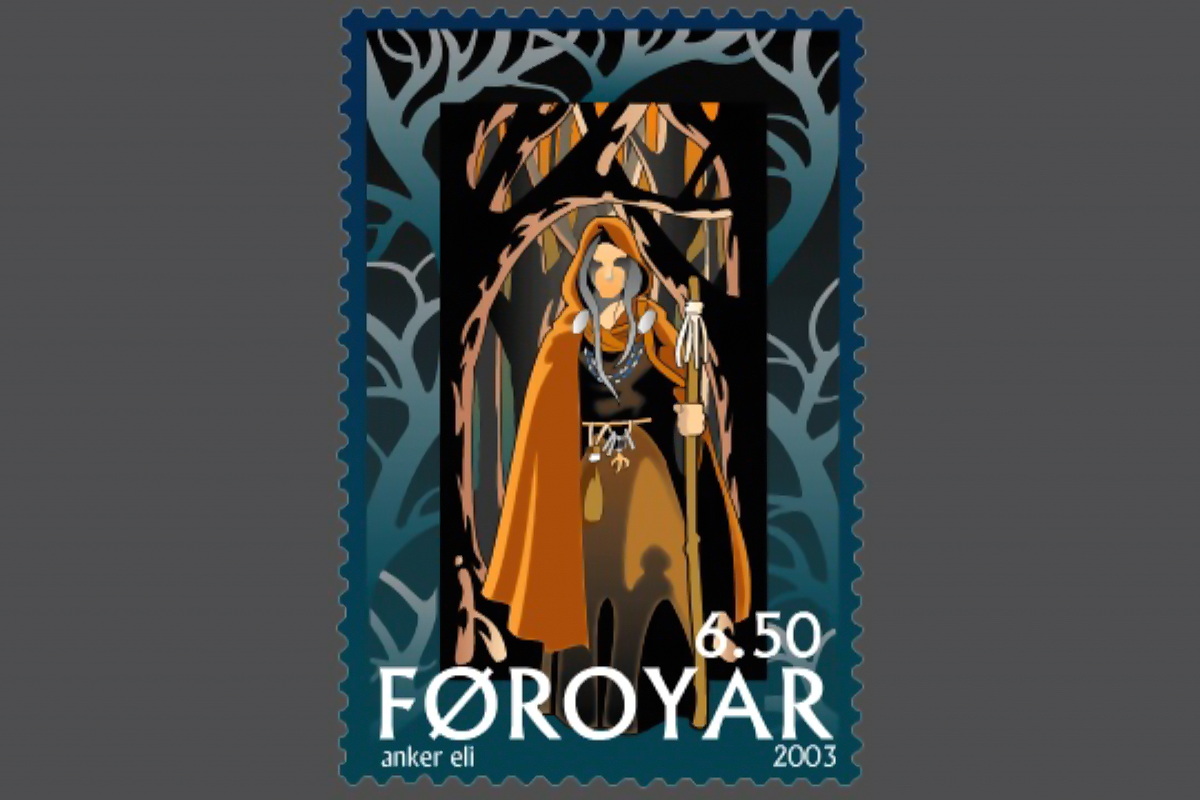
The 2003 Faroe Islands stamp shows the völva from the Völuspá, a Norse poem about the creation and end of the world. Source: Anker Eli Petersen / Postverk Føroya
Other appearances in the sagas
Aside from being the subject of an entire skaldic poem, there are a few memorable appearances of völvas in the rich tapestry of Norse mythology.
In the Saga of Eirik the Red, we encounter a völva who is a seeress for hire. She travels from farm to farm in one of the Norse settlements of Greenland, telling fortunes.
During one harsh and brutal winter, she predicts that the winter will eventually end.
Whilst not exactly a slice of prophetic wisdom, she may well be the first appearance of a would-be meteorologist in Western literature.
Another memorable appearance of a völva occurs in the poem Grógaldr, part of the Svipdagsmál collection. A dead son manages to call upon his mother, Groa, a völva, from beyond the grave to assist him in a plot for revenge.
Using a mixture of magical ability and wisdom, Groa manages to guide her son through a series of deadly challenges.
Whilst we know that magic is not real, from the safety and smugness of the 21st century, this was not the case for people in Viking societies.
The role of a völva, a magical seeress, was not only respected for her magical ability and cosmological insight but also widely revered as a female figure in what was a deeply patriarchal society.
This reverence and respect ensured that völvas became central figures in the rich tapestry of Norse literature.
For more information on an exhibition devoted to these early medieval magical wonders, visit Euronews here.
We get to provide readers with original coverage thanks to our loyal supporters. Do you enjoy our work? You can become a PATRON here or via our Patreon page. You'll get access to exclusive content and early access.
Feel free to reach out to discuss potential stories that may be in the public interest. You can reach us via email at hello@thevikingherald.com with the understanding that the information you provide might be used in our reporting and stories.