


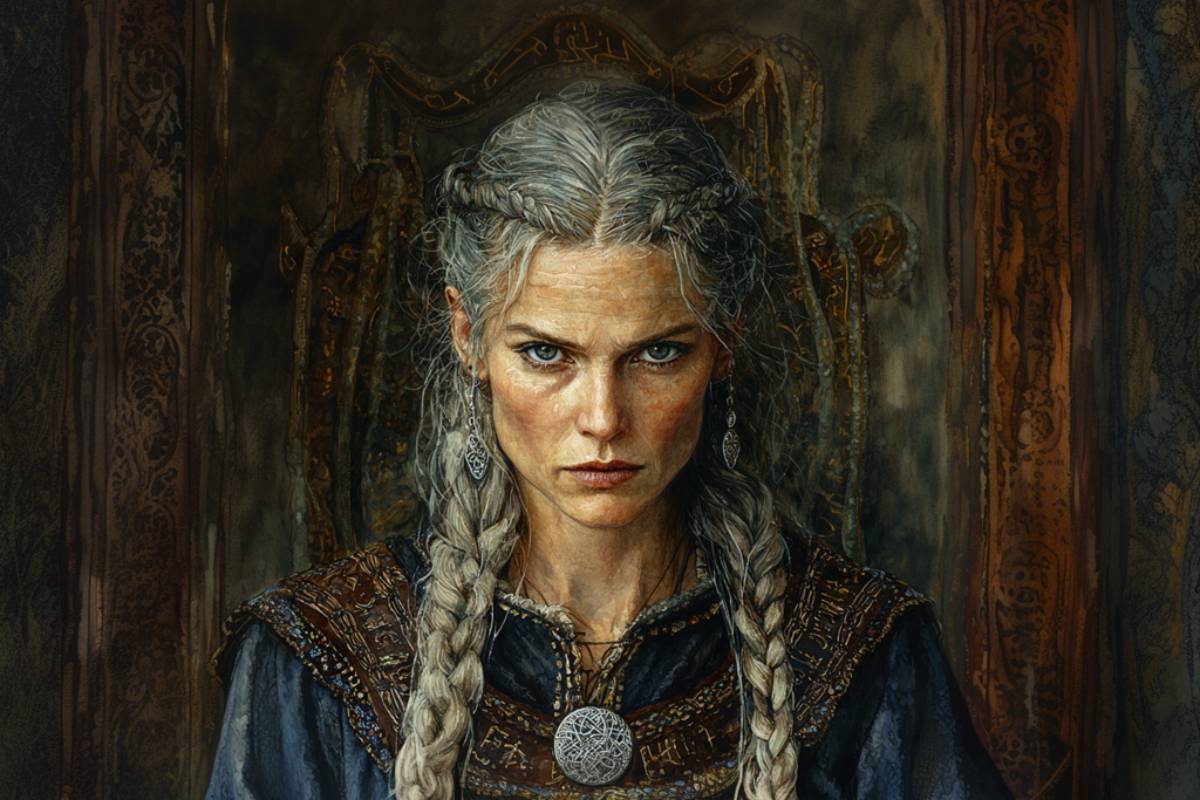
The war in Ukraine has now stretched into a third bloody year.
The Russian invasion of Ukraine was launched back in February 2022, following a downright bizarre rant by Vladimir Putin that saw him twist more than a millennium of shared Russian and Ukrainian history and poisonously distort it for his nefarious means.
The only thing he did get right in his hours-long rant was that Russia and Ukraine have a long and proud cultural history that harks back to the early medieval period, to the founding of the Kievan Rus.
The traditional story of the founding of what we now call the Kievan Rus, according to sources like Nestor the Monk's Primary Chronicle (compiled in the 12th century CE), begins with a group of eastern troublemakers.
The vast swath of land between the Baltic and Black Seas, what we moderns like to clumsily lump together as part of "Eastern Europe," was home to a diverse group of cultures, peoples, and religions during the early medieval period.
These people, including many tribes of Eastern Slavic and Finnic origin, encountered Viking societies traveling eastward from Scandinavia in the mid-9th century CE to raid, then trade and settle.
This is the subject of Dr. Cat Jarman's recent book, which traces the eastern history of the Vikings. It is a must-read for anyone wanting to know the other half of the Viking story.
These "eastern Vikings," whom the Byzantines would later call the "Varangians," had apparently been kicked out of the region by the locals, "forced back to the sea," as Nestor puts it.
Yet despite being freed of their Viking overlords, insecurity and violence were widespread, and they appeared unable to govern themselves successfully.
The locals then decided that the very same people they had just expelled—the Varangians—were the ones best suited to govern them.
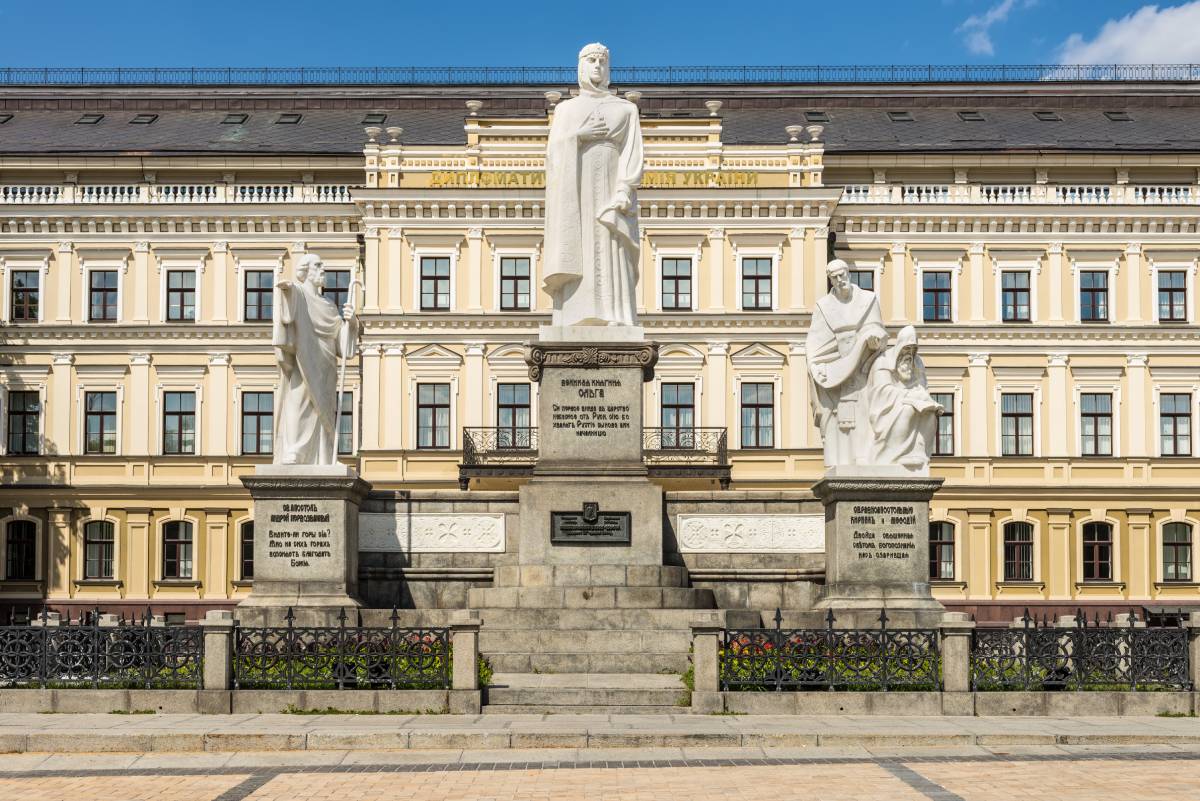
In Kyiv's St. Michael’s Square stands a monument to Olga of Kiev, Apostle Andrew, and the Slavic missionaries Cyril and Methodius. Photo: Navigator334 (CC BY-SA 4.0)
A rich and lawless land
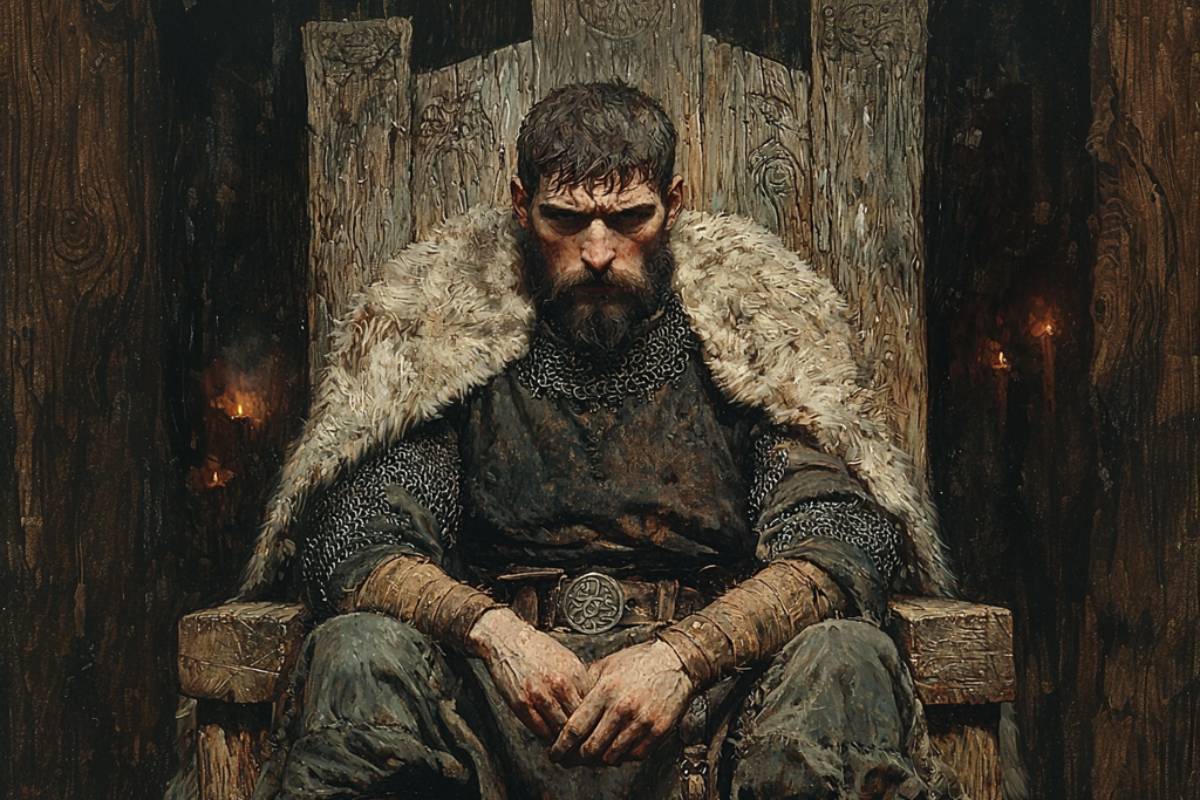
An invitation was then made to a local Varangian warlord, a strong man and warrior named Rurik.
With our language skills here at The Viking Herald rather limited, we will use the 1953 English translation by Samuel Hazzard Cross and Olgerd P. Sherbowitz-Wetzor.
In this, Nestor writes that the hapless locals extended this offer to Rurik, claiming that:
"Our land is great and rich, but there is no order in it. So come and reign and govern over it..." (p. 59)
You can almost see Rurik's eyes lighting up upon realizing the untapped potential (aka loot) of this region.
The Varangian warlord quickly accepted the offer and headed there, not alone but accompanied by his two brothers, Sineus and Truvor—though some later interpretations suggest these names may have originally referred to a household and a retinue, not actual individuals.
Sadly, this family affair didn't last long, as the two brothers died—but not before all three had established towns, at least according to the Primary Chronicle.
Rurik, the surviving brother, was traditionally credited with the founding of Novgorod in 862 CE and soon ruled over the region, establishing a dynasty that would last until the late 16th century CE.
While the details of his life are uncertain, and his very existence is sometimes questioned by scholars, Rurik's legacy would shape Eastern European history for centuries.
These Varangians evidently had a talent for town building, because two of Rurik's followers later journeyed south and established a stronghold on the hills that, over the centuries, would grow into what we now know as Kyiv.
Though archeological evidence shows earlier Slavic settlement in the area, the Varangian arrival likely helped consolidate the city's political and economic significance.
This shared history is what Putin referred to in his pre-invasion diatribe, though in doing so, he twisted both the facts and their meaning to fit his own political ends.
Aside from all the town planning, Rurik laid the foundation for what would become the Kievan Rus—a multiethnic, multireligious, and polyglot polity that, at its height during the early medieval period, was second only in size, scope, and influence to the Holy Roman Empire in Europe.
Despite the praise lavished on Rurik by medieval chroniclers like Nestor, it is not Rurik but his daughter-in-law, Olga of Kiev, whom we at The Viking Herald regard as one of the most consequential and formidable rulers of this empire.
- READ MORE: Five Viking queens who shaped history
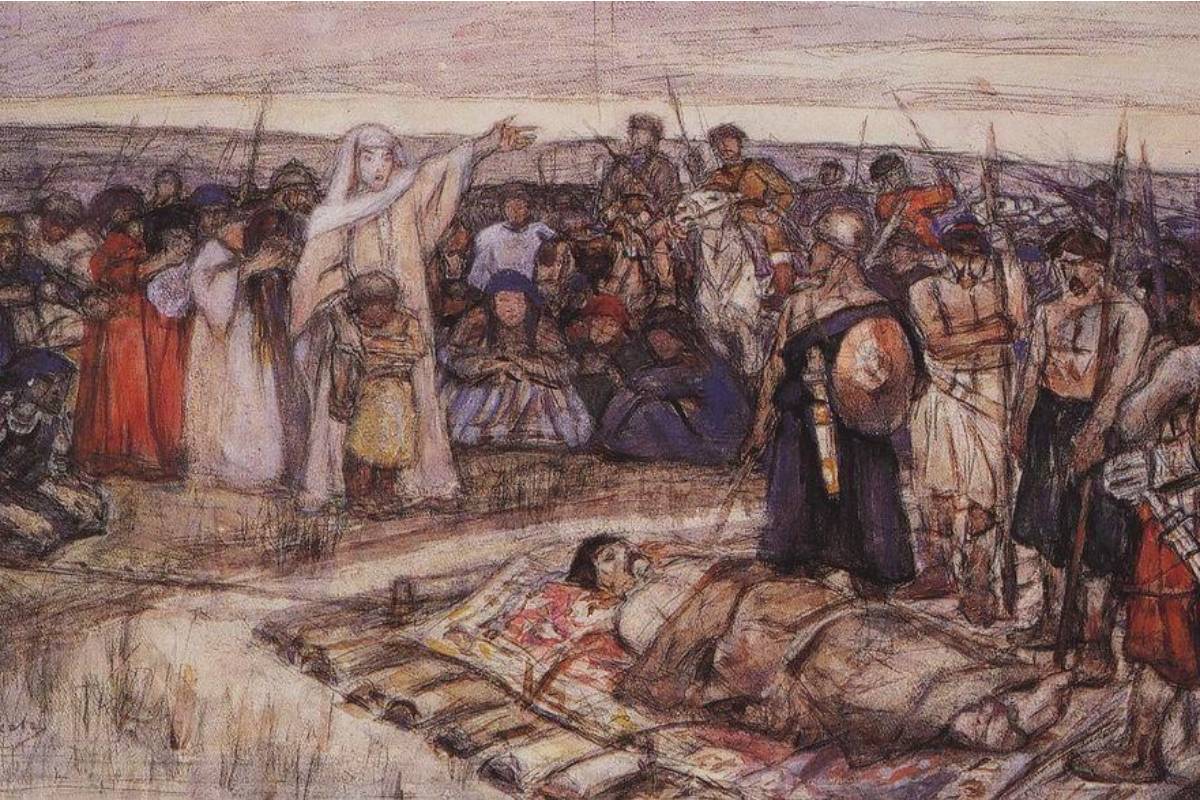
This 1915 sketch shows Princess Olga receiving the body of Prince Igor, killed by the Drevlians while collecting tribute. Illustration: Vasily Surikov (1848–1916)
Marriage and assumption of power
Despite the best efforts of medieval chroniclers, such as Nestor, and later historians, we simply do not know the details of when, or indeed where, Princess Olga of Kiev was born. Traditional accounts state around the turn of the 10th century CE, between about 890 and 925.
She was also said to have been born in what is now northwestern Russia, of Varangian stock. We know little of her upbringing or early life until her marriage at the age of 15. This was, however, no standard marriage, as she became a child bride to Igor, the son of Rurik.
Although he was the son of the founder of the Kievan Rus, Igor was in his infancy when his father passed away, and his kinsman Oleg ruled in his place.
According to traditional accounts, Igor ruled Novgorod for decades and later gained control of the Kievan Rus when Oleg passed away.
With his marriage to Olga, it was assumed that power in this region would be kept in the hands of those of Varangian stock and not allow any outsiders to "dilute" this source of power.
We know little of their marriage other than the circumstances of Igor's death. In 945 CE, he was said to be laying waste to a troublesome Slavic tribe, the Drevlians.
Whilst this tribe had participated in Igor's campaign against the Byzantine Empire—which saw the Varangians at the gates of Constantinople, only to be defeated by that mysterious military technology, "Greek Fire"—they had turned on their northern neighbors.
He marched with a large force on their capital to seek tribute. After receiving it, he turned back but was said to have grown greedy and returned with only a small force.
His greed would ultimately cost him his life, as he was said to have been captured and tortured gruesomely.
Though her husband was dead, Olga was not alone, as the two had a son, Sviatoslav. She was now left to raise a child and rule over a vast empire as a woman in what was very much a medieval man's world.
We shall leave the story of Princess Olga here—a single mother left to pick up the pieces of her personal life and rule over a medieval polity.
This would be a daunting task for most people, but not for Princess Olga, as she was made of stern stuff.
For more information on how Putin and his circle have exploited the history of the Kievan Rus for politics and power, visit The Conversation here.
We get to provide readers with original coverage thanks to our loyal supporters. Do you enjoy our work? You can become a PATRON here or via our Patreon page. You'll get access to exclusive content and early access.
Feel free to reach out to discuss potential stories that may be in the public interest. You can reach us via email at hello@thevikingherald.com with the understanding that the information you provide might be used in our reporting and stories.



.jpg)
