

It is only in recent decades, thanks to the collapse of the Soviet Union and the opening of Soviet archives and new generations of academics, scholars, and thinkers, that a serious analysis and study of the Viking influence on Eastern European history has taken place.
Before this, the story of Viking societies was one with a heavy Western bias, focusing on the adventures and exploits of early medieval Scandinavians in Western Europe.
Yet this was only half the story. Even before the first Viking raids took place in Britain, people from Viking societies had headed across the Viking Pond (the Baltic Sea) to raid, trade, and settle Eastern Europe.
By the end of the 9th century CE, people from Viking societies had established a political and economic foothold in the regions around the many river systems that snake between the Baltic Sea and the Black Sea.
These people from Viking societies, mainly warriors but also merchants and farmers, came to the top of the hierarchy in the emerging Kievan Rus by 882 CE, when Oleg seized Kyiv and made it his capital.
This was a collection of principalities in Northern and Eastern Europe founded by a Viking prince, Rurik. His descendants would go on to rule over this multiethnic and polyglot state that Belarus, Russia, and Ukraine all claim ancestral descent from.
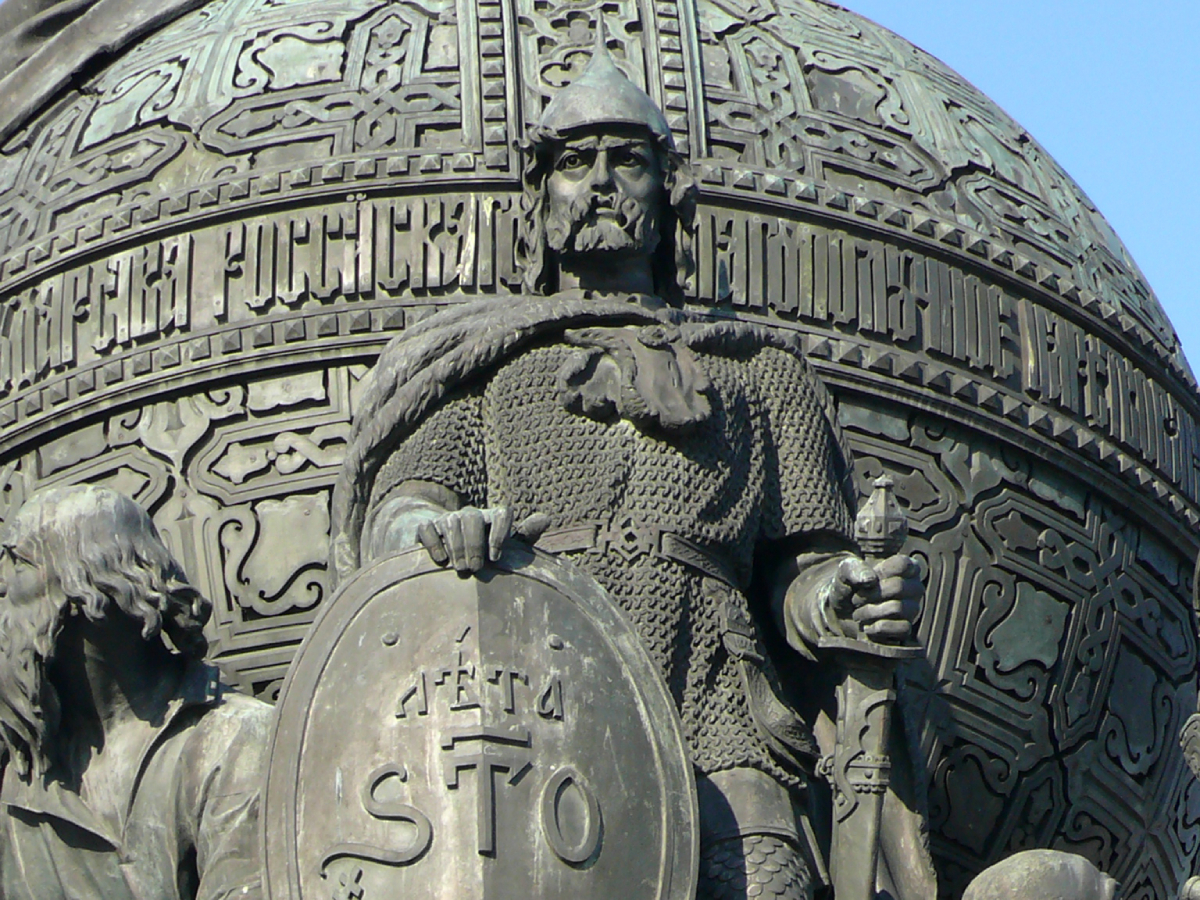
A detail of the Millennium of Russia monument in Veliky Novgorod, Russia, showing the figure of Rurik. Photo: Dar Veter (CC BY-SA 3.0)
From the Vikings to Varangians
Whilst Rurik may have been born somewhere in the Viking homeland of Scandinavia – historical records for this period of history are notoriously unreliable if they exist at all – his dynasty soon became an integral part of the political landscape of Eastern Europe.
By the 10th century CE, the Kievan Rus expanded southward to push its boundaries right up against Europe's preeminent Christian power, the Byzantine Empire.
This empire – the surviving eastern half of the Roman Empire – was controlled from its lavish capital, Constantinople, built as a second Rome on the banks of the Bosphorus.
Confusingly, we have two names for the descendants of Viking peoples who settled in the Kievan Rus. To the Byzantines, these eastern Vikings were known as Varangians.
The descendants themselves referred to themselves as the "Rus," a word which modern linguists believe is derived from the Old Norse word "to row," highlighting not only their Viking heritage but also a nod to how they navigated the many Eastern European river systems in their longships.
By the mid-10th century CE, the Kievan Rus had expanded across large parts of what is now Ukraine and western Russia, with influence extending into neighboring regions.
Its attention then turned south toward the Black Sea, where Byzantine interests shaped politics and trade.
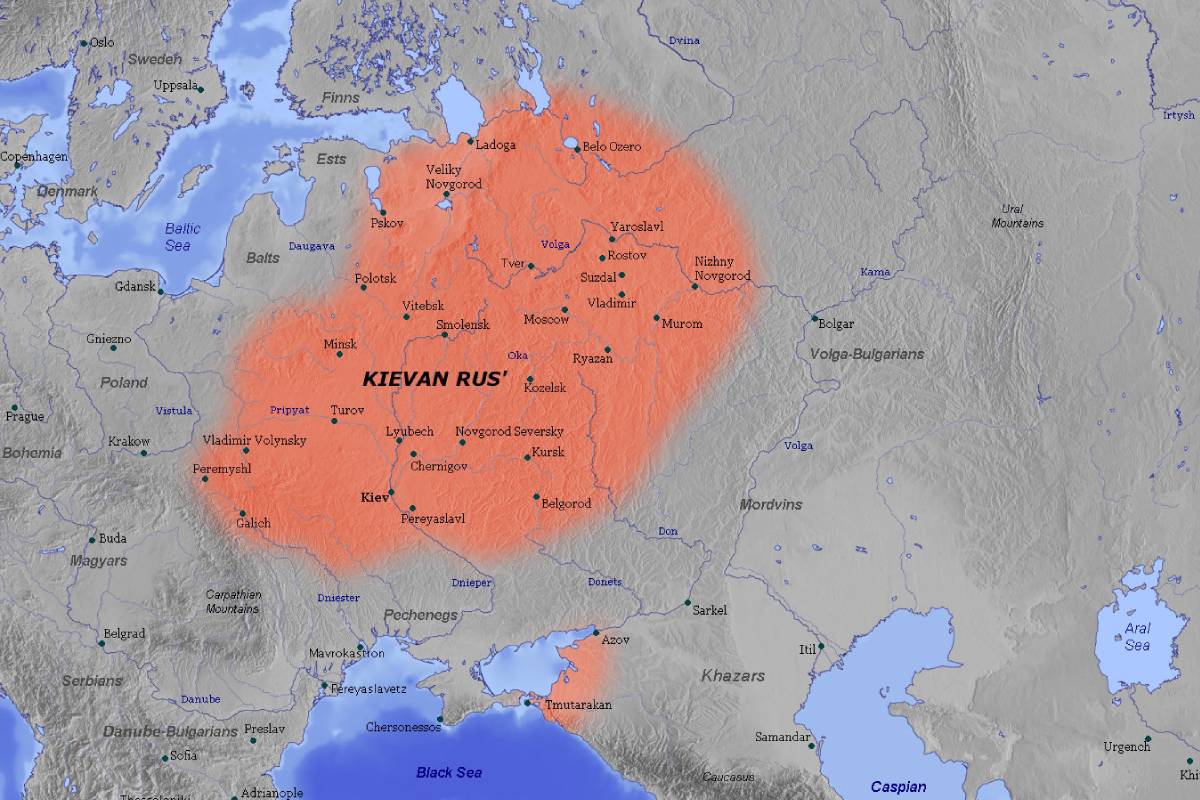
Map showing the approximate extent of the Kievan Rus realm in the mid-10th century. Source: Claude Zygiel (CC BY-SA 3.0)
A time of spiritual and political upheaval
Vladimir (Volodymyr) the Great was born into a milieu marked by political and religious upheaval sometime around 958 CE. He served as Prince of Novgorod from 970 and as Grand Prince of Kiev from 978 until his death in 1015.
The son of Grand Prince of Kiev Sviatoslav I, he was caught up in a struggle among Sviatoslav's sons after Sviatoslav's death in 972 CE. In the course of that conflict, Vladimir fled abroad.
After their brother Oleg's death in 977 CE, Vladimir returned with a force of Viking brethren in 978 CE and deposed Yaropolk. He then spent the next decade consolidating his rule by beating off incursions from various nomadic tribes and steppe peoples.
Some accounts also include a later campaign against the Volga Bulgars, often dated to 985 CE.
Throughout these years of solidification of frontiers and pacification of antagonistic peoples and tribes, Vladimir was said to be a stout believer in Slavic paganism, which dominated much of this region.
However, this was a spiritual belief system under existential threat, with Christian missionaries from both the Byzantine and Latin worlds permeating into the Kievan Rus, along with a minor, but growing, Islamic and Jewish presence.
Vladimir, however, still had strong religious convictions. Chronicle tradition credits him with the construction of a pagan temple to the Slavic God of Thunder and War, Perun, in Kyiv, and it also reports that he took 800 concubines.
Yet the ever-growing presence of these foreign religious influences that had penetrated the region created the need for a unifying force.
Marriage for diplomatic purposes
After he ascended to the throne and beat off military incursions into the state, Vladimir turned his attention to spiritual matters.
Despite the growing size of his realm, Vladimir knew that the Byzantine Empire, on his southern flank, represented an existential threat to safety and security.
The Byzantines and the Kievan Rus experienced cycles of conflict, diplomacy, and trade from at least the 9th century CE, including major raids such as the attack on Constantinople in 860 CE.
It was against this backdrop of more than a century of armed conflict, military expeditions, and raids that Vladimir welcomed representatives of three faiths, Islam, Judaism, and Christianity, in a bid for the conversion of his personal soul and that of his realm.
In 988 CE, Vladimir oversaw a particularly devastating campaign against the Byzantines in Crimea. Some accounts place this campaign at Chersonesus (Korsun), where Vladimir later received baptism.
This gave Vladimir the upper hand in negotiations with the Byzantines, and he was said to have asked for the hand of Anna, the sister of the Byzantine Emperor Basil II.
However, despite the weakened position the Byzantines found themselves in during negotiations, a Christian princess marrying a pagan barbarian was a step too far.
Yet Byzantine courtiers let it be known that if Vladimir would convert, then a marriage alliance between a Christian ruler and the sister of another Christian ruler would be possible. In later accounts, Vladimir's baptism and the marriage to Anna form the diplomatic centerpiece of the agreement.
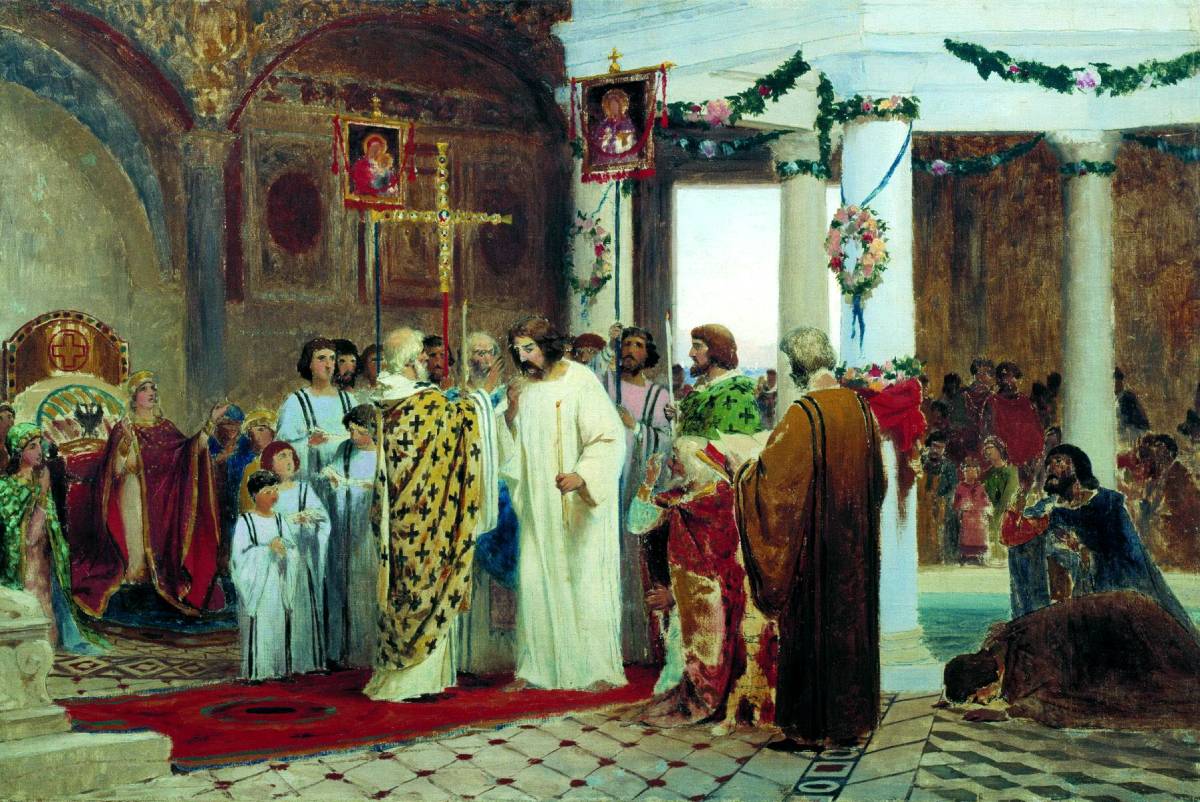
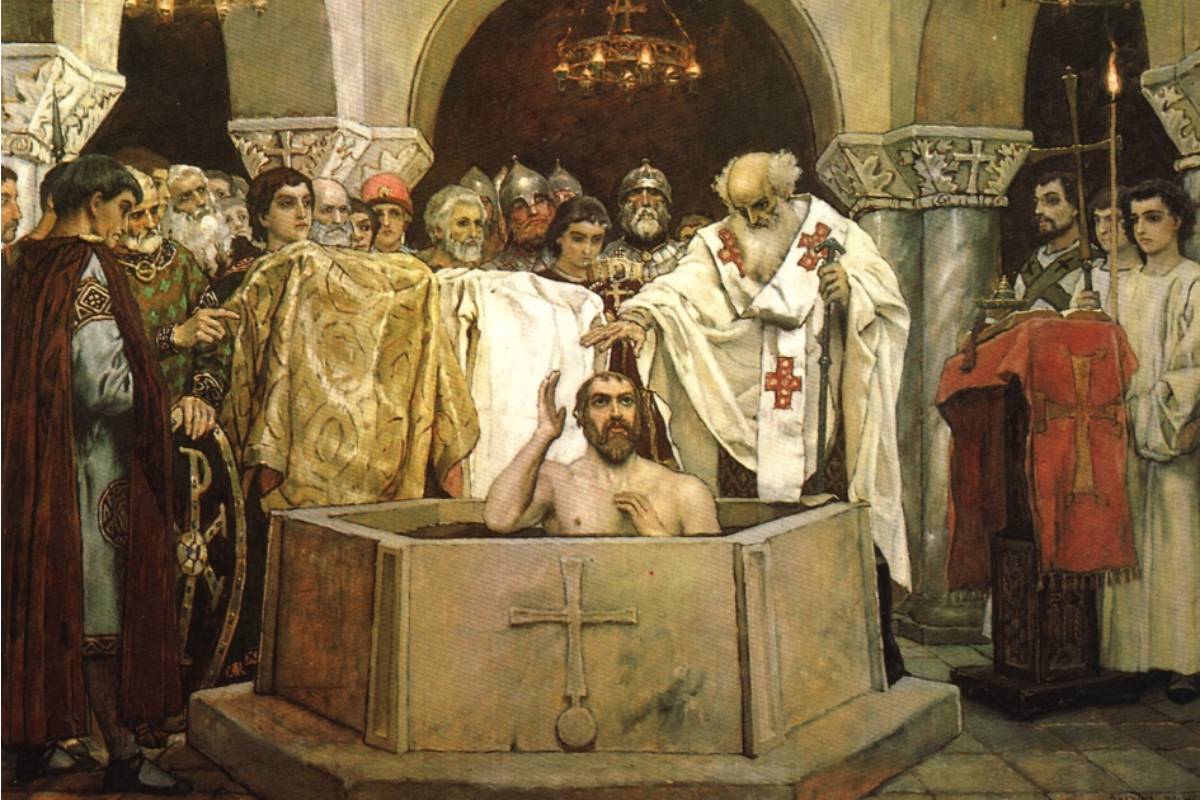
A depiction of the baptism of Prince Vladimir, with clergy and courtiers gathered for the rite. Author: Fyodor Bronnikov (1827–1902)
Conversion for pragmatic motives?
A whole host of apocryphal tales sprang up concerning the conversion of Vladimir.
Upon the arrival of Anna at the Kievan court, Vladimir, who was not baptized, was said to have gone blind. His soon-to-be wife chided him, declaring that only when he was baptized would he regain his sight.
Though this adds more color to the conversion, it appears to reflect later Christian storytelling rather than a firmly established historical report.
Vladimir's baptism took place under the supervision of Byzantine priests in 988 CE. Some later accounts add that the Byzantine Emperor stood as his godfather, and Vladimir took the "Christian" name of Basil in honor of his royal connection to the Byzantine court.
Whilst his conversion to Christianity, which would later diverge from the Latin Church in Western Europe through a long and uneven process, was ostensibly to secure a political alliance with the Byzantine Empire, Vladimir may have also had other motives.
He recognized the need for a unifying force in a multiethnic and polyglot state that could help stabilize his realm. His conversion also offered not only religious legitimacy but also valuable diplomatic and military support.
Vladimir's conversion marked the beginning of the Christianization of this region of Eastern Europe. Chronicle tradition also describes a wider, public baptism in Kyiv soon after, which signaled a shift from a ruler's conversion to a broader program of Christianization.
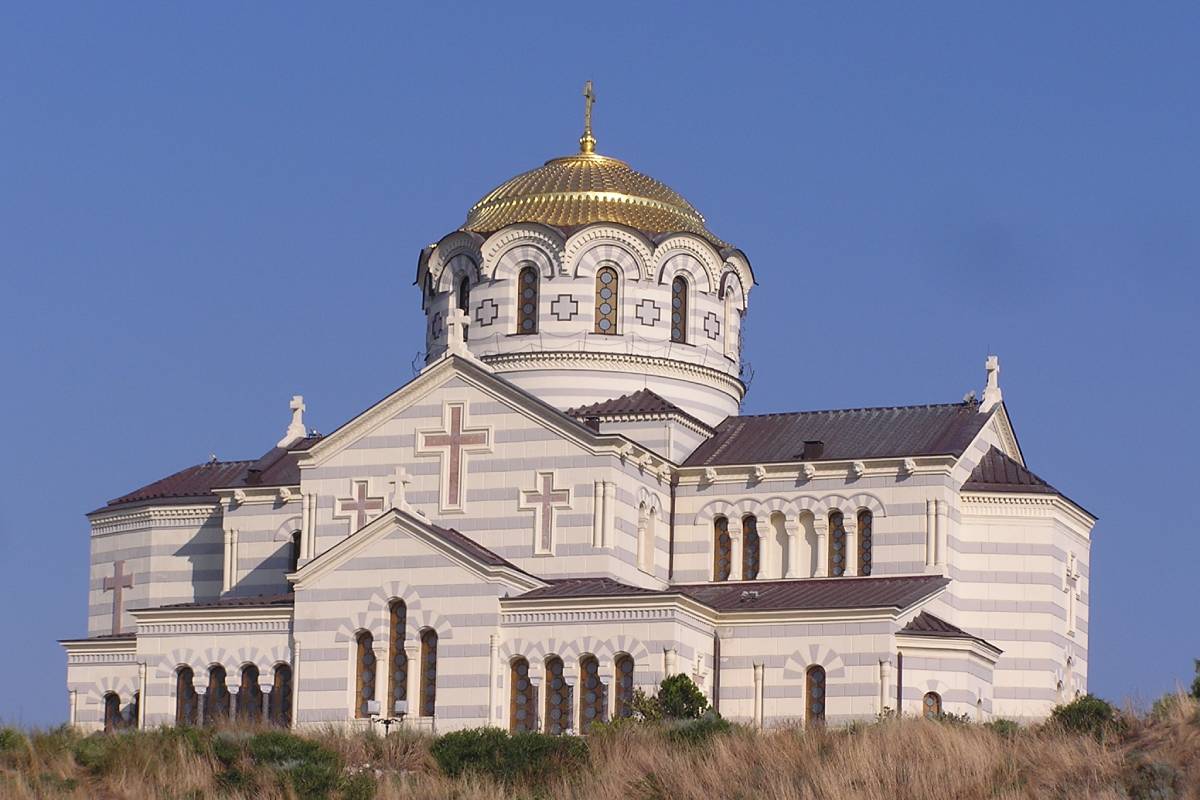
The Saint Vladimir Cathedral at Chersonesus near Sevastopol, Crimea, Ukraine, marks the traditional site of Prince Vladimir's baptism. Author: Andrey Butko (1978–)
Eastern Orthodoxy legacy
The process of the Christianization of the Kievan Rus bears hallmarks of the Rurikid ancestral homelands in Scandinavia.
As in Scandinavia, when rulers and elites adopted Christianity, it often encouraged wider conversion, and at times involved pressure, in what was largely a top-down process.
Vladimir, like rulers in Scandinavia with Viking backgrounds, could also use conversion to strengthen dynastic legitimacy and open avenues for cultural exchange, trade, and diplomatic relations within a broader Christian world.
Religious institutions, including churches, monasteries, and schools, were established throughout Vladimir's realm and promoted the spread of Christian teachings and values.
This served as a catalyst for a distinct Kievan Rus identity, separate from its pagan past and distinct from neighboring realms under pagan or Islamic influence.
The close relationship between large parts of Eastern Europe that had been part of the Kievan Rus and the Constantinople-based church continued long after the Kievan Rus disintegrated.
The modern successor states most often linked to the Kievan Rus legacy, Belarus, Russia, and Ukraine, remain historically shaped by Eastern Orthodox Christianity in no small part because of Vladimir's conversion over a millennium ago.
For more information about a recent Orthodox priest's experience in Norway, click here.
We get to provide readers with original coverage thanks to our loyal supporters. Do you enjoy our work? You can become a PATRON here or via our Patreon page. You'll get access to exclusive content and early access.
Feel free to reach out to discuss potential stories that may be in the public interest. You can reach us via email at hello@thevikingherald.com with the understanding that the information you provide might be used in our reporting and stories.