

For anyone lucky enough to visit Poland lately, you will know that the country is having, as the kids nowadays say, "a bit of a moment."
With one of the strongest economies in Europe, this nation, whose history has not been kind over the past few hundred years, is now throwing off the shackles of its troubled past and entering the 21st century CE with aplomb.
Aside from its staggering rate of growth, it has seen its GDP increase by about 430% since the turn of the millennium (!). It has seen a cultural renaissance epitomized by the opening of the Polish History Museum in the nation's capital, Warsaw.
This gigantic new cultural institution showcases the rich and often tragic history of Poland, but with a focus on the experience of freedom in the nation.
This museum is not only a major boon for the Polish nation, and many a tourist (including the author) will want to flock there, but it also hopes to inspire and explain the detailed history of Poland, from its origin to its current 21st century CE boom.
Of particular interest to us at The Viking Herald is the history of Poland during the early medieval period.
Whilst people from Viking societies were not the first to venture here, they were certainly amongst the first to help link this region with wider trade networks that spanned the ancient world.
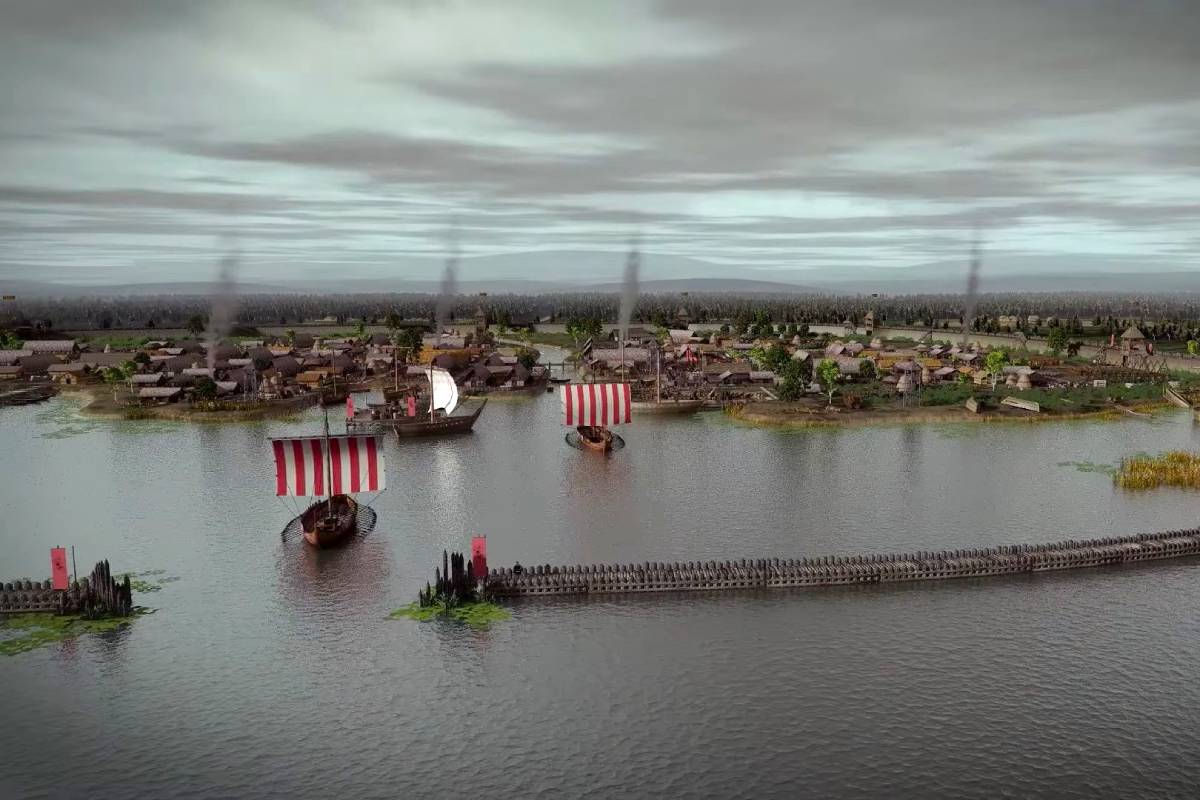
The establishment of a trading town, Truso, at a delta of the river Vistula was the first nascent steps in Poland's economic emergence and saw trade develop between the Baltic region, Scandinavia, and beyond.
Truso is just one part of a rich Viking history that Poland proudly possesses.
River highways
For much of the pre-modern period, the quickest way to get around was not on foot but on water.
We know that people from Viking societies were master sailors and utilized the many river systems of Europe for plunder and profit.
One such river was the Vistula, which rises in the Carpathian Mountains in southern Poland and flows north through much of the country before emptying into the Baltic Sea at the Gulf of Gdansk.
This river, over 1,000 kilometers (600 miles) long, was instrumental in the development of the medieval Polish state and on whose banks two of the nation's largest cities, Warsaw and Krakow, were founded.
With minimal road infrastructure, the rivers were the true superhighways of the medieval period that allowed goods, people, and ideas to freely flow. People from Viking societies utilized these river systems, including the Vistula, to both raid and trade, as Dr. Cat Jarman talks about in her masterful recent tome, River Kings.
It was only a matter of time before people from Viking societies came to capitalize on the river Vistula.
- READ MORE: The Viking history of the Baltic region
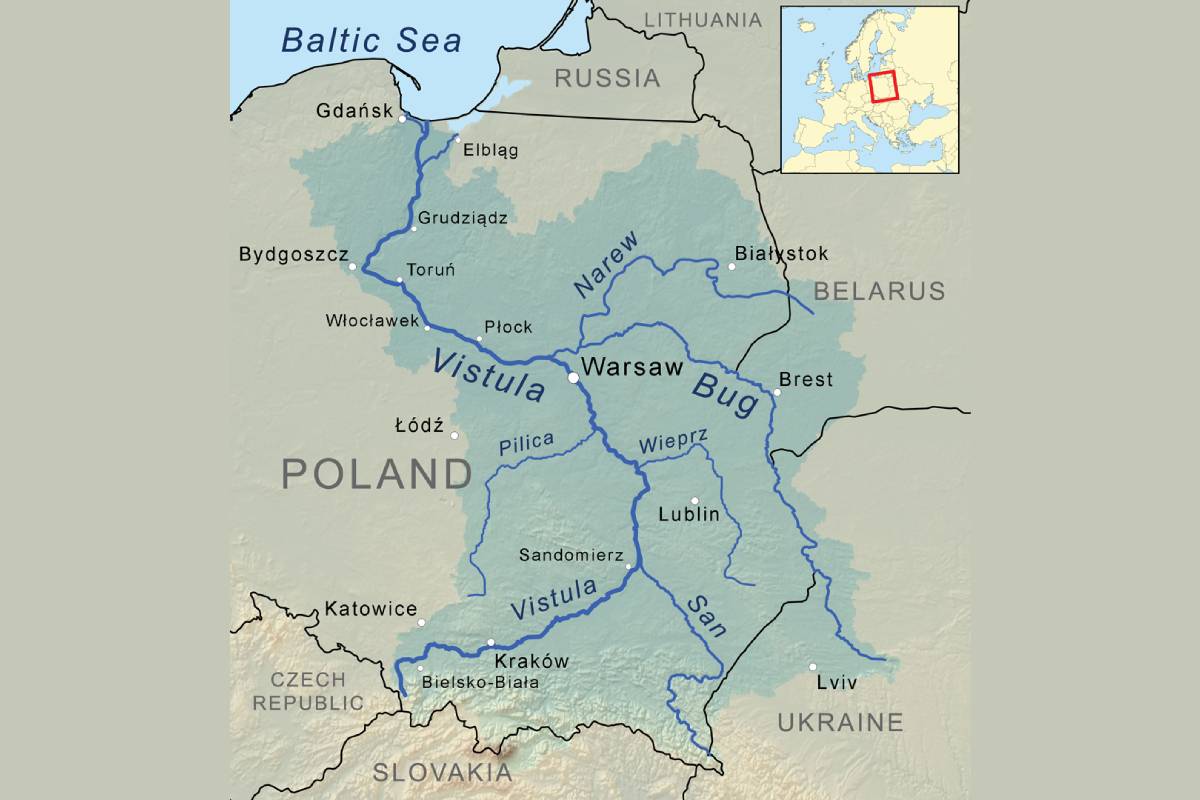
Vistula River basin map of Poland. Truso lay near Elbląg, close to the Vistula delta on the Baltic coast. Source: Kmusser (CC BY-SA 3.0)
A short sail from the Viking heartland
We know that the Baltic region was probably one of the first European regions where a Viking presence was felt outside of Scandinavia.
Recent archeological discoveries at Salme on the Estonian island of Saaremaa have unearthed remains of two ship burials from around c. 750 CE, often interpreted as evidence of a Scandinavian expedition that ended in violent conflict.
This not only pushed Viking activity beyond Scandinavia, but it also made what is now the northern Polish coastline easily accessible to people from Viking societies, just a short sail south of eastern Scandinavia.
Aside from the proximity to the Viking heartland, what made this region even more attractive to people from Viking societies was the Vistula River. Here was an early medieval highway that allowed merchants, traders, and/or warriors to penetrate deep into the heart of central Europe.
It was a route that made long-distance travel accessible in days, whilst the same journey may have taken weeks or even months on foot.
Down the river, people from Viking societies encountered several different cultures and civilizations, including the Polans, Pomeranians, Silesians, Slavs, and Vistulans. Commerce and conquest often went hand in hand.
With close proximity to Scandinavia, a ready-made highway for transport and trade, all that was needed was a center for commerce. Soon, a trading emporium sprang up at the very mouth of the Vistula, close to the Baltic Sea.
This would become known as Truso and play an important role in the economic history of Poland and people from Viking societies.
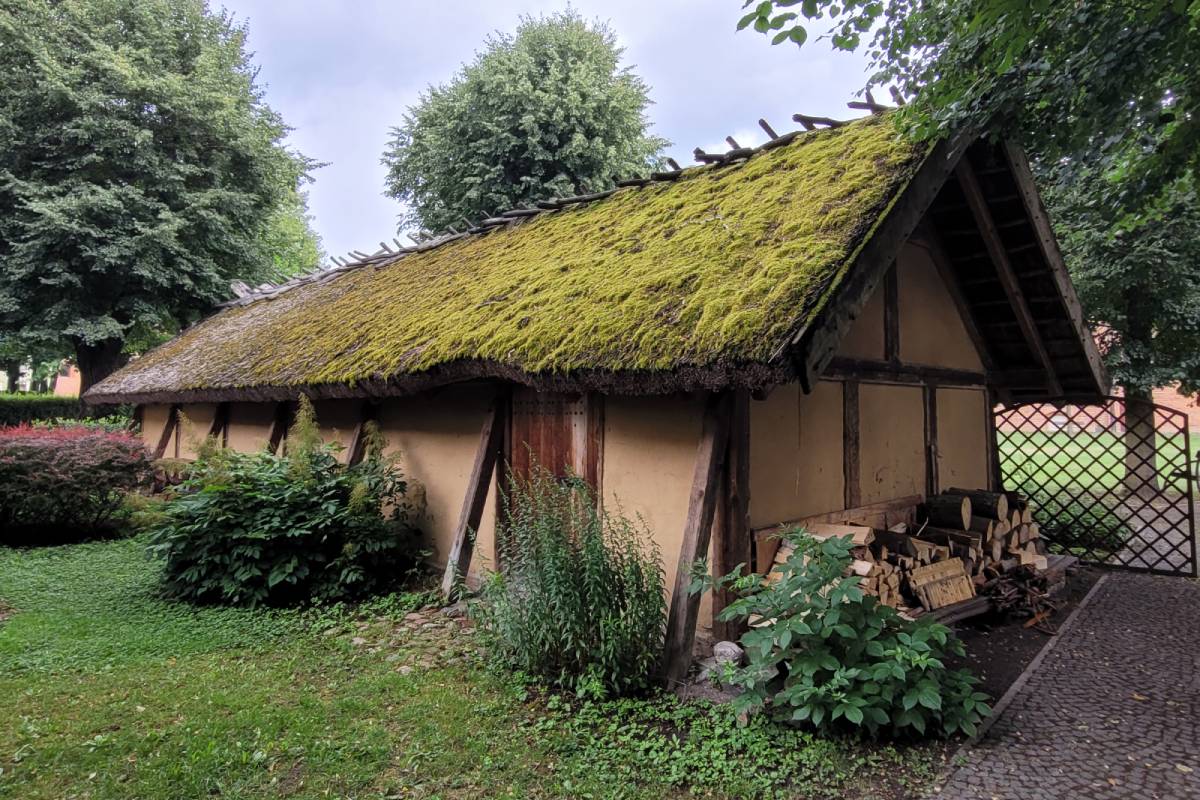
A reconstructed Scandinavian-style house at Truso near Elbląg, shown in the courtyard of the museum in Elbląg, Poland. Photo: Bornholm (CC BY-SA 4.0)
Economic riches
We know that during the Viking Age (c. 750 – 1100), Truso was a busy entrepot, full of commerce and cross-cultural exchange.
Here, traders and merchants could use the Vistula River to travel from Scandinavia to Central Europe and onto the markets and bazaars of the Byzantine and Islamic worlds.
Whilst amber, fur, and enslaved people flowed southward, precious jewels and silks flowed in the opposite direction.
Truso also capitalized on east-west trade links, which connected the nascent Viking societies in what is now Russia with the Frankish realms and Anglo-Saxon England.
Truso's position at the northern tip of Central Europe, with easy access to the Baltic Sea and the river Vistula, ensured that this trading town became one of the most important in Central Europe during the Viking Age.
Travel account of Truso
We do not know exactly when Truso, the premier trading town in the southern Baltic region, was established. However, by the mid-9th century CE, it appears to have been flourishing so much that its reputation went far beyond Central Europe.
We have a contemporary account of Truso from a medieval chronicle, Old English Orosius (Old English History of the World), written not by a Viking scribe but by one far further abroad across the North Sea.
Produced in 900 CE by an author or authors lost to the tides of history, this account was written in the West Saxon dialect of Old English and is often linked to Alfred's court.
This West Saxon tome gives much detail about the history of England (much of it extremely historically questionable but interesting; sometimes one should never let facts get in the way of a good story!) and includes two travel accounts.
Whilst we have discussed the travels of one of the travelers, the Norwegian Ohthere, in a previous article, it is the second, named Wulfstan of Hedeby, that we turn to now.
Here, the anonymous author recounts how Wulfstan had made a trip to Truso about half a century before. According to this account (we use an online version of the 1893 Cassell edition of Richard Hakluyt's The Discovery of Muscovy), in the year 850 CE:
"Wulfstan said that he went from Haethum to Truso in seven days and nights, and that the ship was running under sail all the way. Weonodland was on his right, and Langland, Laeland, Falster, and Sconey, on his left, all of which lands are subject to Denmark."
Sailing to what is now Poland, it appears that Wulfstan sailed through the Baltic Sea until he arrived at the Vistula delta. Here he found a lake,
"...called Estmere, [which] is about fifteen miles broad. Then runs the Ilfing east (of the Weissel) into Estmere, from that lake on the banks of which stands Truso..."
Sadly, however, we do not have more of Wulfstan's reflection on what must have been a busy emporium.
However, this small travel anecdote speaks to the fact that during the early medieval period, even people as far away as Wessex knew of the presence of Truso and considered it a destination worthy of undertaking a long journey to.
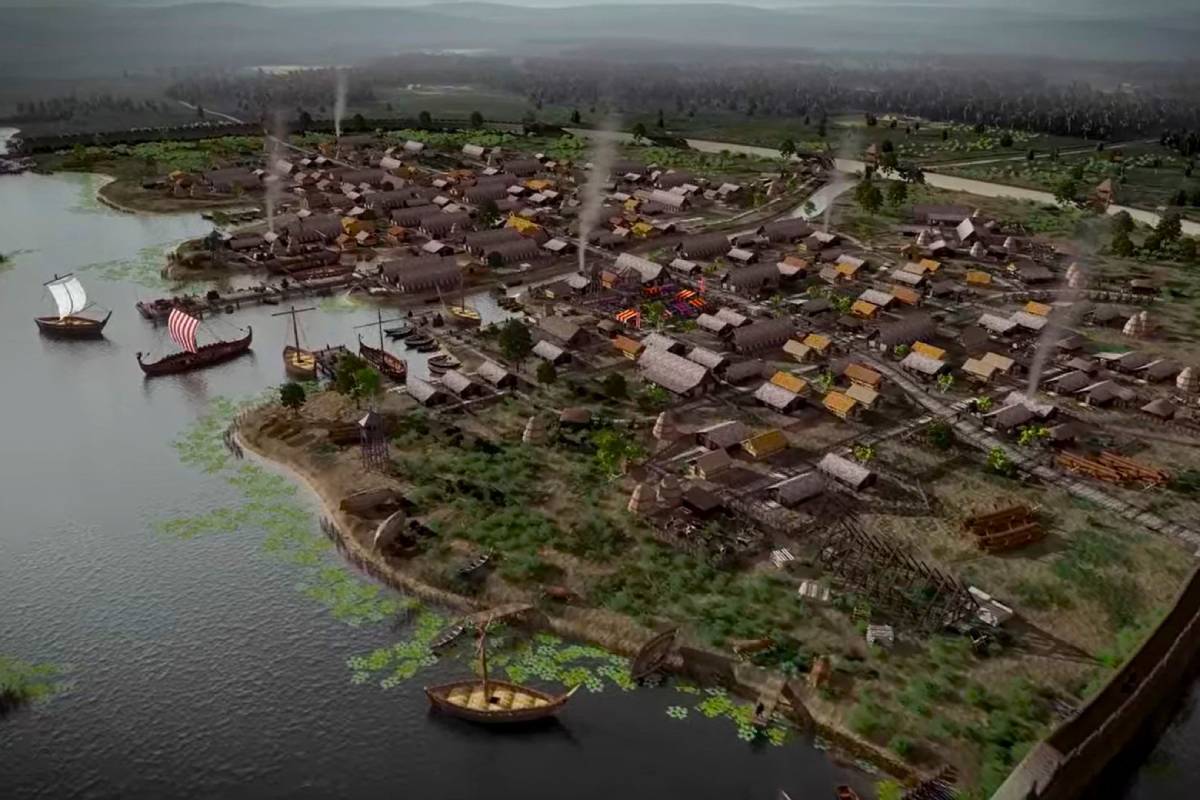
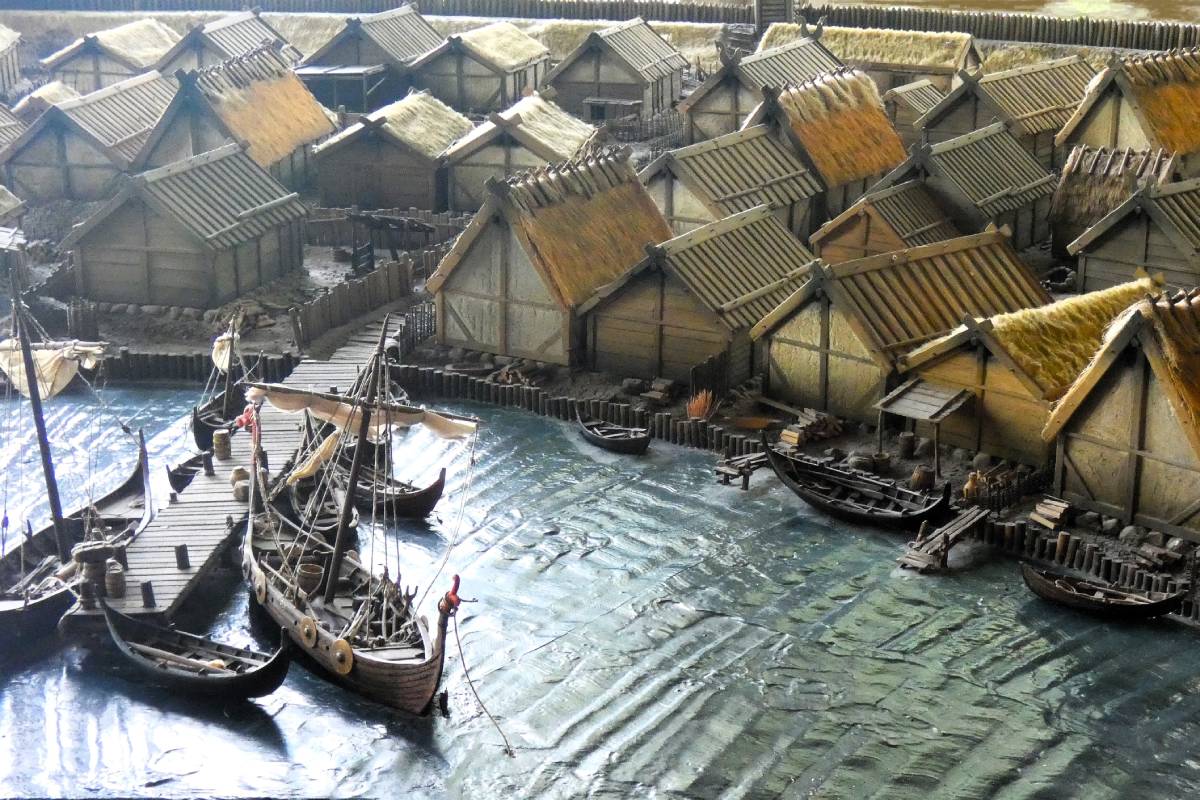
Museum visualization of Viking Age Truso showing the bay and harbor area. Source: Muzeum Archeologiczno-Historyczne w Elblągu (CC BY-SA 3.0)
Demise by flame
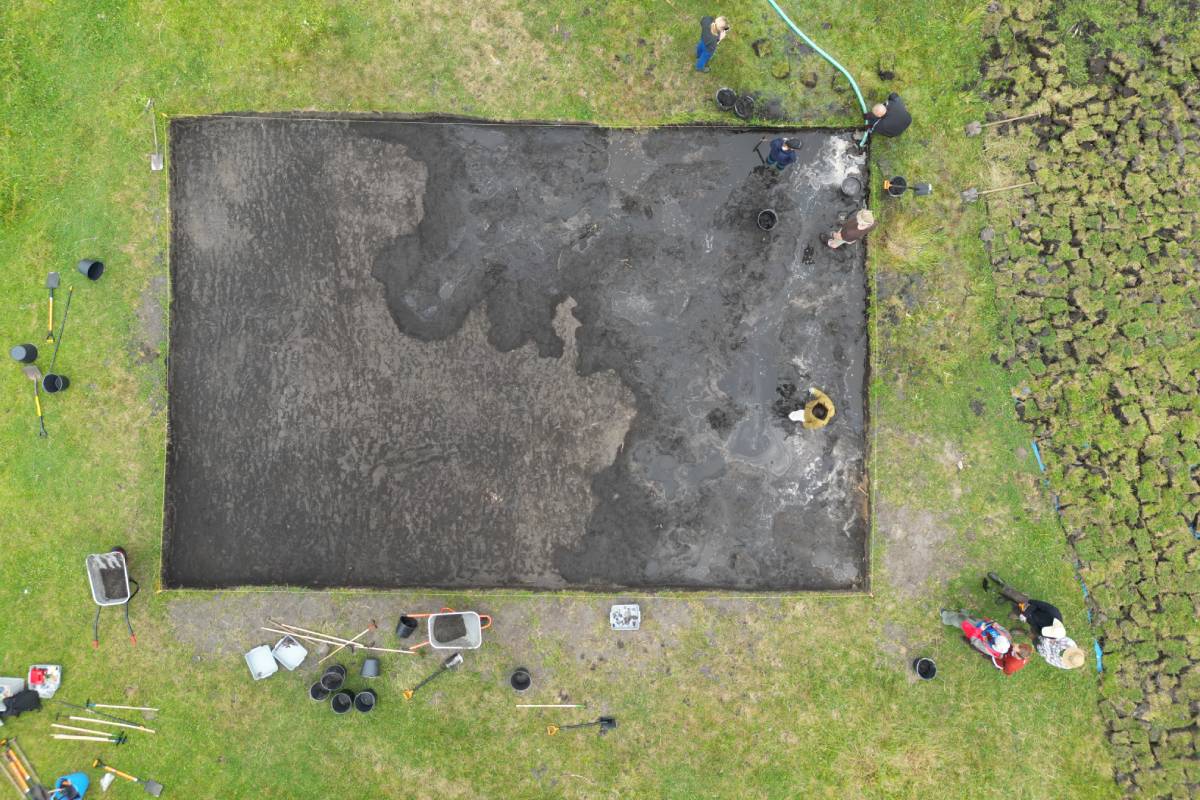
Despite this region being at the crossroads of major political events in the 20th century CE, and seeing several different armies tramp back and forth over its hallowed soils, there has been a slow and steady archeological excavation of the area that was thought to be part of Truso.
Excavations have dug up a graveyard dated to the early medieval period, when Vikings roamed, along with weapons believed to have been used by people from Viking societies.
Further proof of its lucrative nature appears in Marek F. Jagodzinski's chapter "The settlement of Truso" in Wulfstan's Voyage: The Baltic Sea region in the early Viking Age as seen from shipboard (eds. Anton Englert and Athena Trakadas, 2009).
He writes: "...which is indicated by the find of five pieces of scales, more than 300 weights as well as 274 coins...[that] show Scandinavian and Western European influence..."
Whilst we do not know exactly when Truso was founded, we have a rough date for its demise. This seems to have occurred around the turn of the first millennium, sometime close to the year 1000 CE.
Analysis of a level of ash and debris unearthed by archeologists suggests that many of the buildings that once made up Truso had been put to the torch.
Whether this was a planned attack by the nascent Polish state, under Boleslaw I the Brave, looking to wipe out the economic influence of people from Viking societies in the region (and possibly capture the wealth of the town), or just a predatory raid by other Vikings or pirates, we do not know.
Regardless, Truso presents a fascinating snapshot into the Viking story of Poland and shows how, long before commercial flights or ferries, the Baltic region of Poland was well connected to the Scandinavian world.
For more information on the Viking history of Poland, visit Polskie Radio here.
We get to provide readers with original coverage thanks to our loyal supporters. Do you enjoy our work? You can become a PATRON here or via our Patreon page. You'll get access to exclusive content and early access.
Feel free to reach out to discuss potential stories that may be in the public interest. You can reach us via email at hello@thevikingherald.com with the understanding that the information you provide might be used in our reporting and stories.