

We here at The Viking Herald have a love-hate relationship with the early medieval period.
Ok, perhaps "hate" is too strong a word. Call it a "love and very slightly annoyed" relationship.
We love it for so many reasons, chiefly among them the emergence of Viking societies and the colorful characters and events therein.
We are "very slightly annoyed by it" because, like the English historian Michael Wood's seminal tome, we are constantly "in search of the Dark Ages."
It is fashionable nowadays to refer to this historical period in Europe as the early medieval period and not "the Dark Ages."
However, despite all the technological advances in archeology in recent times and all the new sources discovered and analyzed, so much of what happened in Scandinavia during this period remains largely unknown.
What we do know comes from a smattering of contemporary chronicles – many compiled from biased sources and far away – a scant archeological record and sagas written centuries after the fact.
A case in point is the semi-historical Battle of Hjørungavåg, said to have taken place sometime in the late 10th century, traditionally stated as 986 CE.
Whilst we do not know exactly when it occurred, we have shed some light on the colorful characters involved in the battle, including a father-and-son monarch of Denmark, fabled Viking mercenaries, and a rebel ruler of Norway.
Throw in political machinations, backstabbing, and even some good old-fashioned pagan shenanigans, and we have the recipe for a true historical page-turner.
Grab your (historical) torches as we shine a light on the Battle of Hjørungavåg.
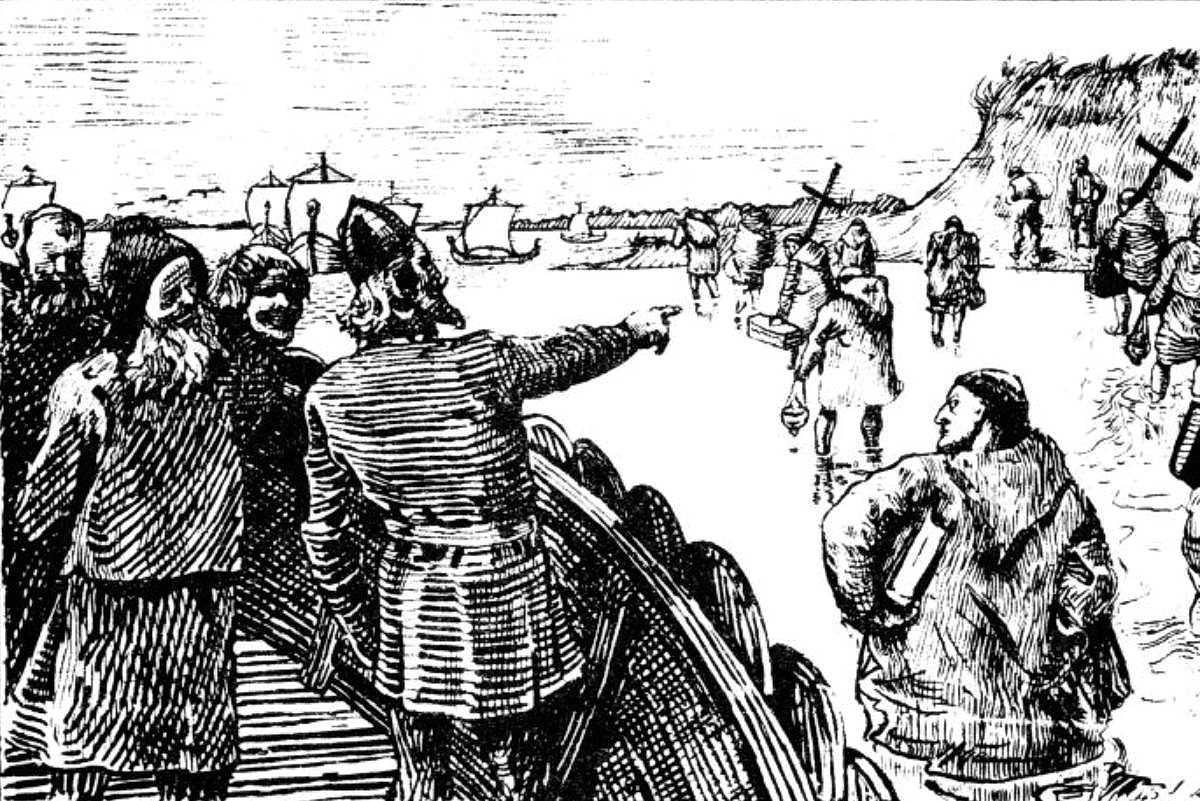
Hákon jarl, Norway’s de facto ruler, is shown here ordering Christian clergymen to return ashore. Source: Christian Krohg (1852–1925)
The main political players
Imagine we are back in that region where the Aurora Borealis dances its magical glow in the colder months – Scandinavia – during the late 10th century.
We would indeed recognize some of the rough political landscape of the time – the very nascent Danish, Norwegian, and Swedish kingdoms in their infancy.
However, the borders, boundaries, and "areas of influence" differed greatly from the modern borders of these countries today.
During the last decade and a half of the 10th century, a father and son sat on the throne in the Kingdom of the Danes.
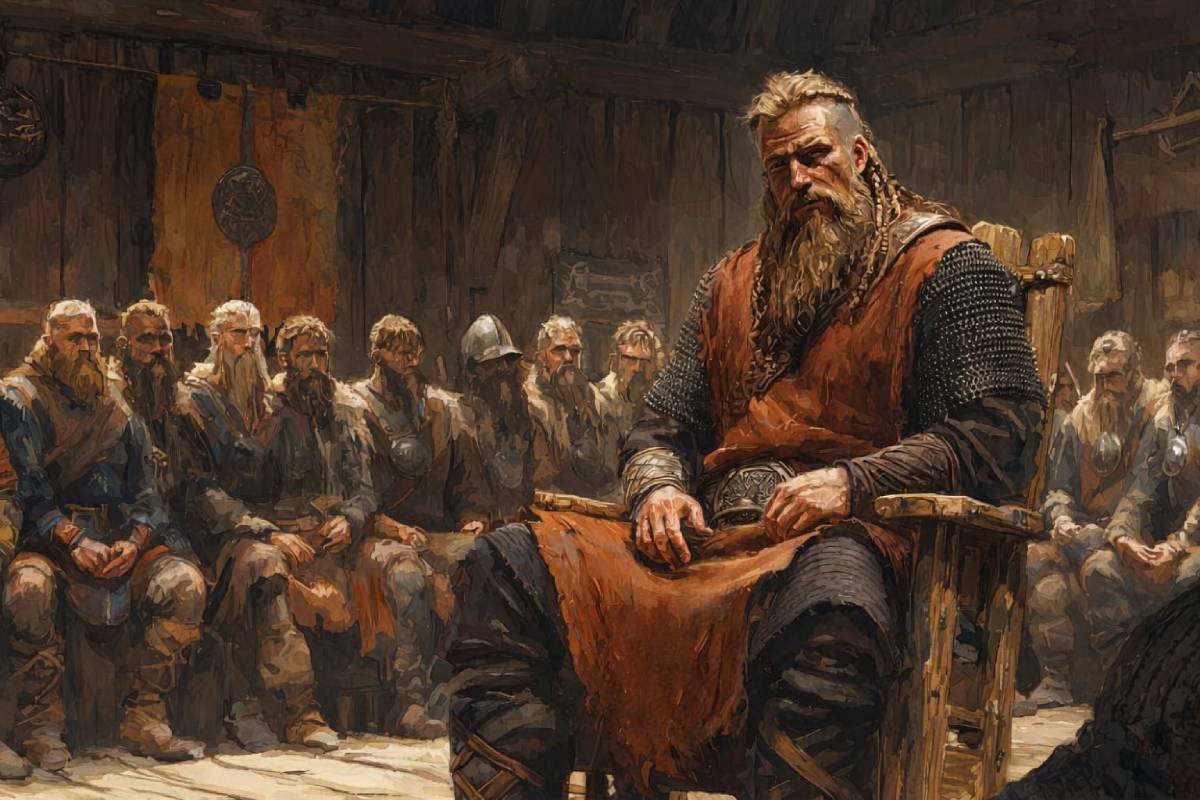
Harald Bluetooth and his son Sweyn Forkbeard – who some say usurped his father and seized the throne sometime around the time that the Battle of Hjørungavåg was said to have taken place – were monarchs who sought to extend the Danes' traditional control over what is now much of southern Norway.
They were blocked, however, by a powerful group of nobles residing in the north of Norway, the Jarls of Lade.
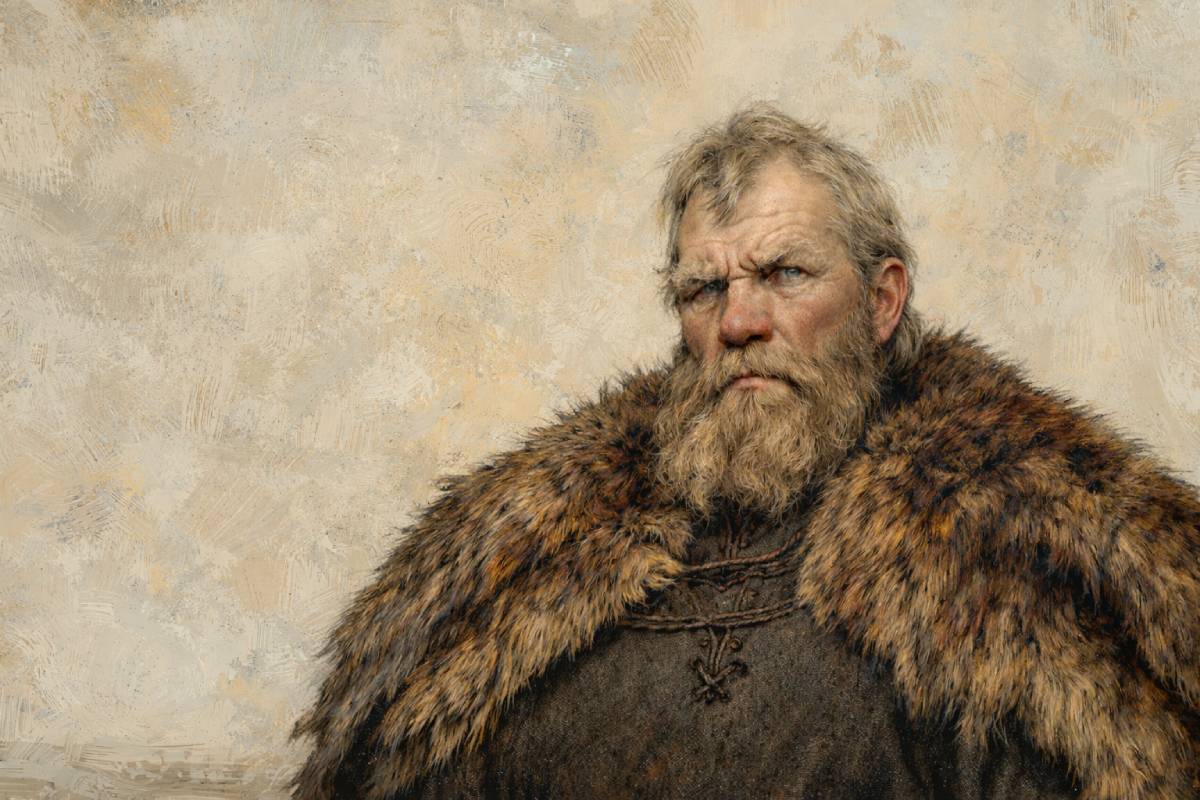
One such northern noble, Haakon Sigurdsson (known in Old Norse as Hákon jarl, which we will use from now on), was so powerful that his reach and control extended far beyond the frozen north and into much of the south and west of Norway.
Since Bluetooth had failed in a military campaign against Holy Roman Emperor Otto II back in 974, Hákon jarl had ruled as the de facto ruler of Norway.
Exploiting the weakened position of Danish military might, Hákon jarl was left to his own devices to rule the nation.
Though he was still technically a vassal of Bluetooth, the preceding decade or so saw a frosty stalemate of cold war proportions, each eyeing the other warily, waiting to pounce – Hákon jarl secure behind the Scandinavian Alps and Bluetooth no doubt glaring northward across the Skagerrak.

Harald Bluetooth saw Christianity as a unifying force and expected his vassals to embrace it. Source: The National Museum of Denmark
Not listening to the good news and unfinished business
To add insult to misfortune, there was the issue of religion.
Not only had Hákon jarl exploited Bluetooth's military defeat and asserted his independent nature, but he had also refused to convert himself or any of his subjects to Christianity.
Given Bluetooth's role as one of the most prolific spreaders of the Christian faith in medieval Denmark, he took great pride in his achievements – just look at the Jelling Stones (a bit of a humble brag, in this author's opinion).
He felt that Hákon jarl's newfound autonomy, as well as his refusal to listen to the "good news" of Christianity, was downright insubordination and treasonous.
So, then, we have two headstrong rulers – one a monarch and the other in all but name. We have a series of what Bluetooth, and later his son Forkbeard, saw as slights and probable acts of treason.
Whilst we do not exactly know who was ruling Denmark in 986 – the year Bluetooth died after being booted off the throne by his own son (the horror!) – we can assume that either father or son had unfinished business lying in the north.
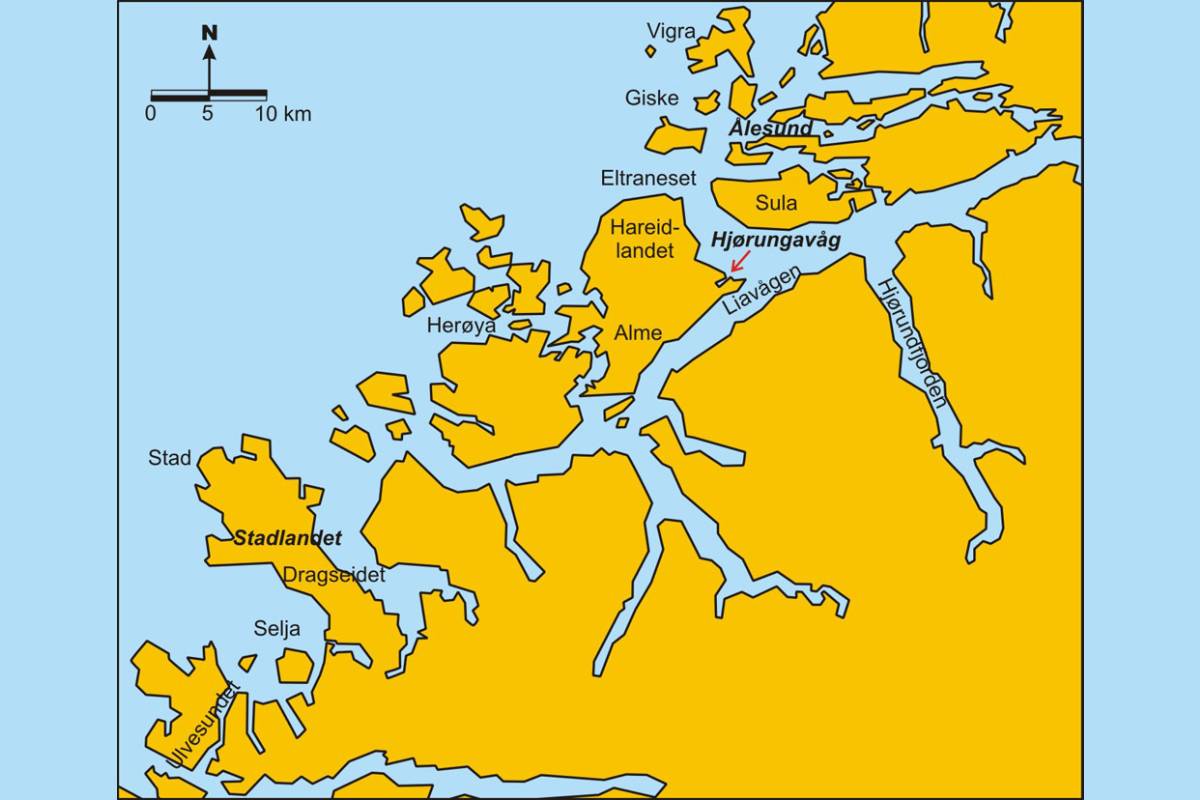
Hjørungavåg’s exact location remains uncertain, but this map marks one possible site of the battle. Source: Fin
Enter the Jomsvikings
As is often the case with early medieval battles in the Viking world, we can find only traces of it in the Norse sagas.
These were written down and compiled by chroniclers like Snorri Sturluson centuries after the events took place, so they should not be treated as historical records.
However, modern historians agree that there is probably more than a shred of historical accuracy in them – just enough to illuminate us moderns.
It appears that the Danish monarchy now turned for help to trounce Hákon jarl once and for all. Help came in the form of hired thugs and Viking mercenaries.
These were the fabled Jomsvikings who, like their roughly contemporary Japanese counterparts, the samurai, had a strict warrior code – a Viking bushido, if you will.
Only the strongest and most fearless were accepted as Jomsvikings, including one of the most famous medieval kings and warriors of Norway.
They were said to have operated their military missions from a fortress – Jomsborg – which many archeologists believe was located on the Baltic island of Wolin in modern-day Poland.
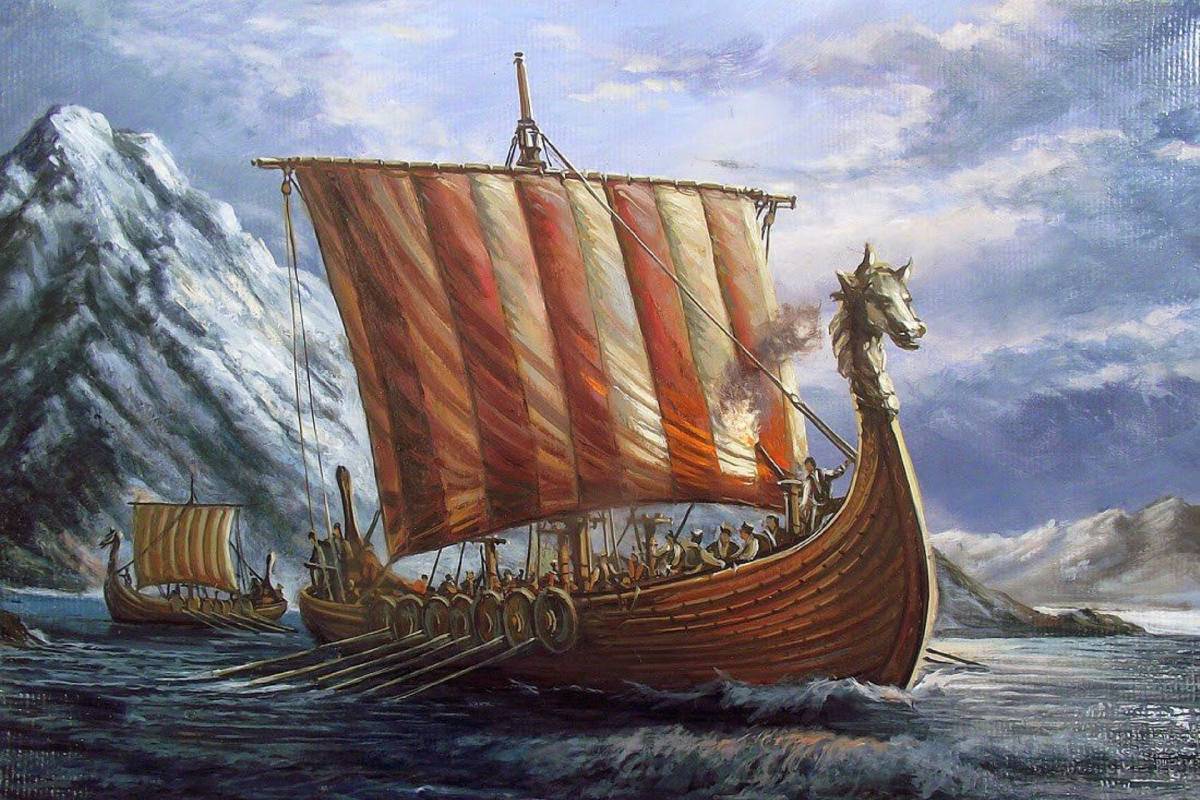
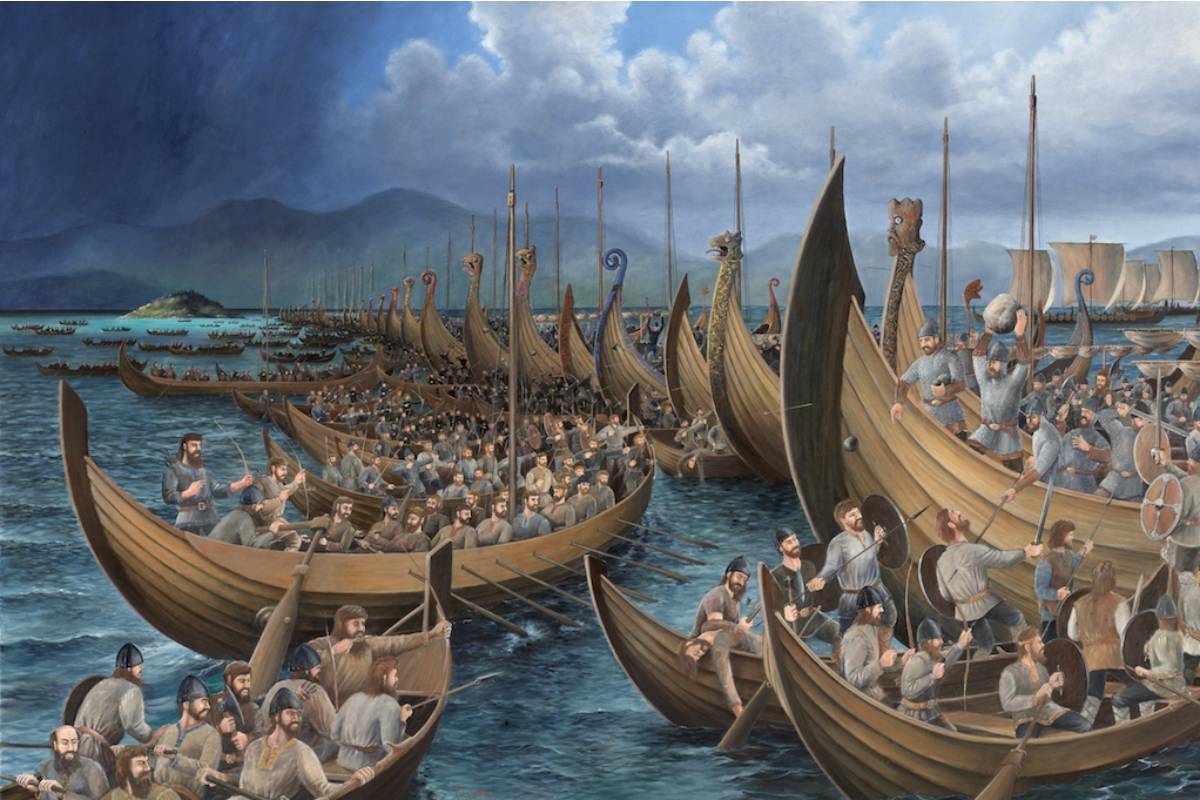
A huge flotilla – said to be more than 180 ships – sailed north to try to exert Danish influence and crush Hákon jarl and his northern rebels once and for all.
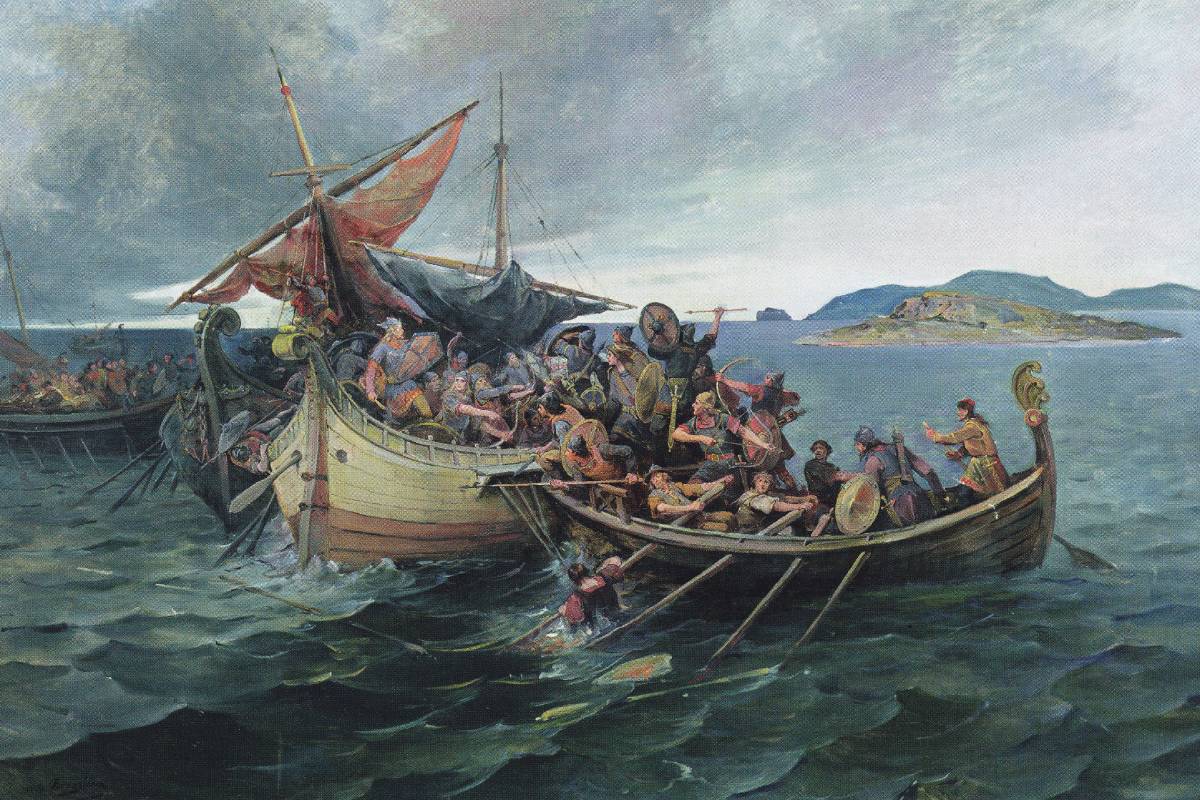
Yet a much smaller Norwegian force, perhaps outnumbered 3 to 1, met the joint Dano-Jomsviking force somewhere off the coast of Sunnmøre, home to some of Norway's most beautiful fjords.
Turning, as we always do here at The Viking Herald, to the sagas, we find one that was translated into contemporary Danish by Laurents Hansson in c. 1550 from the original Old Norse.
We use the 2024 translation by Johan Ottesen to flesh out the famous events leading up to and including the battle. We will quote this at length throughout the remaining story.
One can safely assume that the Jomsvikings were more interested in brawling and battling than in a spot of sightseeing, as even The Saga of the Jomsvikings (written about these fabled warriors) states:
"...came from the south along the coast. They did not proceed peacefully. They robbed, burned, and destroyed houses on their way. Everyone who could escape tried to get away. Now they had come north..." (Page 13)
These mercenaries were said to be led by the legendary Jarl Sigvaldi, a famed warrior feared throughout the Viking world.
The battle begins
Sometime in 986 (or thereabouts), a naval battle took place that has been passed down to us as being at Hjørungavåg.
It should be noted that this name is no longer in use for any place in the region, so we do not know the exact location where the battle occurred – frustrating archeologists, historians, and The Viking Herald writers to no end.
The two naval forces assembled near the mouth of a river or perhaps in a fjord and went about their deadly business. The Saga of the Jomsvikings relates how:
"...the fierce battle began with attacks from both sides. They shot with bows, used string spears and kesjers [large and strong iron, twisted bear spears]. They continued like this for a long time and fought sharply against each other. Likewise, the leidang people used swords and battle axes, halberds and broad axes. For a long time the ships stayed together, and mostly Sigvaldi against Jarl Hákon and his son Sveinn. Neither of them would withdraw their ship for the others. Many people fell on both sides. But most on Hákon's side as the Jómsvikings cut harder and shot harder so it went through the shield of Hákon's men..." (Page 15)
Following this opening salvo, it appears that Hákon jarl and his men had come off their ships and onto the mainland.
The battle is not going well for the Norwegian forces, and Hákon jarl needs some sort of divine inspiration.
Lucky for him, he has safety in numbers, as he is a pagan – a believer in the vast pantheons of the Norse gods.
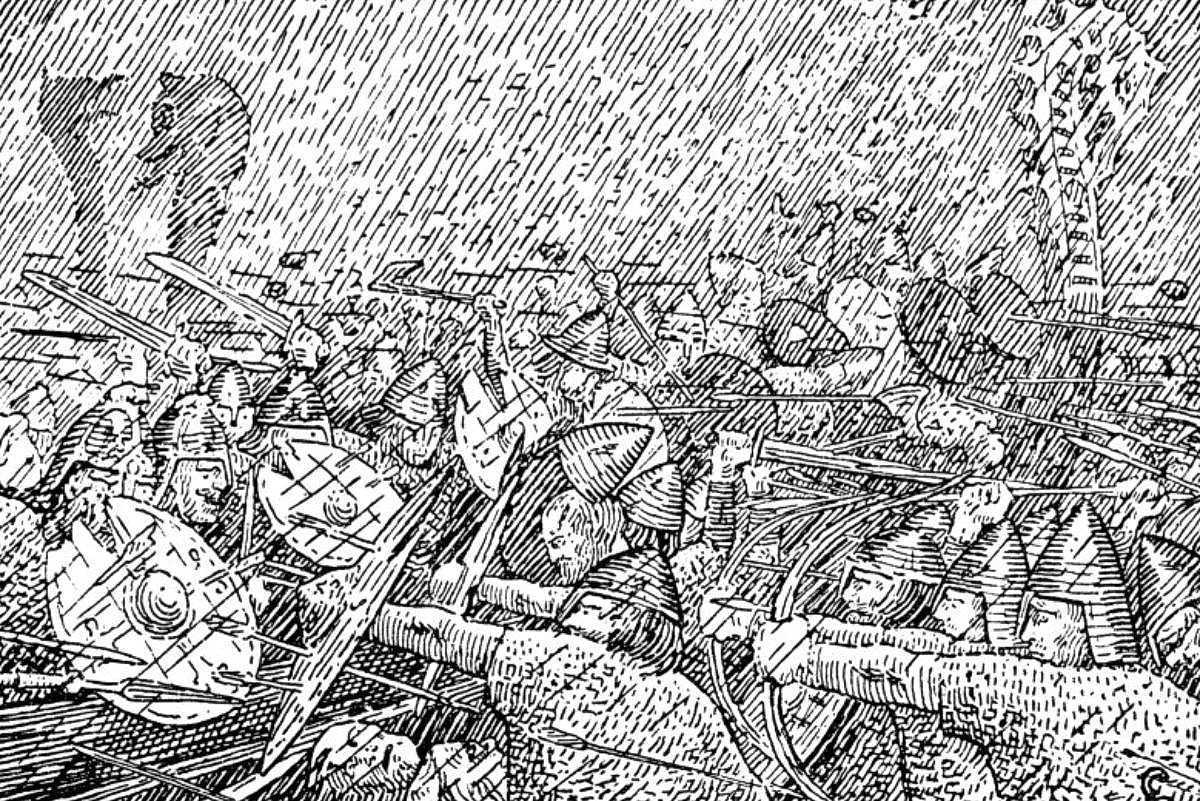
This illustration from the 1899 edition of Heimskringla shows the Jomsvikings fighting in a hailstorm at the Battle of Hjørungavåg. Source: Halfdan Egedius (1877–1899)
A gruesome sacrifice
Given the religious and spiritual differences between the two masterminds of this battle, it should be no surprise that later sagas, including The Saga of the Jomsvikings, make much of the "pagan" nature of Hákon jarl.
Given that this saga was probably compiled in the later medieval period when all of Scandinavia was Christian, it has a vested interest in portraying the old ways – the Old Norse religion – in the worst possible light.
Picking up the action again when Earl Hákon has gone ashore, we see a vivid description of the power of the Old Gods. Turning to the saga again, upon the mainland with his ships in view:
"...Hákon turns to the north and begins to urge and pray to his idols, Þorgerðr [Thor] and Irpa. But they are deaf and will not answer his prayers. He has a feeling that they are angry with him. He asks them to demand something that he can sacrifice. They don't answer..." (Page 15)
He is then forced to sacrifice his young son, a 7-year-old, to the Norse God of Thunder, Thor, and the mysterious deity Irpa, of whom we have only a few mentions. The gruesome human sacrifice seems to have worked because suddenly:
"...the blackest storm cloud moved up in the north. It comes right over the Jómsvikings. From the cloud came the coldest weather and the biggest hail anyone had ever experienced. It thundered and thundered so that the Jómsvikings, who had to defend themselves against this terrible storm, could hardly stay on their feet..." (Page 16)
As Kim Hjardar and Vegard Vike write in their 2016 book Vikings at War (available on Amazone here), "...if you wanted to avoid disaster you had to sacrifice and come to terms with the Gods." Even if this meant sacrificing your son to win a military victory.
Whether this is what truly happened is open for debate and discussion. Could it have been a later Christian invention, much like the story of Abraham and Isaac, but with an obvious negative twist due to the "pagan" and "wrong" nature of the deity being worshipped?
The outcome of this blood payment remains one of the first recorded instances of bad weather ruining a Viking invasion plan.
The inclement weather seems to have either destroyed the flotilla or at least sunk enough ships to stop the invading force from landing on Norwegian soil.
It seems that the Old Gods got their revenge on a force controlled by a king whose mission was to smash the old ways and force Christianity upon his soon-to-be-conquered subjects.
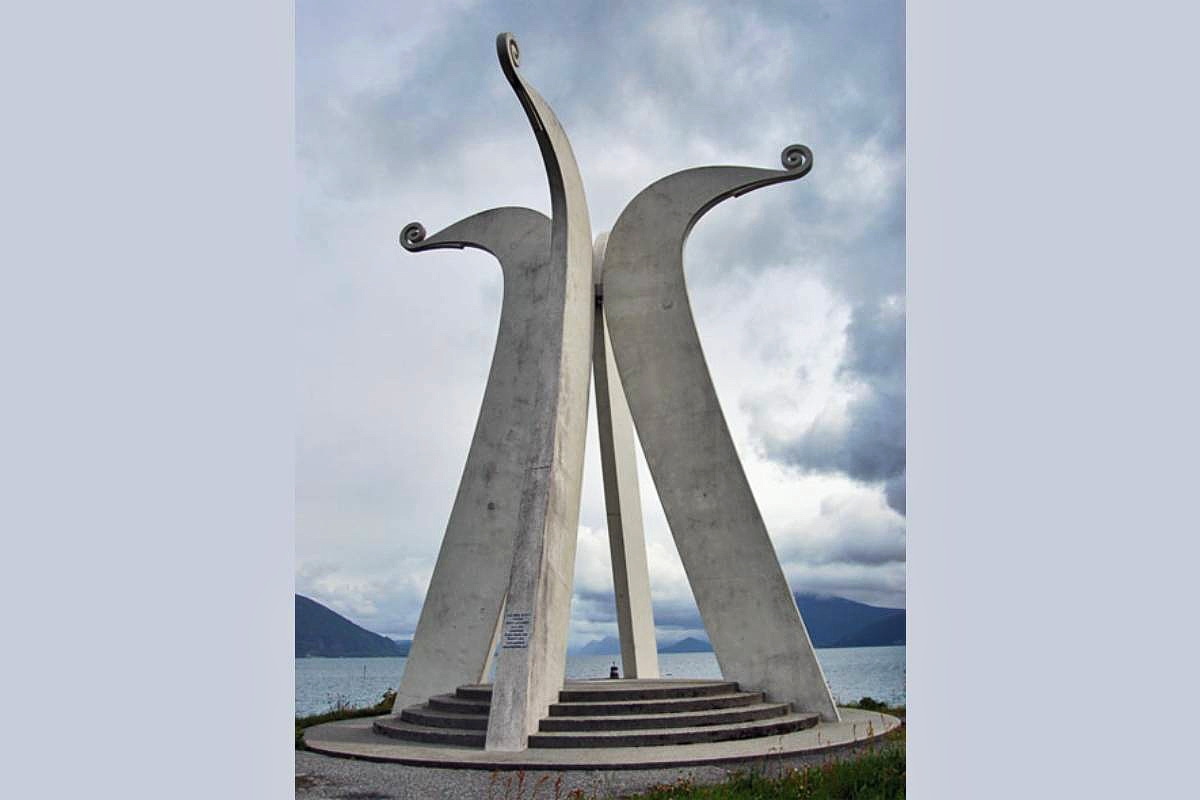
Erected in Norway in 1986, this monument stands in memory of the Battle of Hjørungavåg. Source: Islandmen (CC BY-SA 3.0)
The aftermath
Despite the initial loss at Hjørungavåg, it was but a mere setback for Danish control of Norway and the Jomsvikings.
Eventually, Danish King Sweyn Forkbeard would gain control of Norway from about c. 1000, following the Battle of Svolder – thus completing his father's mission.
He would also add the English throne to his collection and, in 1013, create the North Sea Empire.
For the Jomsvikings, despite their loss in this battle, rumors and legends grew about their ferocity, gallantry in defeat, and refined warrior ethos.
They would go on to plague many coastal communities, including the Norwegian kingdom, until their fortress was set ablaze in 1043 by Norwegian King Magnus I.
Their legend, however, lives on in the Norse sagas, and they have been compared to other elite medieval military units with a warrior ethos, such as the Order of the Ismailis (who we know in English as the "Assassins") in Persia and the Levant, or the Shinobi (Ninjas) in Sengoku-period Japan.
Whilst an important battle, full of literary color and dramatic events, Hjørungavåg was ultimately only delaying the inevitable.
The Danish crown would seize control of Norway within a generation and would continue to influence events in Norway until, arguably, the fallout from the Napoleonic Wars.
For more information on this battle, visit the Archaeology Europe website here.
We get to provide readers with original coverage thanks to our loyal supporters. Do you enjoy our work? You can become a PATRON here or via our Patreon page. You'll get access to exclusive content and early access.
Feel free to reach out to discuss potential stories that may be in the public interest. You can reach us via email at hello@thevikingherald.com with the understanding that the information you provide might be used in our reporting and stories.