

The Netflix series Vikings: Valhalla charts the ascent of three heroes: Harald Sigurdsson, Leif Eriksson, and Freydís Eiríksdóttir.
Freydís becomes known as the "Keeper of the Faith" for her devotion to the ancient gods of Norse mythology, despite the ever-increasing popularity of Christianity in the Norse world.
At the end of season two, it appears Freydís has found her true calling as the new leader of the semi-mythical fortress of Jomsborg.
Yet in season three, which has just been released on Netflix, it appears Freydís' dreams of Jomsborg providing a safe and secure home for all those who believe in the old ways come to an end.
Although Freydís is able to defeat the dangerous Magnus, son of King Olaf, the toll is heavy, and the survivors of the attack depart for a new destination.
But what happened to the real Jomsborg, if it even existed in the first place?
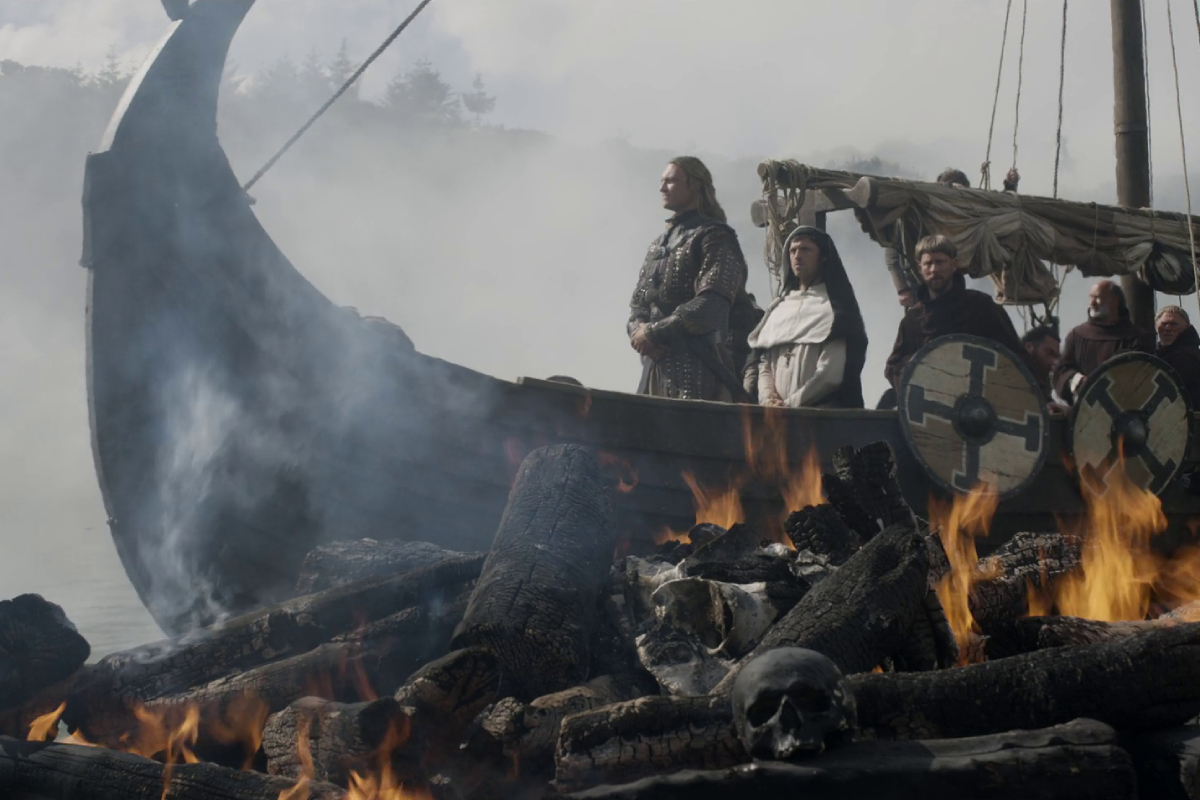
The third season of "Vikings: Valhalla" shows Freydís' hopes for Jomsborg as a haven for believers in the old ways coming to an end. Photo: Netflix, screenshot (Copyright, fair use)
An imposing fortress
"And there he quickly has built in his domain a fortress by the sea, exceedingly large and strongly built, which was called Jómsborg after that. There he also has built a harbor inside the fortress that three hundred longships could be berthed in at the same time, so that they were all shut within the fortress… Some parts of the fortress stood out over the sea, and structures built like that are called sea-castles, and on account of this the harbor was within the fortress."
(The Saga of the Jómsvikings, translated by Alison Finlay and Þórdís Edda Jóhannesdóttir)
Jomsborg is mentioned in several of the Icelandic sagas, including The Saga of the Jómsvikings, which paints a vivid picture of an imposing city by the sea with a harbor capable of containing 300 ships.
It is located in Jóm, a part of the Baltic kingdom of Vindland. The land is offered to Pálnatóki, a legendary Danish hero and the supposed founder of the Jomsvikings.
The Knytlinga Saga and the Fagrskinna, on the other hand, suggest that Jomsborg was built by the Danish king Harald Bluetooth.
The Viking warriors from this special city, the Jomsvikings, were said to be devoted and committed soldiers.
The records also suggest that Jomsborg may have been a significant trading hub, that from its position next to the Baltic Sea between Scandinavia and the Baltic countries, was able to direct and control the movement of goods through important trade routes.
Even so, there is continued debate about whether the city described in the Icelandic sagas – which so often and so freely mixed history with myth – was real or imagined.
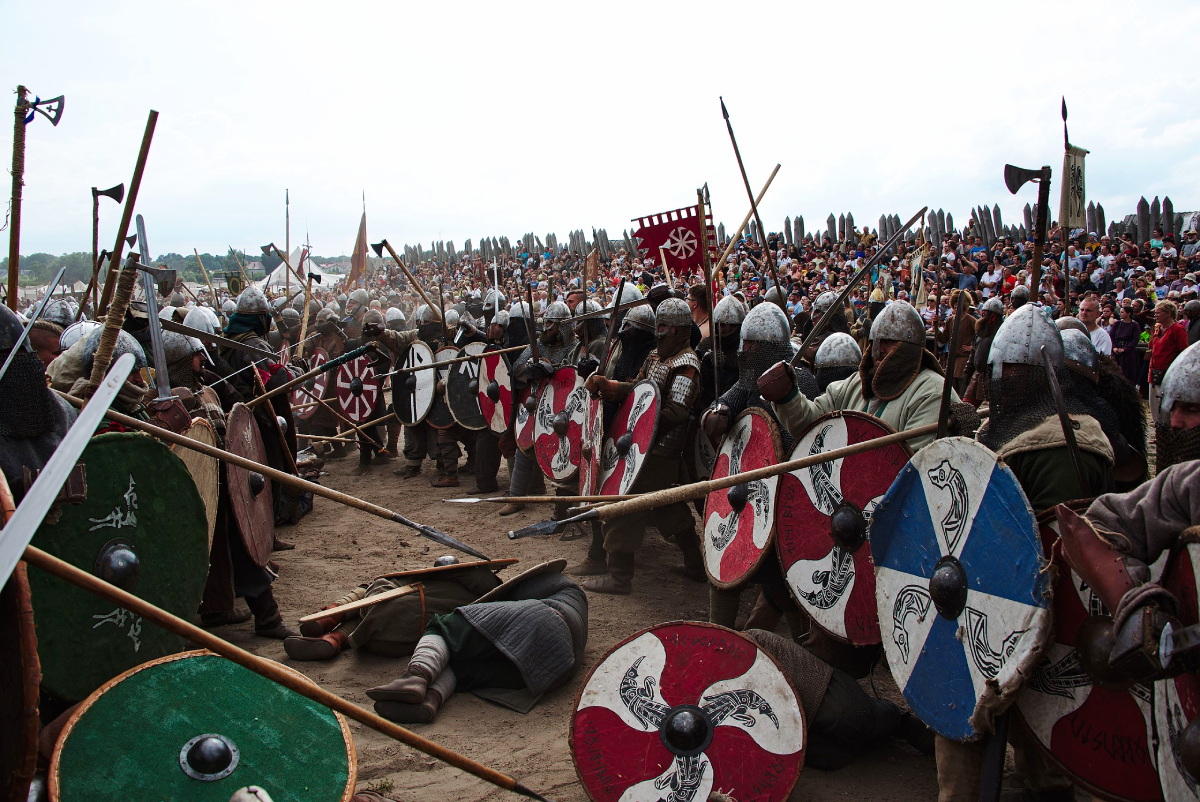
Wolin Island, which may be the historical Jomsborg, hosts the Festival of Slavs and Vikings, renowned for its large battle reenactments. Photo: Jakub T. Jankiewicz (CC BY-SA 4.0)
The Wolin records
If Jomsborg is indeed a real place, then the main suspect for its location is the present-day town of Wolin, located on an island of the same name in northwest Poland.
In addition to meeting the description provided in the sagas, it is also known there was an emporium on Wolin in the early Middle Ages.
Several Viking objects have been found in the area, and the presence of a trading city at Wolin with a possible Old Norse name was even recorded by the German medieval chronicler Adam of Bremen, who refers to it as "Jumne."
"At its mouth, where it feeds the Scythian marshes, Jumne, a most noble city, affords a very widely known trading center for the barbarians and Greeks who live round about… It is truly the largest of all the cities in Europe, and there live in it Slavs and many other peoples, Greeks and barbarians. For even alien Saxons also have the right to reside there on equal terms with others, provided only that while they sojourn there they do not openly profess Christianity. In fact, all its inhabitants still blunder about in pagan rites. Otherwise, so far as morals and hospitality are concerned, a more honorable or kindlier folk cannot be found."
(Gesta Hammaburgensis ecclesiae pontificum, Adam of Bremen)
Yet there remain significant doubts about whether the emporium of Wolin and the fortress of Jomsborg could be one and the same.
There is no mention in the historical records, for example, of Viking warriors in Jumne, and no significant archeological evidence of Viking weapons has yet been found on the island.
Last year, the archeologist Wojciech Filipowiak and his team did uncover the possible remains of a wooden fortress on the island, providing tantalizing – but still unconfirmed – evidence of a possible major military presence.
At this point, however, despite the presence of the Slavs and Vikings' Center on the island and a highly popular accompanying festival, a full consensus has not yet been reached.
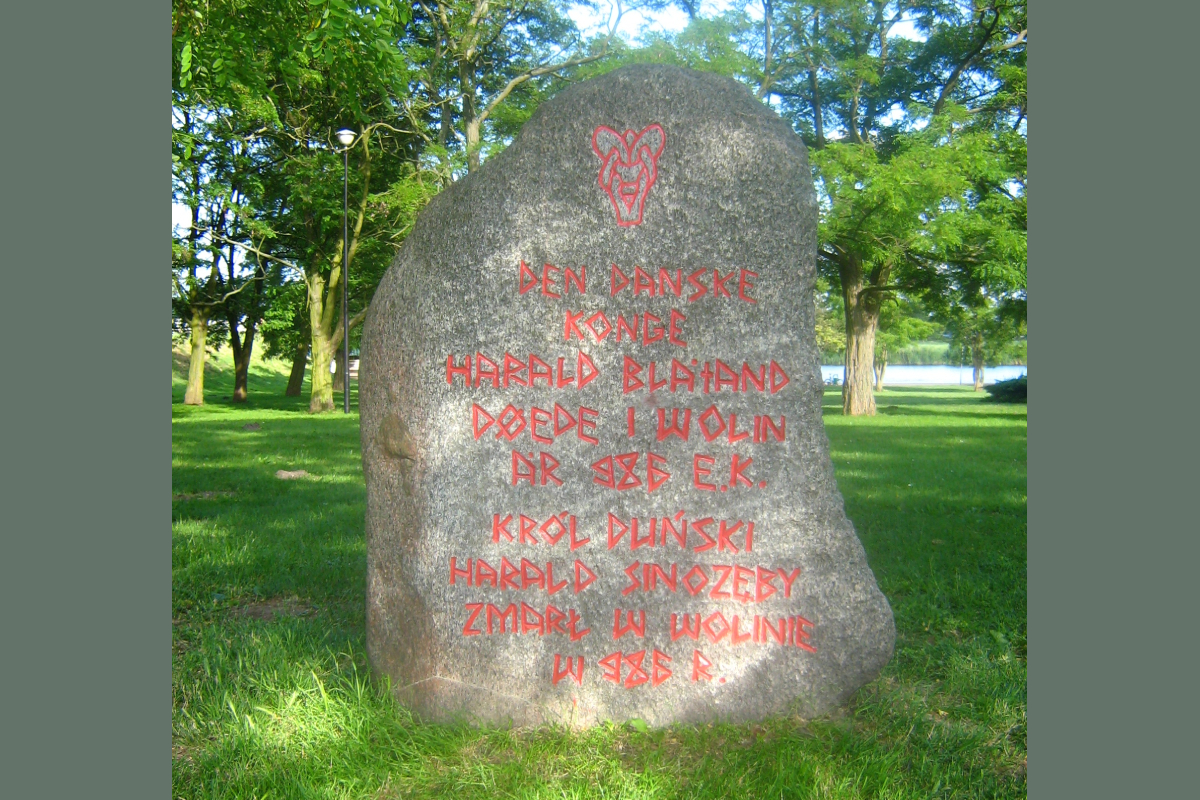
In Wolin, a modern memorial thought to mark the medieval Jomsborg site features inscriptions commemorating Harald Bluetooth's 986 death. Photo: Radosław Drożdżewski (CC BY-SA 3.0)
Shrouded in history
"Now when King Magnus came to Vindland, he attacked Jomsborg and soon took the fortress, killing many people, burning and destroying both in the town and in the country all around, and making the greatest havoc:
'The robbers, hemmed 'twixt death and fire,
Knew not how to escape thy ire;
O'er Jomsborg castle's highest towers
Thy wrath the whirlwind-fire pours.
The heathen on his false gods calls,
And trembles even in their halls;
And by the light from its own flame
The king this viking-hold o'ercame.'"
(Heimskringla, or The Chronicle of the Kings of Norway, by Snorri Sturlason)
As for the demise of Jomsborg, there are once again competing theories.
The Heimskringla indicates that Magnus the Good, King of Norway, destroyed it in 1043, though some people did escape – echoing, in many ways, the tale told in Vikings: Valhalla.
Other sagas tell how the Jomsvikings became involved in several wars within Scandinavia, including at the famous Battle of the Fyrisvellir near Uppsala, Sweden.
There is every possibility that many of the Jomsvikings may have eventually perished in the fighting.
It is also possible that if Jomsborg really did exist, it merely experienced a slow decline into obscurity.
It has been shown time and again that the Vikings were actually highly adept at assimilation and integration. Perhaps this alleged Viking enclave simply merged into the local population and disappeared, almost without a trace.
It should also be acknowledged, however, that there remains a chance that further archeological evidence may yet confirm the legend.
We get to provide readers with original coverage thanks to our loyal supporters. Do you enjoy our work? You can become a PATRON here or via our Patreon page. You'll get access to exclusive content and early access.
Feel free to reach out to discuss potential stories that may be in the public interest. You can reach us via email at hello@thevikingherald.com with the understanding that the information you provide might be used in our reporting and stories.