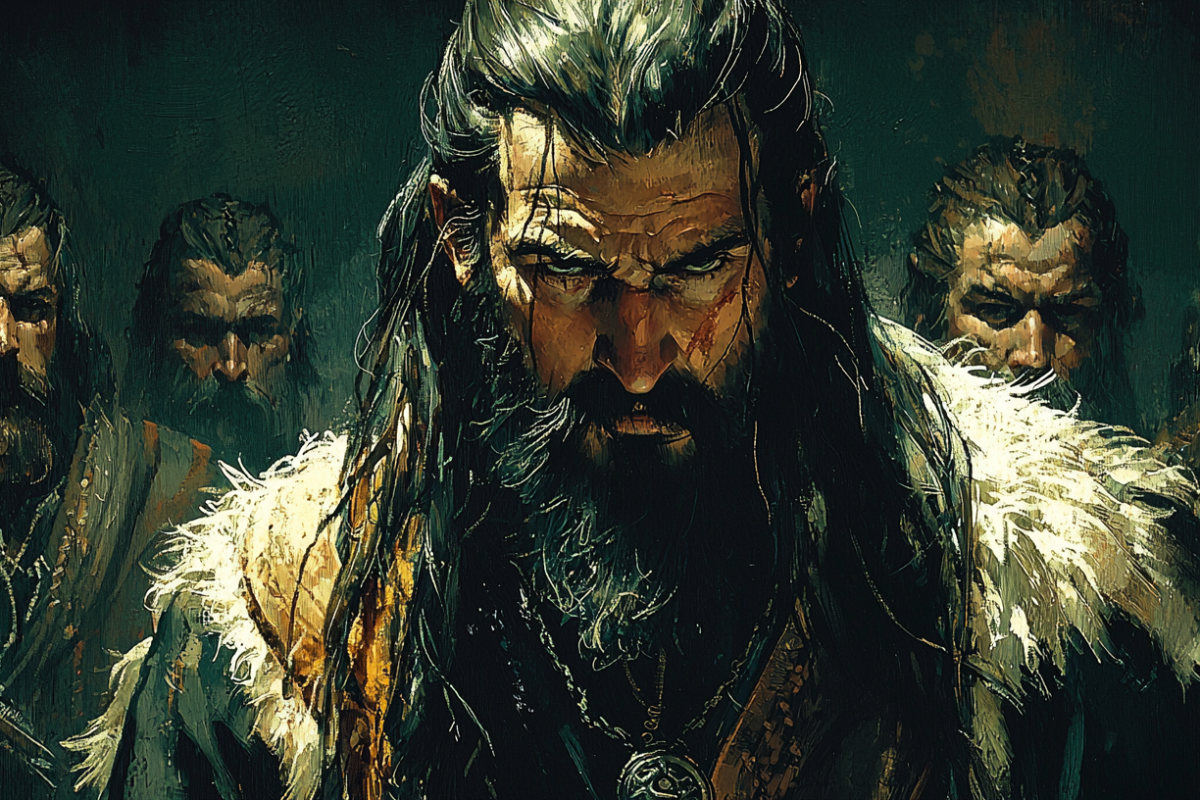


In recent weeks, Viking Herald writer Brian Talgo has been exploring the historic lands of Ringerike in southern Norway. Today, Ringerike is a bucolic and sedate region, found approximately 85 kilometers north of Oslo.
In the Viking Age, on the other hand, the area was a key trading location, home to a notable array of famous monarchs and chieftains. So who are the most significant Viking rulers to hail from this part of Norway?
Betwixt history and legend
Before we delve into the stories of the kings themselves, it is worth noting one major point: Much of what we know about the Norse kings from the Viking Age comes from the Íslendingabók (Book of the Icelanders), written by Ari Thorgilsson (ON Ari Þorgilsson, c. 1067 – 1148) and/or the Heimskringla, the 13th-century compilation of Norwegian kings' sagas (and myths) written by Icelander Snorri Sturluson (1179–1241).
In both of these works, myth, saga, and oral history are intertwined, making it difficult to differentiate between fact and fiction. So while we present and read these tales of monarchs, we should bear in mind that the truths of their deeds are shrouded in doubt.
It’s also worth acknowledging that many of the so-called Norse kings are often referred to by historians as ‘petty kings’, i.e. rulers who presided over smaller areas, petty kingdoms, as opposed to an entire country or nation.
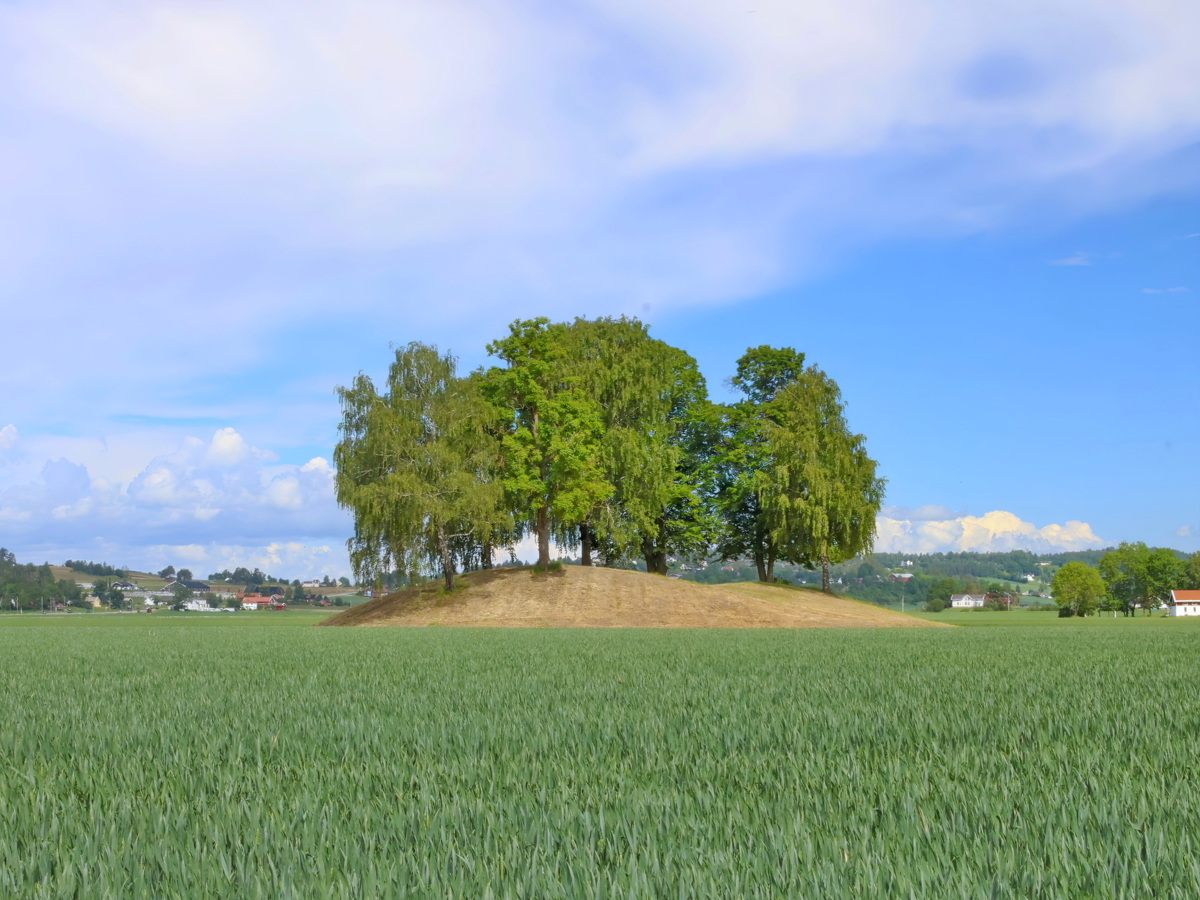
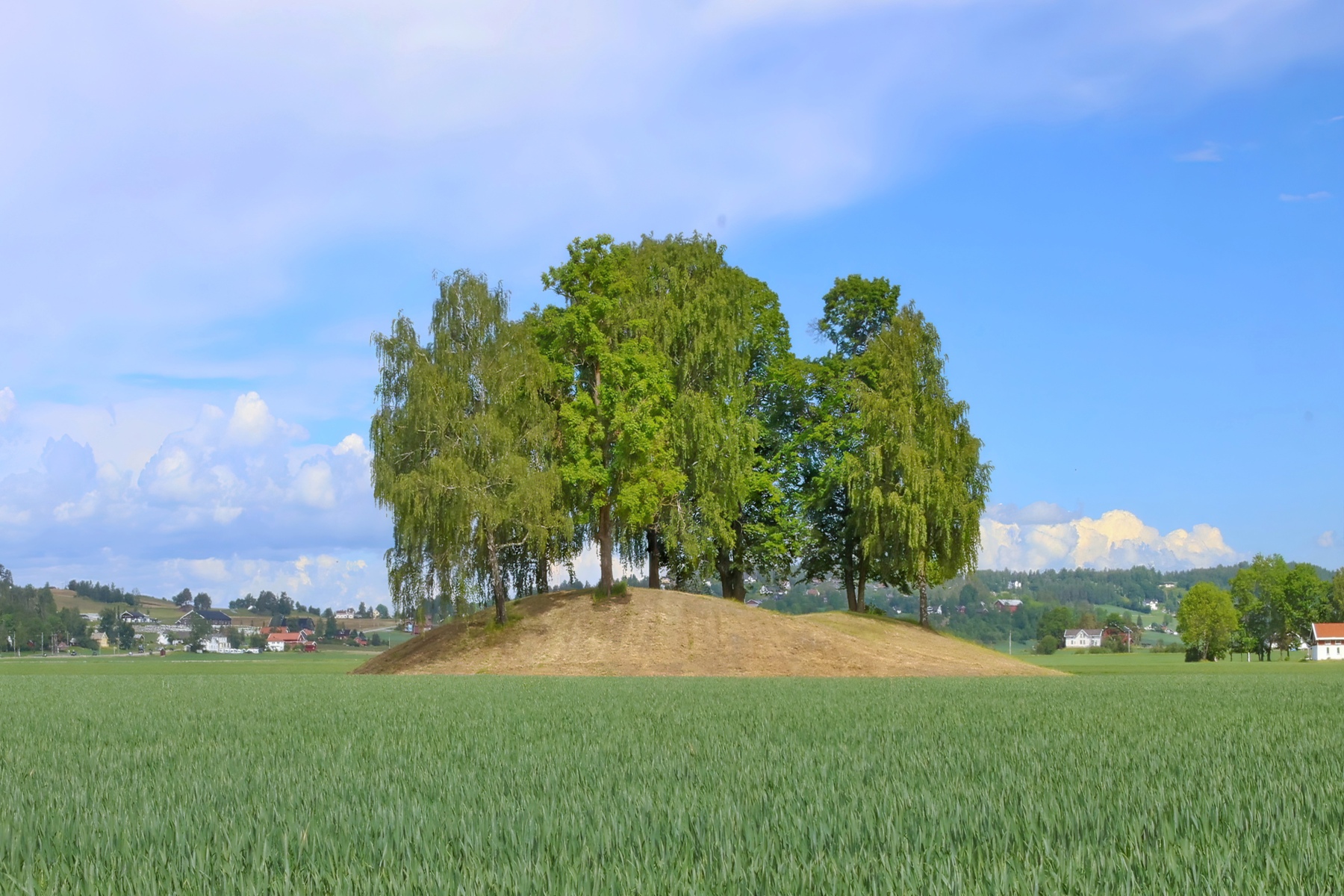
Halvdanshaugen, or "Halfdan's Mound", one of the rumoured resting places of Halfdan the Black. Source: Brian M. Talgo
Halfdan the Black (Old Norse (ON) Halfdanr Svarti, c. 810 – 860)
Halfdan the Black, born in Ringerike around 810, is widely known for being the father of Harald Fairhair (ON: Haraldr Hárfagri, c. 850 – c. 932), who was the first king of a somewhat unified Norway, reigning from c. 872 to 930.
Although his patronymic name was Halfdan Gudrodson (ON Hálfdan Guðröðarson), he was called ‘Halfdan the Black’ due to his black hair. Contrary to popular belief, not all of the Norse population was fair-haired, and dark hair was in fact not uncommon in Scandinavia at that time.
Halfdan the Black was said to have become king of Agder (ON Agðir), which consisted of a large part of southeastern Norway during the Viking Age, when he was only eighteen or nineteen years old. He soon expanded his kingdom, first becoming king of Vestfold and then taking over the surrounding territories of Romerike (ON Raumaríki) and parts of Hedmark (ON Heiðmǫrk).
His wife, Ragnhild, was the daughter of King Harald Goldbeard (ON Haraldr Gullskeg) of Sogn (ON Sygnafylki), a region located on south-western coast of Norway. After series of deaths, including King Harald, Ragnhild, and Halfdan and Ragnhild’s son, Harald-the-first, Sogn was left without a king.
Seeing his chance, Halfdan travelled to Sogn and laid claim to the title of king. His claim went unopposed, thereby allowing him to add Sogn to his realm. When he died in an accident at the age of 50, Halfdan the Black was king of a large swathe of southeastern coastal Norway.
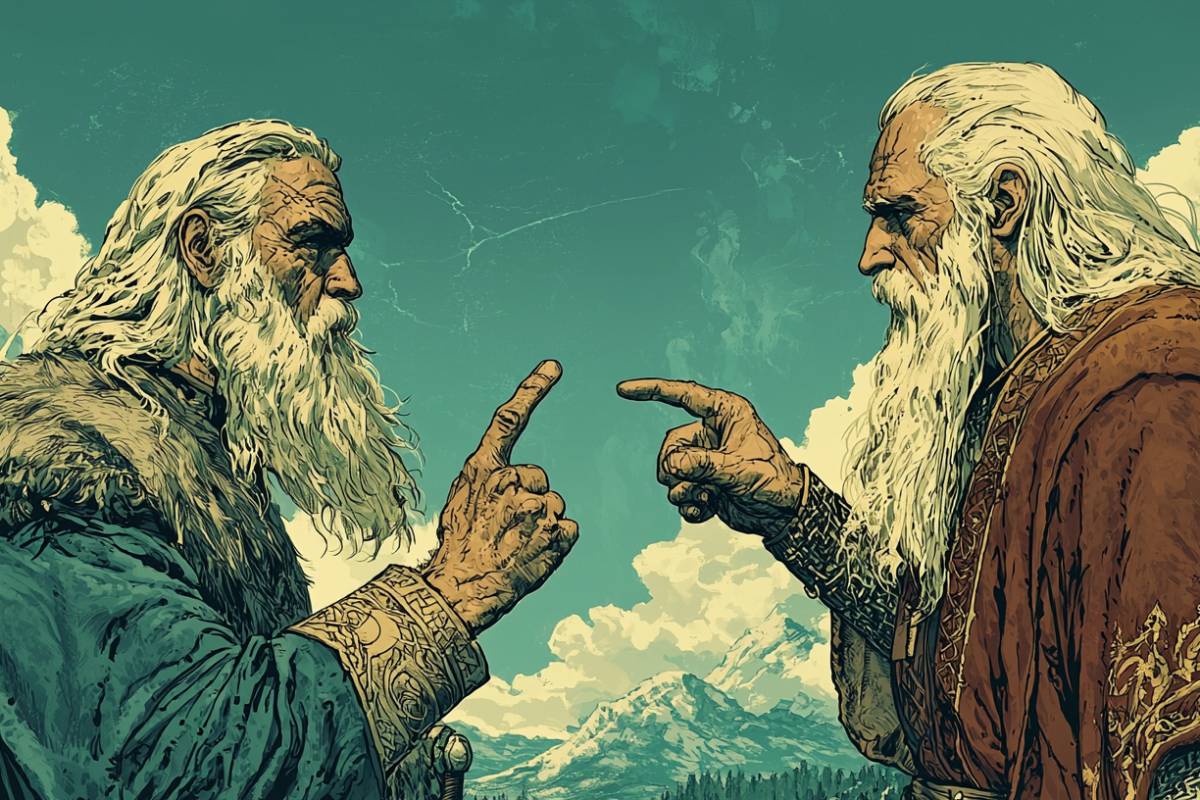
(You can also read about Halfdan's struggles with the petty king Gandalf Alfgeirsson and some links to J.R.R. Tolkien on our Patreon page, here.)
The death of Halfdan the Black
Halfdan the Black’s death and burial occurred in a rather peculiar manner, and was vividly chronicled in Snorri Sturluson’s Halfdan the Black Saga (ON (Hálfdanar saga svarta) as follows (Project Gutenberg translation by Scottish historian Samuel Laing.):
"Halfdan the Black was driving from a feast in Hadeland, and it so happened that his road lay over the lake called Rand. It was in spring, and there was a great thaw. They drove across the bight called Rykinsvik, where in winter there had been a pond broken in the ice for cattle to drink at, and where the dung had fallen upon the ice the thaw had eaten it into holes. Now as the king drove over it the ice broke, and King Halfdan and many with him perished. He was then forty years old.’"
He had been one of the most fortunate kings in respect of good seasons. The people thought so much of him, that when his death was known and his body was floated to Ringerike to bury it there, the people of most consequence from Raumarike, Vestr-Fold, and Hedemark came to meet it.
All desired to take the body with them to bury it in their own district, and they thought that those who got it would have good crops to expect. At last it was agreed to divide the body into four parts. The head was laid in a mound at Stein in Ringerike, and each of the others took his part home and laid it in a mound; and these have since been called Halfdan's Mounds.’
Sigurd Syr, aka Sigurd the Sow (ON Sigurðr Sýr, died c. 1018)
One of the petty kings of Hringaríki, Sigurd Syr is probably best known as the father of Harald Hardrada and stepfather of Olaf Haraldsson, aka Olaf the Holy, two of Norway’s most famous Viking kings (see below).
Sýr is related to Old Norse svīn, and means sow or swine, but if that is the actual source of his name, it’s probably not the insult that it seems, being more likely to do with the attention Sigurd paid to his farm and how he seemingly enjoyed the life of a farmer.
Unlike many of the warrior kings of his time, he was said to have been a reserved and prudent man, and known for being a peaceful leader. While considerably wealthy, he appeared to be neither particularly ambitious nor interested in politics. He was baptized in the Christian faith by king Olaf Tryggvason in 998.
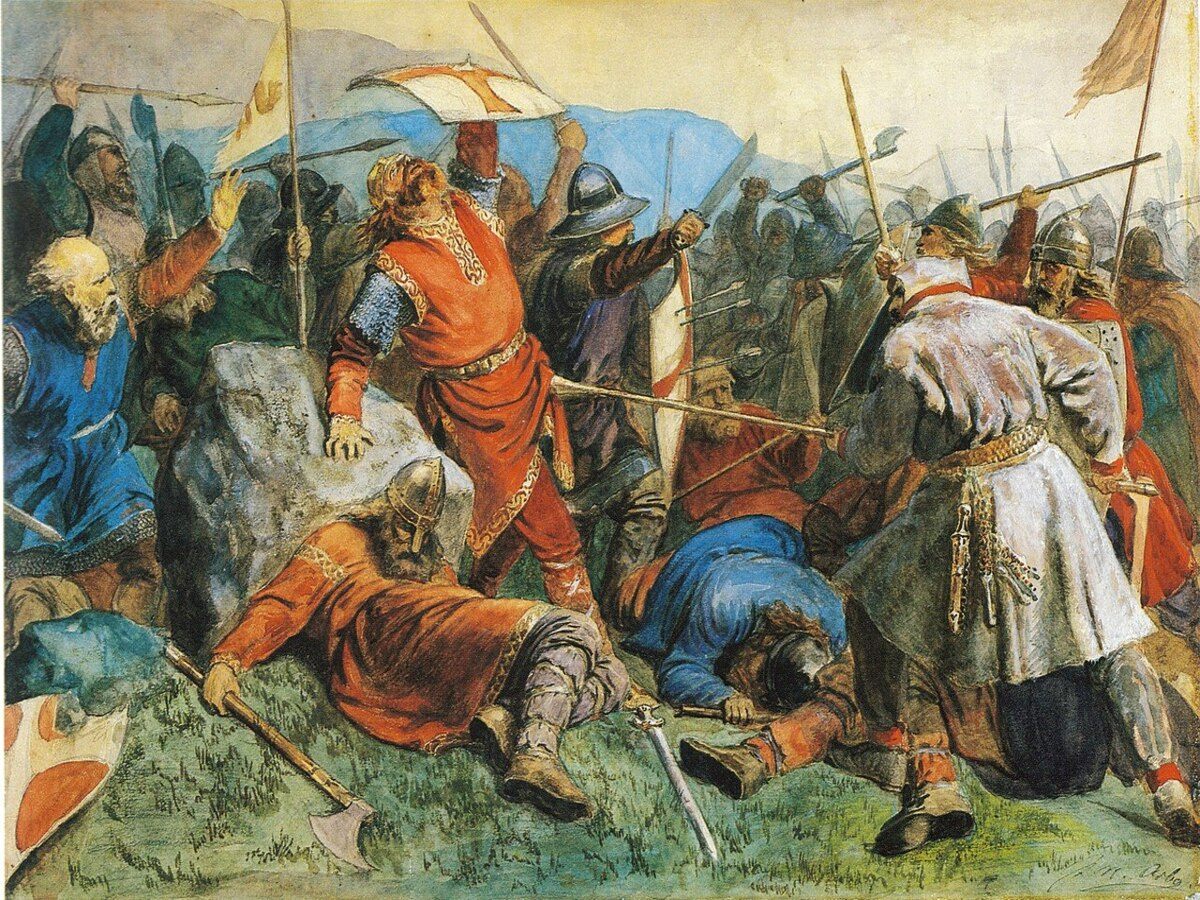
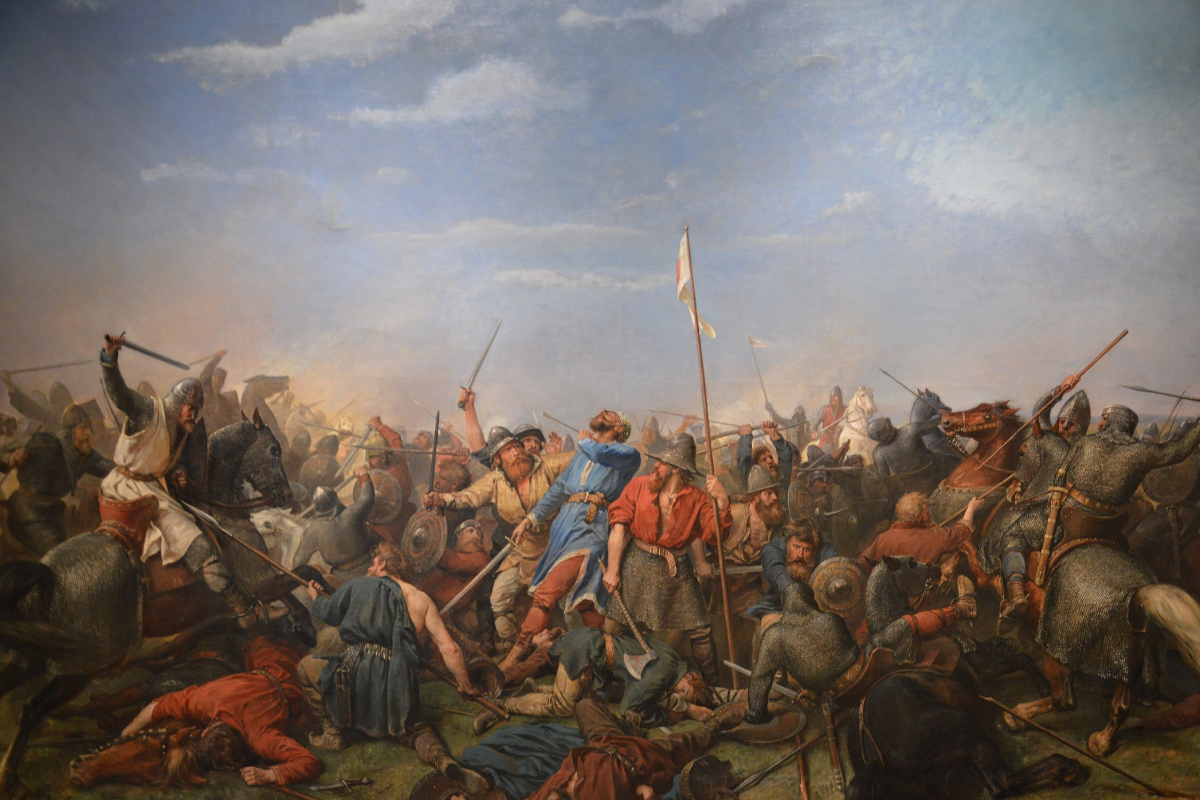
Saint Olav at the Battle of Stiklestad by 19th century artist Peter Nicolai Arbo. Source: Public domain
Olaf Haraldsson, King Olaf II, aka Olaf the Holy (ON Óláfr Haraldsson, c. 995 – 1030)
The story of Olaf Haraldsson, popularly known as Olaf the Holy, is somewhat literally larger than life. Although he did appear in truth to lead a remarkable life, much of what has been later attributed to him is probably more legend and myth than fact.
Reportedly born in Hringaríki in 995, Olaf Haraldsson is without a doubt the most historically significant of the Norwegian Viking kings. His father, petty king Harald Grenske (ON Haraldr grenski), was allegedly murdered in Sweden just before Olaf was born. This would eventually lead to Olaf’s mother, Åsta Gudbrandsdatter (ON Ásta Guðbrandsdóttir), marrying Sigurd Syr, and giving birth to yet another famous son in 1015, later known as Harald Hardrada (see below), making Hardrada Olaf’s half-brother.
As a youth, Olaf supposedly spent many years traveling abroad as a mercenary, visiting lands including Sweden, Denmark, Finland, the Baltics, France, England, and Spain, with some accounts claiming he sailed as far as the Mediterranean and perhaps beyond. Baptized in Normandy in 1013/1014, he eventually made his way back to Norway in 1015. Believing himself to be a great-grandchild of King Harald Fairhair, and therefore a claimant to the throne, he declared himself king at the mere age of 20, after gaining the support of the Upland regional kings.
In 1016 Olaf won the Battle of Nesjar, a brutal sea battle in which he defeated Sveinn Hákonarson (ON Sveinn Hákonarson), a Swedish earl who ruled over large parts of Norway at that time. This turned out to be a decisive battle, leading to Olaf becoming King Olaf II, the first king to rule over a united Norway.
In 1029, after a reign of nearly thirteen years, Norwegian nobles, dissatisfied with Olaf’s rule, supported an invasion by the Danish king, Cnut the Great (ON Knútr inn ríki). Olaf was forced into exile to Kievan Rus', the powerful Eastern Slavic state founded in the 9th century by Norse traders known as Varangians. He returned to Norway shortly thereafter and in an attempt to regain the throne, he was killed during the Battle of Stiklestad, one of the most famous battles in Norwegian Viking history.
Olaf’s legacy
After his death at Stiklestad, Olaf was supposedly buried on the banks of the Nidar River in Nidaros, today’s Trondheim. His body was then exhumed in 1031 and moved to a nearby church, where eventually a chapel honoring him was built over his grave. This chapel was the humble beginning of what would later become Nidarosdomen (Nidaros Cathedral), a massive medieval church which eventually became a destination for Christian pilgrims for close to a millennium.
To this day, Olaf the Holy is annually celebrated in Norway and elsewhere on Olsok (ON ólafsvaka – ‘Olaf’s wake’), July 29th, the anniversary of his death in the Battle of Stiklestad. There exist copious written accounts, sagas, and skaldic poetry (stylized Old Norse verse from 900 – 1400 CE) concerning Olaf’s seemingly extraordinary life.
Historians, however, now believe that much of what has been written about Olaf is what is generally referred to as ‘legend-building’, i.e. a glorification of someone’s life to fit a certain narrative. In Olaf’s case, this was the narrative of a saintly king who united Norway into a single, centralized state, while at the same time transitioning the country from Viking Paganism to Christianity. Moreover, he was also credited with establishing the Christian law code (ON Kristenretten) in 1024, a unique moral framework dealing with human rights, social reform, as well as making Christianity the one true religion of the realm.
Finally, as befits a legendary figure, he was credited with performing miracles and heroic deeds, from giving eyesight to the blind to victoriously battling trolls. Even in death, it was claimed that his body was miraculously uncorrupted, smelling of roses, and that his hair and nails continued to grow. This lead to his local canonization in 1031. He was later officially canonized as a saint of the Catholic Church in 1164 by Pope Alexander III. At this time he was also given the Latin title Rex Perpetuus Norvegiae, "The eternal king of Norway".
While there is probably a kernel of truth in many of these accounts and sagas, it’s now assumed that Olaf’s role in these achievements is much less than was believed in the past. It’s been said that to a certain extent he used Christianity as means to gain and consolidate power, often through brute force. Based on what is considered historical fact, it would appear that Olaf was in many ways not a particularly competent king, and that he hardly lived the life of a saint.
Nevertheless, Olaf’s life and reign as king have left an indelible mark on medieval history, particularly on the history and identity of Norway. He is considered to be both a national and international hero and saint, with his name appearing in many diverse places, from hospitals, churches, shrines, towns, plants, streets, ships, colleges, and pilgrimage trails, to the Order of St. Olav, Norway’s prestigious award conferred for ‘…distinguished services rendered to Norway and mankind’.
Harald Sigurdsson (ON Haraldr Sigurðarson, c. 1015 – 25 September 1066), aka Harald Hardrada (ON Haraldr harðráði)
Known historically for his Old Norse epithet harðráði (ruthless/severe), there seems to be some confusion as to if this is a correct rendering, with several early sources from contemporary Britain stating that he was actually called Harold Harfagera/Haralld Harfagyr, i.e. Harald Fairhair - not to be confused with the earlier King Harald Fairhair c. 850 – c. 932.
In any case, Harald Hardrada was said to be born in Hringaríki on the Stein farm in 1015 and lived quite a colorful life before becoming king. He accompanied his half-brother Olaf the Holy participated in the famous battle of Stiklestad, Olaf’s attempt to reclaim the Norwegian throne from the Danes.
With the battle lost, and Olaf dead, he was sent off in exile to Kievan Rus', the powerful Eastern state formed in the 9th century by Norsemen known as Varangians. He later travelled south to Constantinople, eventually becoming the commander of the Byzantine Varangian Guard, an elite, ruthless company of Scandinavian Vikings and Rus' warriors who served as loyal personal bodyguards to the Byzantine emperors.
In 1042, after participating in campaigns in the Mediterranean, Asia Minor, and elsewhere, Hardrada left The Byzantine Empire, after having at that amassed considerable wealth. He eventually became King of Norway in 1046 and, after claiming the Danish throne, spent the next 14 years unsuccessfully trying to conquer Denmark through constant coastal raids.
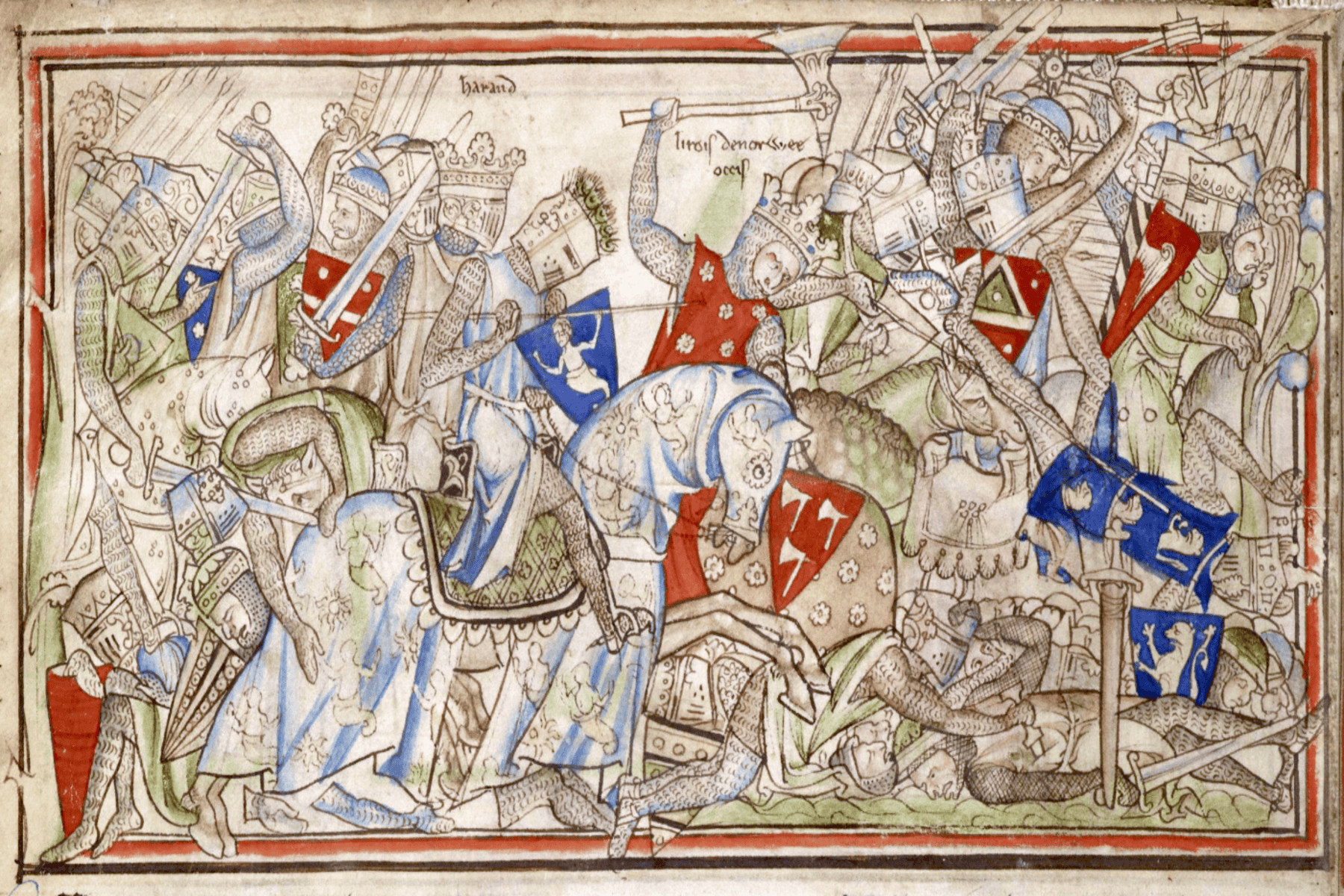
Finally, renouncing his claim, Hardrada set his sights on the English throne after a pledge of support by Tostig Godwinson, Earl of Northumbria, and brother of the English king, Harold Godwinson. Amassing an enormous force of roughly 10,000 troops and 300 longships, the Viking forces were initially successful, beating the local English forces from Northumbria and Mercia in the Battle of Fulford, near York.
On 25 September, after having travelled circa 185 miles in four days, King Godwinson and his army surprised the Norwegians at Stamford Bridge. The Norwegians were unprepared, and lacking heavy amour, were soundly defeated with Harald Hardrada dying in battle. It’s been said that of the original 300 Viking ships in the invading force, only 24 returned to Norway.
Although the Battle of Stamford Bridge is often referred to as the end of the Viking age, it’s considered more of a symbolic date, as Viking raids continued elsewhere for decades afterwards. That said, it was the last large-scale Viking invasion and put a stop to Scandinavian claims to the English throne.
Also worthy of mention:
King Hring Raumsson: Named in the Orkneyinga saga as the first king of Ringerike, Hring is said to have lent his name to the region.
Halfdan the Old: Another legendary figure, Halfdan the Old is said to have made a great sacrifice in order to live for 300 years. Instead, he was told his descendants would rule for the next three centuries.
Sigurd Hring: Another story shrouded in legend, Sigurd Hring is said to be the father of the legendary Viking hero Ragnar Lothbrok.
We get to provide readers with original coverage thanks to our loyal supporters. Do you enjoy our work? You can become a PATRON here or via our Patreon page. You'll get access to exclusive content and early access.
Feel free to reach out to discuss potential stories that may be in the public interest. You can reach us via email at hello@thevikingherald.com with the understanding that the information you provide might be used in our reporting and stories.