

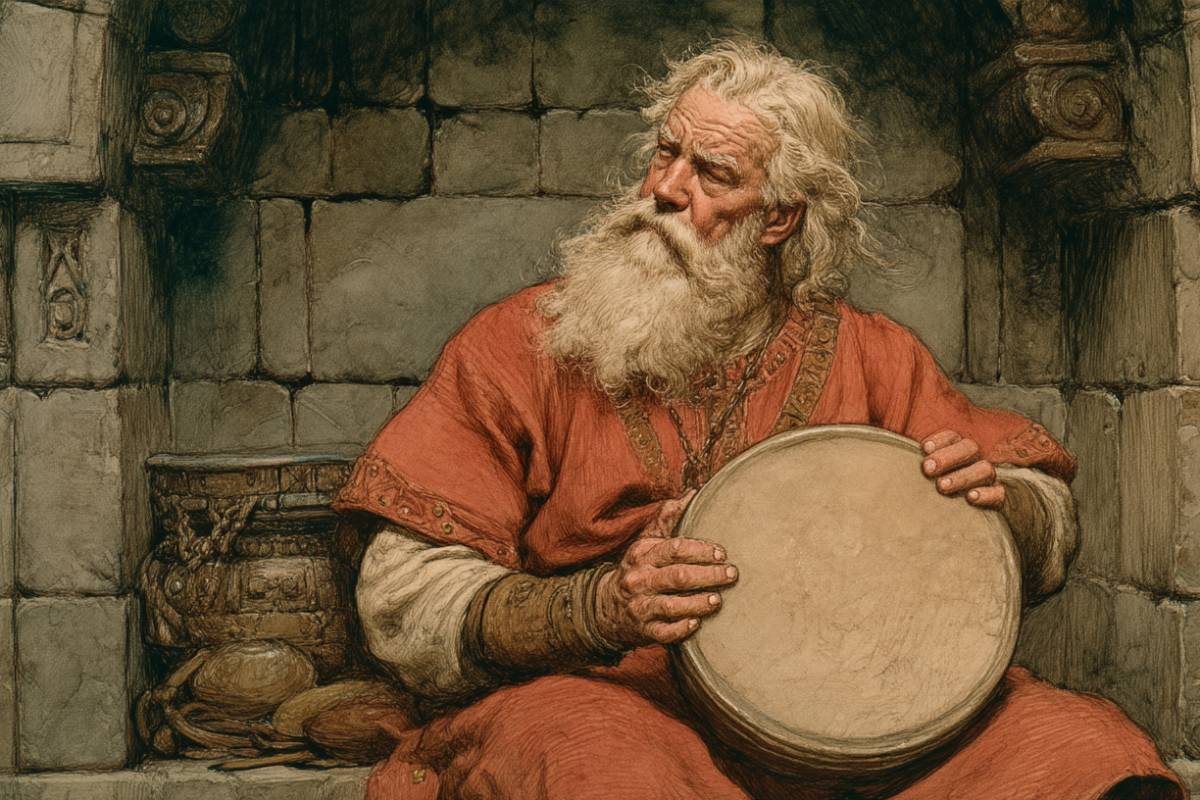
The early medieval period in Europe was once derided by historians as a "dark age."
Historians of the last few centuries have viewed this period, roughly spanning the fall of the Western Roman Empire and the emergence of the high medieval world (with dates varying by region and historian, and with the Crusades as one common marker), as a time when the continent took a step backward in its civilizational development.
It was during this period, after the supposed cultural heights of the Roman Empire, that much of Europe was said to get into decline, politically fragment, and take a backward civilizational step.
That was the traditional historical view that permeated historical thinking for centuries.
Yet recent academic focus and research have helped dispel this outdated view of the period, often associated in part with writers like Edward Gibbon, whose magnum opus, The History of the Decline and Fall of the Roman Empire, helped shape it.
As historical perspectives have evolved, we now know that while there was great societal change across Europe during the early medieval period, its cultural life was anything but "barbaric." A far more nuanced approach is now taken by historians when studying this most consequential period of European history.
Turning to the northern edges of Europe, from where some of the period's most feared raiders and warriors hailed, we find a rich cultural life throughout Viking societies, fostered and championed by those at the very top.
Viking rulers were cultural, as well as political, leaders and skillfully used skaldic poetry as a tool to help shape public perceptions, historical narratives, and legitimize their rule.
As powerful as any weapon for a ruler
For many Viking rulers, whilst power may have been won with the pointy edge of a sword, ruling was done not by mere force alone. A more nuanced approach was needed to ensure that the rule was seen as legitimate and that the wider community bought into their new overlord.
Part of the way that rulers tried to secure legitimacy for their rule, and approval of those that they ruled, was through skaldic poetry.
Court bards and poets, the famous skalds of Norse literature, were employed to regale ruling and royal audiences with fabulously flowery poems that extolled the virtues of the ruler.
These poems were just as useful to enforce the ruler's authority and legitimacy as any weapon in their armory.
As Margaret Clunies Ross talks about in her 2005 book, A History of Old Norse Poetry and Poetics (available on Amazon here), the main purpose of these poems was "...to serve as a public endorsement...of the figure of its ruler, as a leader in war, a tough fighter himself, and a generous rewarder of his personal entourage."
We now turn our focus to some examples of skaldic praise poetry that embodied all of these traits.
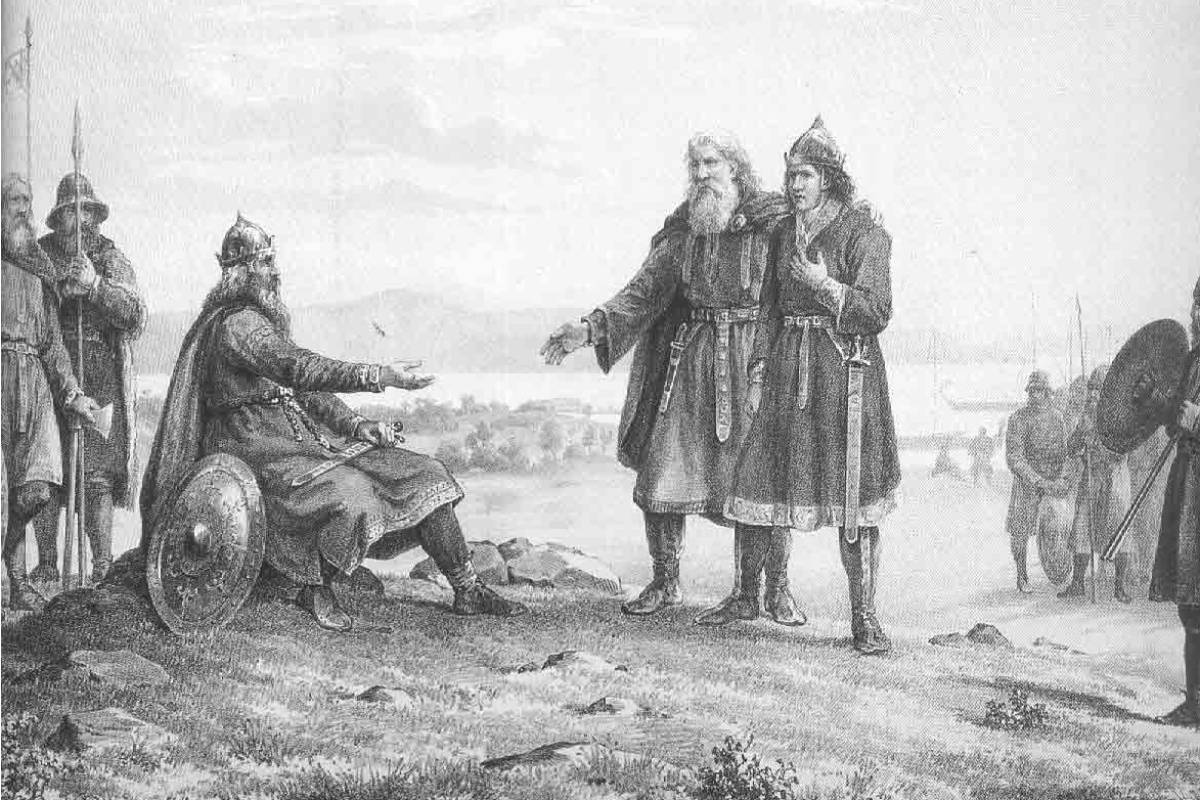
The skald Gudtorm Sindre (center) reconciles King Harald Fairhair (seated) with his son Halfdan. Author: Peter Nicolai Arbo (1831–1892)
The epitome of praise: Hrafnsmál
It is said that it was Harald Fairhair who first fused the several petty kingdoms of Norway under his iron grip to form a unified realm.
That is, at least, according to Þorbjǫrn hornklofi (rendered in Modern Norwegian nowadays as Thorbjorn Hornfloki), a 9th-century poet who was said to be part of Fairhair's retinue and who later sources associate with the poem, Hrafnsmál (Old Raven's Song), about the actions and deeds of unified Norway's first king.
Sadly, only a fragment of the poem survives, but what remains heaps praise on Fairhair. Preserved in later saga sources, the Hrafnsmál also appears under the alternate title Haraldskvæði, and it should be read as the epitome of a skaldic praise poem, as it presents the political union of Norway as a justified act.
Using an online version of the 2012 English translation in the book Poetry from the Kings' Sagas 1: From Mythical Times to c. 1035 (edited by Diana Whaley), we find that Fairhair is described as the "forward striving mighty ruler of Norway," reinforcing not only his prestige but also his claim on the nascent Norwegian kingdom.
Following a vivid description of his victory at Hafrsfjord (the description is a powerful and biased narrative that helped to shape the collective memory of the battle, though its dating and its role in "unification" remain debated), Fairhair is portrayed as a generous ruler, rewarding all those who fought alongside him.
Here, Hornfloki, through the clever use of the poem's protagonist, the eponymous raven, describes Fairhair as being:
"...generous is he to those who guard his land, the excellent war-hastener to his men of skills. Strife-displayers [warriors] are greatly enriched, those who cast dice at Haraldr's court. They are endowed with valuables and handsome treasures, with Hunnish metal and an eastern bondwoman." [Stanzas 15 and 16]
Nothing speaks to Viking Age generosity more loudly than sharing spoils that include "Hunnish metal" and an eastern bondwoman or two.
Given that Fairhair had recently vanquished many of his foes, perhaps there was a need to remind his followers, his troops, that he could provide them with untold riches and financial security, to remind them exactly who "buttered their bread," so to speak.
Finally, Fairhair's intelligence, both as a ruler and in his exquisite choice of followers, is explicitly spelled out. Stanza 21 reveals how Fairhair:
"...the sovereign wise in understanding, may entrust himself to men of courage alone..."
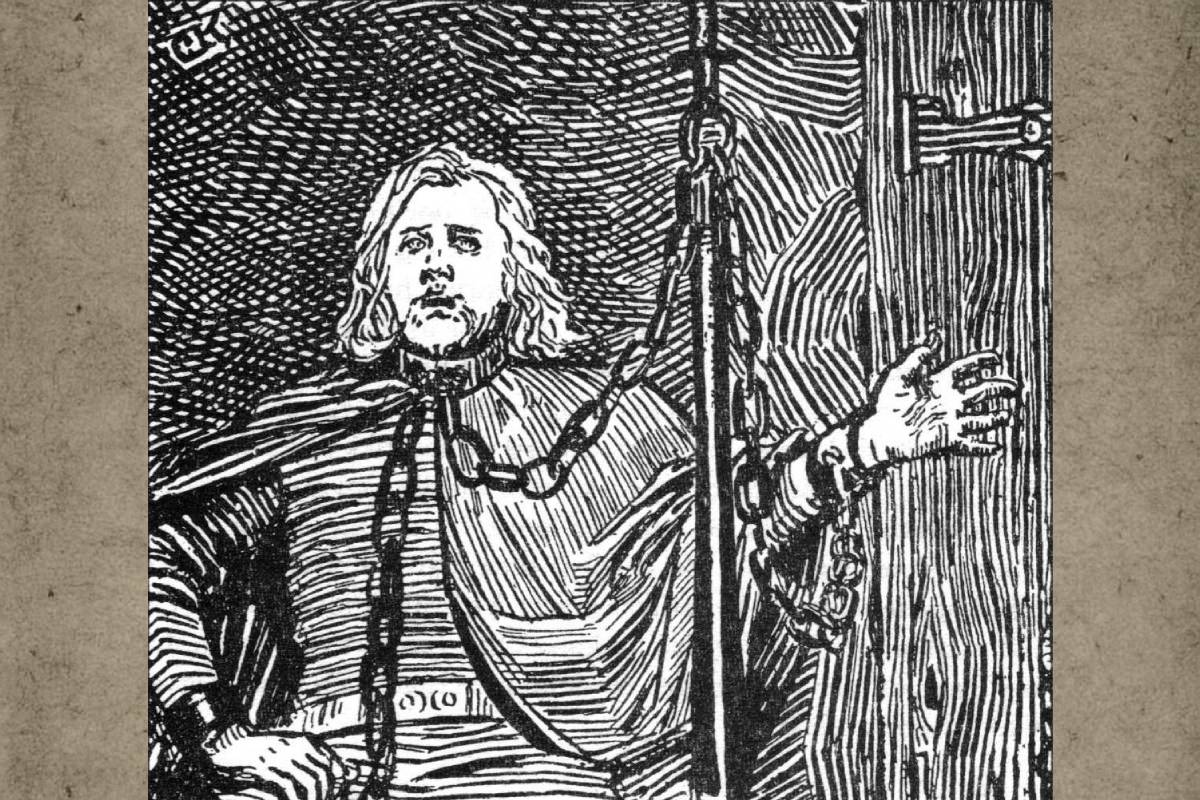
This illustration from Heimskringla shows Bersi Skáldtorfuson as he composes poetry after King Olaf Haraldsson imprisoned him. Author: Christian Krohg (1852–1925)
Other examples
Aside from the Hrafnsmál, we can also find other examples of skaldic praise poems used as pieces of political propaganda.
The Ynglingatal (Enumeration of the Ynglingar) was said to be composed by Þjóðólfr of Hvinir (Thjodolf of Hvinir) sometime in the late 9th century CE, and quoted frequently by Snorri Sturluson in the Ynglingsaga.
Here, Fairhair's lineage is examined and linked, in saga tradition, to a genealogy that ultimately descends from the mighty Norse All-Father, Odin himself.
Þjóðólfr of Hvinir legitimizes Fairhair's rule through his supposed illustrious ancestry that harks all the way to the Norse gods themselves, a genealogy that reflects medieval ideological tradition rather than verifiable lineage, and it set a precedent for the divine rule of kings later exploited by Christian monarchs throughout Scandinavia.
We even have a possible case where a skaldic praise poem saved a life. According to Egils Saga, Egil Skallagrímsson made powerful enemies when he wasn't off composing poems and getting into shenanigans.
Skallagrímsson ended up with a literal bounty on his head (thanks to Eric Bloodaxe) and only survived by composing a poem that heaped praise on the one-time ruler of Norway and two-time ruler of Northumbria, entitled Hǫfuðlausn (Head Ransom).
The flattery worked; Bloodaxe was deeply impressed, and Skallagrímsson was released from captivity, ensuring his head remained firmly on his shoulders for another day. Here, in saga tradition, this poem was seen as having real political currency, ensuring that sometimes a little bit of flattery goes a long way.
Public recognition through performative praise
Despite the ultimate authority and power that rulers in Viking societies often wielded, there was a need for these powerful rulers to continually assert, legitimize, and negotiate their authority throughout the community.
Skaldic praise poems were composed not only to flatter the ruler and entertain their court but also to influence the hearts and minds of the ruled.
Whilst power was often seized by the point of a sword, public recognition of the authority and right of the ruler was needed, and this was done through performative poetic praise.
This public recognition was needed to legitimize the ruler and make sure that their rule was accepted and respected by the entire community, rather than just simply being feared.
For more information on skaldic poetry, visit the BBC here.
We get to provide readers with original coverage thanks to our loyal supporters. Do you enjoy our work? You can become a PATRON here or via our Patreon page. You'll get access to exclusive content and early access.
Feel free to reach out to discuss potential stories that may be in the public interest. You can reach us via email at hello@thevikingherald.com with the understanding that the information you provide might be used in our reporting and stories.