


Walk through the busy city center of Bergen, Oslo, or Stavanger, and you will see the hustle and bustle of a Nordic powerhouse – a nation that is very much a world leader in cultural, economic, and social progressivism.
With a highly developed market economy and a burgeoning technology sector, Norway is transitioning into the brave new world of the 21st century.
Yet, despite its modern glow, Norway is a nation deeply embedded in the past.
Although it has been an independent modern nation only since 1905, when it broke away from Sweden, many Norwegians would argue that this marked the end of a roughly five-century period of foreign domination (or subjugation), which began with its absorption into the Kalmar Union in the 15th century.
The events of 1905 were thus seen as a return to normalcy, with Norway once again asserting itself as an independent kingdom after a five-century absence, during which it was dominated by its eastern and southern Scandinavian neighbors.
In fact, Norway had been a unified and independent kingdom since the early medieval period, around the late 9th century, and was one of the cultural and military powerhouses of northern Europe.
Its foundation can be traced back to a singular figure – a semi–historical, semi–legendary Viking king named Harald Fairhair.
By force of personality and arms, he was said to have unified all the petty kingdoms of Norway under his iron grip and forged a nation.
It is said that modern Norway was born at the Battle of Hafrsfjord, with Fairhair securing supremacy and founding a royal dynasty.
However, can we separate fiction from fact, medieval propaganda and lore from cold, hard historical truth? What do we know of this battle that is said to be so pivotal in the history of Norway?
- READ MORE: A Viking history of Norway (Part 1)
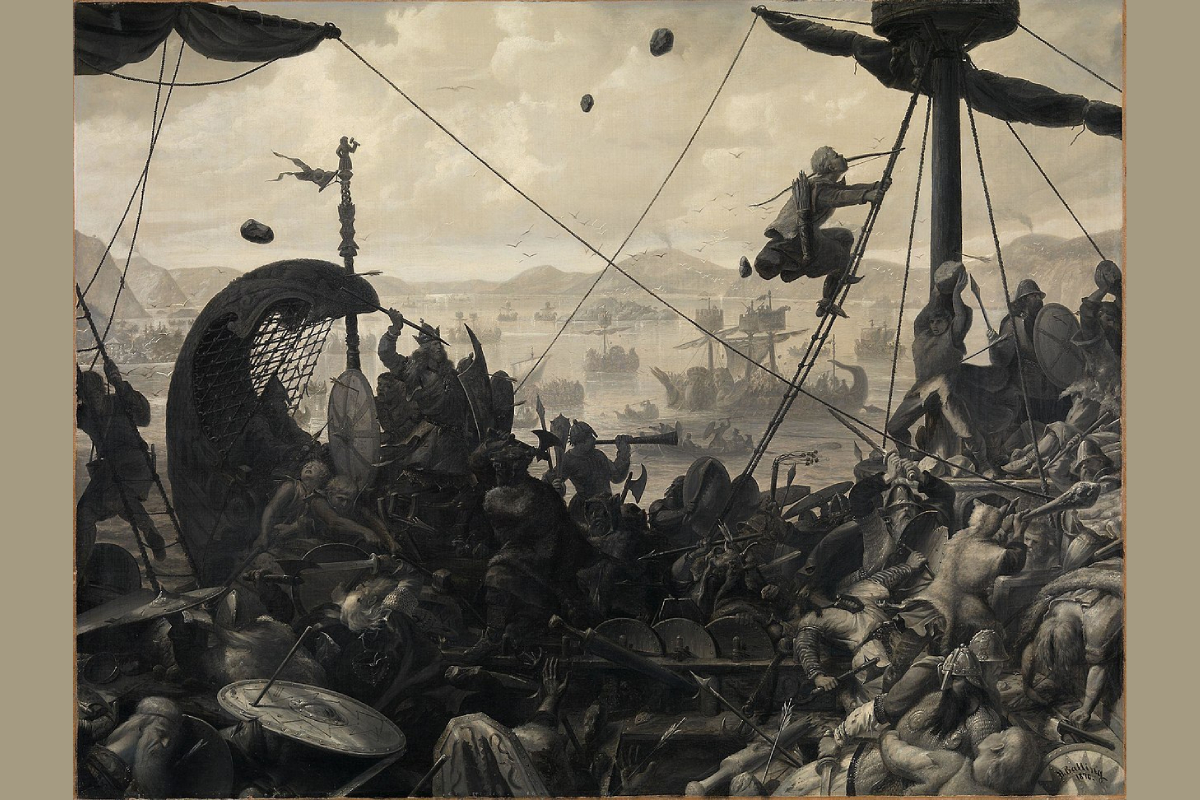
"Harold the Fairhaired in the Battle at Hafrsfjord" is an 1870 oil painting, housed in the National Museum of Art, Architecture, and Design in Oslo, Norway. Illustration: Ole Peter Hansen Balling (1823–1906), Public domain
The early rumblings of Norway
The history of Norway, truth be told, stretches back into the tides of history, long before the first Viking ship ever sailed.
Civilizations from what historians call "Classical Antiquity" – specifically the Romans and the Greeks – had an inkling about Scandinavia but thought the peninsula was, in fact, a series of islands.
There have also been many archeological discoveries of Roman artifacts and wares in Scandinavia, suggesting at least indirect trade between Rome and these northern societies.
By the collapse of the Western Roman Empire around the 5th century, the population in what is now Norway was burgeoning.
A look at the lie of the land shows that Norway has little arable land, dominated by a huge range of mountains that run down its spine – the famous Scandinavian Mountains.
By the early medieval period, population pressure contributed to the beginning of the Viking expansion outward.
What started as a series of predatory raids, often hand in hand with trading expeditions, had by the mid-9th century turned into conquest and settlement in the British Isles and Eastern Europe.
These raids and trading expeditions helped funnel power into several petty kingdoms that had grown in Norway throughout the early medieval period.
By the mid-9th century, many smaller entities were absorbed into larger petty kingdoms.
It has been estimated that during this time there were about nine petty kingdoms that dominated much of what is now Norway, from the southeast to the west coast and as far north as what is now Finnmark.
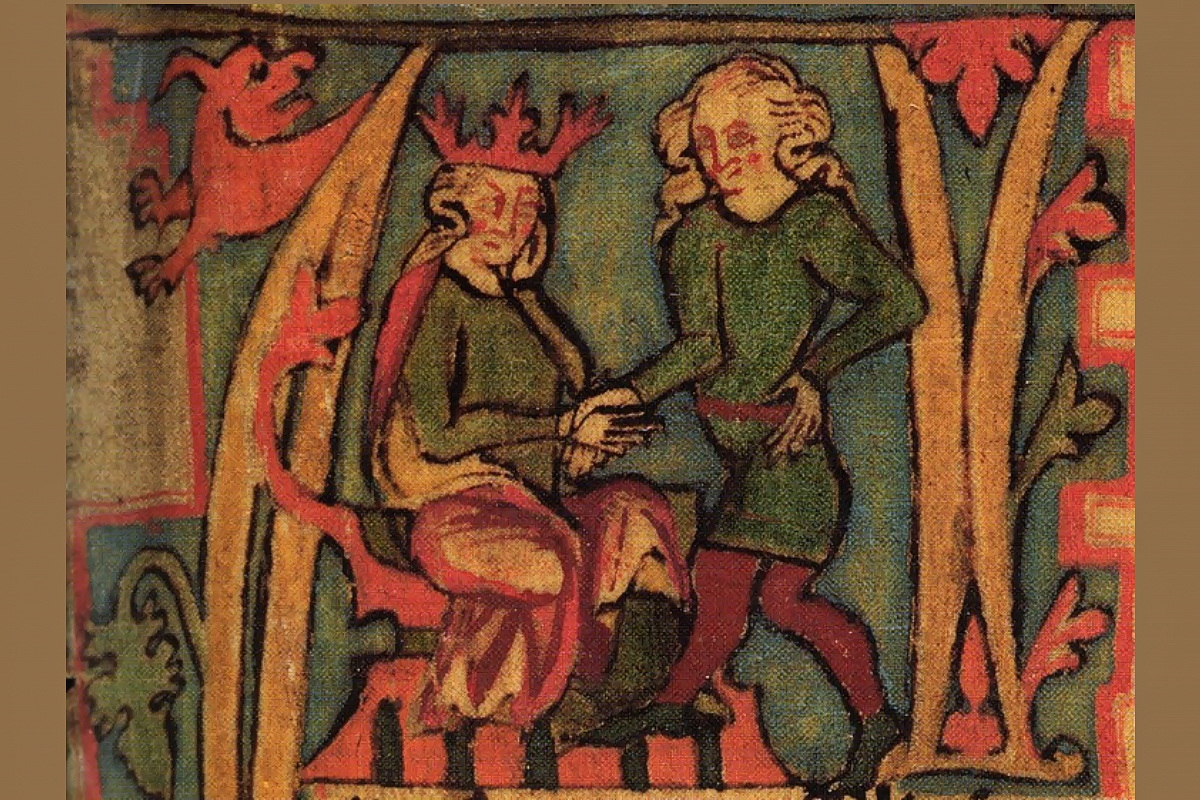
The Flateyjarbók manuscript from the 14th century contains an illustration of King Harald receiving Norway from his father. Source: Public domain
Look to the sagas
It is in this milieu that we first encounter Harald Fairhair. Yet there are almost no contemporary accounts of the man who was said to have unified the petty kingdoms of Norway.
Scouring the sagas – many of which were written centuries later – we learn that Fairhair was said to be of royal descent, born to the son of a ruler in what is now Oppland, Norway.
His father, Halfdan the Black, drowned when Harald was a teenager, meaning he had to come of age quickly.
Some sagas point out that upon ascending to the throne, Harald set about the long, slow, and bloody acquisition of power for more than 20 years.
Other sagas suggest that by the time his forces took the (naval) field at Hafrsfjord, he was only 20 years old.
Like all good stories, the sagas seem to rarely let the truth get in the way.
We cannot know which event is more likely, but by the early 870s, Harald was obviously a powerful ruler who had set about battling and conquering nearby kingdoms.
The sagas also explain how Harald earned his moniker. Whilst "Fairhair" in English gives people the assumption he may have been blonde, this is factually incorrect.
We do not know the color of his hair, but we know its length. His moniker derives from the fact that he was said to have boldly claimed he would not cut his hair until he became supreme overlord, leaving him with flowing locks.
A united opposition and the element of surprise
If we turn to the sagas, we can trace the timeline of Fairhair's slow but steady conquest of the petty kingdoms.
Christian Raffensperger wrote in his 2009 article in the journal Russian Review about this conquest and how Fairhair snaked his way throughout the region.
Starting in Oppland, Fairhair won a great battle in Hakadal, which, had he lost, would have snuffed out his outsized ambitions once and for all.
From his power base, he moved northward, laying waste to what is now Trøndelag. A decisive battle was won in Orkadal before he headed southward.
Here, on the west coast, he fought two battles at Solskjel before swinging back down to the southeast and winning a famous victory at Götaland.
By 872, only the southwest stood alone, with chieftains from Rogaland and Sognefjord united in opposition against the all-conquering Fairhair.
The two most prominent rulers were Eirik of Hordaland and Kjotve the Rich.
These two powerful rulers, responsible for Hordaland and Agder, respectively, formed an alliance and began to gather their forces, ferrying them to cut off Fairhair before he could strike.
Yet before these two rulers could land their forces northward along the western coast, Fairhair found out about their plan.
He quickly assembled his forces and sailed to cut off the planned attack. The two forces met near Jadar, in the Hafrsfjord, now part of the city of Stavanger.
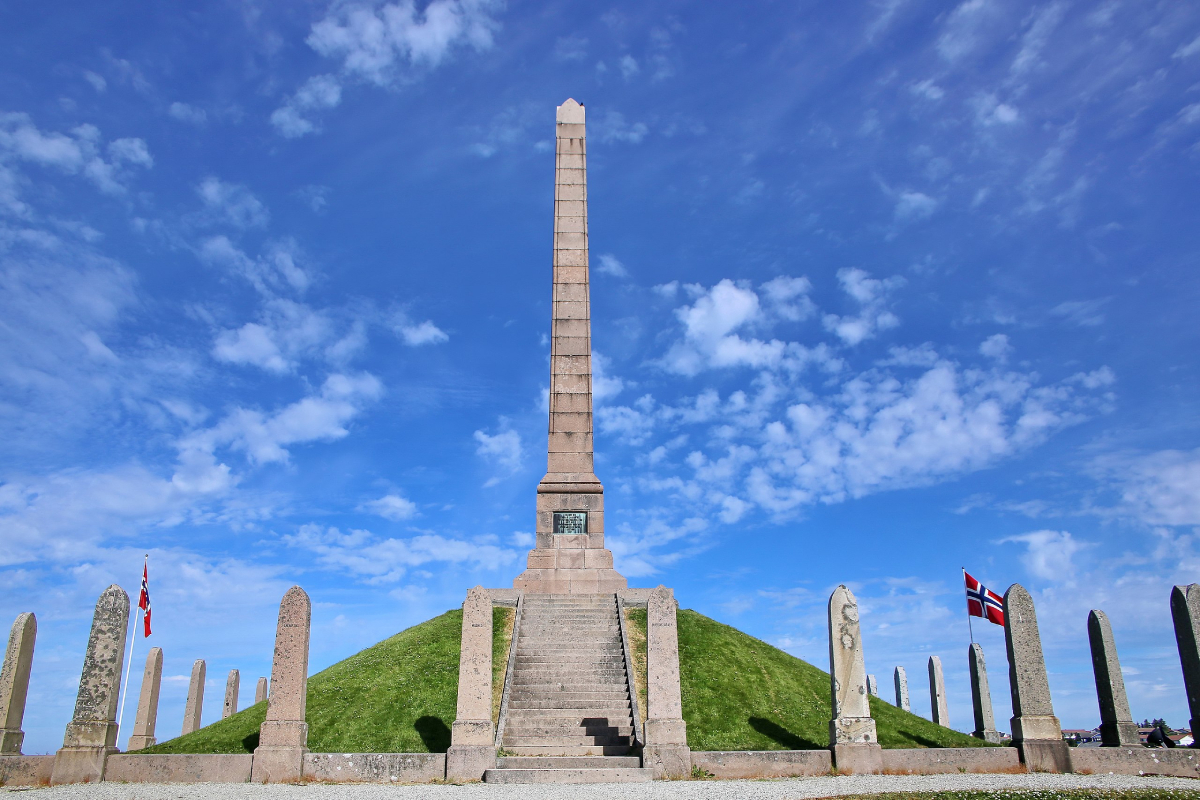
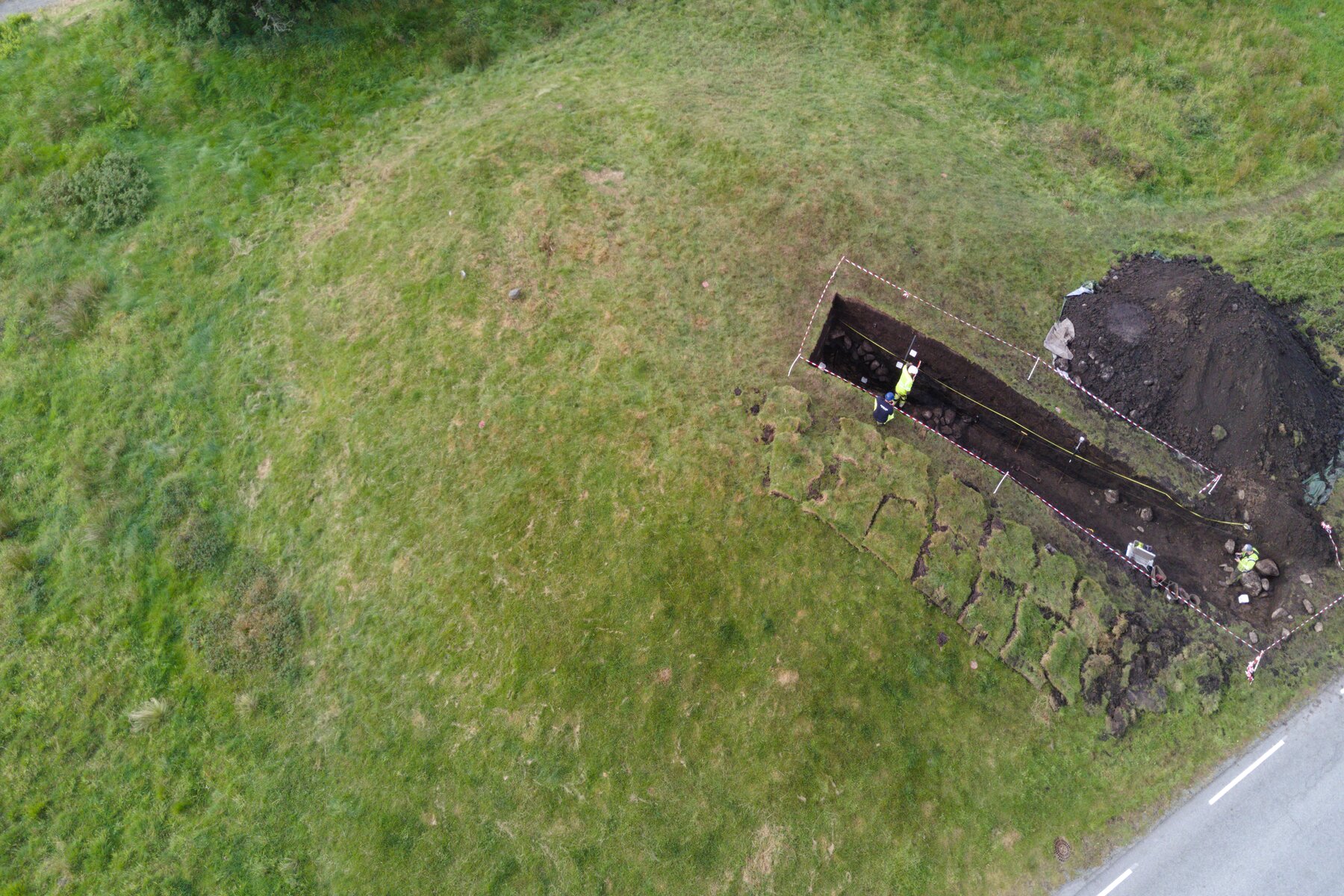
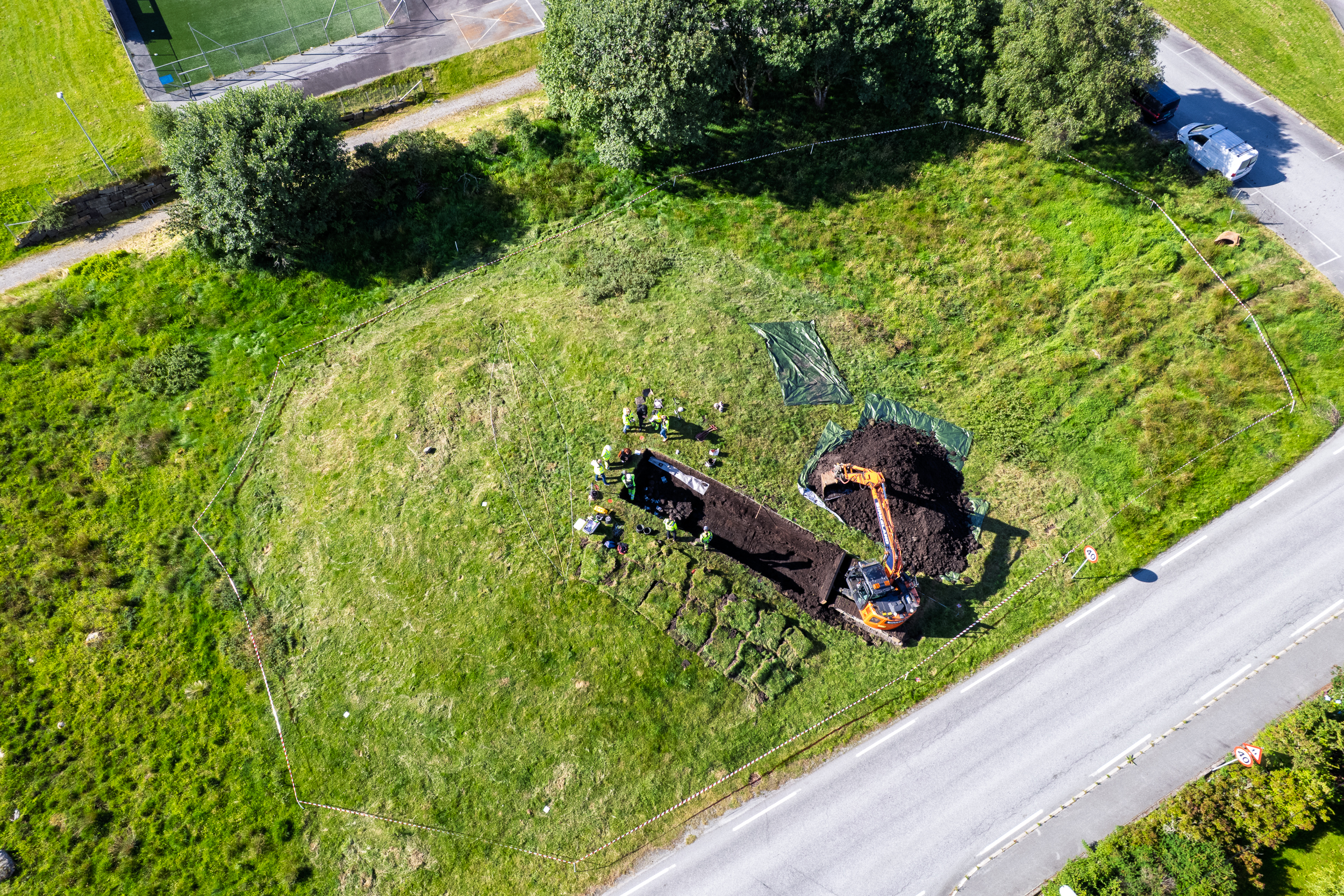
Haraldshaugen, the national monument located in Haugesund, was erected in 1872 to commemorate the 1000th anniversary of the Battle of Hafrsfjord. Source: Mark König (CC BY-SA 4.0)
A battle rich in legacy but scant in detail
Like so many early medieval battles, we know frustratingly little about the details.
Our best source is Snorri Sturluson, who compiled an account of the battle... but more than three centuries after it had taken place and a world away in Iceland.
We know that the two sides met in the Hafrsfjord and that a great naval battle ensued.
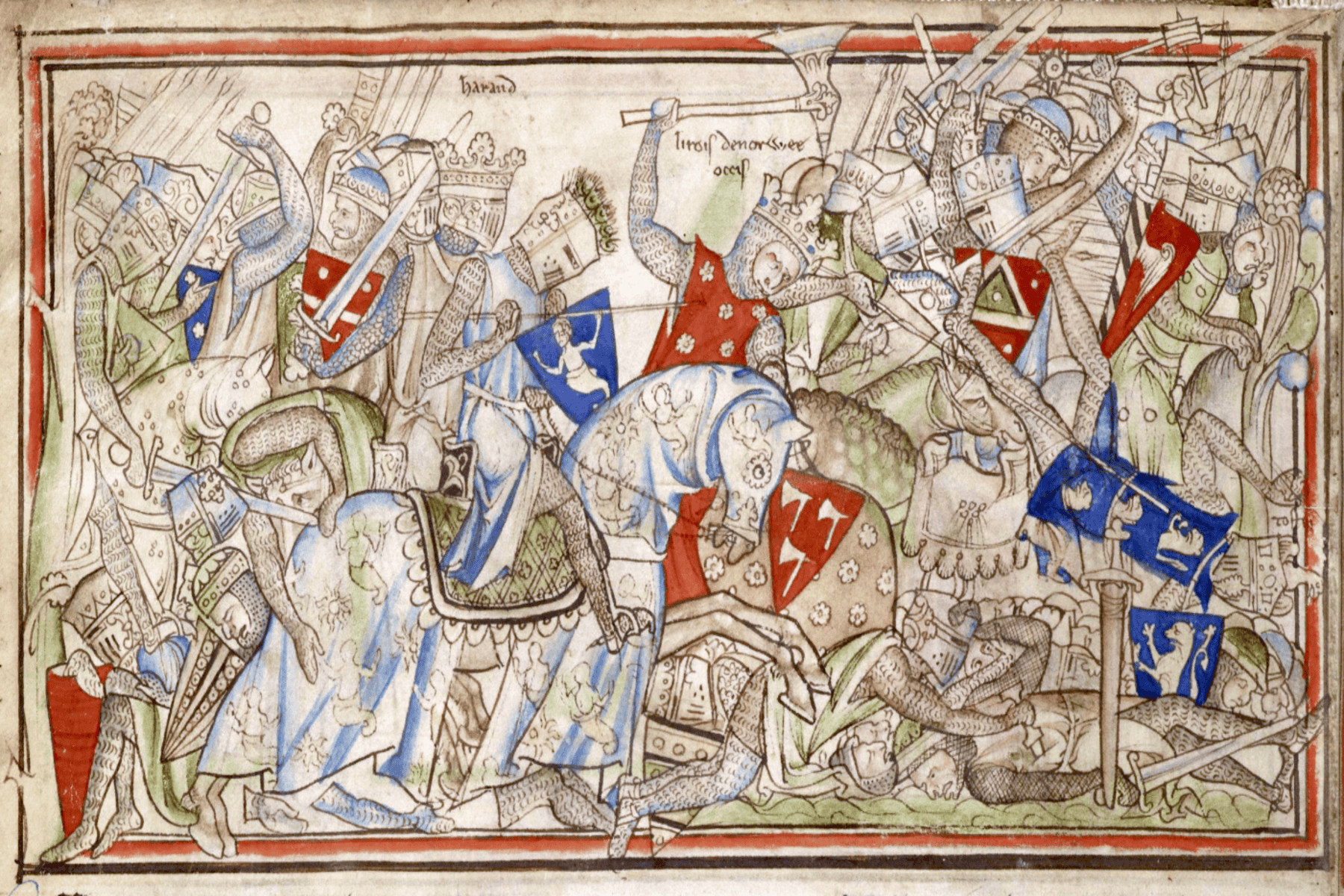
As Bruce Lincoln wrote in his 2019 book, Between History and Myth: Stories of Harald Fairhair and the Founding of the State, of the battle itself, Sturluson only gives us the briefest details but states that it was a "long and hard battle; but at last King Harald gained the day."
This was not, however, before allies of Kjotve had tried to ram the ship that Fairhair was on in a desperate act to seize victory from the jaws of defeat.
However, Fairhair held on, with Eirik slain in battle and Kjotve forced to flee.
Following the battle – which modern historians date to anywhere between 872 and 900 – all opposition to Fairhair's subjugation disintegrated, and he was, according to the sagas, free to crown himself the first "King of Norway" and found a royal dynasty that the current monarch, Harald V, can trace his ancestry back to.
Whether such a decisive battle ever took place is open to historical debate. Yet it appears that in the late 9th century, many people from Norway decided to cross the North Sea to start a new life on the island of Iceland.
The sagas state that many of these people were subjects of either Eirik or Kjotve or from other areas that Fairhair had conquered.
They were not only unhappy with their new king but were also said to be furious with the high taxes he was forcing upon them.
Modern-day celebrations
This semi-legendary, semi-historical battle, said to be the bloody birth of the Norwegian nation, is rightly seen as a pivotal moment in the story of Norway.
While we know little detail about it, the battle seemed to capture both medieval and modern imaginations. It has continued to inspire those born centuries after the last Viking ship ever sailed.
A monument to the battle – the Haraldshaugen – was erected in 1872 to celebrate the 1000th anniversary of the battle. A new addition to the monument, the Sverd i fjell (Swords in the Rocks), was unveiled in 1983.
For more information on why Vikings were so effective in naval battles, visit Science Norway here.
We get to provide readers with original coverage thanks to our loyal supporters. Do you enjoy our work? You can become a PATRON here or via our Patreon page. You'll get access to exclusive content and early access.
Feel free to reach out to discuss potential stories that may be in the public interest. You can reach us via email at hello@thevikingherald.com with the understanding that the information you provide might be used in our reporting and stories.



.jpg)