

A common historical misconception is that our medieval ancestors did not travel and lived out their entire lives a few yards from where they were born.
We assume that before the invention of the car, train, or airplane, people must have traveled little. Whilst this may be the case for some ancient cultures and societies, this was certainly not the case for Viking societies, early medieval Europe's great travelers.
The fact that a tiny population managed to explore, trade, settle, and conquer a huge swath of the world from the shores of Canada to the Caspian Sea is one of the medieval period's most fascinating events.
As such, a large segment of Viking societies traveled frequently for profit, plunder, or more peaceful means. With travel often a fact of life, hospitality was widely valued and practiced during the Viking Age.
Now, good manners may not be a thing you associate with Vikings, but hospitality in the Viking world was a highly developed cultural practice and societal norm.
Several Old Norse terms related to hospitality include vinátta ("friendship," a general social bond) and gestaréttur ("guest right," the customary protection of guests).
In practice, travelers, known or unknown, were welcomed into households and given comfort and safety away from the harsh realities of early medieval life. We break down all you need to know about this version of Viking hospitality.

A reconstructed Viking longhouse at the Viking Farm in Avaldsnes, Norway. Photo: LGieger / Shutterstock
Mutual respect, trust, and obligation
Living in the harsh climatic conditions of the Nordic region, hospitality was an important part of the behavior of Viking societies.
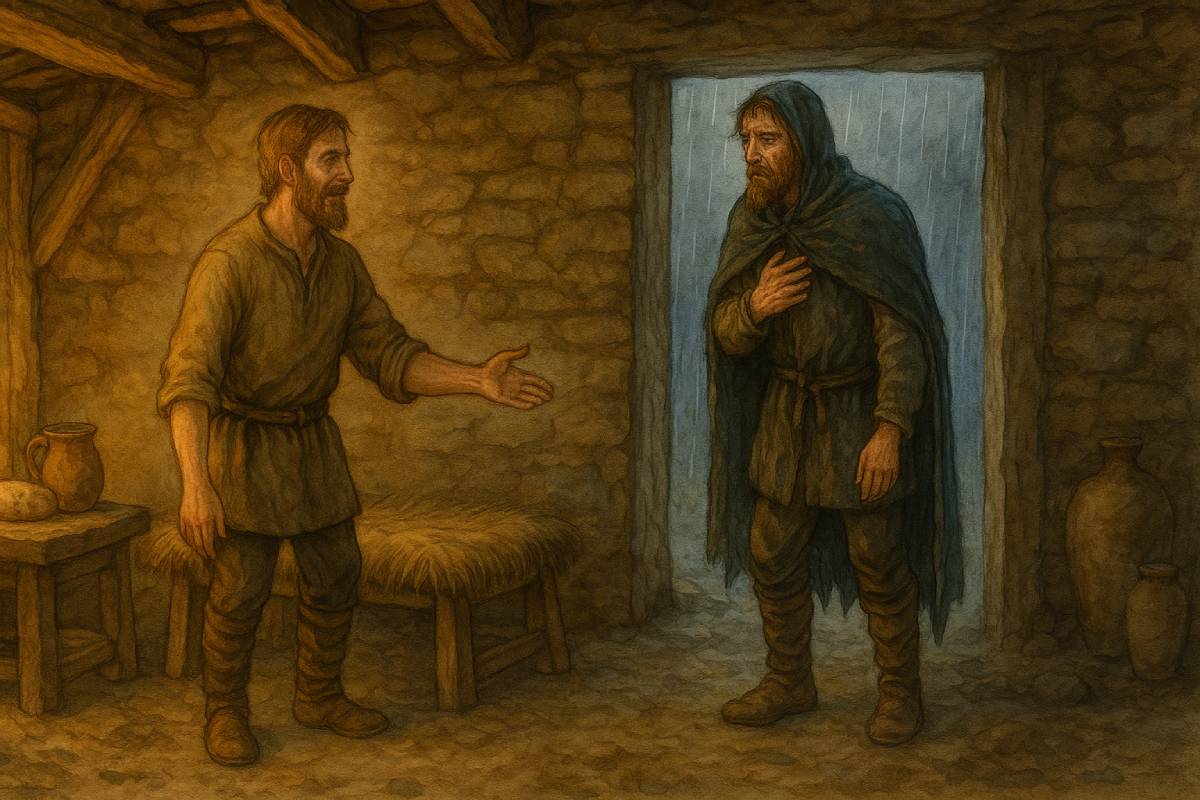
First and foremost, a host was expected to provide the weary traveler with food, protection, and shelter. This was done whether the traveler was a family member or a stranger. As Sirpa Aalto writes in her 2009 article, Commercial travel and hospitality in the King's Sagas, it was:
"...the host's duty to stand between his own social group and his guest, and offer his protection to the guest. Of course, food, drink, and shelter were important to the traveler, and were part of the hospitality offered."
In turn, the guest had to respect all members of the household. This mutual respect was considered almost sacred, and breaking this could result in societal shunning or even violence.
Part of how mutual respect was shown was through reciprocity. Only a small minority of those welcomed into a house may have been of significant means; however, this did not stop gift-giving.
Whilst expensive goods may have been rare, guests could offer gifts of a different kind, including their services or news about current affairs or market gossip, from either near or far.
This reciprocity helped to fulfill societal obligations and could lead to the formation of social networks. Finally, these social networks were of use in an era when there was widespread political instability and violence.
The hosting of guests allowed communities to gain information and insight and form military or political alliances.
Having armed help to call upon in a community's time of need was much sought after throughout the early medieval period. Offering up hospitality to one's foe could help prevent violence, soothe relations, and stop blood feuds from wreaking havoc in the community.

Interior of a reconstructed Viking house at L'Anse aux Meadows, Canada. Photo: Erik Mclean / Pexels
Found in the Norse sagas
Given the societal importance that people from Viking societies placed upon hospitality, we can find numerous references to it in the rich tapestry of the Norse sagas.
In Grettis saga Ásmundarsonar (The Saga of Grettir the Strong), we find a classic case of the "guest right" where the protagonist, Grettir, is welcomed into the home of an acquaintance to stay for the winter. Using an online version of the 2008 English translation by Douglas B. Killings et al., we find that:
"During the autumn, Grettir returned to the South and did not stop till he came to his kinsman Thorsteinn Kuggason in Ljarskogar, who welcomed him. He accepted Thorsteinn's invitation to stay the winter with him." [Chapter 53]
Another example occurs in Egils saga Skallagrímssonar (The Saga of Egil Skallagrímsson) when the hero Egil is hiding from an ambush with some companions in the thick of the woods.
Luckily for these forest dwellers, hospitality was generously offered by a local man of ample means. Using an online version of the 1893 English translation by Reverend W. C. Green, we find that Egil and his company:
"...went on their way, and nothing more happened till they got out of the wood and found lodging near the wood with a landowner named Alf, who was called Alf the wealthy... A good reception, Egil found there..." [Chapter 76]
Here, Alf offers Egil and his men protection and safety from those who want to do them harm. Both of these examples highlight how, in the Viking world, the same rights of hospitality were extended to the familiar and the stranger alike.
For people in Viking societies, hospitality was a societal obligation and right that bound all under mutual respect.
A hospitable welcome was offered to, and accepted by, friend or stranger alike, and this then ensured that social order, through obligation, was upheld throughout the Viking world.
Failure to abide by the strict obligations and unwritten rules of Viking hospitality could result in societal ostracization, violence, or, even worse, the anger of the Norse gods.
For more information on one of Iceland's favorite sons, Egil Skallagrímsson, visit Guide to Iceland here.
We get to provide readers with original coverage thanks to our loyal supporters. Do you enjoy our work? You can become a PATRON here or via our Patreon page. You'll get access to exclusive content and early access.
Feel free to reach out to discuss potential stories that may be in the public interest. You can reach us via email at hello@thevikingherald.com with the understanding that the information you provide might be used in our reporting and stories.