

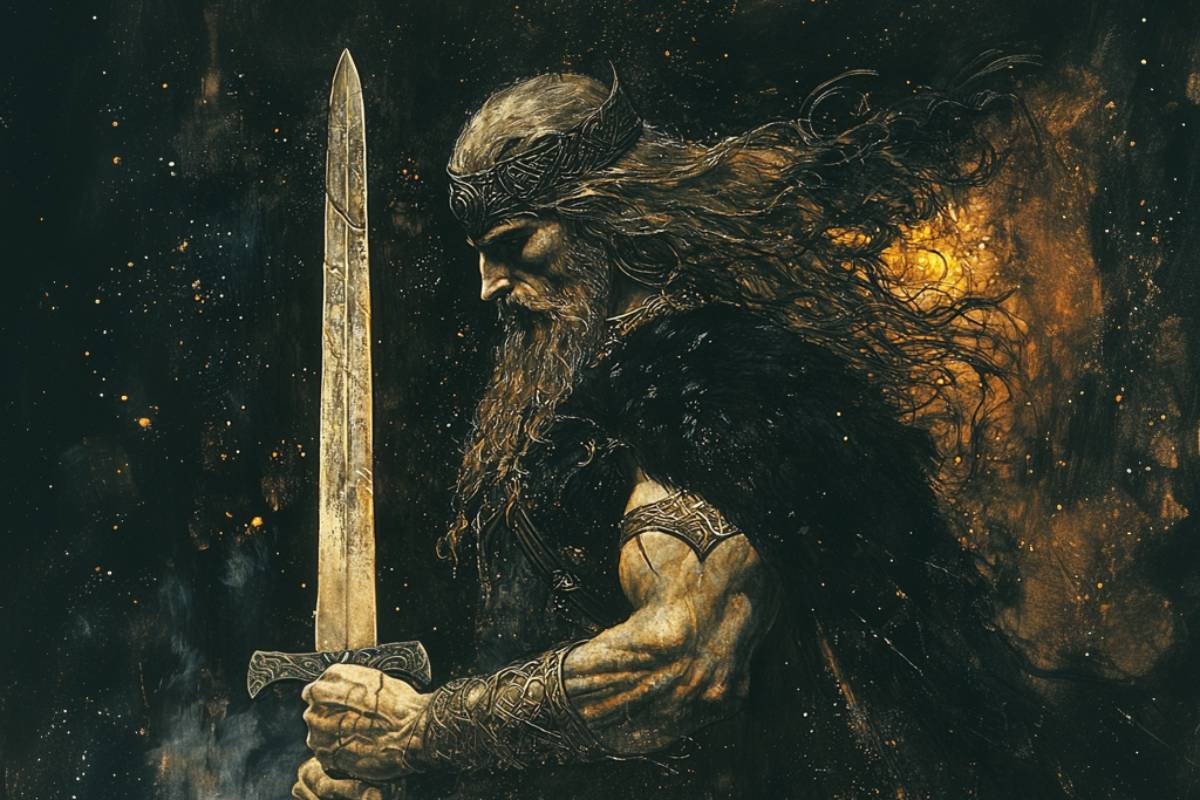
Josef Stalin, the bloody dictator who dominated and plagued much of 20th-century Europe, is often credited with the phrase, "Quantity has a quality all of its own."
Given that he directly or indirectly was responsible for the deaths of millions of people, he would know. Whilst Uncle Joe probably wasn't thinking about the Norse gods, this quote could easily apply to them.
One of the reasons why Norse mythology has remained so popular—first as a religion and then, since the advent of Christianity into Scandinavia, mainly as a source of good entertainment—is the vast number of gods, deities, and mythical beings that inhabit the two (yes, two!) pantheons.
We are spoilt then here at The Viking Herald when we have many of these deities to discuss.
There are so many Norse deities that even Uncle Joe probably couldn't send them all to the Gulag!
Whilst Freyja may have the best ride in medieval lore (who wouldn't like a cat-drawn sky chariot!) and Baldur the most tragic death, we turn our gaze now to Víðarr.
Said to be the product of a union between a Norse god and a jötunn (a giantess), he plays an epic and violent role in the Norse apocalypse, Ragnarök, and is also revered for his silence.
Has this piqued your interest? Let us then open the rich tapestry of the Norse sagas, myths, and legends to learn more about this god who is associated with silence as well as vengeance.
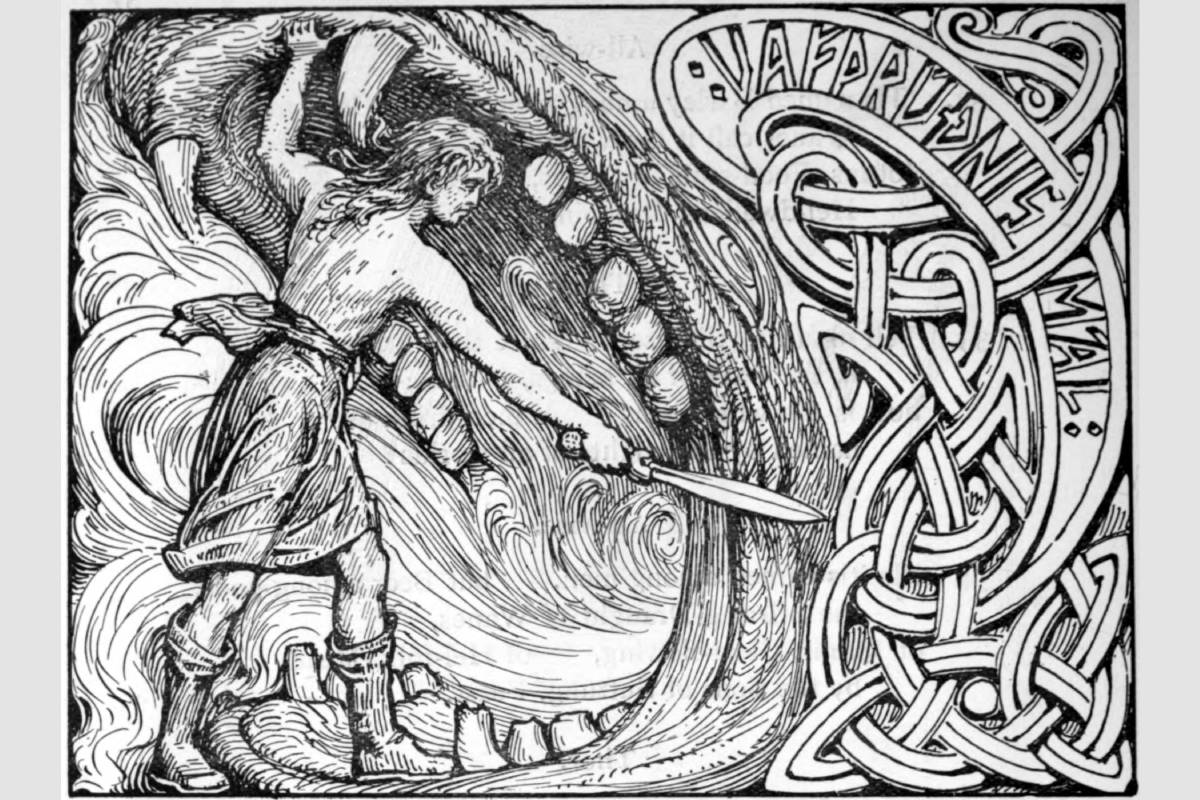
The 1908 illustration depicts Víðarr in the act of stabbing Fenrir, inspired by the imagery found on the Gosforth Cross. Source: W.G. Collingwood (1854–1932)
The strong and silent type
Like all good Norse detectives, we must now turn to the rich tapestry of Norse mythology to find some clues about the life and reputation of Víðarr.
Using the Prose Edda—compiled, we believe, by Snorri Sturluson in the 13th century but based on legends and stories that people in Viking societies told one another—we find a reference to Víðarr.
Described as the son of Odin and the jötunn Gríðr, we find a short description of Víðarr in the 1880 Rasmus Bjorn Anderson translation of this seminal tome:
"Víðarr is the name of the silent asa [Æsir]. He has a very thick shoe, and he is the strongest next after Thor. From him, the gods have much help in all hard tasks." (Section 29)
What this author thinks is quite remarkable is that not only was Víðarr renowned for his superhuman strength—second only to his mighty half-brother Thor (imagine separating those two when they were teenagers brawling!)—but there is also a description of a Norse god with a thick shoe!
This thick shoe and supreme strength will be of great use to the gods during the apocalyptic end of times, Ragnarök.
In these end times, we see this Norse god put to good use. It appears that Víðarr could arguably be seen as the originator of the "strong, silent" type both in life and literature.
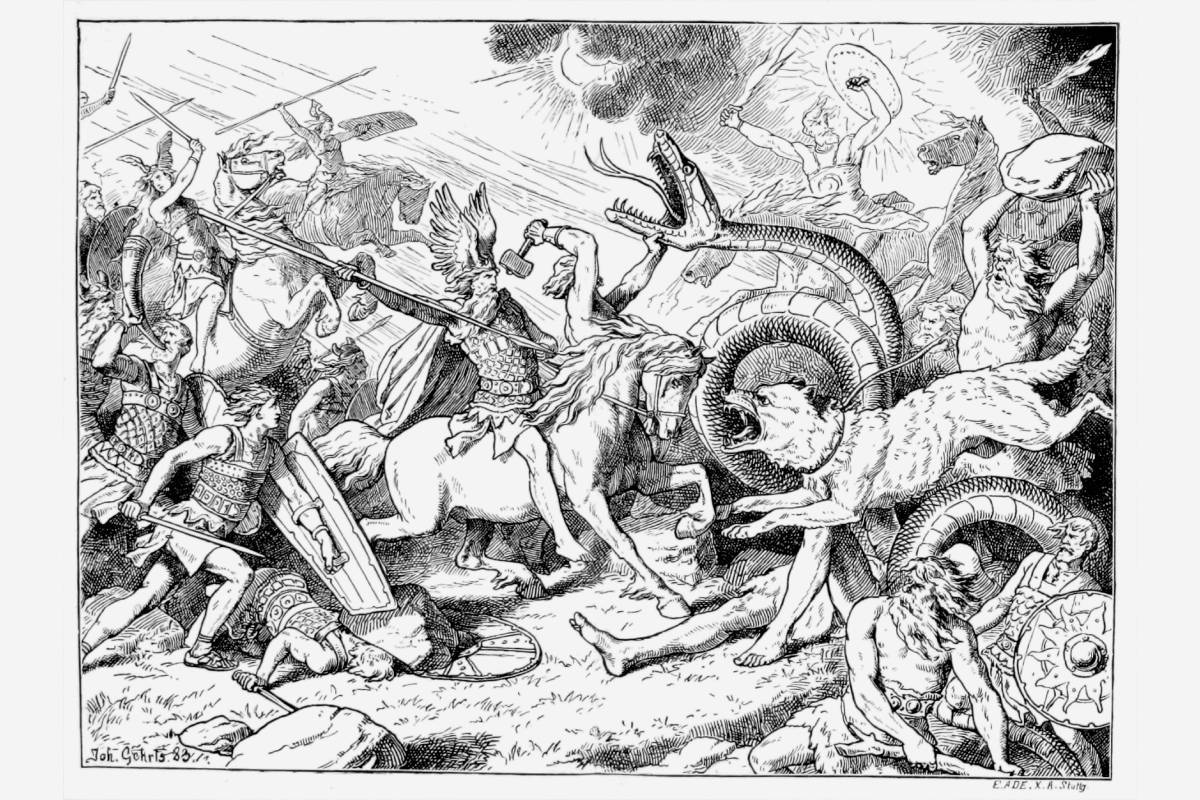
Ragnarök, the cataclysmic battle in Norse mythology, marks the end of many gods and the destruction of the Norse cosmos. Source: Johannes Gehrts (1855–1921)
Ragnarök: Violent end of times and violent vengeance
Can you imagine the trauma of seeing a parent murdered in front of you?
Sadly, for humanity, this happens to many children the world over daily. What should be reserved only for the pages of stories plays out tragically in everyday life.
Aside from Norse mythology being a great source of exciting entertainment, therein lies a great tragic undertone to many of the sagas, including Ragnarök.
Turning back to the Prose Edda now, we see how Víðarr is influential in the murder of his father's murderer, the giant wolf Fenrir. According to the Prose Edda:
"The wolf [Fenrir] swallows Odin, and thus causes his death; but Víðarr immediately turns and rushes at the wolf, placing one foot on his nether jaw. On this foot he has the shoe for which materials have been gathering through all ages, namely, the strips of leather which men cut off for the toes and heels of shoes; wherefore he who wishes to help the cause must cast these strips away. With one hand Víðarr seizes the upper jaw of the wolf and thus rends asunder his mouth. Thus the wolf perishes." (Section 55)
What makes this very much a family affair is that Fenrir is the son of Loki, who is a blood brother to Odin, Víðarr's father.
Got it, right? So Víðarr is killing the son of his father's blood brother—a sort of adopted cousin if you will.
It is this bloody act in honor and defense of his father that makes Víðarr become associated with vengeance.
We know that for people in Viking societies, the spilling of blood was a part of everyday life. Blood feuds were an important way to settle long-standing disputes, and therefore it made sense to have a deity associated with violent vengeance.
Famed historian and author John Lindow, in his 2002 book Norse Mythology: A Guide to Gods, Heroes, Rituals, and Beliefs (available on Amazon here), describes Víðarr's act of vengeance as "constituting a bridge to the distant future" whereby some of the Norse deities survive and indeed thrive.
Whilst Ragnarök signals the destruction of the Norse cosmos and its fiery rebirth, it also spells the end for many Norse deities. Yet Víðarr manages to survive, signaling his importance in the new cosmic order.
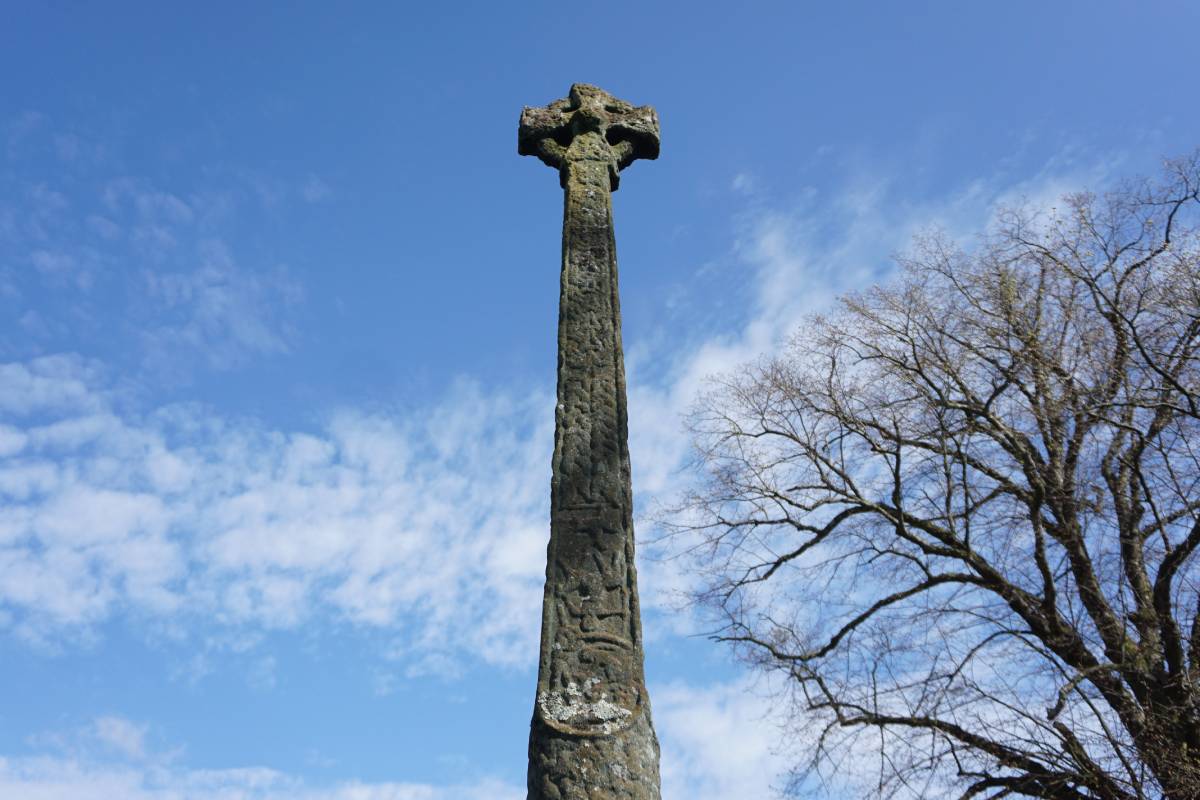
The Gosforth Cross, dating back to the early 10th century, features an image of Víðarr tearing open Fenrir's jaws. Photo: Ingwina
Archeological evidence found in England
Even though Víðarr is one of the lesser-known Norse gods, he does appear in the archeological record.
The village of Gosforth, Cumbria, nowadays a bucolic slice of English rural life, was part of the Viking-dominated Kingdom of Northumbria.
On the grounds of St. Mary's Church stands the Gosforth Cross, a large stone monument believed to have been erected sometime in the early 10th century.
Chiseled upon this cross are several images ripped straight from the sagas, including Víðarr tearing the jaws of the mighty Fenrir. You can also see his mighty shoe upon the lower half of the great wolf's jaw.
Despite this scene being ripped straight from the Norse sagas, the defeat of a great beast also has parallels in the Christian religion with Christ's defeat of Satan, who was often depicted as a great beast.
This could be evidence of the synthesis of religious beliefs—"pagan" and Christian—that many people held in Viking societies throughout the early medieval period.
As Anders Hultgård discusses in their 2022 book, The End of the World in Scandinavian Mythology: A Comparative Perspective on Ragnarök, this religious synthesis was a result of "a number of Christian motifs" that began to be included in Norse mythology during the latter period of the Viking Age (c. 750–1100 CE).
Having survived the events of Ragnarök, time has not been kind to Víðarr, as he has largely fallen into historical and literary obscurity.
It is high time that this member of the Æsir, the slayer of a giant wolf and defender of the Allfather of Norse mythology, gets some time in the spotlight.
The Spectator has an article with more information on the Gosforth Cross here.
We get to provide readers with original coverage thanks to our loyal supporters. Do you enjoy our work? You can become a PATRON here or via our Patreon page. You'll get access to exclusive content and early access.
Feel free to reach out to discuss potential stories that may be in the public interest. You can reach us via email at hello@thevikingherald.com with the understanding that the information you provide might be used in our reporting and stories.