

Swipe your screen or switch on your television nowadays, and it seems that the modern world is suffering its very own Ragnarök, the end of times.
Death, destruction, and war are ever-present throughout this small globe of ours, from Eastern Europe through West Asia, down into Central Africa, and as far east as Myanmar.
Each of these conflicts has a myriad of causes, and a path to peace seems about as navigable as traversing a boggy quagmire. Sadly, this is no modern phenomenon.
People from Viking societies lived in an era that, even by our modern standards, was steeped in political insecurity and thus chaos and violence.
Part of this violence, of course, was the rape, enslavement, and murder committed by the famed warriors from Viking societies—the Vikings—who laid waste to a whole swathe of Europe, West Asia, and even reached as far as North America.
Even the tales they told one another that have been passed down to us and lumped clumsily together as the Norse sagas—an exotic mix of legends, myths, and poems—are steeped in bloodshed, violence, and warfare.
We turn to a story that may represent the earliest mention of a peace treaty in Northern European history: the fallout from the Æsir–Vanir war.
Having originally been two warring pantheons, the Norse gods settled their differences in a most unusual way. We turn now to the peace negotiations and what they birthed.
Spit-acular diplomacy
"The gods had a dispute..."
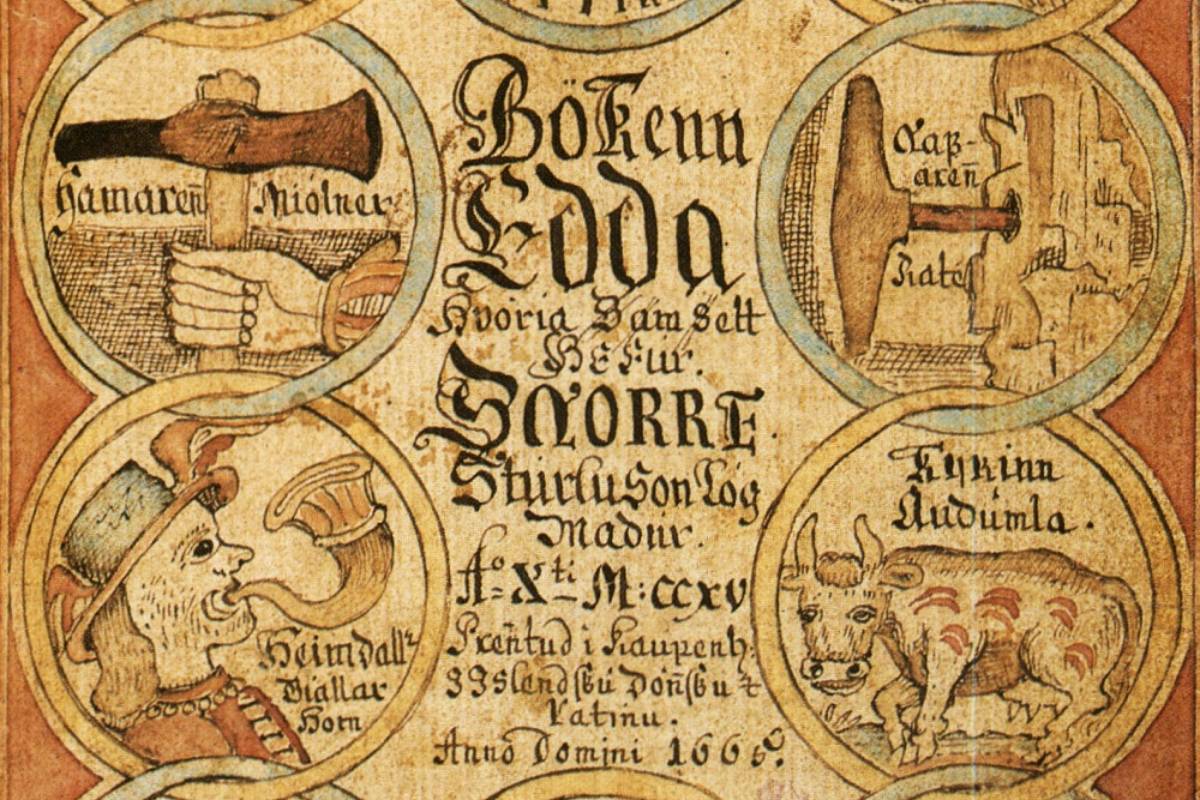
Whilst Scandinavians have a reputation for being understated—whether in food, fashion, or thought—this is how the terrible Æsir–Vanir war was described by 13th-century CE poet and politician Snorri Sturluson in the poem Skáldskaparmál, part of his famous compilation, the Prose Edda.
We have already covered the causes and major events of this mythical battle, which saw the two pantheons of Norse deities unite into one after much bloodshed and violence, but it is the peace negotiations that followed that interest us.
Further down in the poem (we are using an online version based on the 1916 English translation by Arthur Gilchrist Brodeur), we find that both the Æsir and the Vanir,
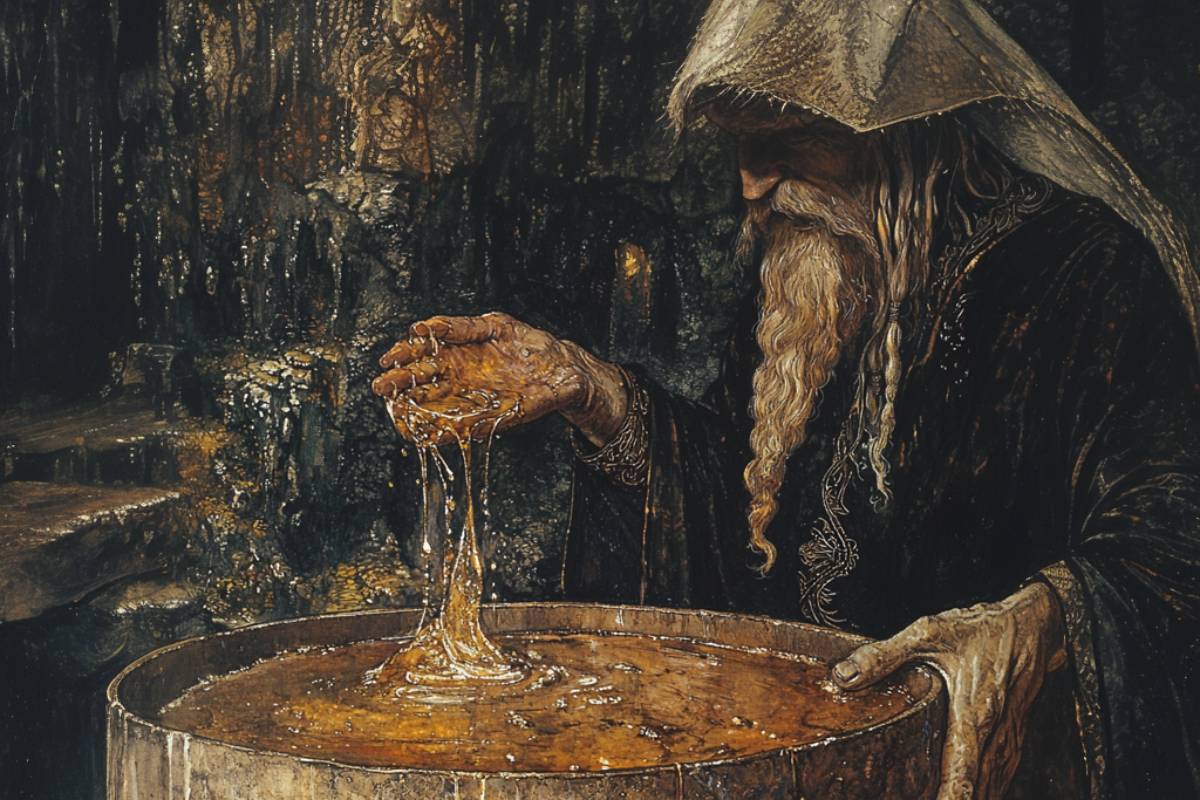
"...appointed a peace-meeting between them and established peace in this way: they each went to a vat and spat their spittle therein. Then, at parting, the gods took that peace token and would not let it perish, but shaped thereof a man. This man is called Kvasir..."
Let us pause here to consider what we have just read. To seal an everlasting peace and to end the blood, feud, and violence, the gods spat into a vat and then used this spit to create a man.
Now, given the current negotiations underway between Ukraine, the United States, and Russia, one can hardly think of Trump, Zelenskyy, and Putin sealing a deal by gobbing into a bowl!
Endowed by the bodily fluids of all the Norse deities, we can safely assume that this Kvasir was going to be endowed with magical powers.
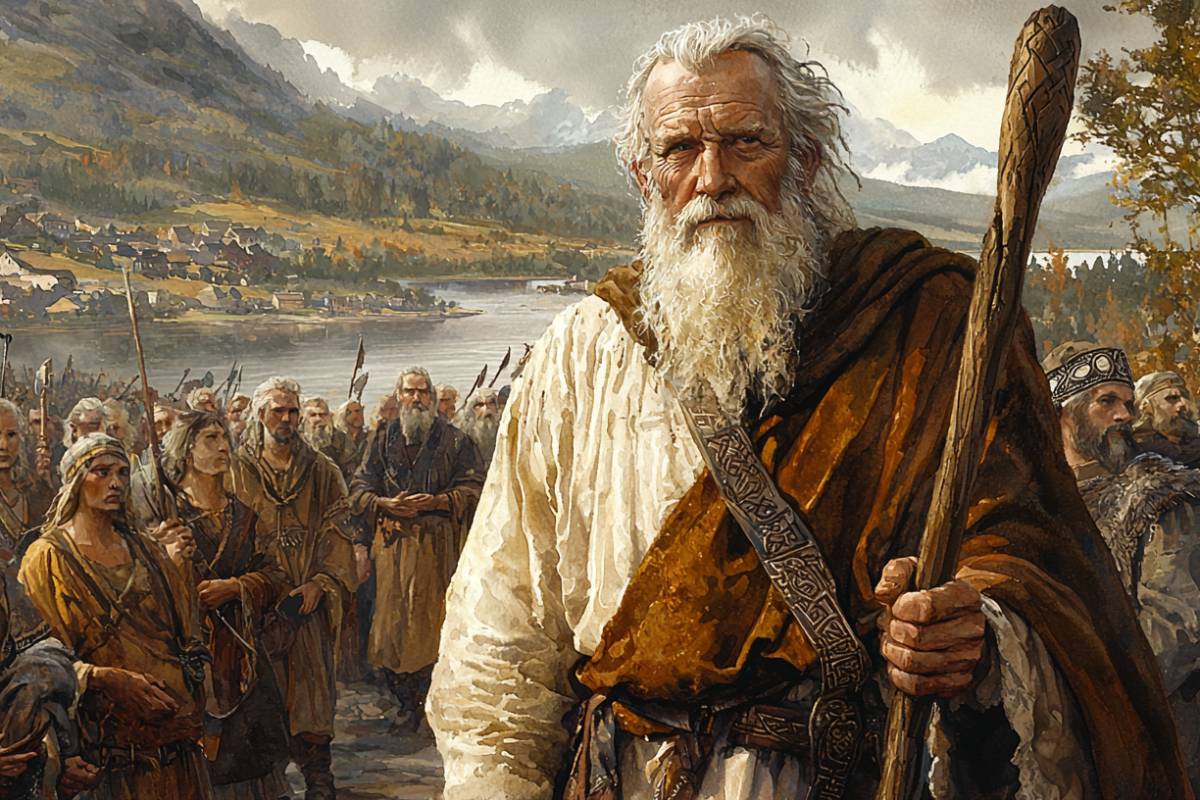
Created from the spit of the gods, Kvasir walked the earth offering knowledge to anyone who sought it. Illustration: The Viking Herald
A wise wanderer and possible Christian overtone?
Given his rather unique creation, Kvasir was always destined to have a special position in the Norse sagas. Having been shaped from spittle by the gods, Kvasir was something of an intellectual prodigy.
It was said that Kvasir:
"...was so wise that none could question him concerning anything but that he knew the solution. He went up and down the earth to instruct men..."
We know that Sturluson was compiling these ancient Norse sagas and stories in the 13th century, long after Christianity had gained supremacy throughout the former Viking world.
As Nicolas Meylan writes in his 2013 article in the journal Viking Society for Northern Research, it was during this era that "kings began to move away from the oral, occasional performance of praise poetry to anonymously written sagas" as kingship throughout Scandinavia had "increasingly turned to the Church for legitimacy."
The image of Kvasir traveling and imparting wisdom parallels the life of Jesus Christ, who is said to have spent his final years journeying and preaching his gospel.
Was this a deliberate insertion by Sturluson to remind listeners (the Norse sagas would have been regaled as oral tales, even when Sturluson was compiling them, since literacy rates were minuscule) to Christianize this pagan tale?
We will never know for sure, but we do know there is a heavy Christian overtone in many of the Norse sagas as Sturluson saw fit to transcribe them.
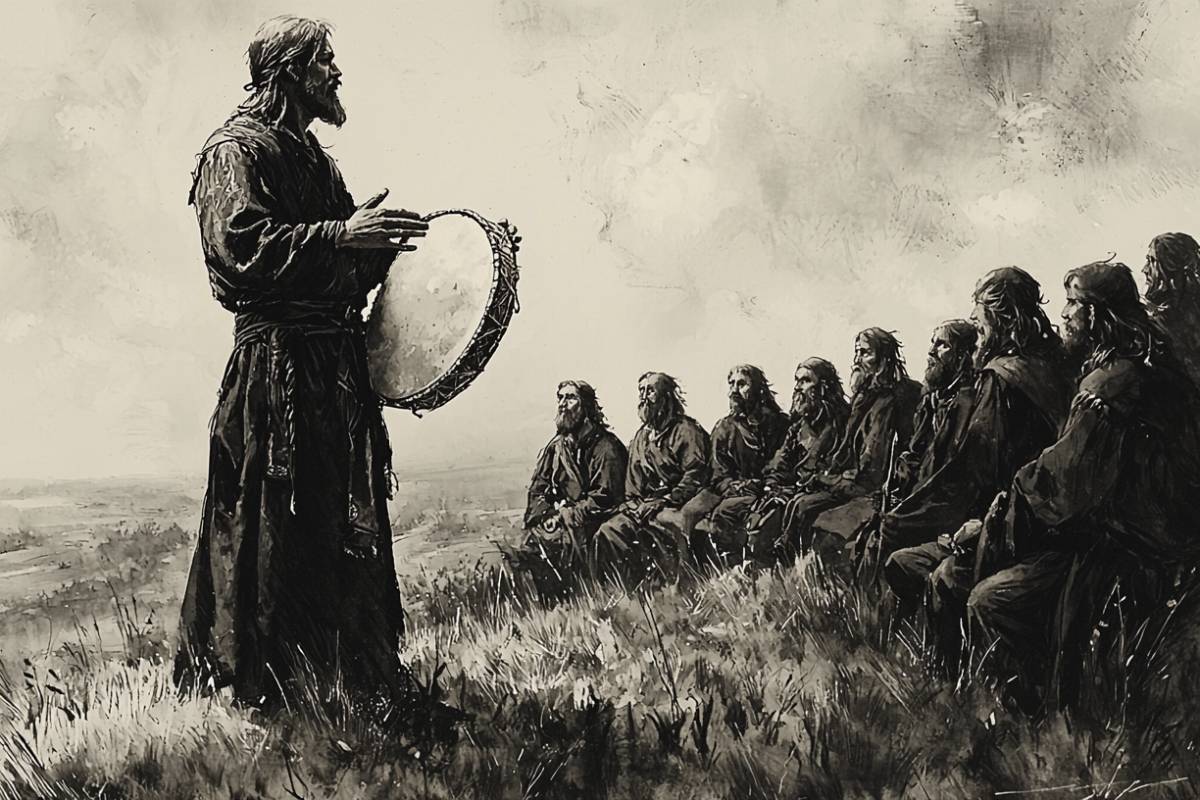
Vikings respected poets just as much as warriors, so they believed great verse could only come from the divine. Illustration: The Viking Herald
Artistic inspiration through an intoxicating libation
Sadly for Kvasir, he would suffer the same fate as Jesus Christ: a gruesome death. Amongst his wanderings, Kvasir was said to have:
"...came upon invitation to the abode of certain dwarves, Fjalar and Galarr, they called him into privy converse with them, and killed him, letting his blood run into two vats and a kettle..."
Now, compared to, say, other southern European cultures, Scandinavians may not have the best reputation for hospitality.
There's even a raging online debate about whether Scandi parents serve food to their children's friends during a play date. But we won't get dragged into that!
Still, I'm not sure you'd ever be killed for having a conversation with a Dane, Norwegian, or Swede!
Following this gruesome death and the draining of his blood, it appeared that the two dwarves were wannabe mixologists, as they:
"...blended honey with the blood, and the outcome was that mead by the virtue of which he who drinks becomes a skald or scholar."
Thus was born the source of supposed artistic inspiration, Kvasir's Blood—or to give it another name, the Mead of Poetry.
Given the high value that people from Viking societies placed upon poems, skalds, and the spoken word, going very much against their often modern stereotypical "barbarian" image, it was only fitting that anyone graced with poetic skills had to have been endowed with it through a divine hand.
As Anthony Faulkes said in the Dorothea Coke Memorial Lecture delivered at University College London in 1997,
"...if I were to find something to set against the Viking's reputation as a raider, rapist, and pillager to demonstrate how civilized and intelligent he was, I would choose first not his trading activities, nor even his navigational and organizational skills, nor yet his artistry and craftsmanship except perhaps in shipbuilding, but his verbal skills."
High praise indeed from the man who is widely regarded as one of the most important scholars of the Viking Age in recent years.
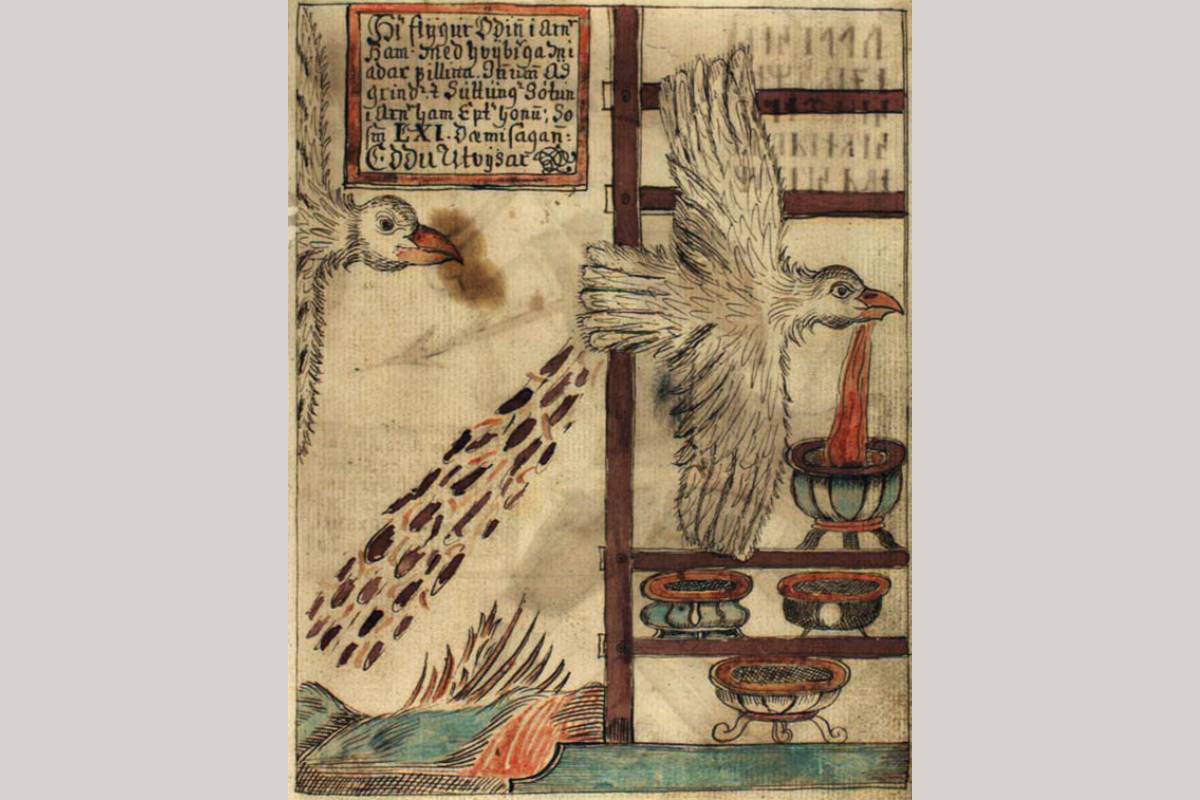
This 18th-century Icelandic manuscript shows Odin taking off with the Mead of Poetry in eagle form. Source: NKS 1867 4to
A delicious concoction
This is not the end of the Mead of Poetry, though. We know that our favorite Norse All-Father, Odin, has a quest for knowledge.
Later in the poem, he transforms himself into an eagle, steals the mead from a giant, and whisks it away to Asgard.
Yet along the way, he accidentally spills some, and from a great height, the mead's potency seems to have waned. These drips from such a great height were said to be the reason for bad poets!
It's a funny origin story for anyone who is (like the current author) not the best at crafting a cunning kenning.
The tale of Kvasir and the Mead of Poetry has everything that we loved about the Norse sagas—yes, a fair share of bloodshed and violence, but also the creation of a sacred substance that was said to give anyone not only wisdom but also immense poetic power.
This blending of the visceral and the cerebral, of broken bones and rhyming couplets, of pillaging and poetry, is why Viking societies, and the stories they told one another, have remained so intriguing to this day.
Getting down off our intellectual high horse, this story is also downright entertaining and, despite the gruesome murder of Kvasir, quite funny too.
Whoever first regaled a crowd of people from a Viking society with the tale of Kvasir had more than their fair share of the Mead of Poetry, and we are all the richer for it.
For more information on Viking poetry, visit the BBC here.
We get to provide readers with original coverage thanks to our loyal supporters. Do you enjoy our work? You can become a PATRON here or via our Patreon page. You'll get access to exclusive content and early access.
Feel free to reach out to discuss potential stories that may be in the public interest. You can reach us via email at hello@thevikingherald.com with the understanding that the information you provide might be used in our reporting and stories.