


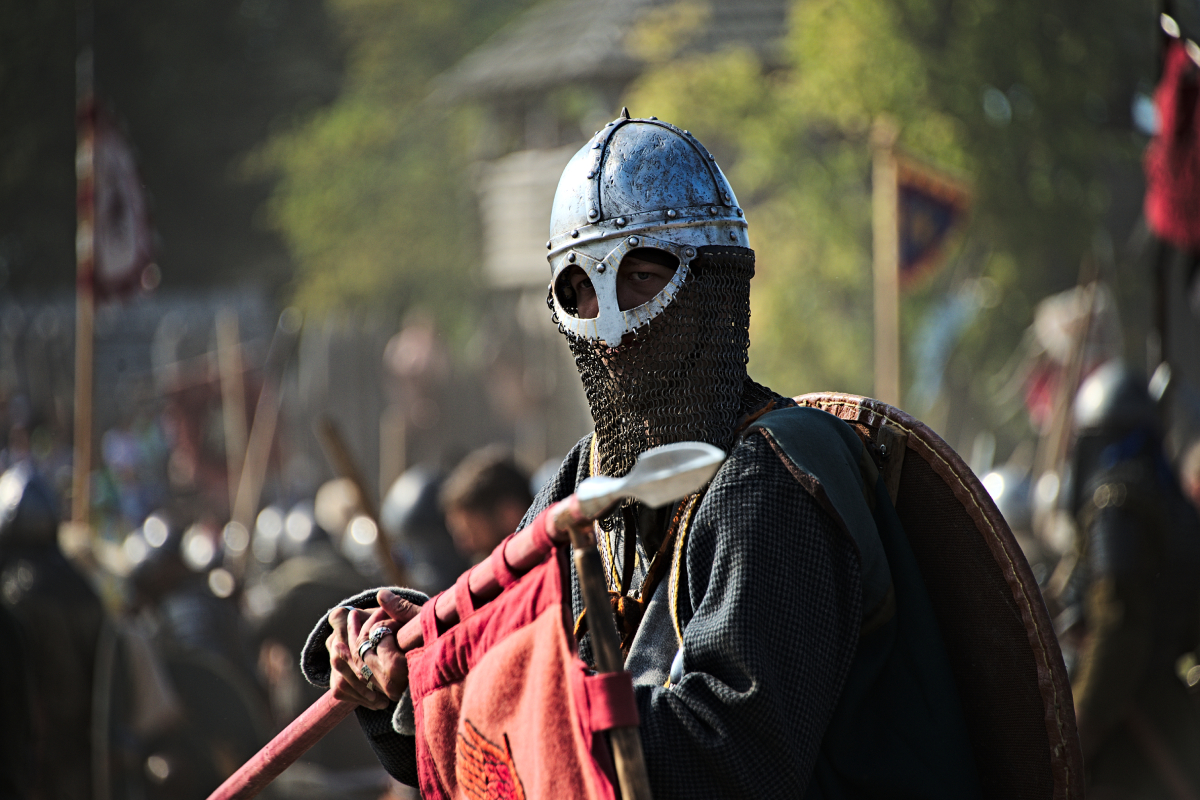
In this exploration, we delve into the five helmets that have been uncovered and examine how each one reveals unique insights into Viking culture and warfare.
Viking war
Sometimes, archeology can be a thankless profession. Imagine digging around in a field – out in the elements for hours a day – hoping to strike archeological (or literal) gold but ending the day full of sweat and dirt.
Spare a thought then for archeologists who specialize in the early medieval period, searching for artifacts and hidden treasures from people in Viking societies.
We know that these societies produced the feared Viking warriors, who terrorized Europe and surrounding areas from the late 8th century to the early 12th century.
We know that these warriors were armed to the hilt, with a plethora of swords, axes, and other weapons uncovered. Yet despite their martial prowess and the countless battles they fought, we have only uncovered the remains of five (!) helmets used by Viking warriors.
There have been several reasons put forward as to why archeologists have uncovered so few Viking helmets.
Some of the most notable include the fact that these helmets were made from iron, which corrodes and decays over time; the incredible expense, both in time and resources, required to make these helmets, making them a rare luxury; and the likelihood that only the most skilled or elite warriors wore them.
Archeologists have scoured what was once the Viking world, from the Baltic to the British Isles, from Scandinavia to southern France, and have uncovered only five remains of Viking helmets.
We delve into the history and meaning of each Viking helmet discovered.

The Gjermundbu helmet, found in nine fragments in 1943, has since been restored and is now displayed at the Museum of Cultural History in Oslo. Photo: Wolfmann (CC BY-SA 4.0)
Gjermundbu: Iconic symbol of a nation
Norway was in desperate need of a symbol of its glorious past when a farmer dug up the remains of a Viking helmet in his field in 1943.
With the country under Nazi occupation, Norwegian society was not only divided – between the resisters and collaborators – but also facing active persecution.
When Gunnar Gjermundbo started digging in a burial mound on his father's farm on that fateful day in 1943, he uncovered what has become an instant icon of the Viking Age.
The Gjermundbu helmet was found in nine fragments but has since been masterfully restored by the University of Oslo.
It is believed to have been created in the early 10th century. Later excavations of the burial mound and surrounding areas have revealed incredible archeological riches.
The contemporary historical consensus is that the burial mound belonged to a wealthy and powerful individual – more than likely an influential ruler or chieftain – who wished to depart into the next world with one of the most beautifully crafted helmets of the early medieval period.
It is now on display in Oslo's Museum of Cultural History and has become a symbol of Norway's Viking Age.
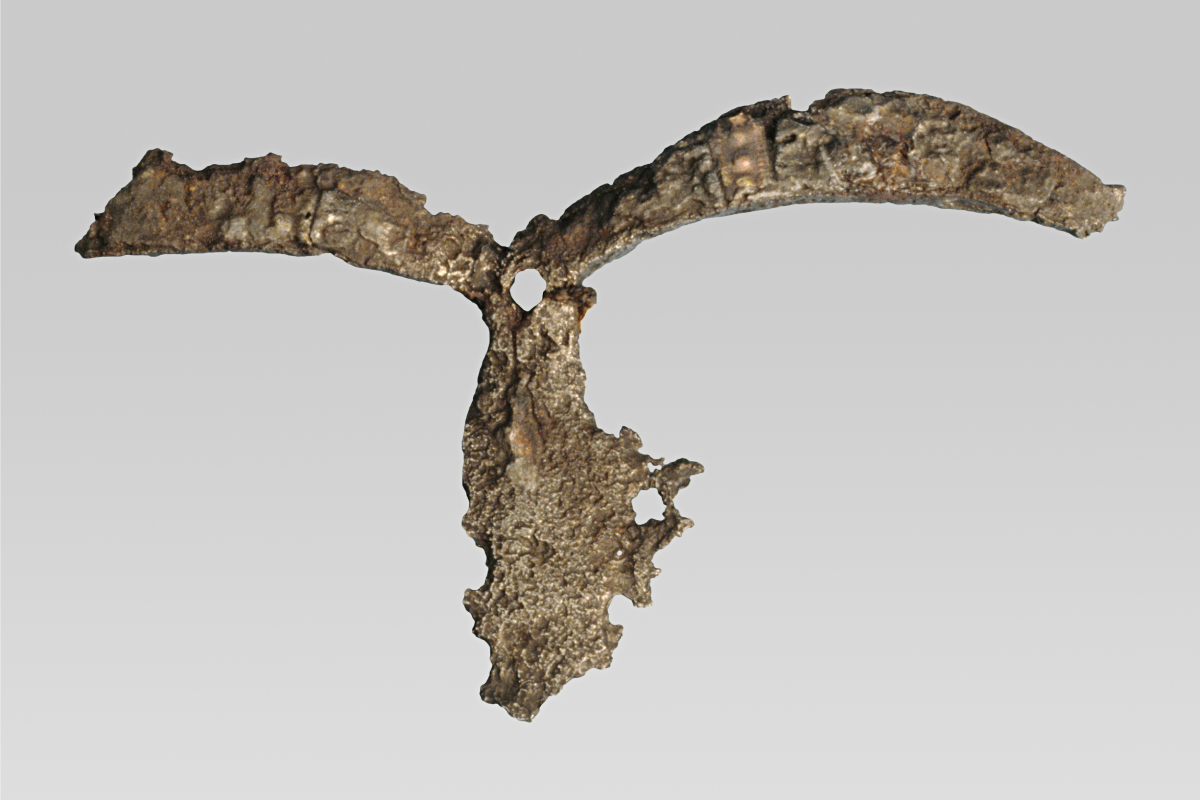
The Tjele Viking helmet fragment, initially mistaken for part of a saddle, turned out to be a vital component of a defensive face guard. Photo: Arnold Mikkelsen / National Museum of Denmark (CC BY-SA 2.5)
Tjele: A tantalizing fragment
Traveling from Gjermundbu in Norway to Tjele in Denmark, we cross the Skagerrak – the sea that separates Norway from its southern neighbor – and wind the clock back a century.
In 1850, a collection of tools from the Viking Age was sent to the National Museum of Denmark from Tjele. Among them was a "wing-shaped" object, made of bronze, that was assumed to be part of the mounting of a saddle.
There it sat, with the tools, for more than a century until 1984.
It was only in that year, thanks to modern scientific and technological advancements, that the museum staff realized this was part of a helmet – a small fragment of the nose guard that would protect part of the face from heavy blows.
The tools discovered with it date from the 10th century, and recent analysis suggests they were from around 950 to 970.
According to Elisabeth Munksgaard, the research assistant who recognized it as part of a Viking helmet, "The best finds are often made not in the field but in the museums."
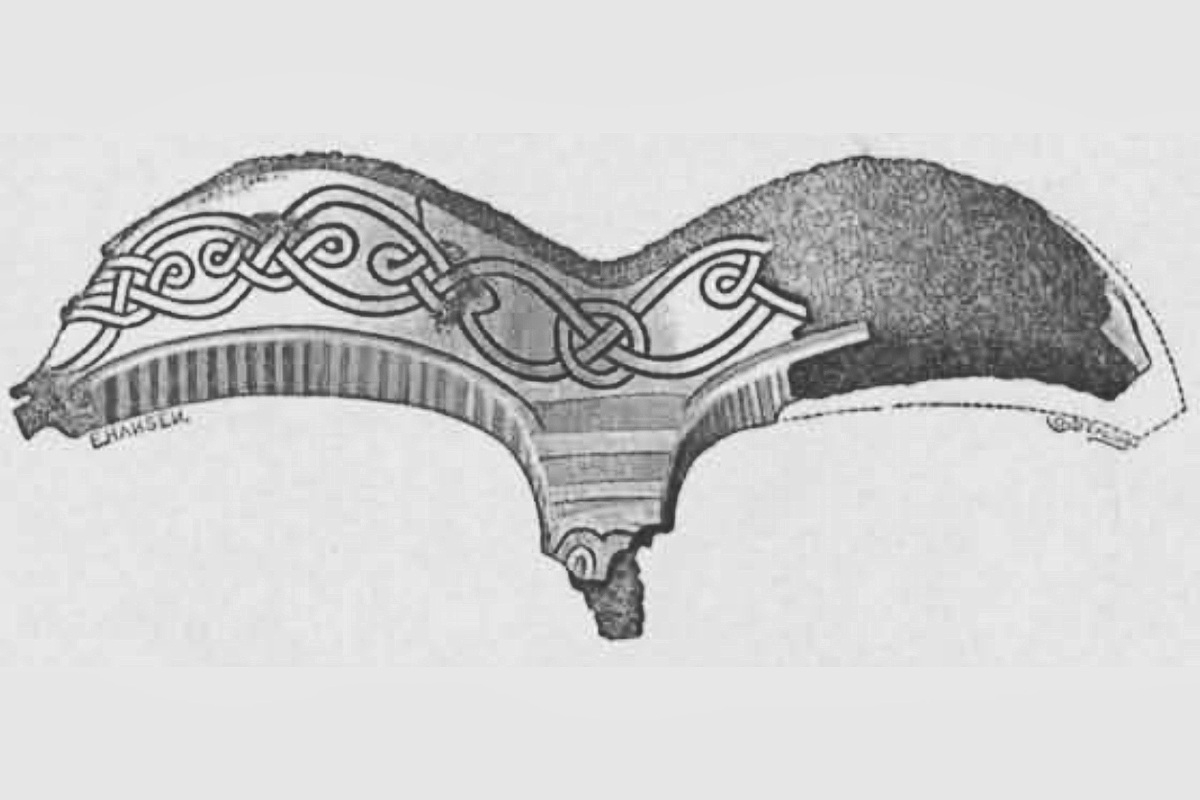
A drawing of the Lokrume helmet fragment from 1907. Source: Public domain
Gotland: A Viking treasure island
We now journey northeast from Denmark to the Swedish island of Gotland.
Today, part of Sweden, Gotland was, for centuries, an important piece of political and economic real estate for competing polities around the Baltic Sea.
Now a popular tourist hub, the island had a long and storied Viking history and was the location for the incredible discovery of the world's largest Viking hoard back in 1999.
Yet even more archeological gold was uncovered in the small village of Lokrume on the island. Though we do not know the exact date of its discovery, a small fragment of a Viking Age helmet was first described here back in 1907.
Like the other helmets, we believe it is from the 10th century. The small fragment is from the part of the helmet that protected the eyebrows and the top of the nose.
Its surface was said to be covered in silver and features a design like that on swords discovered in Norway and Poland from a similar era.
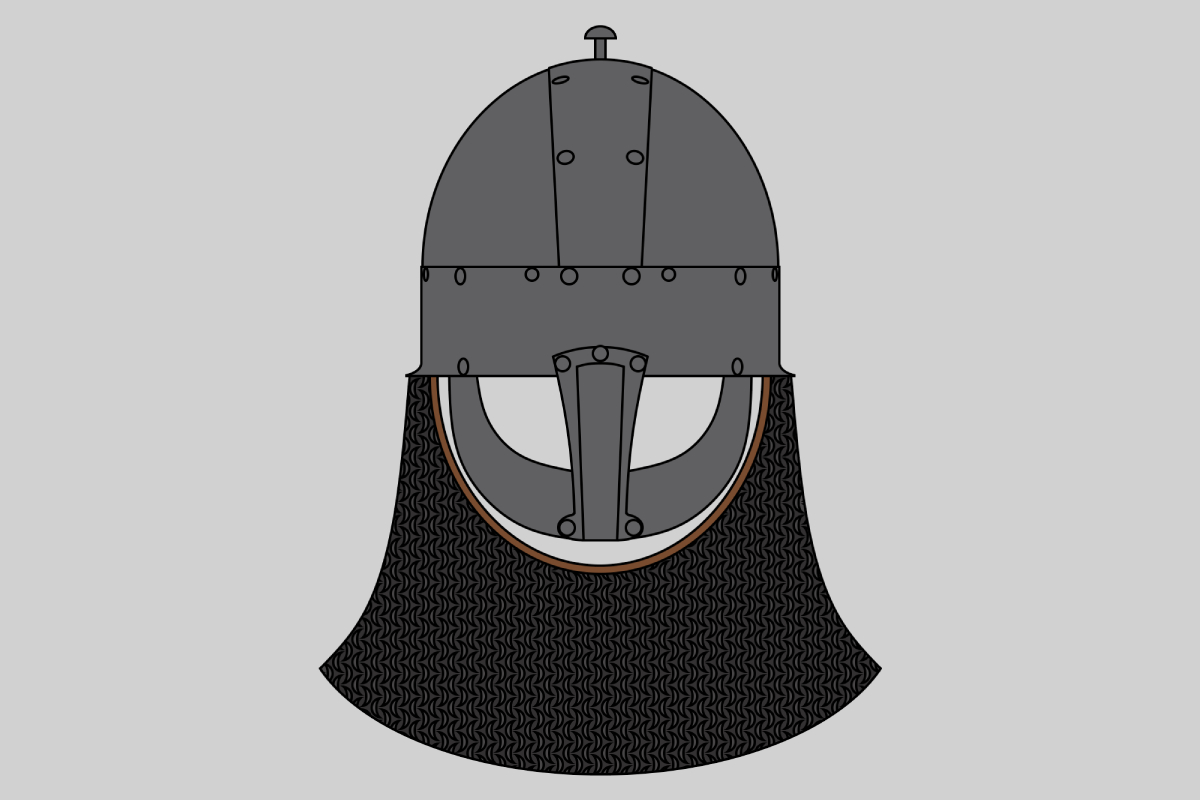
This illustration of the Yarm helmet, discovered in England, features a hypothetical mail aventail in a darker color. Illustration: Blockhaj (CC BY-SA 4.0)
Yarm: A symbol of cultural osmosis
Sailing now across the North Sea, we find ourselves in northeastern England, an area of the British Isles that was under the direct control of people from Viking societies for decades.
In the 1950s, workers were digging a ditch and stumbled across the remains of a nearly complete helmet. Recent analysis has shown that it dates to the mid-9th to early 10th century.
This period marked the consolidation of Viking invasions and conquest of the British Isles. They secured not only the Danelaw, a region of England under Viking political and cultural influence but also established the Kingdom of Jorvik.
Centuries later, the workers were digging near the village of Yarm, a place that would have fallen within this region where Viking cultural and political dominance was an everyday part of life.
As Jo Buckberry and colleagues wrote in their 2014 article in the Oxford Journal of Archaeology, given the violence and political insecurity that this part of England suffered – thanks to the Vikings – for centuries, it should be no surprise that such defensive armor was discovered.
Historians look to the Yarm helmet as an example of the synthesis of Anglo-Saxon and Norse culture, and the helmet is surely one of the most striking examples of this cultural osmosis.
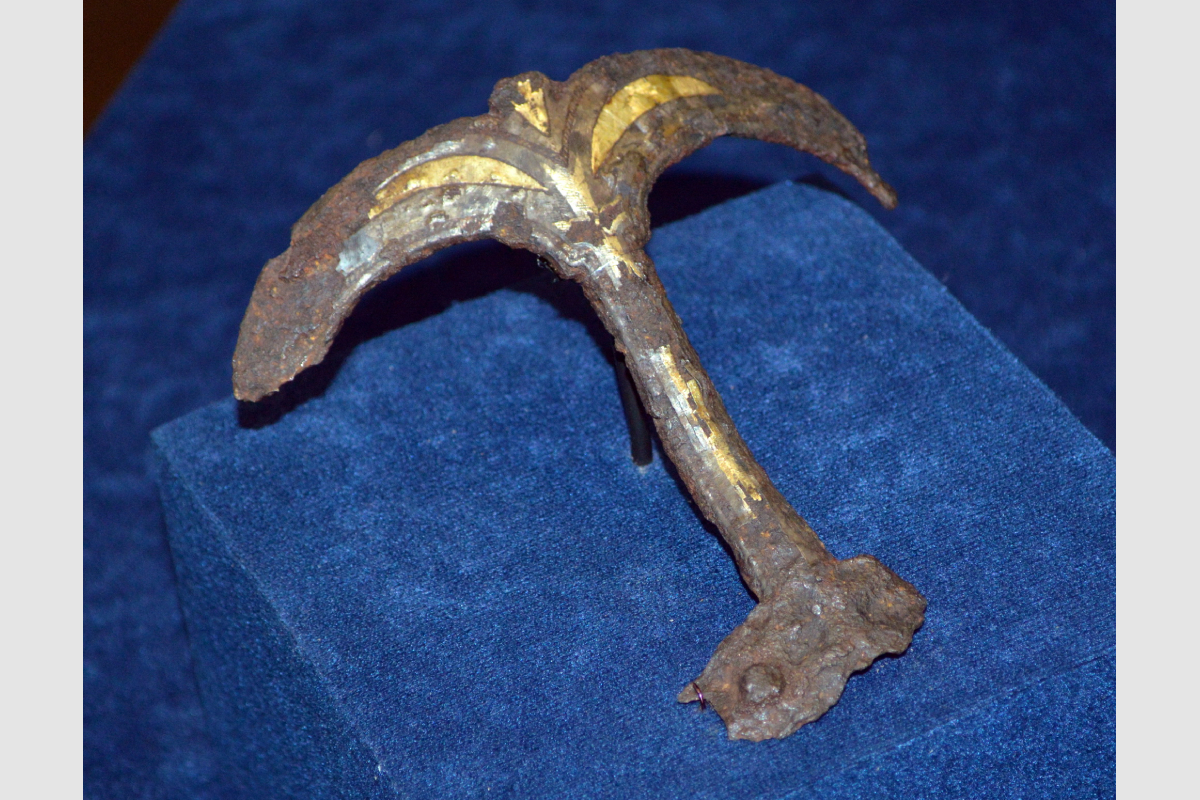
The Kyiv helmet fragment was discovered within the ruins of a church said to have been founded during the reign of Prince Vladimir of Kiev (circa 980s). Photo: Lapot (Public domain)
Kyiv: Eastern adventures
For those in the Western world, the story of the Vikings is very much one played out in Western Europe. However, just as soon as the first Viking ships sailed westward across the North Sea, they were also setting off eastward.
Journeying across the Baltic Sea, they utilized the many river systems of Eastern Europe to secure land, trade, and power in a region that spanned the Baltic to the Black Sea.
It was during this eastern expansion of Viking influence that they ventured into the heart of Eastern Europe, laying the groundwork for the emergence of Kievan Rus.
As Katie Lane wrote in her 2005 book Vikings in the East: Scandinavian Influence in the Kievan Rus, the foundational history of Belarus, Russia, and Ukraine dates back to these traders, raiders, and settlers from Viking societies.
Just as all roads led to Rome, in an earlier period, all these rivers led to the New Rome, Constantinople, the shining capital of the Roman (Byzantine) Empire.
Here, Vikings soon established themselves as merchants and traders, and their martial skills were so highly prized that they soon became the emperor's personal bodyguards.
A small fragment of a helmet, part of the noseguard, was discovered in the remains of a church said to be founded under the reign of Prince Vladimir of Kiev (c. 980s).
Though only a small part remains, this fragment of the noseguard highlights Viking adventures throughout Eastern Europe and on the fringes of the Black Sea.
It was housed in the Kyiv Historical Museum but, given the bleak situation in Ukraine at the moment, it may well be moved, along with other cultural treasures, to a safer place.
Each of these helmets tells a story of the impressive martial prowess and skilled artisanal work of the Norse, as well as their cultural exchanges throughout Europe and its surroundings.
Though we have only found the remains of five helmets, there may well be more hidden treasure lying underground, waiting to be discovered.
For more information on Viking helmets, visit the National Museum of Denmark here.
We get to provide readers with original coverage thanks to our loyal supporters. Do you enjoy our work? You can become a PATRON here or via our Patreon page. You'll get access to exclusive content and early access.
Feel free to reach out to discuss potential stories that may be in the public interest. You can reach us via email at hello@thevikingherald.com with the understanding that the information you provide might be used in our reporting and stories.




_Museum_Oslo._VIKINGR_Norwegian_Viking-Age_Exhibition_08_Iron_helmet_from_Gjermundbu_(Gjermundbuhjelmen)._Best-preserved_viking_helmet,_grave_find,_destroyed_in_funeral._Equestrian_warrior_950-1000._4665.jpg)


.png)
