


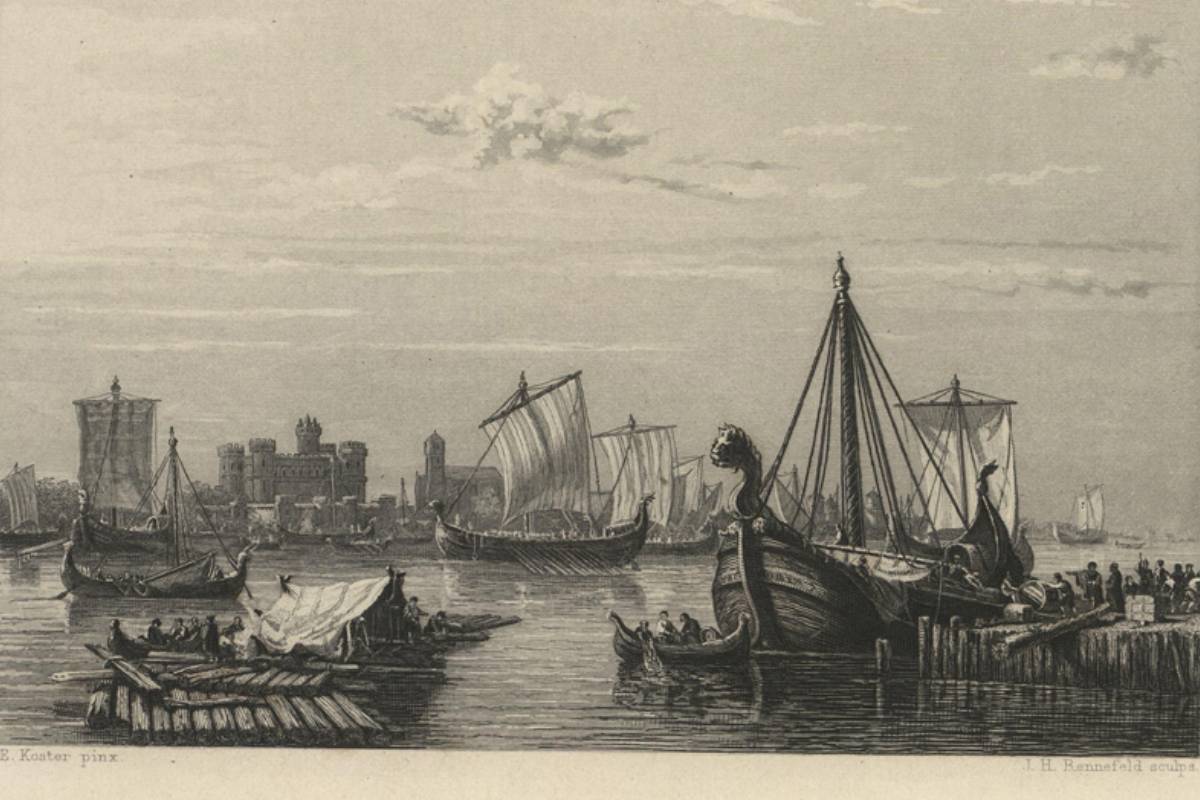
The Netherlands, it can be argued, is one of the birthplaces of the modern mercantile world.
From the first stock exchange and publicly traded company to the first global multinational (the Dutch East India Company), the modern financial world owes a huge debt to the entrepreneurial spirit of the Dutch.
However, this spirit was not a creation of the early modern period, as it can be traced back to, yes, you guessed it, our favorite historical age: the early medieval period.
Following the collapse of the Western Roman Empire during this period, and the political fragmentation of its former territory, a fortress that the Romans built, upon a fork in the River Rhine deep in what is now the Dutch province of Utrecht, soon grew.
By the reign of Charlemagne, often considered the first Holy Roman Emperor, this fortress had been developed into Dorestad, an important trading town and European entrepot.
Its strategic situation allowed it to exploit trade north to what is now Germany via the Nederrijn (a northern branch of the river), onward to the northern Netherlands, Germany, and the Viking heartland (via the Kromme Rijn, another tributary), as well as access the Anglo-Saxon kingdoms across the channel in England.
By the early 9th century CE, the town grew so rich from shipping tolls and harbor rents that it established a mint. Dorestad later vanished as a living town, but its site is known today near Wijk bij Duurstede in the Netherlands.
It wasn't long before its wealth captured the attention of warriors further north.
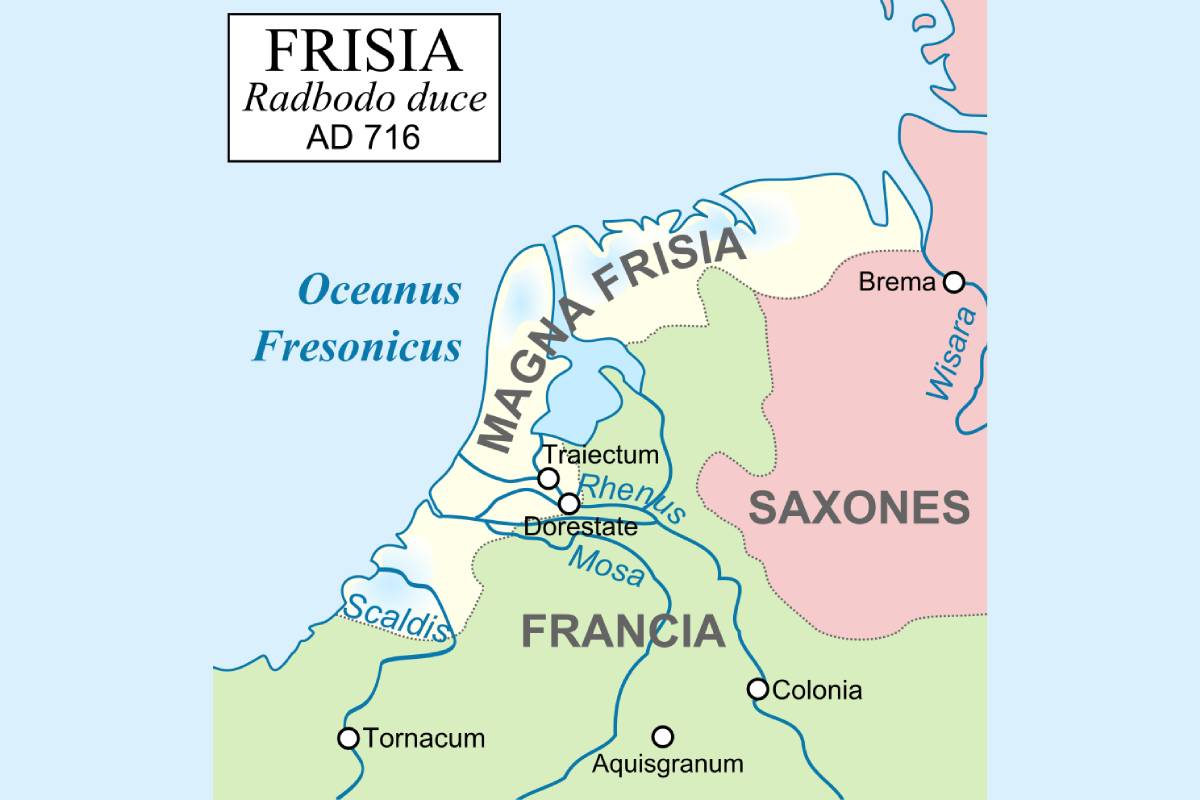
A Latin map of Frisia around 716, with Dorestad marked on Rhine routes that linked the North Sea coast with inland towns. Source: Sémhur, Eric.dane (CC BY-SA 3.0)
Exploiting political instability
The beginning of the Viking Age, the late 8th century CE, was also the high point of the wealth and influence of Dorestad.
The town grew rich as it capitalized on the burgeoning trade networks that linked places as far afield as the Islamic world, the Byzantine Empire, and Scandinavia with Charlemagne's empire.
As Christian Cooijmans writes about in his 2015 article in the journal Northern Studies, Dorestad was endowed, "...with innumerable merchants exchanging goods, silver and ideas at the emporium, its wealth and prestige made it a prime target of Viking incursion."
Soon, it was raiders, not traders, that sailed there for profit and plunder.
Dorestad had everything in a location that Viking warriors loved: it was rich, river-exposed, and a short sail from their Viking heartland in southern Scandinavia.
Whilst Charlemagne had expanded his empire's coastal defenses, especially in Frisia, a family drama was soon exploited by the Vikings.
Charlemagne's son, Louis the Pious, was ousted by his son, Lothair I, echoing later events a century later up in Scandinavia between Harald Bluetooth and his son, Sweyn Forkbeard.
This political instability saw Louis go on the attack and try to reclaim his throne. He did so by capturing Dorestad, a vital source of wealth and taxes for any would-be ruler.
He eventually won his empire back and exiled his son to Italy. However, the damage was done. Louis was now more intent on securing his throne rather than looking outward at potential strategic threats.
The first Viking raid on the town was said to have occurred in 834 CE. However, this was not a hit-and-run raid, as a second raid followed the next year.
And the year after. Like much of the Carolingian Empire and the former Frankish realms, Dorestad was experiencing this new, more aggressive and violent phase of the Viking expansion during the early 9th century CE.
- READ MORE: 5 Viking raids that shaped European history
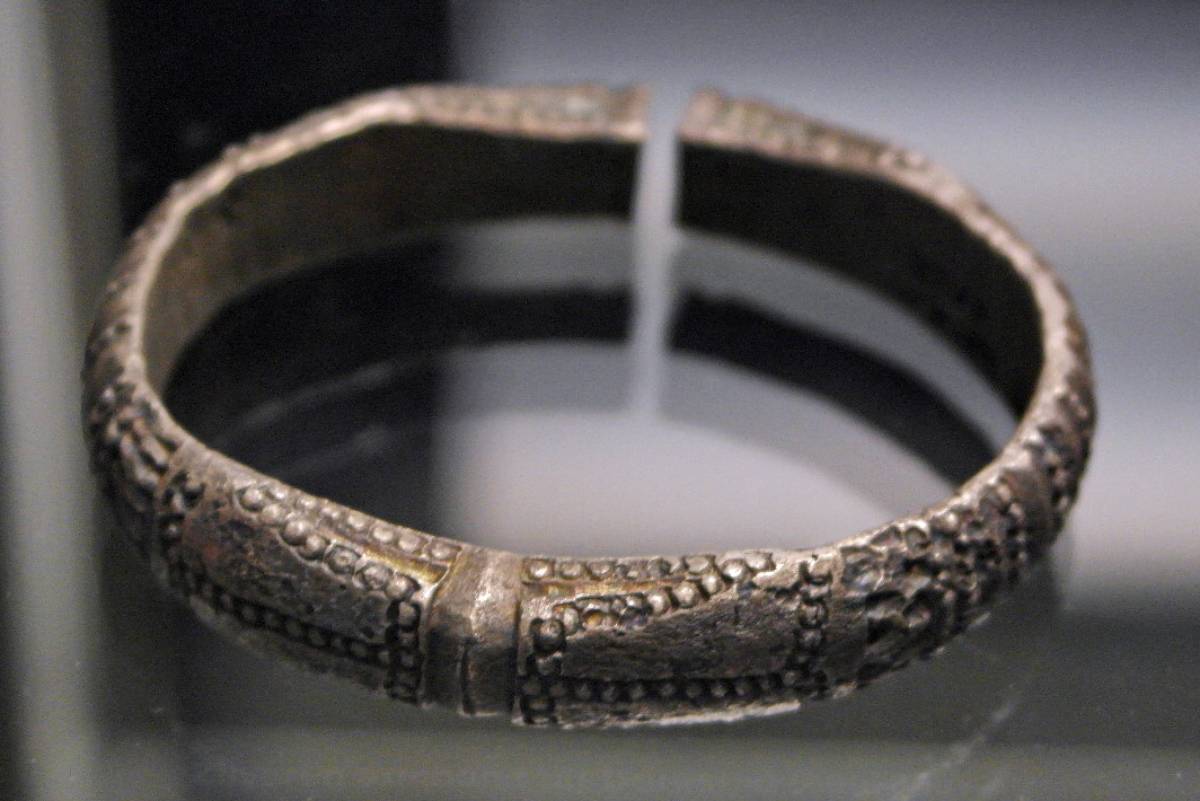
Silver bracelet from Dorestad, early 9th century. Photo: Kleon3 (CC BY-SA 4.0)
Viking control
Following the constant raiding, not only the looting of wealth, but also the untold personal tragedies that stemmed from Viking raids (including widespread violence, sexual assault, death, and enslavement), Louis decided the best way to secure this important trading town from Vikings was to bring in... well, Vikings.
Foreshadowing events further south in Normandy almost a century later, the Emperor enlisted the help of the Danes (aka people from Viking societies) to protect the town and broader region from further Viking attacks.
By the early 840s CE, a ruler emerged from the new Viking overlords: Rorik, often identified as Rorik of Dorestad.
Whilst Louis had been trying to secure his empire, Rorik had been scheming with Louis's son, Lothair, who soon awarded control of much of Friesland to the Vikings.
Rorik secured his base at Dorestad and would consider himself the "King of Friesland," ruling until the early 870s CE. Despite his self-given moniker, he was still essentially a vassal to the Carolingian emperor.
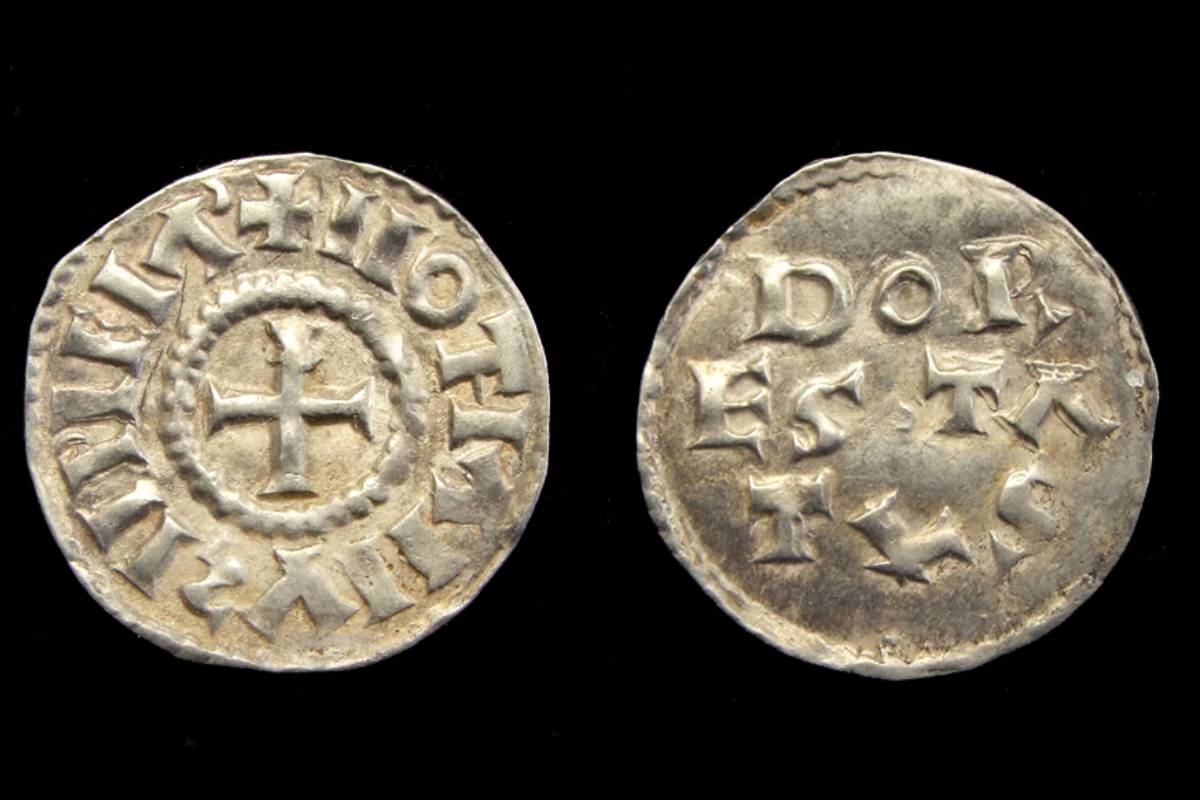
Denier of Lothair I from Dorestad, dated to about 851–855 CE, with the mint name “DORESTATVS” on the reverse. Photo: Numisantica (CC BY-SA 3.0)
Decline and a blueprint for later exploits
Despite being a nominal "Viking" possession, further raids were said to have occurred during Rorik's rule.
However, after more than two decades of raiding, it appears that the town declined in its economic importance. Traders and merchants plied their trade elsewhere inland or further away from the Viking threat.
Within a few decades, the Vikings that had once sailed down to attack the Frisian coast, to plunder and pillage, would turn their eyes across the English Channel.
From the mid-860s CE, Viking warriors plundered and pillaged huge swathes of Anglo-Saxon England. Here, unlike a boatful of possessions, Vikings could secure land and untold wealth; some even established kingdoms.
Despite a focus on Anglo-Saxon England, Viking raiding on the Rhine certainly did not stop.
Whilst Dorestad seems to have declined into obscurity, Vikings used the Rhine to raid further and further inland, attacking deep into the Frankish heartlands.
Towns like Aachen, Bonn, Mainz, and Cologne were all laid to the sword and axe.
The history of the Carolingian Empire during the first half of the 9th century CE is one of the failures of successive rulers to stop the increasing frequency and violence of Viking raids.
The raiding that led to political negotiations and the acquisition of Dorestad would serve as a blueprint for later Viking raiders, particularly those who attacked the Frankish realms between the Seine and Loire during the early 10th century CE.
Whilst Vikings loved a coastal community, it was their raids down the Rhine, including on Dorestad, that secured their title as river kings.
For more information on a recent possible Viking find in the Netherlands, visit the Smithsonian Magazine here.
We get to provide readers with original coverage thanks to our loyal supporters. Do you enjoy our work? You can become a PATRON here or via our Patreon page. You'll get access to exclusive content and early access.
Feel free to reach out to discuss potential stories that may be in the public interest. You can reach us via email at hello@thevikingherald.com with the understanding that the information you provide might be used in our reporting and stories.




,_Rijksmuseum_van_Oudheden,_Leiden.JPG)
