


Do all historical roads lead to Rome? Well, if you're talking about Europe, the answer is a probable yes.
Without wanting to wax lyrical about the glories of the Roman Empire – we'll leave that to our esteemed colleagues on podcasts like The Rest is History – so much of the story of Europe can be viewed through both a pre-Roman and post-Roman lens.
Look at the modern nation of France. Before the Roman legionaries, this was a region full of disconnected cultures, peoples, and tribes.
Following France's "Rome Era," the Carolingian Empire emerged, laying the foundations for the later medieval kingdom of France – you know, the one the English fought and hated, and the kingdom responsible for the construction of the (old) Notre Dame and the production of Joan of Arc.
What we here at The Viking Herald are interested in is what happens in the somewhat historically obscured period (just don't call it the "Dark Ages," please) between the collapse of Rome's power in what is now France and the emergence of the kingdoms that would form the backbone of medieval France.
Enter the Vikings
It is in this period that our friends, the Vikings, did their best (or, if you were an early medieval inhabitant of France, their worst) work – full of the usual plunder, pillage, rape, and ransack.
Throw a little commerce into the mix, too – after all, they weren't all barbarians.
Vikings had been raiding the coastal communities of what is now France since the late 8th century and took to the river systems – especially the Loire and the Seine – in northern France to launch countless early medieval blitzkriegs.
We have tales, in the Norse sagas, of the Vikings coming to ransack a small town on the river Seine by semi-legendary figures like Ragnar Lothbrok by the mid-9th century.
This first half-century of Viking incursion was more predatory. Following the sack of Paris in 845, the next half-century saw more advanced and organized Viking attacks decimate all of France.
These raids stretched from Paris to the Pyrenees, from the Seine River in the north to the Rhône in the south, emptying out gently into the Mediterranean and everywhere in between.
Despite the best efforts of the Frankish and later Carolingian elite, nowhere was more plagued by Viking attacks on the continent than the region around what is now France.
One of their most successful leaders was Rollo, whose tenacity would secure a Viking foothold in Frankish real estate and change the course of France forever.
- READ MORE: The Viking history of France (Part 1)
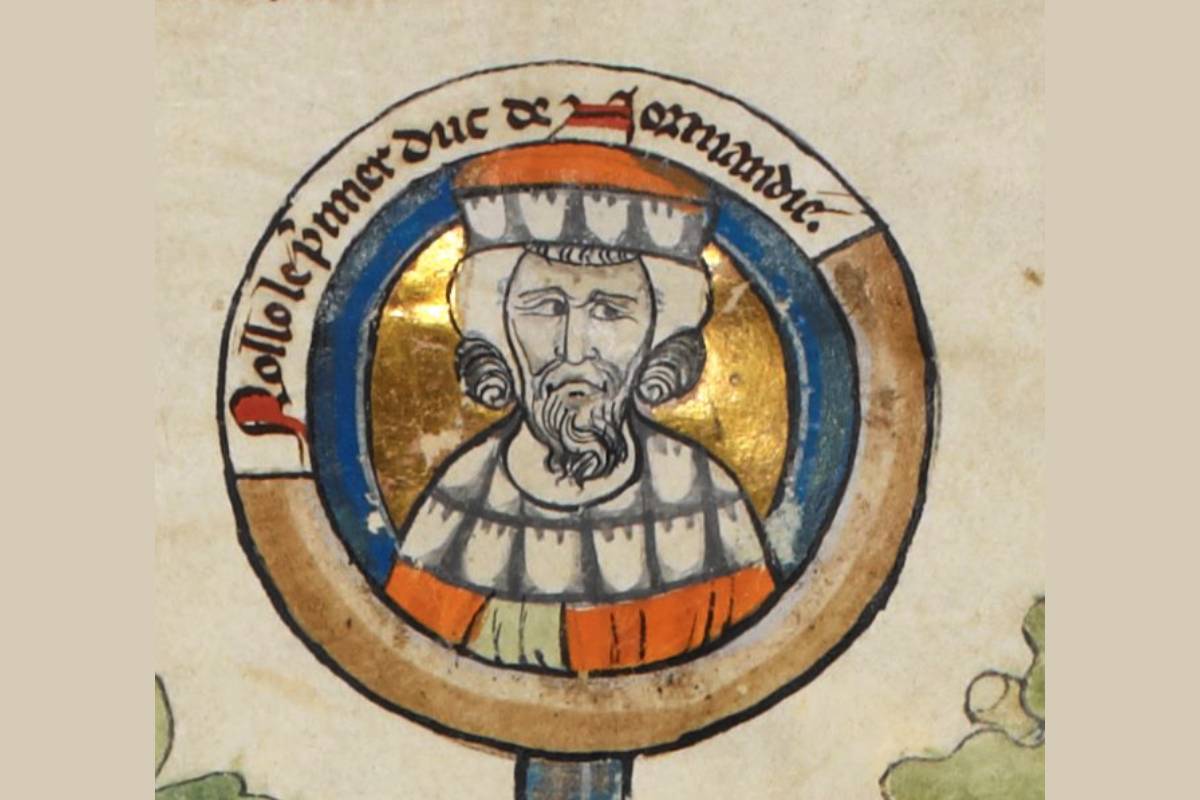
In 911, Rollo, a Viking chieftain, was granted the title of Duke of Normandy, marking the beginning of Norman rule. Source: Public domain
Hrolf comes rolling in
Like most early medieval warriors, we know little of the true origins of Rollo.
We are told, in the sagas and the scant historical records, that he was of Danish origin – but whether he was born somewhere within the modern borders of Denmark or – more likely – this just meant he was probably from Scandinavia – we'll never know.
It appears that our Rollo was a feared warrior. His actual name may have been Hrolf Ganger ("Rolf the Walker" in English – not exactly a Tarantino-esque badass nickname, but I'm sure he was scary enough wielding a sword).
Names aside, Hrolf / Rolf / Rollo launched an unsuccessful attack on the capital of West Francia, Chartres, in 911.
The Frankish ruler at the time, Charles the Simple (a more memorable nickname than Rollo but regrettably so for Charlie boy), would ultimately lift the siege of this important capital.
Yet it appears that the psychological damage had been done after decades of deadly Viking attacks.
Seeing which way the (metaphorical) wind was blowing, Charles decided to embark on a different course of action to stem the Viking flow.
Despite lifting the siege and securing a tactical battlefield victory, Charles knew that he could not strategically win against Rollo and his Viking kind. The only way to secure peace was to negotiate.

The treaty granted Rollo control over land centered around Rouen, which became the heart of early Norman territory. Source: Sergii Figurnyi / Shutterstock
A famous treaty to secure some prime medieval real estate
The powerful and mighty under both Charles the Simple and Rollo met at the town of Saint-Clair-sur-Epte, lying on the road between Rouen and Paris, in 911.
The negotiations would see Charles the Simple cede a prime piece of Frankish real estate – between the rivers Loire and Seine – to Rollo and his followers to colonize and settle.
In return, as Jean Renaud discusses in their chapter in the 2008 book The Viking World (available on Amazon here), edited by Stefan Brink and Neil Price, Rollo and his followers would convert to Christianity.
As Renaud explains, "The king apparently granted Rollo a territory already more or less under Danish control, demanding that the Vikings should defend it, thus protecting the realm from further attacks, and become Christians."
Rollo would himself become a vassal of Charles (as the first Duke of Normandy) and pledge to protect this region from further Viking incursions and invasions.
Not for the first time in pre-modern history, a ruler of a settled society used a predatory "barbarian" to fend off attacks from other "barbarians."
From the Byzantines to the Ming Chinese, this tactic has been used as a key tool of foreign policy the world over.
For Charles, it was, in the words of former U.S. President Lyndon Baines Johnson, better to have Rollo and the Vikings "inside the tent pissing out, than outside the tent pissing in."
The area of land that was ceded to Rollo became known as the land of the "Norsemen," which would, over the decades, turn into "Normandy" in the local Frankish dialect.
In fact, the modern borders of Normandy have changed little in the 1,100 years since the treaty was signed.
- READ MORE: Top 5 Viking sites in Normandy and France
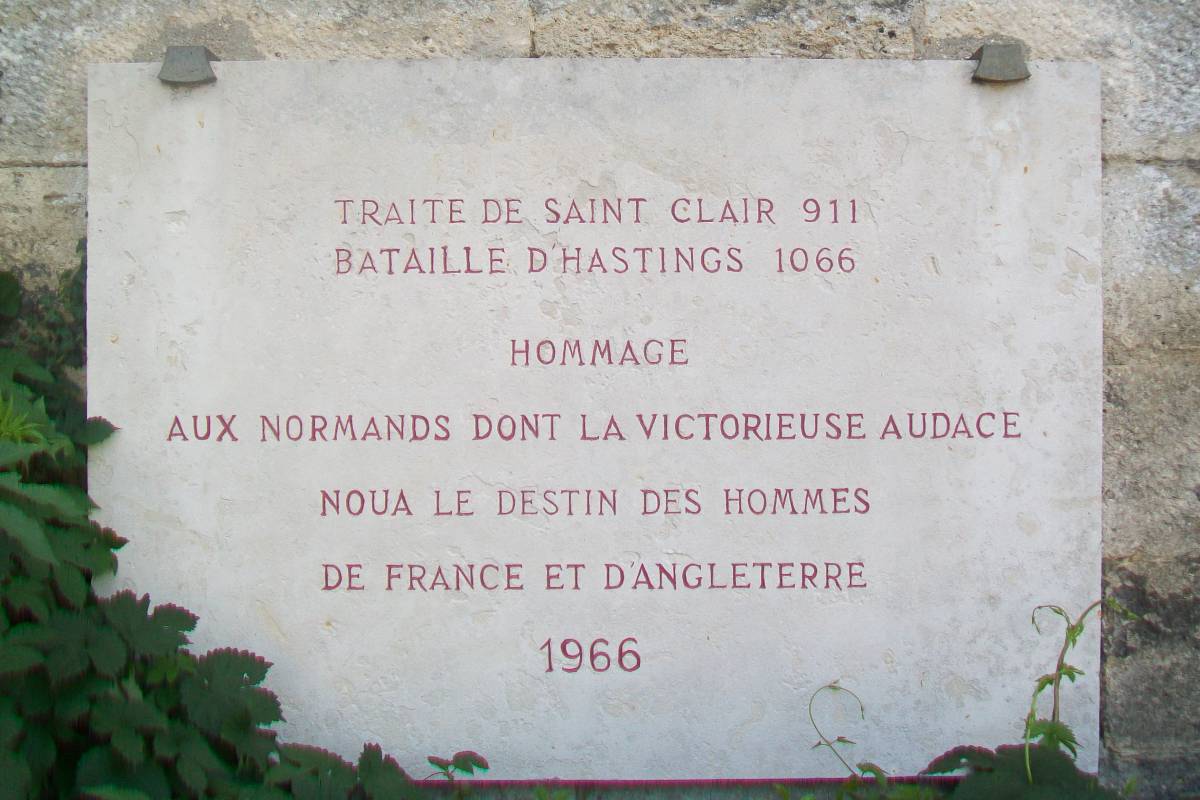
Installed in 1966, the plaque honors Norman boldness, recalling the Treaty of Saint-Clair and the Battle of Hastings. Source: P.poschadel (CC BY-SA 3.0)
From Vikings to Normans
With the treaty signed and a prime piece of European real estate won, Rollo is said to have been gifted the daughter of Charles to wed.
One wonders whether poor old Giselle, Charles' daughter, had any say in her use as a political pawn piece. Rollo and his fellow people from Viking societies soon settled down, farmed the land, and adapted to the local customs and language.
However, that is not to say that they shed all vestiges of their Viking culture.
Over the course of the next few centuries, these people developed a hybrid culture that took the best parts of Frankish society. This included the language, the religion, and the feudal system.
They combined these with the best of their Viking heritage – a violent warrior ethos and an inherent desire to journey forth throughout Europe and its surrounds.
It was this mixture of cultures, as Letty ten Harkel discusses in her 2006 article The Vikings and the Natives: Ethnic Identity in England and Normandy c. 1000 AD, published in the journal The Medieval Chronicle, that saw the Northmen become the Normans.
Their expansion outward in the world, which saw them conquer, fight, and settle everywhere from the British Isles to Byzantium, from the Italian to the Iberian Peninsula, and everywhere in between, is a story that both runs parallel with and later concludes the Viking expansion of the early medieval period.
All of this was possible thanks to the Treaty of Saint-Clair-sur-Epte, which helped turn early medieval people from Viking societies into medieval Normans.
For more information, including a great documentary hosted by esteemed medieval historian Dr. Eleanor Janega, visit History Hit here.
We get to provide readers with original coverage thanks to our loyal supporters. Do you enjoy our work? You can become a PATRON here or via our Patreon page. You'll get access to exclusive content and early access.
Feel free to reach out to discuss potential stories that may be in the public interest. You can reach us via email at hello@thevikingherald.com with the understanding that the information you provide might be used in our reporting and stories.



,_plaque_comm%C3%A9morative_pr%C3%A8s_de_la_mairie.jpg)