

As the Norse sagas tell us, Erik the Red was the man responsible for establishing the first Norse settlements of Greenland. In time, this nascent colony would evolve into a society that would last well beyond the Viking Age.
Over the past few decades, archeological excavations at Erik's former abode of Brattahlid have helped to reveal some of the history behind the legend. So what do we know about the home of one of the Viking Age's most famous and colorful characters?
Early beginnings...and banishments
We have written widely on the life story, itself a literal saga, of Erik the Red. Nevertheless, it is worth a quick recap before we delve into the details of his famous estate.
The man known to posterity as Erik the Red (or Erik Raude in Old Norse) was born in the middle of the 10th century CE as Erik Thorvaldsson. At this time, there was an increasing frequency of Viking ships, ferrying goods and people (free or enslaved), and crisscrossing the waters of northwestern Europe.
This was an era where people from Norse societies had spread out across Northern Europe to build new worlds, or reforge old ones, from Iceland all the way to the Black Sea and seemingly everywhere in between.
Erik and his family grew up on the western coast of Norway, around Rogaland. Despite having spent his formative years on Norway's beautiful western coast, his fate would be linked to regions further west across the Atlantic Ocean.
When young Erik was ten, his father was banished from Norway for manslaughter, and headed across the Norwegian Sea to what was then the medieval equivalent of a Cowboy Frontier town: Iceland. The settlement of Iceland was only decades old, and it was here that Erik grew up, married, and started a family of his own.
His children, according to the sagas, included his equally famous son, Leif Erikson, and a daughter, Freydis Eirikisdottir. Just like their father, both would become renowned for their adventurous exploits.
Erik, on the other hand, apparently inherited a violent streak from his own father. Following a dispute with a neighbor’s thralls – who were said to have started a landslide that killed a friend – Erik murdered a man and was exiled in 982. He first headed to some of the western islands off Iceland’s coast. However, yet again, Erik’s violent temper got the better of him. Following another murder, he sailed westward still.
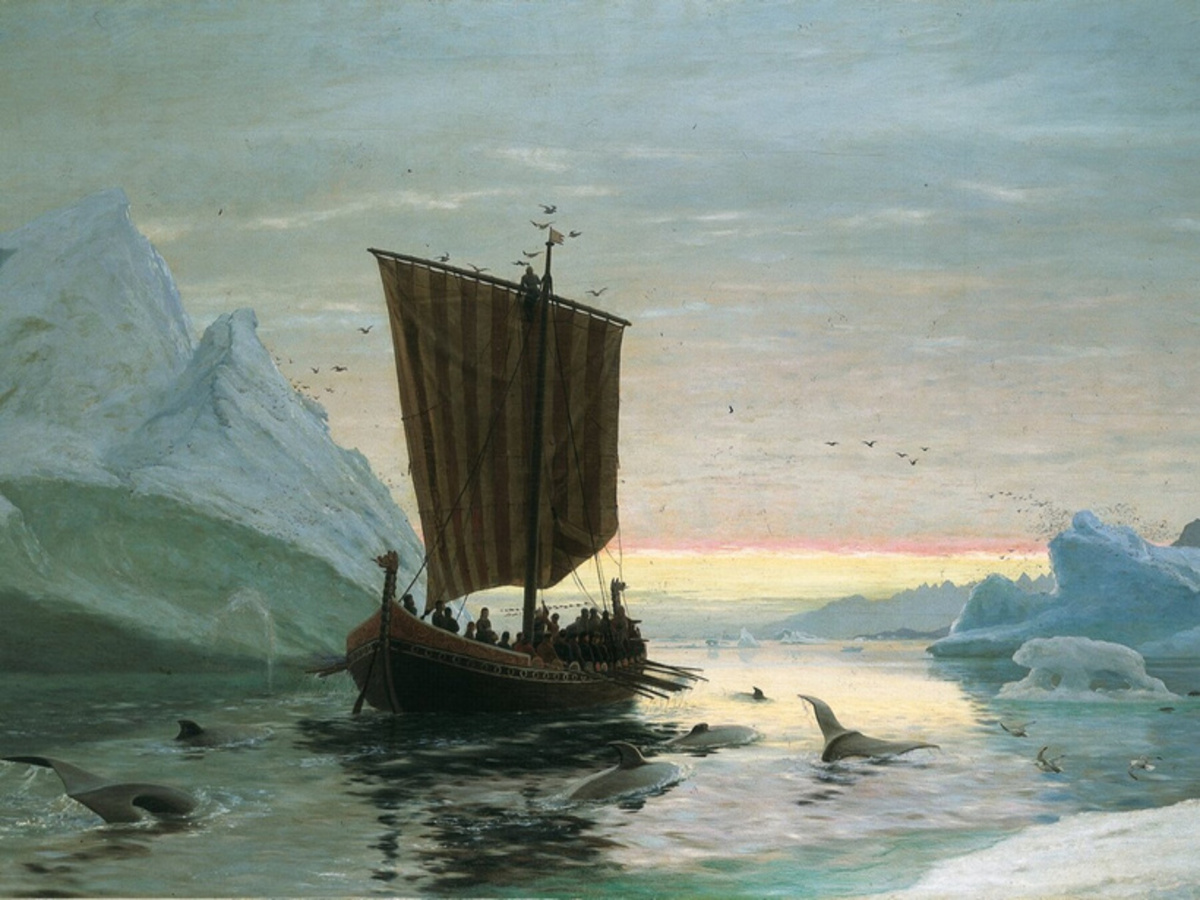
Erik the Red in Greenland, by Jens Erik Carl Rasmussen. Source: Public domain
New lands
Although Erik has often been hailed as the European discoverer of Greenland, there is no conclusive evidence that this is definitely the case – other Norse compete for the same claim. What we can assert with some confidence, however, is that Erik the Red was key to its extended settlement by the Norse.
According to his eponymous saga (we quote here from an online version based upon the 1880 English translation by J. Sephton), Erik sailed to Greenland, before returning to Iceland, bringing news of a new "virgin" land to the west. Erik also coined the name, despite Greenland’s notable lack of greenery,
"...because," said he, "men will desire much the more to go there if the land has a good name."
Erik convinced, "Thirty men ventured on the expedition with him" as well as their families, to sail from Iceland to Greenland. The new settlers experienced a truly horrid start to their new lives that involved, " ...great gales, and made but an ill-sped voyage throughout the summer. In addition to that trouble, there came fever upon the expedition..."
These people were made of hardy stuff. Soon they had established two settlements, now commonly referred to as the Eastern Settlement and the Western Settlement. This was the beginning of Greenland's close relationship with Scandinavia (something that still, of course, has geopolitical ramifications today).
The Eastern Settlement
At this point, it should be acknowledged that the names of the two Norse settlements in Greenland are somewhat confusing. The so-called Eastern Settlement, where Erik would reside, actually lies on the southwestern tip of the island. It was, however, further to the east than the Western Settlement – hence the name.
The settlement was founded within what is today known as Tunulliarfik Fjord, also referred to as Eiríksfjörður – Erik’s Fjord. It was here, in an area that offered protection from the ocean yet also access to the open seas, where Erik and his fellow travelers would establish the first farms of the new colony.
At its height, there were, at best estimates, around 4,000 inhabitants in the Eastern Settlement. Whilst this may well seem like a small figure, it is worth remembering that medieval urban populations were generally far smaller than today. As an example, following the Norman Conquest, London, today a global megacity, had barely a population of 10,000-15,000.
Wild farming
Yet it would also be inaccurate to think of the Eastern Settlement as a concentrated urban center. With space aplenty, the Eastern Settlement developed into something more like a farming frontier town – not unlike the pastoral properties of the American West during the 19th century. This was an economy and society built upon livestock farming – sheep and cattle with some seal hunting.
Archaeological explorations have confirmed that the settlement was made up of a large number of farms and estates spread over a wide area. We are aware of the ruins of about 500 farms within this region, spanning the four centuries of the Norse settlement of Greenland (c. 1000-1400 CE) as well as 16 churches.
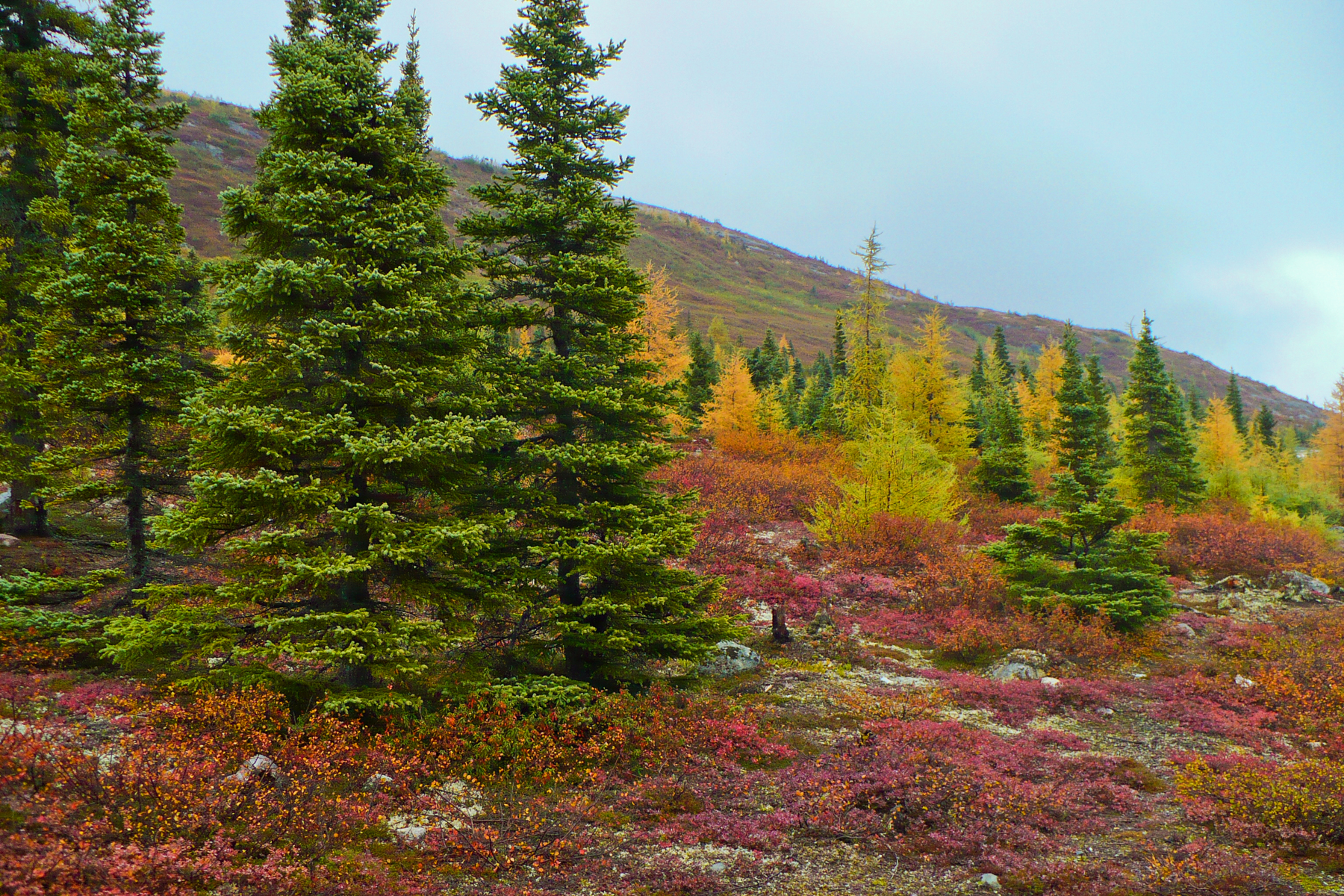
It is also worth noting that this settlement was possible thanks in part to a phenomenon known as the Medieval Warm Period, a period of relative warmth in the North Atlantic from c. 950-1250 C.E. This means that in contrast to modern conceptions of Greenland today as a winter wonderland, Greenland, in the warmer months, actually lived up to its name to some extent.
So, having been responsible for the early beginnings of the Norse settlement of Greenland, what sort of homestead did Erik the Red establish?
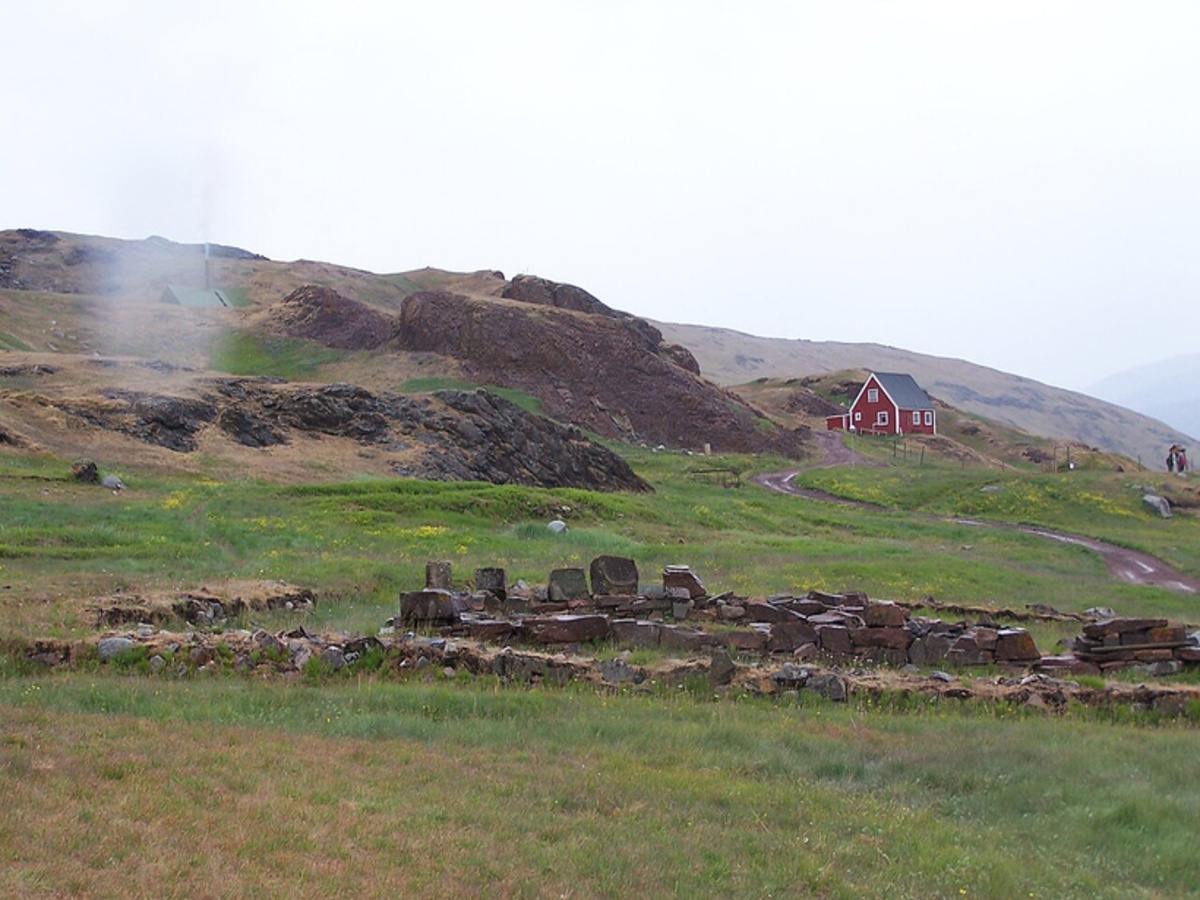
Brattahlid ruins. Source: Af PederM, Wikipedia
Brattahlid – the steep slope
Brattahlid, the large estate of Erik the Red, is situated about 60 miles / 100 kilometers from the harsh Atlantic Ocean, at the head of the Tunulliarfik Fjord. As the sagas tell us, Erik established a home and estate that would serve as a seat of power that would help strengthen his hold over the budding colony.
Naturally, Erik also chose the best grazing pastures – in a new land, livestock and good quality arable land was both essential to survival and a source of prestige and power. As the manor farm grew, Brattahlid developed a reputation for hosting enormous feasts – particularly at Yule time.
On many an occasion, Erik would receive other powerful local figures and important guests – such as the explorer Thorfinn Karlsefni, who wintered at Brattahlid after arriving from Iceland with two cargo ships. Later, Brattahlid also served as the staging ground for Leif Erikson’s voyages to North America.
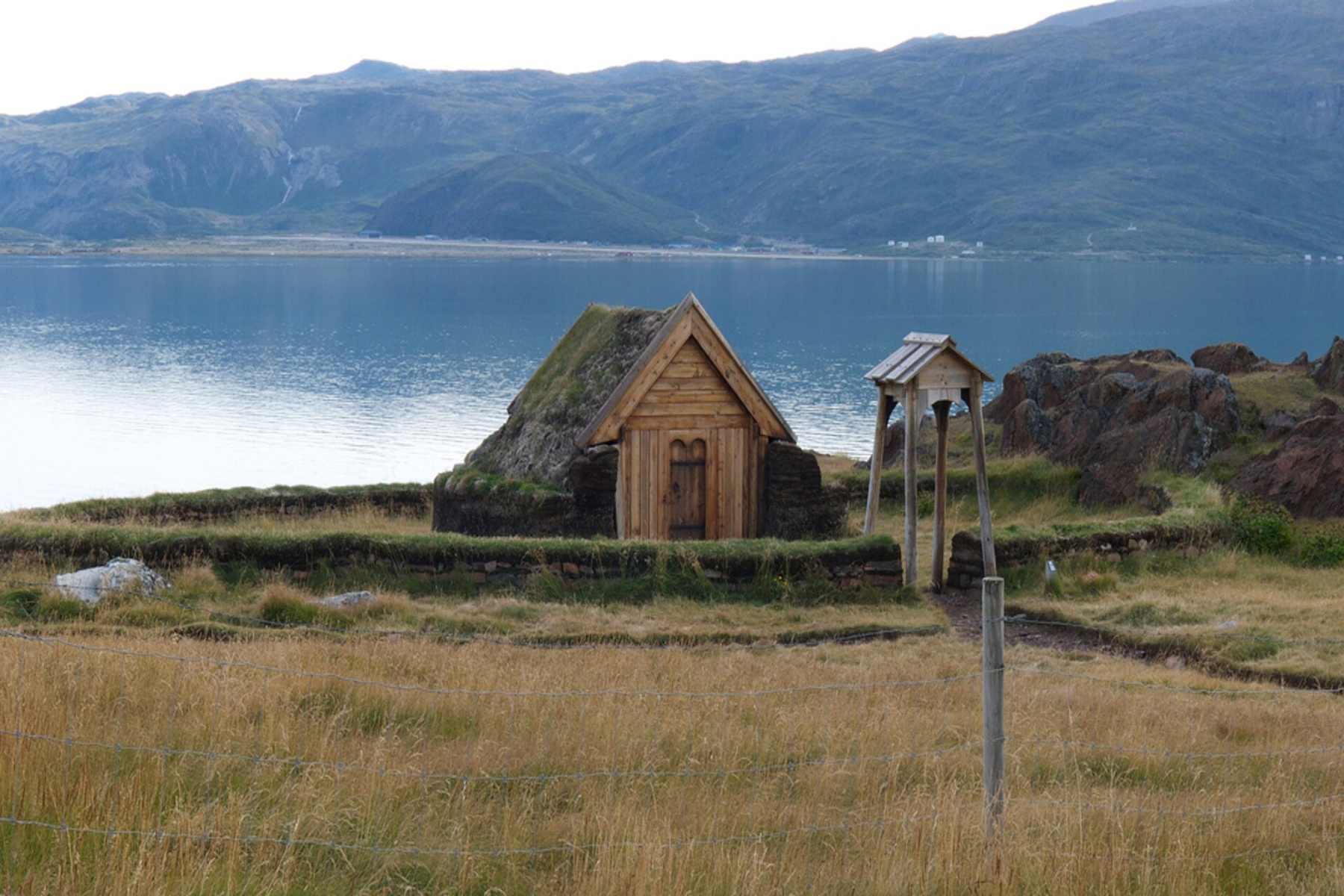
There were disputes too, of course, even in Erik’s time. Erik’s Saga tells of one incident where Leif returned to Brattahlid with a priest and Christian teachers sent by Olaf Tryggvason, King of Norway. Though Erik’s wife Thjodhild converted immediately, the leader angrily rejected the new faith. Undeterred, Thjodhild had a small church built – though at a short distance from the main farmstead.
Even beyond Erik's passing, Brattahlid remained an important location for many years. As late as the 1120s, it was the official seat of Greenland’s lawman, Sokki Þórisson, who petitioned the Norwegian crown for permission to establish an independent bishopric in Greenland.
Archeological traces of Erik’s abode
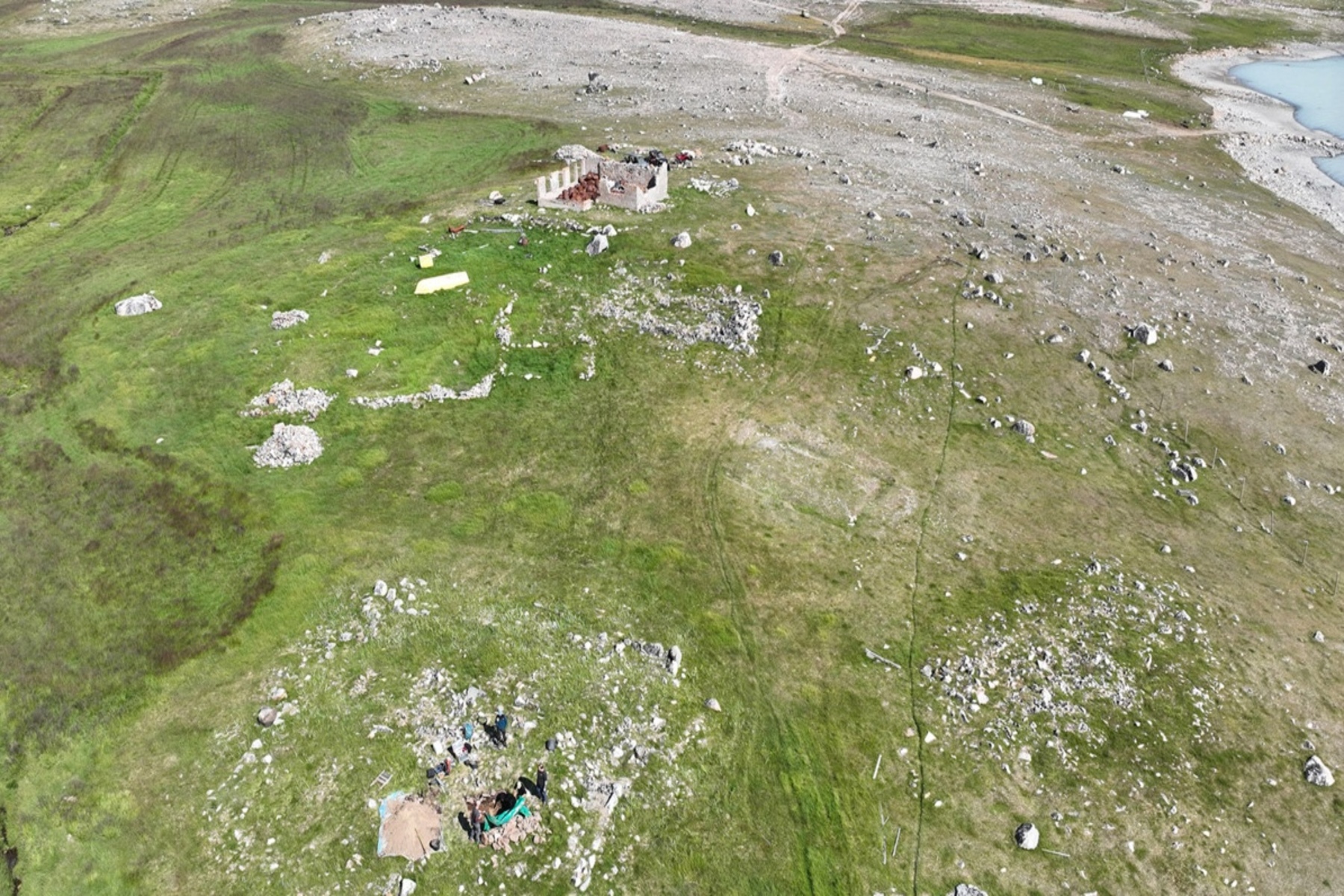
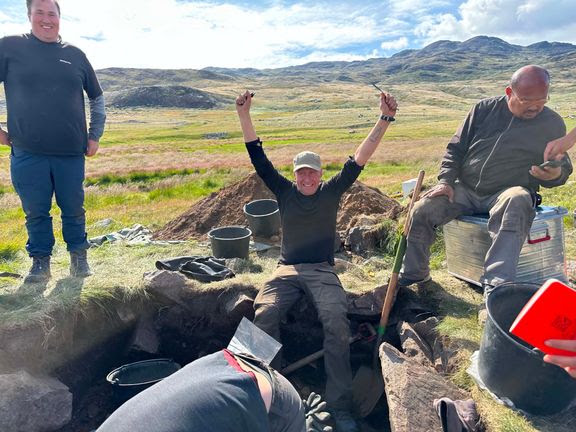
Today, we know the exact location of Brattahlid (Steep Slope in English). Archaeological excavations have uncovered evidence of a large and thriving community that Erik established, including two churches, a storehouse, a stable, a milking fold, a sheep pen, the remains of a dwelling, and potentially a forge too.
That Erik established Brattahlid here was no accident. This is some of the best farmland throughout Greenland as it is sheltered from the harsh climate rolling in from the Atlantic Ocean. Despite the location, and the relative "warmth" of the period, this was still Greenland.
The remains of the dwelling show thick stone walls with an added layer of protection from turf. This was a medieval version of insulation that helped to regulate the temperatures inside, keeping them warm in winter and cooler in the warmer months.
Aside from those living in and around the estate, there was evidence found of a graveyard. The remains of 144 individuals have been uncovered but, sadly, there were no grave markings or headstones, making their identities impossible to discover. Could one of these individuals be Erik the Red? Perhaps it is unlikely, given that the bodies lie near the church and Erik remained a committed pagan, but we will never know for sure.
What is certain is that Brattahlid remained a bustling estate that survived the death of its founder for many generations. Aside from the longhouse that was the center of dwelling for those that lived on the estate, we can imagine it supporting the lives and livelihoods of a sizable number of people during the Norse settlement of Greenland.
The political significance of Brattahlid
Aside from being the location of Erik the Red's familial estate, Brattahlid is also regarded by many as the home of the first Greenlandic parliament. Traditionally, the Althing in Iceland is cited as amongst the oldest continuously running parliaments in the world, tracing its origins back to 930 CE.
Like all aspects of Viking society, the political institutions were also exported during the outward Viking expansion during the early medieval period. Given his pivotal role in the early development of the Norse settlement of Greenland, it is certainly plausible that a “thing”, or assembly, would have been held regularly on the estate of Erik the Red, whose standing and influence would have made him a natural host.
Scholars have identified two possible sites for such a meeting, one at Brattahlid, and another at the nearby Garðar. Naturally, this custom would have passed with the end of the Norse Greenland settlements, and neither site is a confirmed place of assembly as of yet.
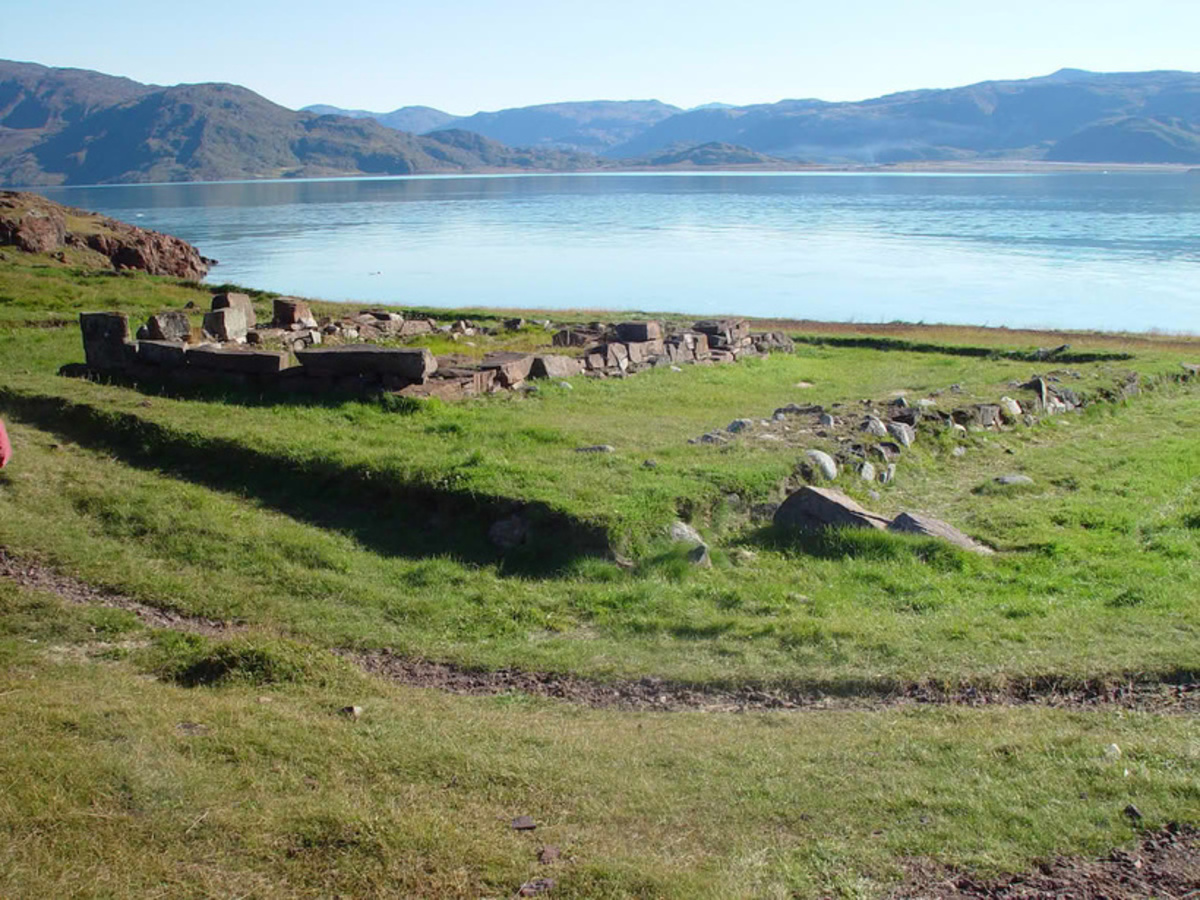
Another view of the ruins at Brattahlid. Source: Store Norske Leksikon
World Heritage Site
Brattahlid was, like the remainder of the settlements on Greenland, eventually abandoned by the early 15th century. There is some historical speculation as to what caused this abandonment, but likely a combination of climatic change (the ending of the Medieval Warm Period returned Greenland to its chilly norm) coupled with the ravaging effects of the Black Death, particularly upon Norway (where as much as 50% of the population died, an important source of labor and supplies for Greenland), likely caused the collapse of this society.
Our last reference to Norse life on Greenland was a letter found by Icelanders, including details of a wedding, in 1408.
The Brattahlid estate is today a part of Qassiarsuk, a more modern though sparsely populated settlement, with around 40 residents. Much of the area is a UNESCO World Heritage Site. Visitors to Qassiarsuk can enjoy an open-air museum on Erik the Red’s estate, complete with a reconstructed Viking longhouse and a replica of Thodhild's Chapel.
We get to provide readers with original coverage thanks to our loyal supporters. Do you enjoy our work? You can become a PATRON here or via our Patreon page. You'll get access to exclusive content and early access.
Feel free to reach out to discuss potential stories that may be in the public interest. You can reach us via email at hello@thevikingherald.com with the understanding that the information you provide might be used in our reporting and stories.