

Last week, the National Museum of Denmark confirmed that a Norse church had been discovered in Greenland. Provisionally dated to 1100-1300 CE, it is the first church from the era of Norse colonization found on the island for 60 years.
To find out more about what it’s like to uncover such a precious piece of history, The Viking Herald speaks exclusively to Christian Edelfelt Koch Madsen, a senior researcher at the National Museum of Denmark and the man who unearthed the skeleton that confirmed the identity of the church.
Decades of wondering
As Christian tells The Viking Herald, the investigations into the church site at Qinngua began a quarter of a century ago. “There was a local museum leader some 25 years ago who suggested this could be a church site based on the layout of the ruin,” Christian explains.
“There was an excavation in 2002. The National Museum of Denmark and some international collaborators went in to check whether there was a church or not. They made test trenches across the churchyard and looked for skeletons, which are considered the smoking gun evidence for a churchyard, but they didn't find anything.
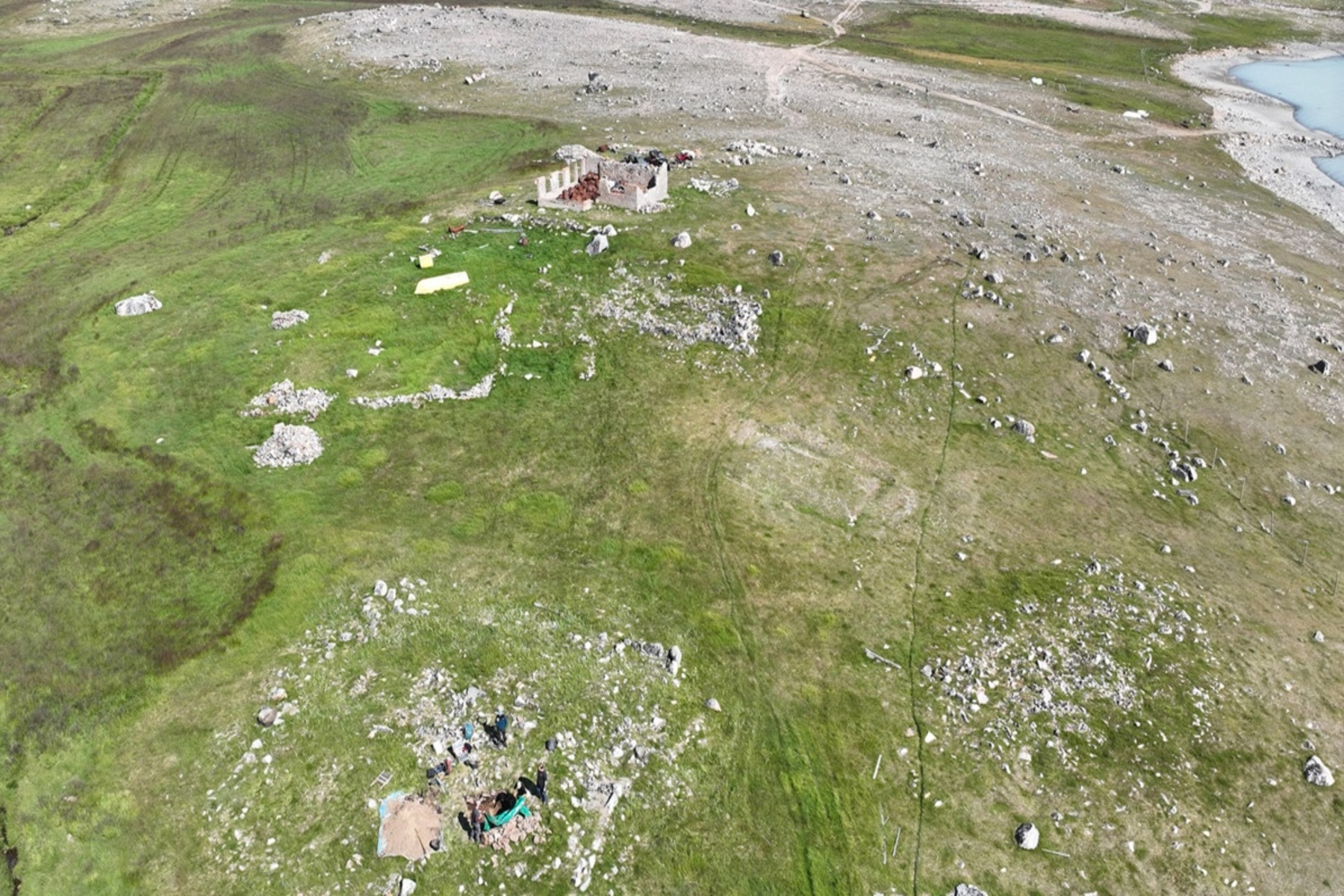
“Then in 2024 I was in Greenland to survey some Inuit ruins along the coast. I was searching with a drone – as we do today – and I was looking down. And I happened to fly over the church. When I saw it from 60 meters straight down vertically, I just thought, 'How can this not be a church?' I decided we really needed to go back and see.
“The next year, a small group of us from the Danish and Greenlandic National Museums had a little bit of leftover funding from a project, and decided to go and investigate four possible church sites. Three didn’t pan out, but this, the fourth one, was different.”
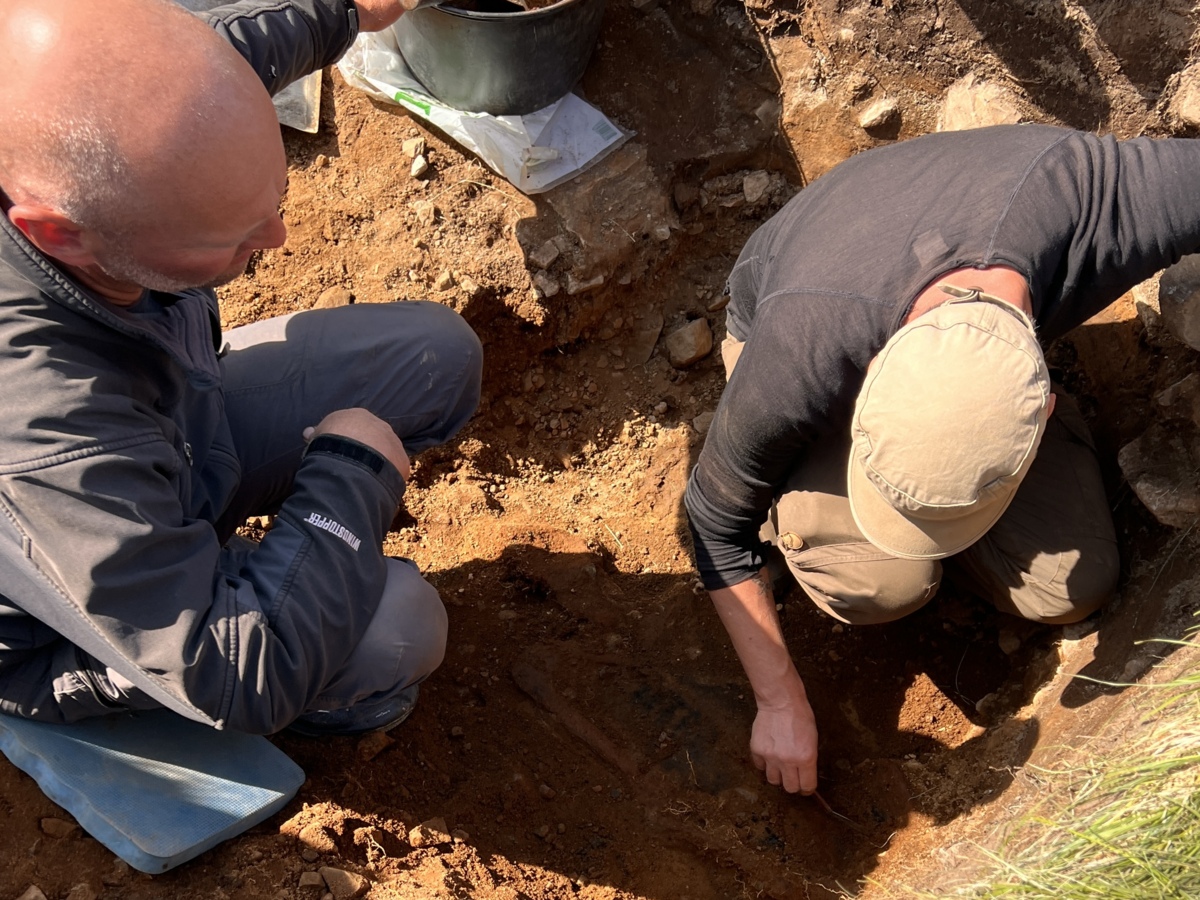
The shape of the skeleton begins to emerge as Christian works. Source: Photo: Michael Nielsen, Greenland National Museum and Archives
The cliffhanger
This was the site at Qinngua, close to the settlement of Narsarsuaq and just three miles from Brattahlíð, the 10th-century estate of Erik the Red. Although the ruins identified in 2001 had already indicated the possible presence of a church at Qinngua, Christian was looking for more conrete proof. One possible solution was to find a human burial. In general, if there are people buried next to a building that has a church-like structure, it is highly likely that the building is indeed a church.
The initial 2025 exploration, however, was modest, consistign of a single one-by-one meter trench. “We were working our way through it and we came to the gravel layer,” Christian informs The Viking Herald. “We hadn't found any skeletons or anything that looked like a burial. At five o'clock on the last day of the excavation, I was down there to clean up the excavation unit so we could document it.
“I was cleaning the gravel, and then bits of charcoal started coming out. I just thought, ‘Well, okay…’ I kept going a little bit, and the charcoal kept popping up. I realized that humans must have been here, to leave this burnt material. So I kept working through the gravel with the charcoal. And then underneath
that gravel came what looked to be completely decomposed human bones – or at the very least some kind of organic matter.
“I immediately thought it could be a burial. But by that point it was seven o'clock in the evening and we still had to close up the excavation. We also didn't have room to expand it either. At that point, we only had a 20-by 20-centimeter corner left. So we had to close it up and leave it. It was a bit of a cliffhanger.”
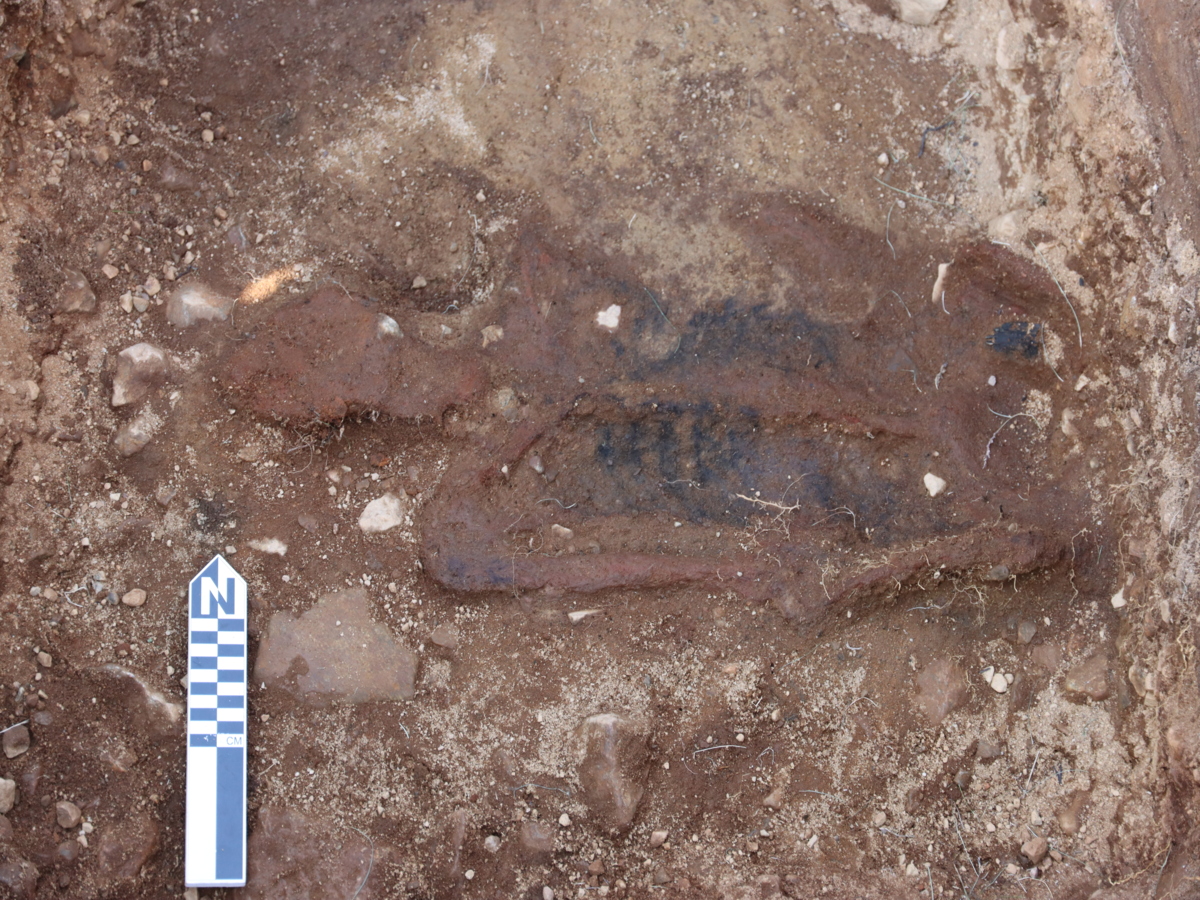
The skeleton is now clearly visible. The arrow indicates north. Source: Photo: Michael Nielsen, Greenland National Museum and Archives
“You get really happy”
So it was that a team that included researchers from the National Museum of Denmark, Greenland National Museum and Archives, the University Museum of Bergen and UNESCO Kujataa returned to the site in August of this year to complete a more extensive exploration of the find.
“Of course, we now knew exactly where to put our excavation unit – with the small piece of bone smack in the middle of it," Christian confirms. “We excavated a two-by-two meter unit all the way to the gravel. We found the same layering, with the charcoal in the gravel, and we followed that down and came to the bone.
“As we traced the bone we began to uncover the skeleton. It’s a magical experience, really. You know, no matter your color or your age, everybody has the same bones. If you know what you're doing – and I've been doing that for a long time – it becomes anatomical. You know what is coming next.
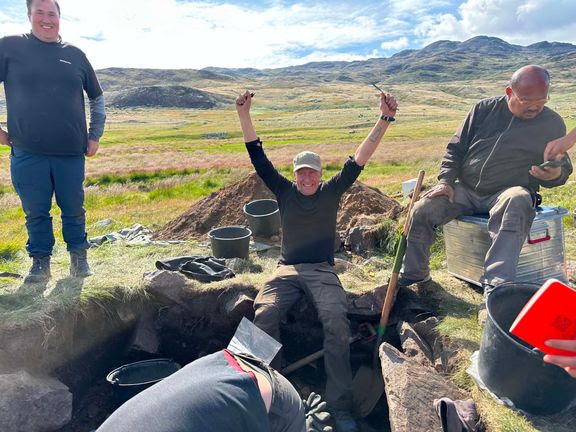
“We followed what was a lump of badly composed bone, cleaned it up and then it turned into a humerus. You find an upper arm and then the traces of a rib cage, then the lower arm, that turns into the hip bone. And you realize that it is working in just the way it should. We could also see that the skeleton was oriented east-west, looking east like a Christian burial should, with the arms lying down the side. And that’s when you know you've found something, and you get really happy.”
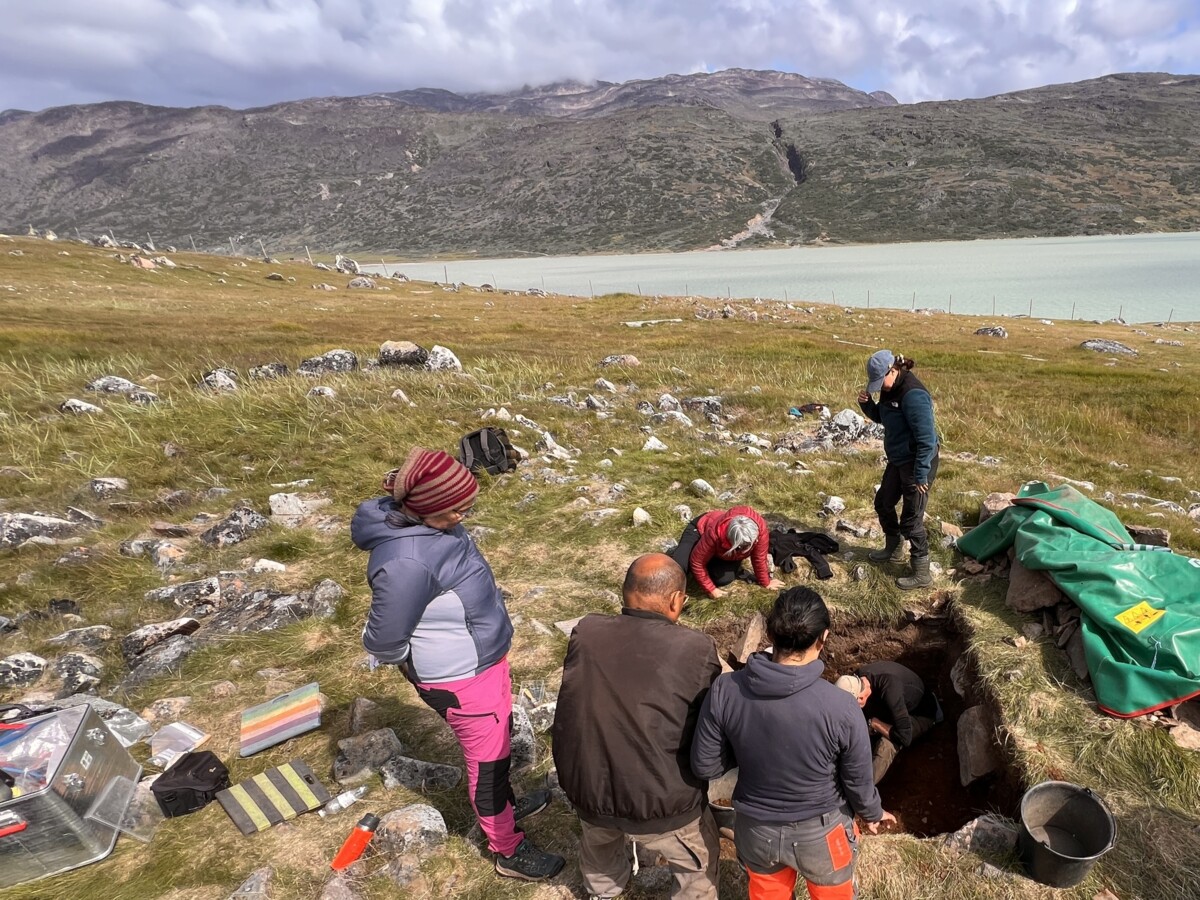
The site excavation with some of the mountains in the background. Source: Michael Nielsen, Greenland National Museum and Archives
Do we have the name of the church?
As reported by The Viking Herald last week, there appears to be a possible connection between the building and a church listed in the historical records. The Flateyjarbók, or "Book of Flatey”, a medieval Icelandic manuscript, mentions a “Kirkja undir Sólarfjöllum” (the Church Under the Sunny Mountains) which situated in a familiar-sounding location.
“This is a difficult question,” Christian admits. “There are a lot of mountains and a lot of places that look the same in Greenland. But we do know that the Norse named things after the landscape, at least in the first phase of the settlement. This particular site is surrounded by mountains, they're located just under the ice cap. This means there's quite often high pressure and good weather over the mountains.
“We were working out there, so we could see that it can be very sunny,” Christian adds. "At the same time, when it's raining it feels like the sun moves to the mountains in this location. Often, in the evening or when the sun is setting at night, you still have that high pressure and clear skies over the mountains, and they will glow red while the west will be covered in low clouds.
“So that matches very nicely with the name, but of course I'm just grasping in the air still! It definitely fits very well, but I don't think we will ever be completely certain. Having said that, if we could identify the next one or two churches on the same list, and they are also medieval, then I think we're pretty close to something that's quite credible in this regard.”
The struggle for power
Greenland was home to a Norse colony for approximately 500 years. And while the church is located close to Erik the Red’s settlement – founded in approximately 985 CE – it is believed to date to 1100-1300 CE. This would place its construction at just after the end of the Viking Age, when the Norse Greenlanders had turned to Christianity.
It is one of several churches in the local area – an indication of both the concentration of people in this space, and also a possible struggle for power and influence. "I think there's two main things that make this find important,” Christian asserts. “The first is to understand the region around Brattahlíð, where Erik the Red settled down, and Qinngua, our new church.
“In total there are six churches in the area. This is one – if not the – core area of the Norse settlements in all of Greenland. There's nowhere with a denser settlement and bigger farms than here, except for the Garðar estate, but that’s essentially only a bishop's farm. So this area is definitely a powerhouse for the whole colony.
“Understanding what's happening here will essentially help us understand what's happening outside of the core area, because everybody is dependent on this powerhouse. It's a small colony, we are talking maybe 3,000 people at its peak. Whoever is running places – or trying to run them – is leading where the society is going.
“What's interesting is that there seems to be almost a rush in this area, some kind of competition about who should have the power. Because building churches is really about building power – both in religious and economic terms. This is not the Catholic church, it's not Rome building these small churches – it's the local rich farmers or landlords.
“They will, of course, try to retain control, and whoever ends up winning this race will win the religious power and the revenues that goes with actually owning the church. These churches seem to demonstrate that in the early Middle Ages they started competing about who's going to run the show.”
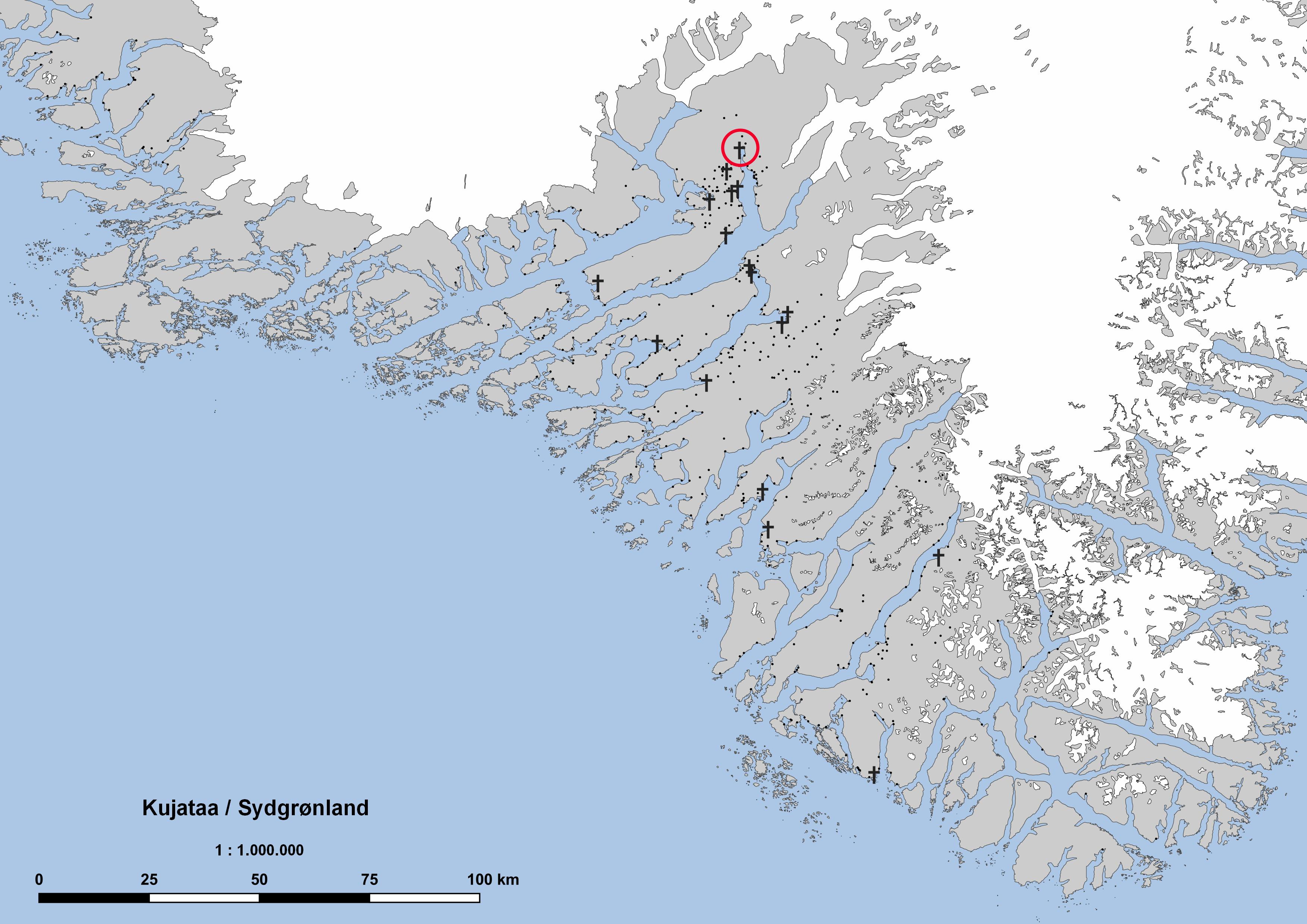
Crosses mark churches from the Norse period in South Greenland. The red circle shows the new find. The dots are registered locations for the Norse. Source: The National Museum of Denmark
Mapping the church landscape
With the excavation work now complete, the next step will be to analyze the materials collected at the site and potentially get a definite date on the site of the church. Yet there are also other tantalizing possibilities.
“If we were to go back and continue our investigations, we would most likely extend the trench,” Christian explains. “But rather than trying to expose all of the skeletons, which is a tremendously expensive, slow process, I think going for the church itself would yield more interesting results. We can reach the church wall, and this could get us a firm date on when it was constructed and what was underneath. But we have to find some funding to go out again – Greenland is an expensive place to work!”
Christian, however, is also tempted to try and search for further churches in the area that could match with those listed in the historical records. “This is even more interesting for me – perhaps because I'm a landscape archaeologist,” Christian admits.
“I think it's really cool that we now have a church that actually fits perfectly with these Icelandic church lists from the Middle Ages. We've been confused for many years about which church was the one mentioned in the historical record. It’s kind of a vague list, and we don't know what we have, really – it’s a puzzle.
“In and around the Second World War they started finding these small churches that didn't really fit the pattern, and there were too many churches compared to the church list, because they were essentially late Viking Age, very early medieval churches. But now we have a medieval church that actually does the pattern, and also the time when the sources are written down.”
“If this is correct, then we are missing two medieval churches, and we have a rough idea whether they should be. So the most interesting step for me would be to try and follow those churches and the descriptions to see if we can find the last two churches.”
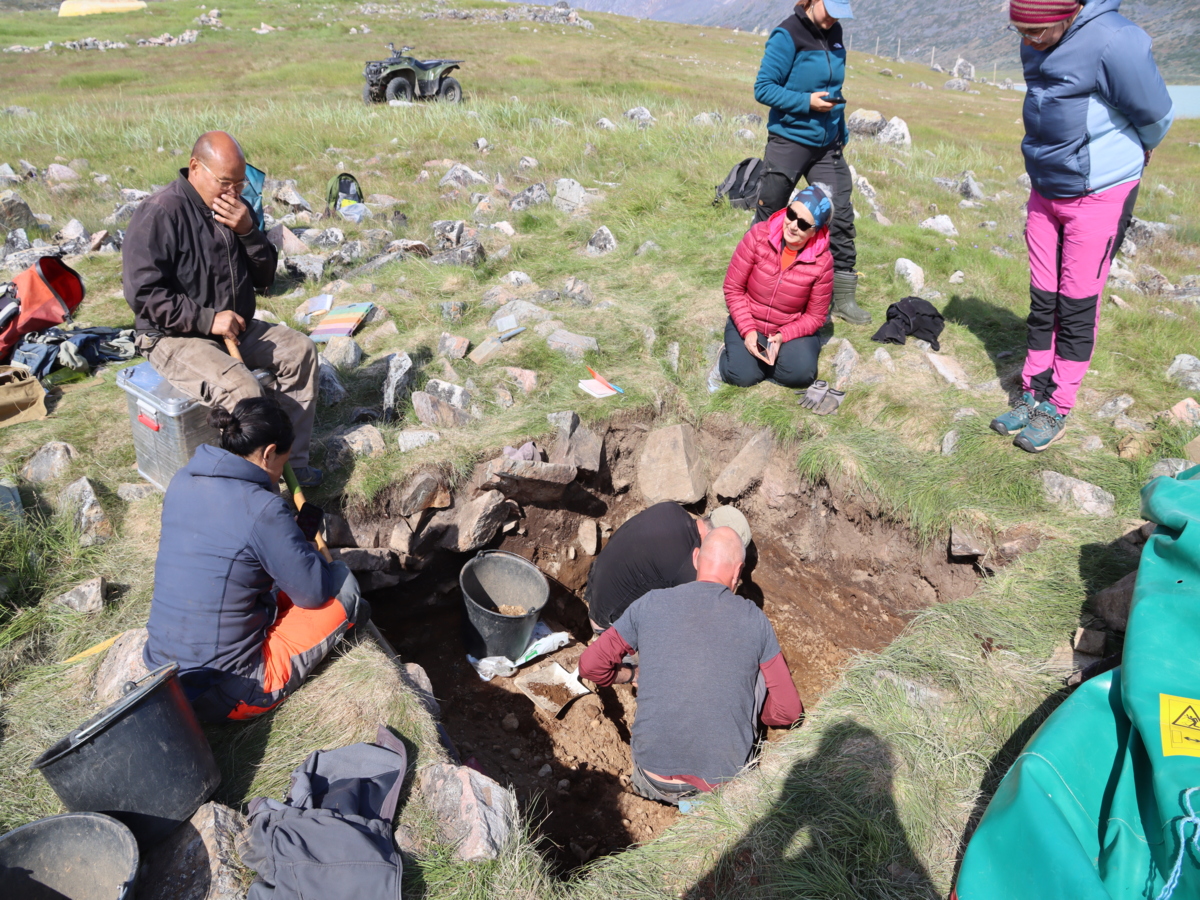
The end of the excavation process. Photo: Michael Nielsen, Greenland National Museum and Archives.
Link to the past
It is fair to say, however, that the excavation is already a clear success. “It’s an amazing feeling,” Christian admits. “Especially because it’s been so long since a medieval church was discovered. It's exciting on an academic interpretational scale, but also in an individual sense.
“When you start with a bone and you don't know what it is, it's just a bone. But as soon as you get a person and you get an idea about the size, maybe the age of the person, it becomes a real individual who belongs to that period and that colony.
“And, of course, that becomes a more personal experience, because you feel very close to them – the people of the past.”
We get to provide readers with original coverage thanks to our loyal supporters. Do you enjoy our work? You can become a PATRON here or via our Patreon page. You'll get access to exclusive content and early access.
Feel free to reach out to discuss potential stories that may be in the public interest. You can reach us via email at hello@thevikingherald.com with the understanding that the information you provide might be used in our reporting and stories.