


As much as history unites us, it can sometimes divide. The exact dating of when one era ends and another begins can lead to angry tweets and academics shouting the world over.
What we moderns call the "medieval period" – spanning a rough period in Western European history, from the "fall" of Rome in 476 CE until about the Renaissance – is a period of about a millennium.
This period is further divided into what we history geeks like to call the "early medieval period" (c. 500–1000 CE) and the "late medieval period" (c. 1000–1500 CE).
So, what differentiates the two periods? Well, the early medieval period – as all you fans of The Viking Herald will know – is when our favorite friends, the Vikings, operate.
By the end of this period, Viking societies had developed into the medieval kingdoms of Denmark, Norway, and Sweden. It was also at the end of this period that one of the most iconic symbols of the medieval period in general started sprouting up: the castle.
To simplify centuries of European history into something that even a TikTok user can understand (#shotsfired) – before 1000 CE, no castles; after 1000 CE, lots of castles – got it, right?
Despite this vast oversimplification, history, like life, lies in the details. Humans have been building fortresses to keep things out and people in (or vice versa) for thousands of years.
It was the Normans who truly perfected the art of constructing a brick-and-mortar castle. Given that the Normans are often seen as the later medieval continuation of the Vikings, was it possible that all this fortress and fortification building lay in their DNA?
Whilst we don't often associate Vikings with fixed fortifications, scattered across Europe today are the remains of Viking strongholds. By examining some of the most impressive of these fortifications, we can unlock some of the hidden histories of the Viking Age (c. 750–1100 CE).
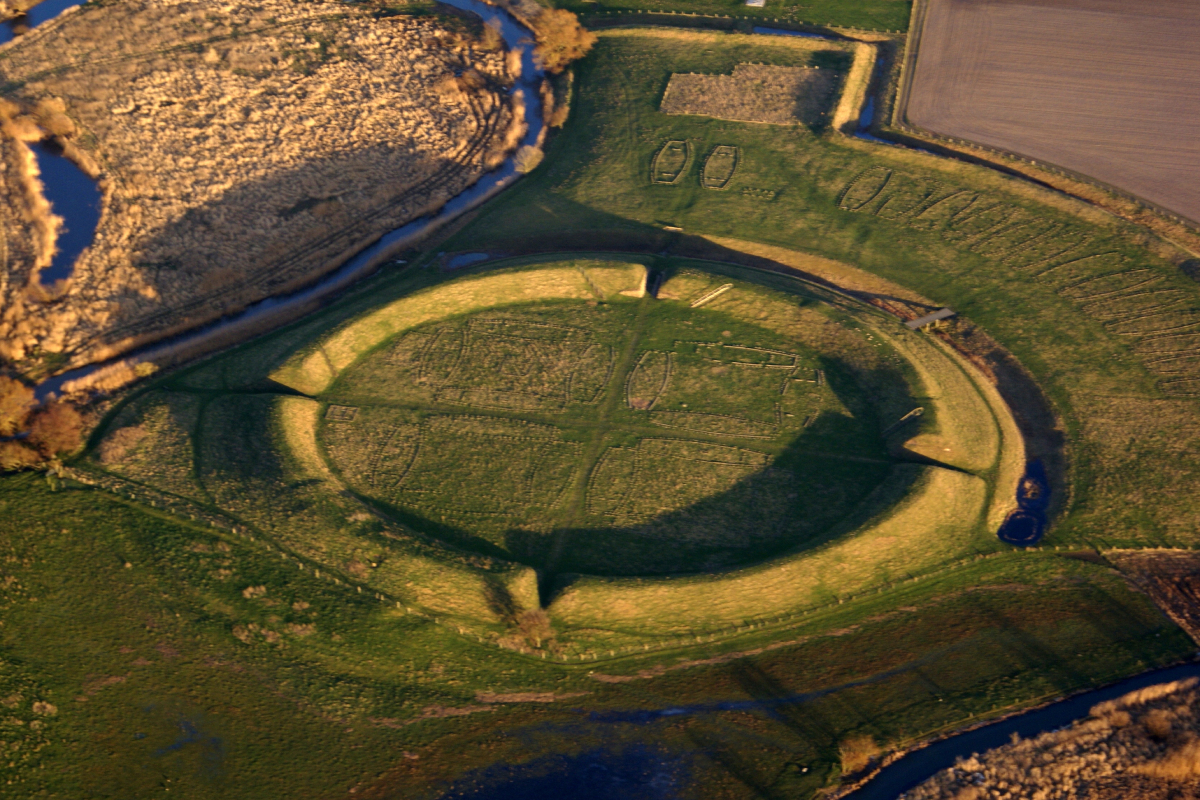
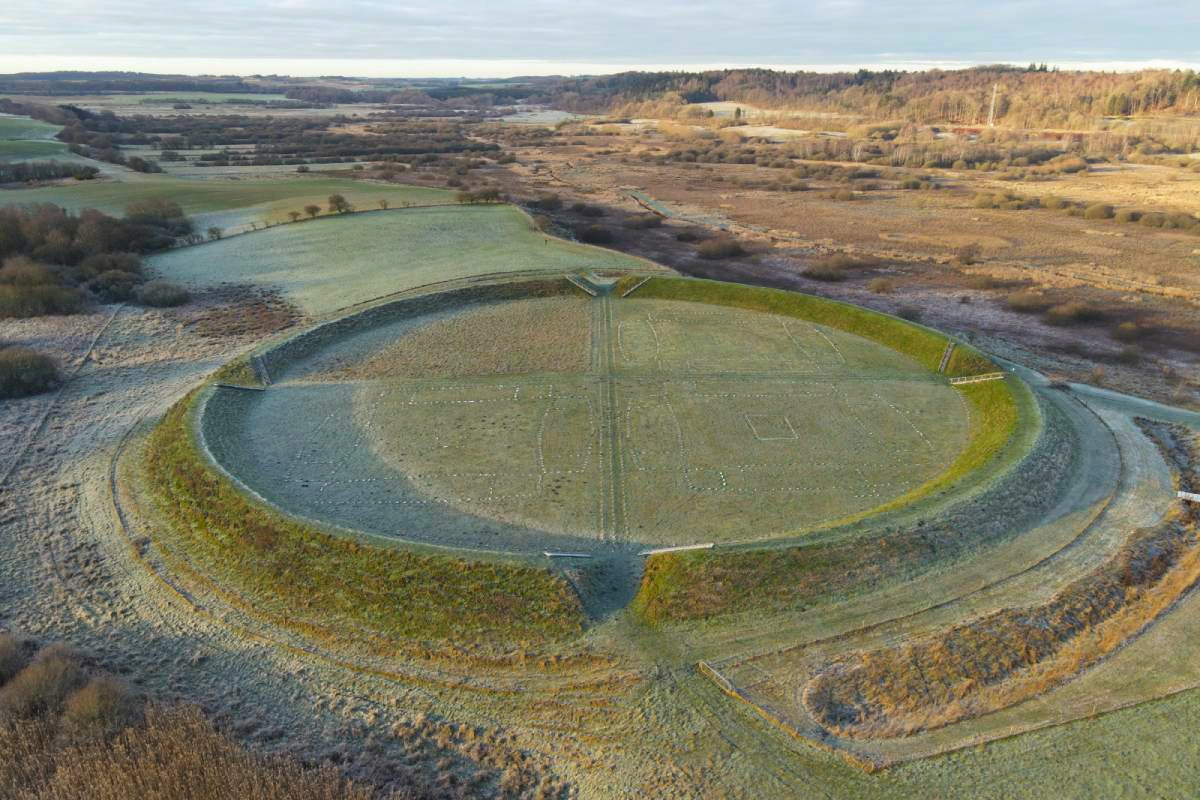
Trelleborg, a Viking ring fortress on Zealand, was built around 980 and once featured four gates and 14 longhouses. Source: Thue C. Leibrandt (CC BY-SA 3.0)
Trelleborg: Controlling a strait and a sea
On the Danish island of Zealand lie the best-preserved remains of a Viking fortress. Trelleborg is a ring fortress believed to have been commissioned by the Danish king and Viking warrior Harald Bluetooth in about 980 CE or possibly by his son (see below).
The fortress is shaped like an almost perfect circle and features four gates. It is believed to have housed around 1,300 people in 14 longhouses.
The name of the fortress is sometimes interpreted as Old Norse for "slave-built," deriving from þræll (thrall), meaning slave or serf. However, some scholars suggest that it may instead refer to trelle, meaning wooden stakes or palisades, describing its construction rather than its labor force.
Given the scale of the project, there is no doubt that, for the early medieval period in Scandinavia, this was a serious undertaking – showing the power, prestige, and resources that the Danish monarch was able to command in the late 10th century.
As T. Douglas Price et al. write in their 2015 article in the journal Antiquity, Trelleborg was instrumental in playing "...a key role in the formation of a Danish state under Harald Bluetooth."
Trelleborg certainly does not look like a typical medieval fortress, but its power lies in its strategic position on what was once a peninsula. This peninsula looked out toward the Great Belt, a strait of water that separated the islands of Zealand and Funen.
It was through this strait that all shipping had to pass to enter or exit the Baltic Sea, a major causeway for naval operations during the Viking Age. Controlling this strait meant that Bluetooth could exert his influence far beyond his royal court at Jelling.
Aside from the fortress, a graveyard houses the remains of more than 135 people, some of whom bear the hallmarks of Christian influence.
Archeological excavations since the 1930s have uncovered mundane everyday life artifacts, including pottery. There are signs of a skirmish and a fire, and it is believed that the fortress lost much of its importance following Bluetooth's death in about 987.
Today, it is a popular tourist site thanks to its UNESCO World Heritage status.
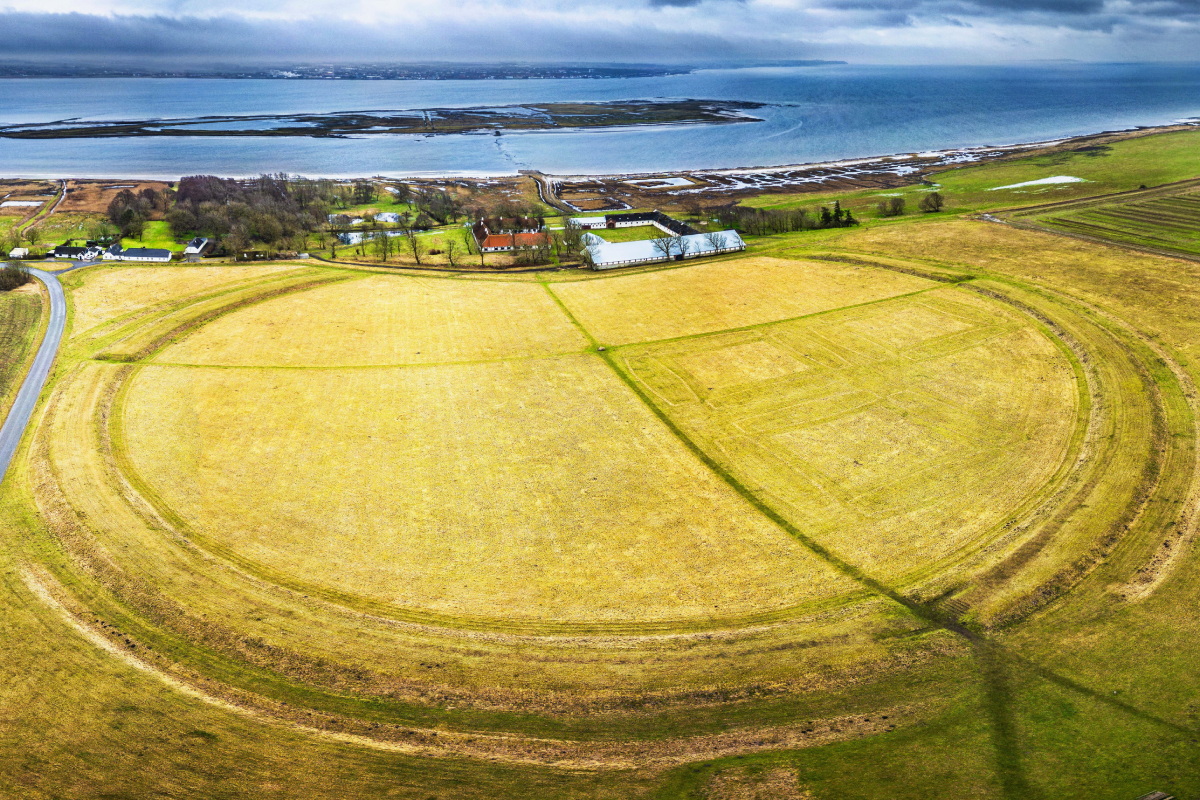
Aggersborg once had 48 longhouses and may have served as a military base for Sweyn Forkbeard. Source: Frank Bach / Shutterstock
Aggersborg: A springboard to enable Viking invasions
The relationship between Viking monarchs and their successors, often a father and son, was always an uneasy one.
Nowhere is this fraught relationship between ruler and ruled, between powerful and powerless, more obvious than with the father and son Harald Bluetooth and Sweyn Forkbeard.
According to the Norse sagas, Forkbeard rose up against his father, seized the Danish throne, and sent his father into exile on an island in the Baltic Sea. However, what we don't know is the exact date when this transition – nay, usurpation – of power happened.
Like the fortress at Trelleborg, Aggersborg is another ring fortress that may have been constructed either by father or son sometime around 980 CE.
According to archeological excavations, a village was demolished to make way for this ring fortress, the largest of its kind, overlooking the Limfjord Strait in northern Denmark.
Boasting an inner diameter of 240 meters (787 feet), this was a huge fortress, as evidenced by the more than 30,000 artifacts discovered since the 1990s.
Some 48 longhouses may have housed a garrison as strong as 5,000 men, and it is believed that this was a major military and logistical center.
While some scholars suggest it may have played a role in Forkbeard's campaigns against Anglo-Saxon England, its exact use during the early 1000s remains debated.
Gathering and training troops here, at the northern tip of Denmark, was a logical move before a quick sail across the North Sea to England.
These incursions and invasions would eventually lead to Forkbeard's seizure of the English throne, adding it to his Norwegian and Danish crowns and establishing the North Sea Empire.
The former Danish kommune (municipality) of Løgstør used a stylized version of Aggersborg on its coat of arms, and the fortress remains one of the key historical sites in northern Denmark.
Aggersborg is just one of at least five ring fortresses that have been uncovered across Denmark (Aggersborg, Fyrkat, Nonnebakken, Trelleborg, and Borgring), all believed to have been built in the late 980s. A possible sixth site near Odense has also been identified.
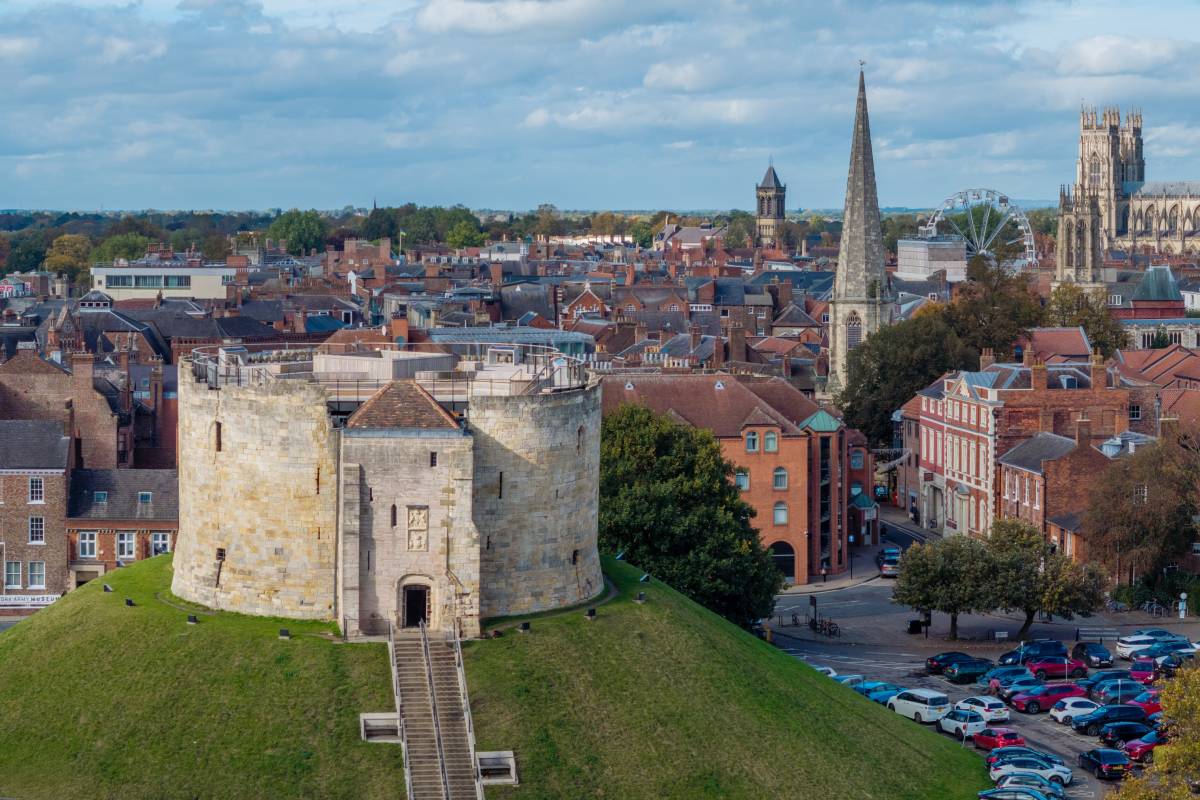
When the Vikings seized York in 866, they reinforced its defenses and turned it into a key stronghold. Source: Christopher Chambers / Shutterstock
Best of the rest outside Scandinavia
Viking fortifications and fortresses were not just confined to Scandinavia. We can find the remains of many scattered across Northern Europe, including England, Ireland, and Poland.
Across the Norwegian Sea from the Viking heartland of Scandinavia lies the English town of York.
This city was once the stronghold of Jórvík, a major outpost of Viking activity and later a kingdom in the borderlands between what is now England and Scotland.
When the Vikings captured the city in about 866 CE, they quickly developed the town into a major trading and military center.
They likely reinforced the existing Anglo-Saxon and earlier Roman town walls with wooden earthworks and palisades and possibly even constructed ramparts along the River Ouse, which snakes its way through the center.
The so-called Coppergate excavations from the 1970s onward uncovered a wealth of artifacts suggesting that Jórvík was, during its Viking rule, a bustling center of economic and military activity that dominated this northeastern region of the British Isles.
Nowadays, the city is a student hub and boasts one of the best Viking museums in England.
We have spoken of how Dublin, today a bustling city and the capital of the Republic of Ireland, has a long and proud Viking history. In fact, it was people from Viking societies who laid the (literal) foundations of this now-great metropolis on the River Liffey.
From 841 CE onward, Dublin was established as a major trading port – particularly for the slave trade, a lucrative part of early medieval Europe's economy.
Following the bloody and protracted Norman invasion of Ireland in the late 1160s CE – which wiped out the remaining Viking presence on the island – there was a need to construct a solid fortress that would dominate this burgeoning trading town and help the Normans rule over this emerald isle.
It is believed that the castle was built upon earlier fortifications dating back to the early medieval period and that the Vikings laid the groundwork for what became one of the most impregnable castles of the British Isles.
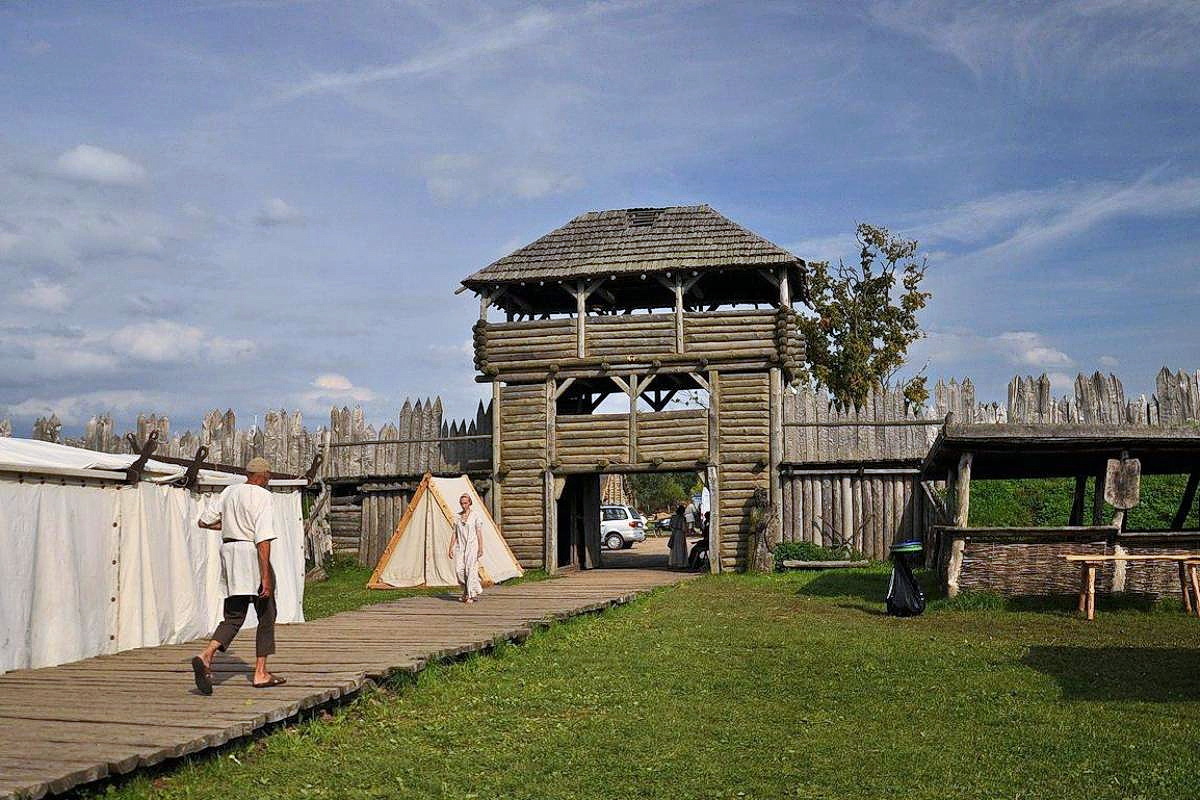
Wolin Island in Poland is one of the sites most often associated with the legendary Jomsborg fortress. Source: Arro / fotopolska.eu
Jomsborg: The legendary Viking stronghold
Finally, the hunt continues on the Polish island of Wolin for the semi-historical, semi-mythical Jomsborg, the fortress of the dreaded Jomsvikings.
Seen as some of the most feared and elite warriors of the Viking Age, the Jomsvikings were said to have used this fortress as a base for their operations from around the 960s until the early 1040s.
According to some accounts, Harald Bluetooth may have been responsible for its establishment, though definitive evidence remains elusive.
As Sven Rosborn discusses in his 2021 book, King's Golden Treasure: About the Curmsun Disc, the Discovery of a Lost Manuscript, Harald Bluetooth's Grave, and the Location of the Fortress of Jomsborg, Vikings were "typically the dominant exterior force..." in much of what is now Poland.
If we look at the sagas, the fortress was said to have been eventually burned down by the Dano-Norwegian king Magnus the Good in 1043 to rid himself of these pesky and petulant mercenaries once and for all.
Recent excavations on the island have tantalizingly uncovered some evidence, but not conclusive proof, to back up some of the tales of the Jomsvikings and their fortress in the Norse sagas.
However, a newly launched Polish–Danish archeological project aims to change that.
This large-scale investigation, the first of its kind at Wolin, will explore key sites – including a suspected fortress linked to Jomsborg – in hopes of shedding light on the settlement's Viking Age history.
Researchers anticipate significant discoveries that could finally clarify the nature of Scandinavian influence in the region and determine whether Jomsborg was a historical fortress, a cultural hybrid, or purely a legendary creation.
For more information on Denmark’s Viking ring fortresses, including their UNESCO World Heritage status, visit the National Museum of Denmark's website here.
We get to provide readers with original coverage thanks to our loyal supporters. Do you enjoy our work? You can become a PATRON here or via our Patreon page. You'll get access to exclusive content and early access.
Feel free to reach out to discuss potential stories that may be in the public interest. You can reach us via email at hello@thevikingherald.com with the understanding that the information you provide might be used in our reporting and stories.





.jpg)