

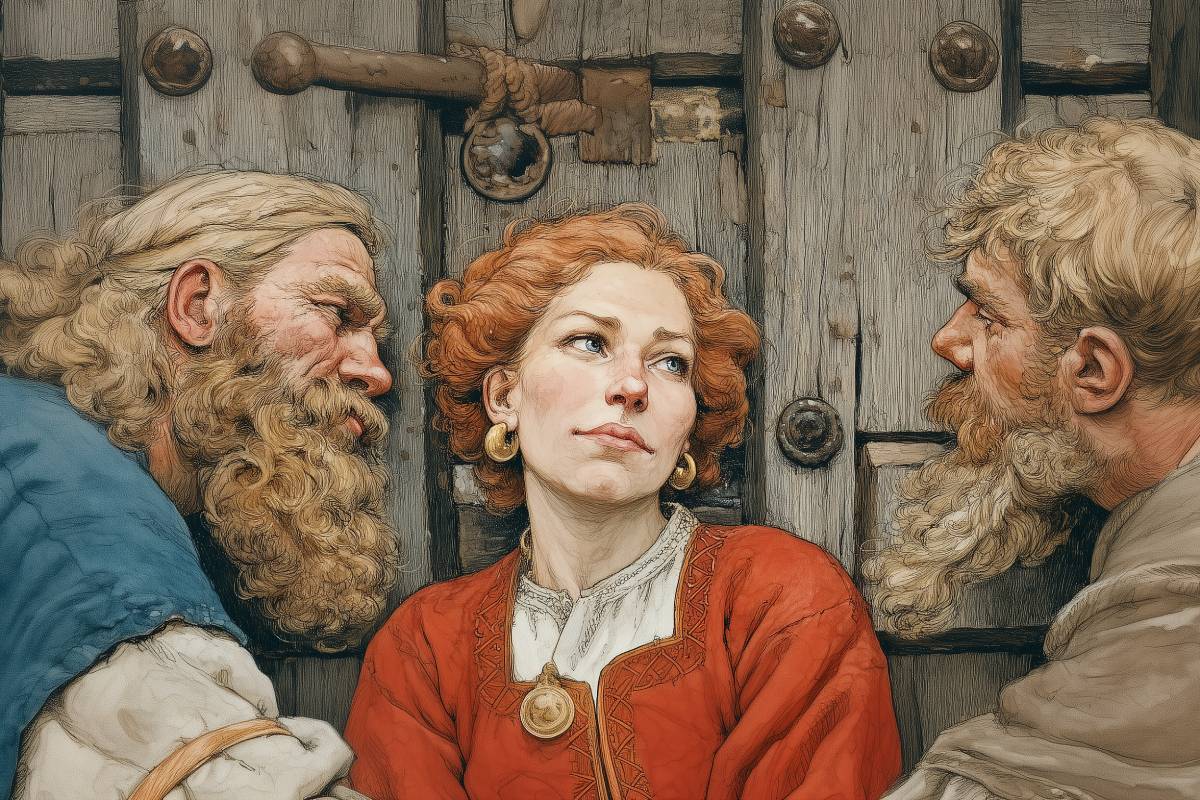
Love, ambition, violence, and betrayal can all be found in the Laxdæla saga, which blends fact and fiction, history and drama found among the inhabitants of a small slice of Viking Age Iceland.
Iceland is so hot (and cold) right now
Cast your eye adrift online to any travel blog or show nowadays (or, to appease the younger readers among us, any TikTok or Instagram reel) and it seems everything is coming up Iceland.
This rocky outcrop of the Nordic world, bobbing up like a cork in the mighty Atlantic Ocean, has seen an unprecedented tourist boom in recent years.
Fueled in part by its proud Viking history and heritage, this land of fire and ice has become renowned just as much for its past as for its stunning and brutal natural landscapes.
As Orri Vésteinsson and Thomas H. McGovern talk about in their 2012 article in the journal Norwegian Archaeological Review, the story of human habitation in Iceland harks back to the very early beginnings of the Viking Age (c. 750–1100 CE).
According to legend, though, none better than the Norse sagas themselves, the story of human habitation begins when malcontents fled the iron grip of Norwegian King Harald Fairhair after he unified the petty kingdoms of Norway into a single kingdom in 872 CE.
They sailed west, across the Atlantic Ocean, to create a new life on the island of Iceland.
These malcontents – the first case of Nordic people fleeing abroad to what they saw as heavy-handed regulation and taxation – fled to the remote island of Iceland.
This first period of the human story of Iceland, from c. 870 to 930 CE, is known as the Age of Settlement in Icelandic history.
People from Viking societies came here to start life anew in this brave new world. Whilst refugees from Fairhair mark the beginning of this period, the end is signaled by the founding of the Althing in 930 CE, which the modern parliament of Iceland traces its ancestry to.
From settlement to sagas
Over the next few centuries, the Icelandic Commonwealth, as the island became known, was an important and influential part of the Viking world.
Yet it was after this "Golden Age," when the country became a part of the Kingdom of Norway, that scholars like Snorri Sturluson wanted to write down some of the oral stories, legends, and sagas that had been told by people on this island since its first settlement.
As Lars Lönnroth writes in his chapter in the 2008 book The Viking World, these "Icelandic sagas" mainly (though not always) deal with the first few centuries of human settlement in Iceland – the trials, tribulations, and triumphs, often epic in proportion and prose, of the brave souls who helped create a society on this rocky outcrop of civilization.
For those wanting a great overview of what is and isn't an "Icelandic saga," Lönnroth's chapter (no. 23) is a great place to start.
One of the most memorable deals with the romantic problem of three people in a love triangle – and its repercussions for their descendants – over the course of a century (from the late 9th to early 11th century CE) in the western part of Iceland.
We are, of course, talking about the Laxdæla saga, one of the most memorable in the rich tapestry of Norse literature. Fetch your box of tissues as we delve into this epic tale of love, revenge, and tragedy.
- READ MORE: The Viking history of Iceland – A primer
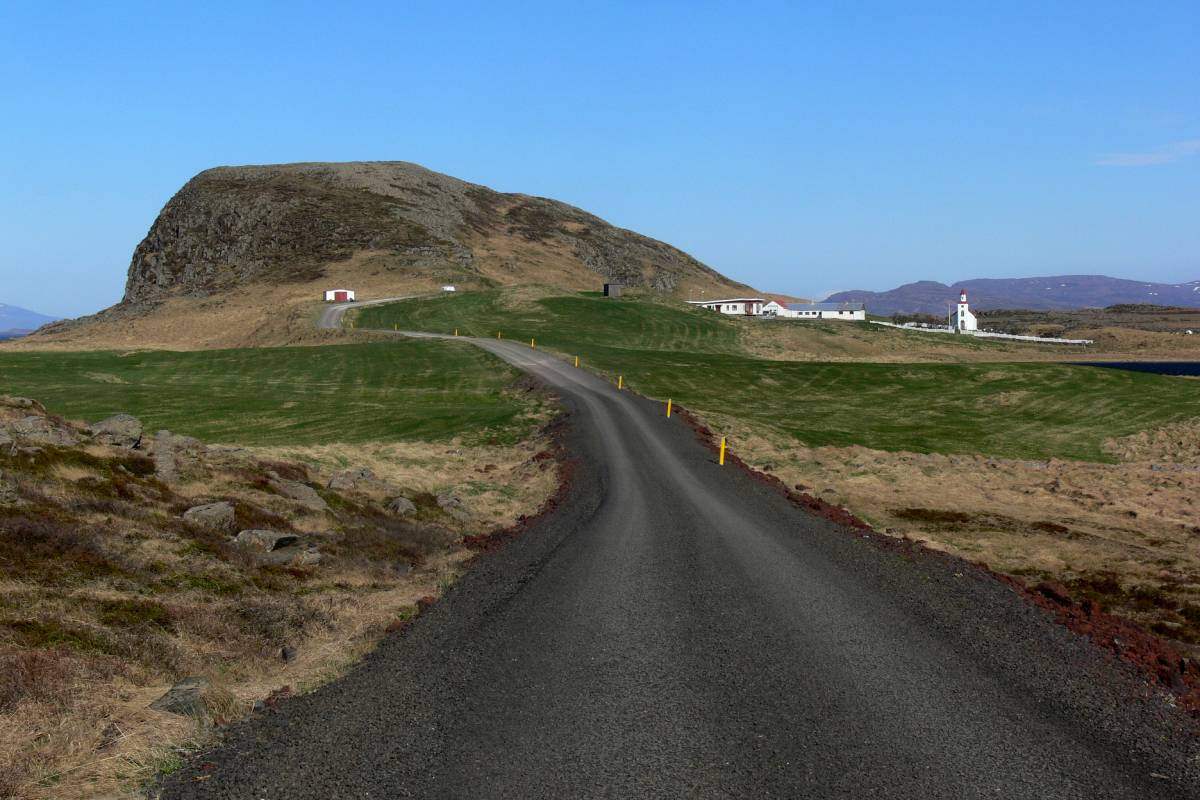
The road to Helgafell in western Iceland, traditionally the site of the home and burial place of Guðrún Ósvífrsdóttir. Photo: Christian Bickel fingalo (CC BY-SA 2.0)
Knowing your unknowns in Norse literature
Like so many of the Norse sagas, the Laxdæla saga starts with a problem: we do not know from whose mind it sprang. Frustratingly for academics, historians, and writers, the author or authors of the Laxdæla saga have been lost to the tides of history.
We do, however, know that the entire saga deals with one very specific location in Iceland – the region around a large, shallow bay, Breiðafjörður, in the west of the island. We can assume, then, that whoever created the saga must have had some local knowledge of that area.
Like the mystery of the author or authors, we also do not know when it was first written down, but academics have put forward the early 13th century as a probable date.
We also do not know if this saga was simply transcribed, in whole, from an oral story, or if it was a creation of several other sources or sagas molded together.
Regardless of all this, as former U.S. Secretary of Defense Donald Rumsfeld might say, "known unknowns," there is a wealth of information and detail in this entertaining romp.
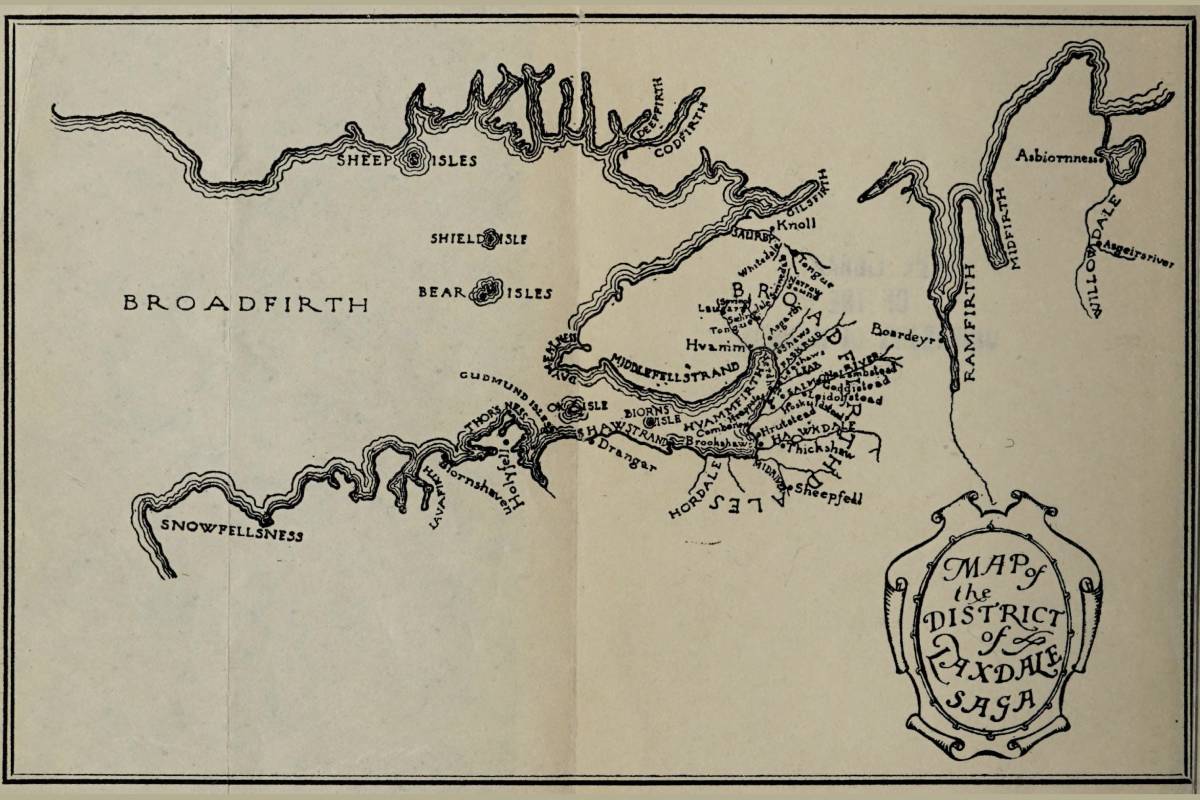
Map of the Laxdæla saga district around Breiðafjörður and Laxárdalur in western Iceland. Source: The Project Gutenberg
Unnr the Deep-Minded and Salmon River Valley
The prelude to the most famous love triangle in Norse literature deals with one of those malcontents that we were speaking of earlier, fleeing Harald Fairhair, the rather fabulously named Ketil Flatnose.
Skipping town on a boat westward, he brings his family to settle in Iceland sometime during the period of the "Age of Settlement" to build a new life.
It is his daughter – Unnr the Deep-Minded (another great name! She is also sometimes referred to as Aud in English) – who has all the early action, as we join her in her adventures throughout Scotland and the Orkneys before she eventually claims lands in the Breiðafjörður region of Iceland.
It is here that her descendants will settle and build a community eventually called Laxárdalur, which translates roughly to "Salmon River Valley" in English.
It is this community name that gives the saga its alternative name in English, The Saga of the People of Laxárdalur.
What is unusual for Norse literature, especially as this is said to have been written in the late medieval period, is the powerful figure of Unnr.
Through force of will and deed, she emerges as the memorable matriarch of this saga and sets the tone for the remaining tale as one where women have a remarkable amount of agency and power.
This generally contrasts with the period in which the saga was set, as women in Viking societies were often treated little better than second-class citizens, at best.
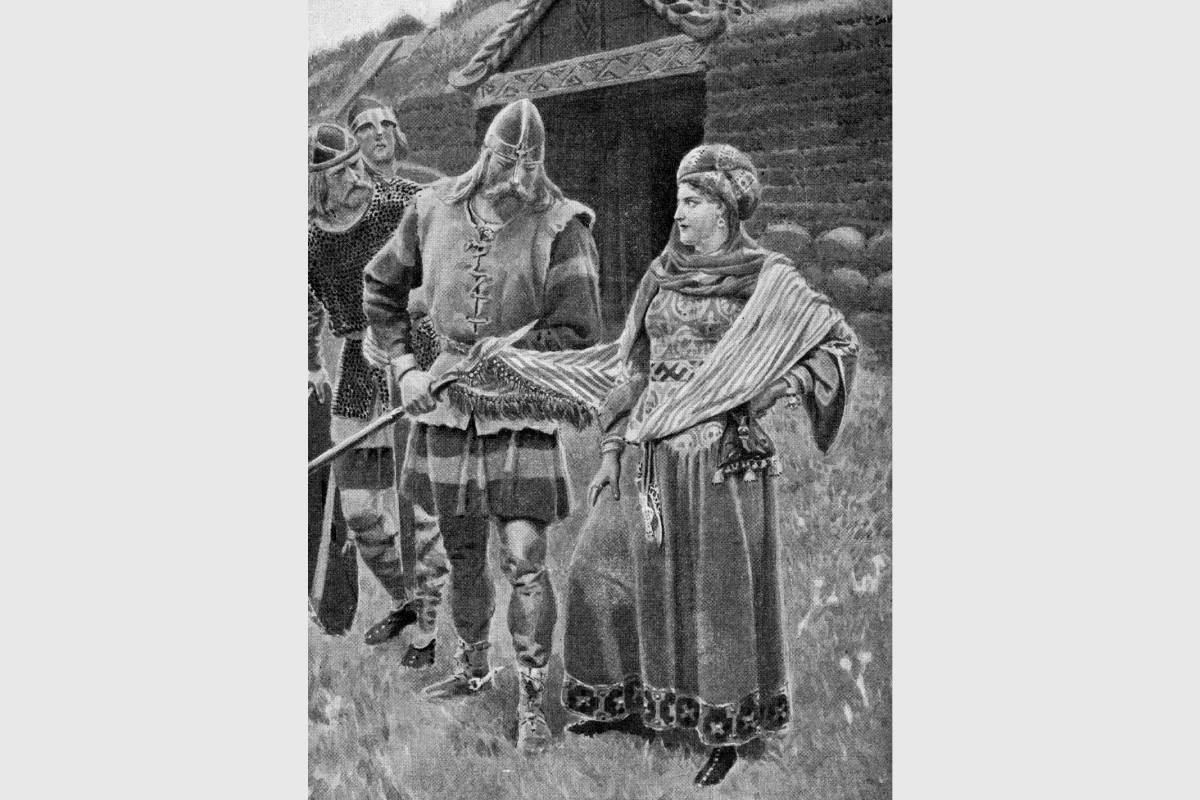
Guðrún Ósvífrsdóttir in a 19th-century illustration of the Laxdæla saga. Author: Andreas Bloch (1860–1917)
Bizarre (and bloody) love triangle
Let us face it. If you've read this far, you're here for the entertaining part of the saga, the betrayal, the violence, the broken hearts, souls, and bones part.
If we fast-forward several decades after Unnr's life, when her descendants have built a community in the Salmon River Valley, we are told of Guðrún Ósvífrsdóttir, who was said to be one of the most beautiful women ever born (then or since) in Iceland.
Like Unnr, she is a complex female character and is renowned just as much for her acerbic and quick wit as for her natural beauty.
Whilst others may focus on the fact she was prophesied to have four marriages – and to bury three husbands (!) – we here at The Viking Herald prefer to focus on affairs of the heart less macabre, as Guðrún is at the center of one of the most famous love triangles in medieval literature.
Having divorced her first husband (she married him at 15) and buried the second (he fell afoul of a witch), she then falls in love with her childhood friend, Kjartan Ólafsson.
Yet after not exactly rushing home to her after a lengthy trip abroad, Kjartan misses his chance as his foster brother, Bolli Þorleiksson, marries her instead.
Eventually finding his way home and realizing he has lost his chance at happiness, Kjartan descends into a downward spiral of jealousy, resentment, and rage.
Likewise, Guðrún's unresolved feelings for her childhood friend speak of the often unhappiness of medieval marriages that were often marriages of convenience or politics rather than for love.
Without giving away too many spoilers, this love triangle becomes engulfed in violence, blood, and gore... but you'll have to read the saga, as we here at The Viking Herald do not kiss and tell!
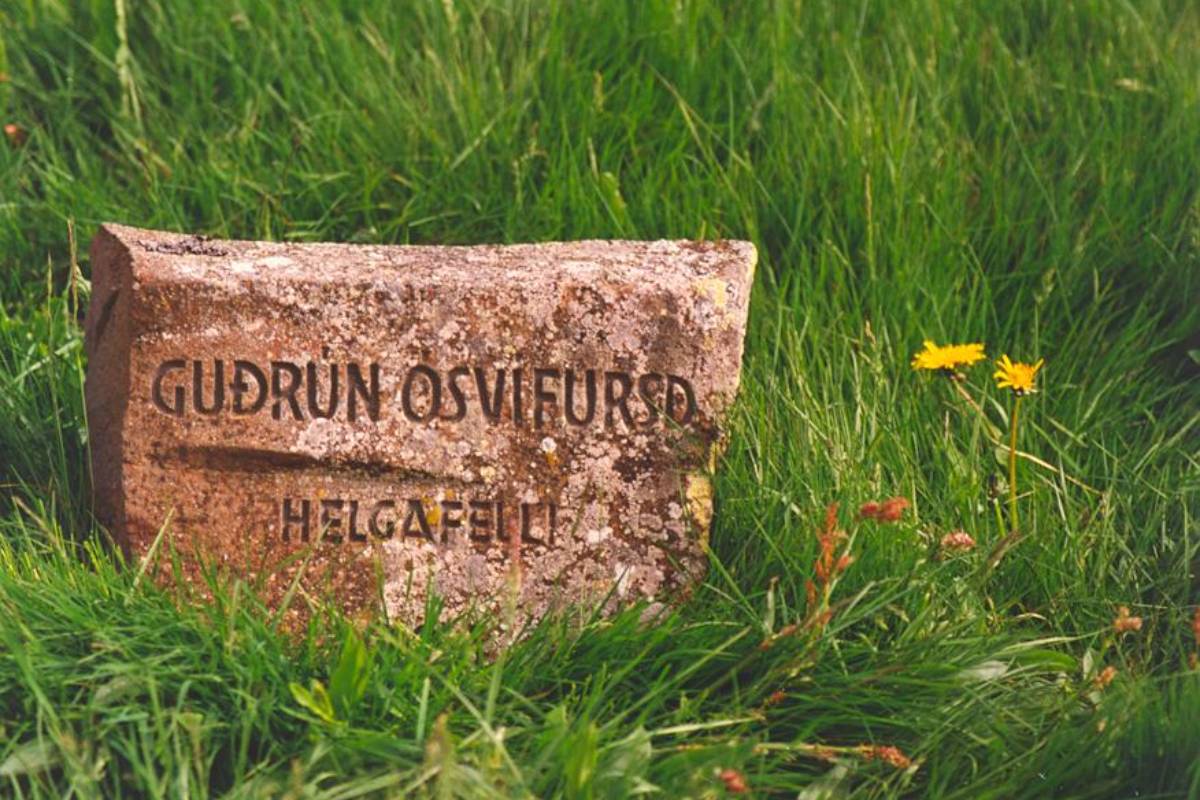
Guðrún Ósvífursdóttir memorial stone at Helgafell in western Iceland. Photo: Laeri Reinhart (CC BY-SA 3.0)
Not just a love story
Now, for those annoyed at us for not fleshing out (pun intended) more of the love triangle or saga, fear not.
This saga, which, at first glance, seems to deal only with the lives of the inhabitants of Salmon River Valley, a small community on the western edge of a rocky outcrop of Viking society in the early medieval period, is so much more than a medieval soap opera.
Characters in the saga deal firsthand with both affairs of the heart and state, and a whole list of famous Viking characters, from Harald Fairhair to the Varangian Guard, from Saint Olaf to Olaf Tryggvason, make an appearance or play a role.
Furthermore, aside from the specific characters, mostly members of this community in western Iceland, larger themes are explored, too.
The conversion of Iceland to Christianity is a constant backdrop for much of the saga and shows how communities – indeed, families – were torn apart by this momentous shift in societal beliefs.
Whilst human relationships are at the center of this saga, there is also a great deal of politics and power, as communal Things, and the decisions made there, form another popular setting in this saga.
What makes this saga so timeless is that there is something here for everyone: power, greed, ambition, violence, love, betrayal, kindness, and, hell, even witchcraft!
Whilst we may never know who first recorded this epic tale, the Laxdæla saga should be high on your list of things to read in 2025.
For more information on the Icelandic sagas and tourism, visit The Guardian here.
We get to provide readers with original coverage thanks to our loyal supporters. Do you enjoy our work? You can become a PATRON here or via our Patreon page. You'll get access to exclusive content and early access.
Feel free to reach out to discuss potential stories that may be in the public interest. You can reach us via email at hello@thevikingherald.com with the understanding that the information you provide might be used in our reporting and stories.