

Russian President Vladimir Putin gave an incredible speech on February 21, 2022, explaining why his so-called "special military operation" in Ukraine was needed.
The next day, the full might of the Russian armed forces illegally invaded neighboring Ukraine in a bid – he said – to "overthrow fascist Nazi elements" within the country.
In this bizarre and wildly historically inaccurate speech – bordering on a downright rant – explaining why Russia needed to breach the sovereignty of Ukraine, he gave a broad overview of his twisted version of Slavic history.
He pointed to the fact that the Slavic countries of Russia, Ukraine, and Belarus all trace their foundation back to the Kievan Rus, an early medieval political entity that traces its origins to the time when people from Viking societies first traveled eastward.
This period marked a significant phase in the long and complex relationship between people from Viking societies and the Slavs, encompassing political, cultural, and economic dimensions.
Before delving into this multifaceted history, it is essential to first understand who the Slavs were.
Who were the Slavs?
The first half of the first millennium CE was a time of great migration and movement in what we now call Europe.
Whilst Scandinavian societies were evolving into Proto-Viking communities during the Nordic Iron Age, significant movement was occurring further east.
By the 6th century CE, an ethno-linguistic population, potentially originating near the region now known as Belarus and Ukraine, began expanding outward across Central, Eastern, and Southeastern Europe.
We now call these people "the Slavs," a term derived from a Proto-Slavic word meaning "people who speak the same language."
Driven by a mix of overpopulation, environmental pressures, and opportunity, Slavic tribes settled in modern-day Poland, Ukraine, the Balkans, and beyond.
As with most early medieval societies, the Slavs were primarily agrarian but had a degree of societal organization centered around kinship groups and fortified villages.
Their belief system was polytheistic, with deities linked to nature, fertility, and the harvest.
By the 7th century CE, Slavic culture had spread through alliances and settlements, influencing early state formations such as the first Bulgarian Empire, originally founded by the Turkic Bulgars, who later assimilated into the Slavic population before Viking contact.

Many date the start of the Viking Age to the 793 raid on Lindisfarne, though some point to an earlier raid on Saaremaa, Estonia, around 750. Photo: Miks Mihails Ignats
Viking contact
Whilst others may date the start of the Viking Age to a raid on Lindisfarne, we here at The Viking Herald prefer to date its beginning to a similar raid on the Estonian island of Saaremaa half a century earlier, in 750 CE.
This event marked a new phase of expansion from Viking societies eastward, across the Baltic Sea to Eastern Europe.
As Heiki Valk describes in a chapter of the 2008 book The Viking World, people from Viking societies – sometimes raiders, sometimes traders – soon began navigating the river systems winding through this region.
The Volga and Dnieper rivers became vital trade routes, with goods like furs and amber moving southward, while silks, silver, and spices from the Islamic Caliphates and Byzantium traveled northward.
Yet another prized commodity for people from Viking societies was slaves. Traders and merchants amassed great wealth, and these river routes became lucrative networks for Viking rulers and chieftains.
This wealth and economic opportunity fueled further expansion as people from Viking societies settled along these rivers, establishing towns and communities.
A steady stream of Slavic enslaved people was sent back up the river routes – to Scandinavia – or to several major slave markets in the medieval world, including Baghdad, Constantinople, and Dublin.
There is no doubt that much of the wealth people from Viking societies acquired in Eastern Europe came from pillaging and plundering.
Whilst there was cooperative and mutually beneficial trade, Vikings often lurked around the next bend of the river, ready to ransack a village, steal its riches, and whisk away its population into bondage.
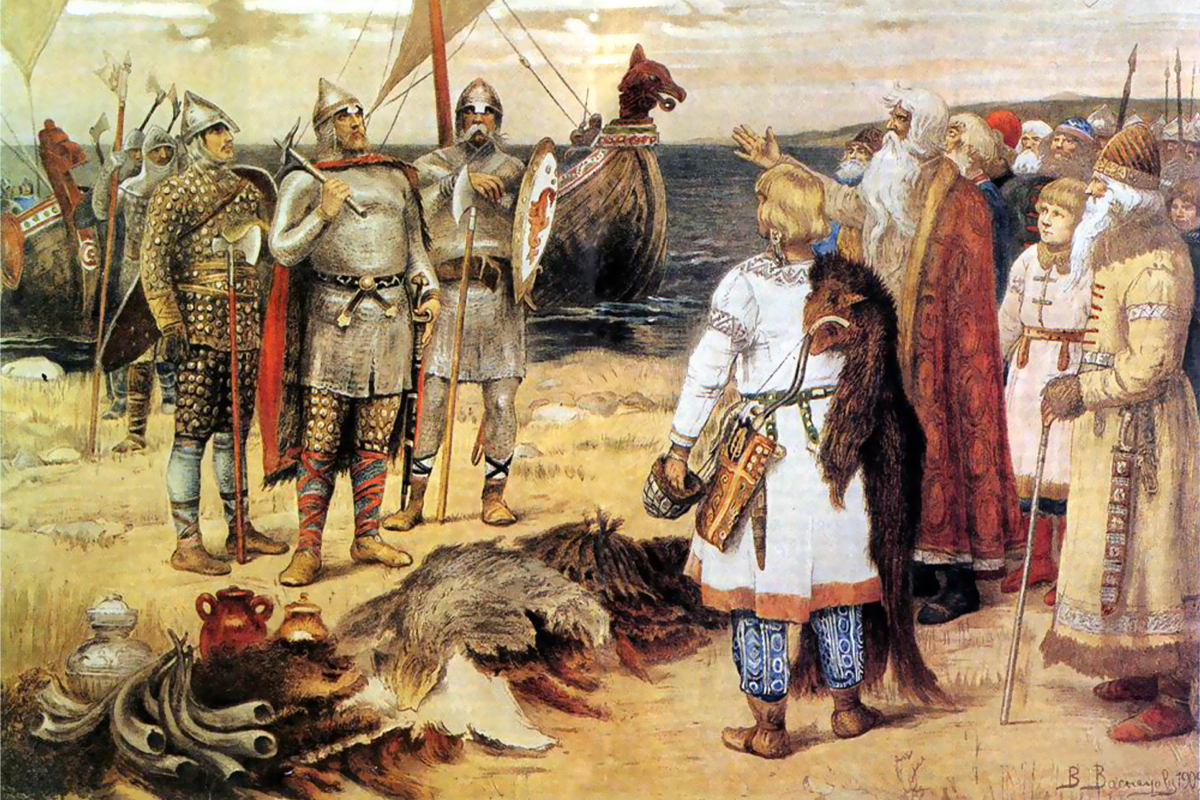
"The Invitation of the Varangians" shows the arrival of Rurik and his brothers Sineus and Truvor in the lands of the Ilmen Slavs. Illustration: Viktor Vasnetsov (1848–1926)
The Kievan Rus
The relationship between people from Viking societies and the Slavs soon became forever cemented thanks to the foundation of the Kievan Rus.
This was a multiethnic, multireligious polyglot entity that had a much-debated foundation myth.
As Ryan Nonna and Harris Zena wrote about in their 2004 article in the New Zealand Slavonic Journal, according to some historians and scholars – who believe in what has been called the "Normanist theory" – it was Viking strongmen and rulers who were responsible for the foundation of this early medieval state.
According to the Primary Chronicle, the Slavic tribes invited a Viking chieftain, Rurik, to rule over them and bring stability to the region in 862, though this account is partly legendary and debated among historians.
Ruling first from Novgorod, his successors expanded and soon ruled over a huge swathe of what is now Belarus, Russia, and Ukraine.
On the other side of the debate are the historians and scholars who adhere to the "Anti-Normanist theory." For them, it was the Slavic tribes themselves that set about this societal organization, not Northmen from Scandinavia.
They argue that the Kievan Rus was dominated by the Slavs, with people from Viking societies having only minimal and peripheral influence.
A less partisan view, that is now becoming more common, is a middle-ground approach whereby both Slavic and Scandinavian influences shaped the Kievan Rus.
Regardless, the state grew to become one of the largest and most influential political entities in early medieval Europe.
By the 10th century, the Kievan Rus had transformed into a powerful and predominantly Slavic state, with Norse influence still evident in its ruling elite and military organization.
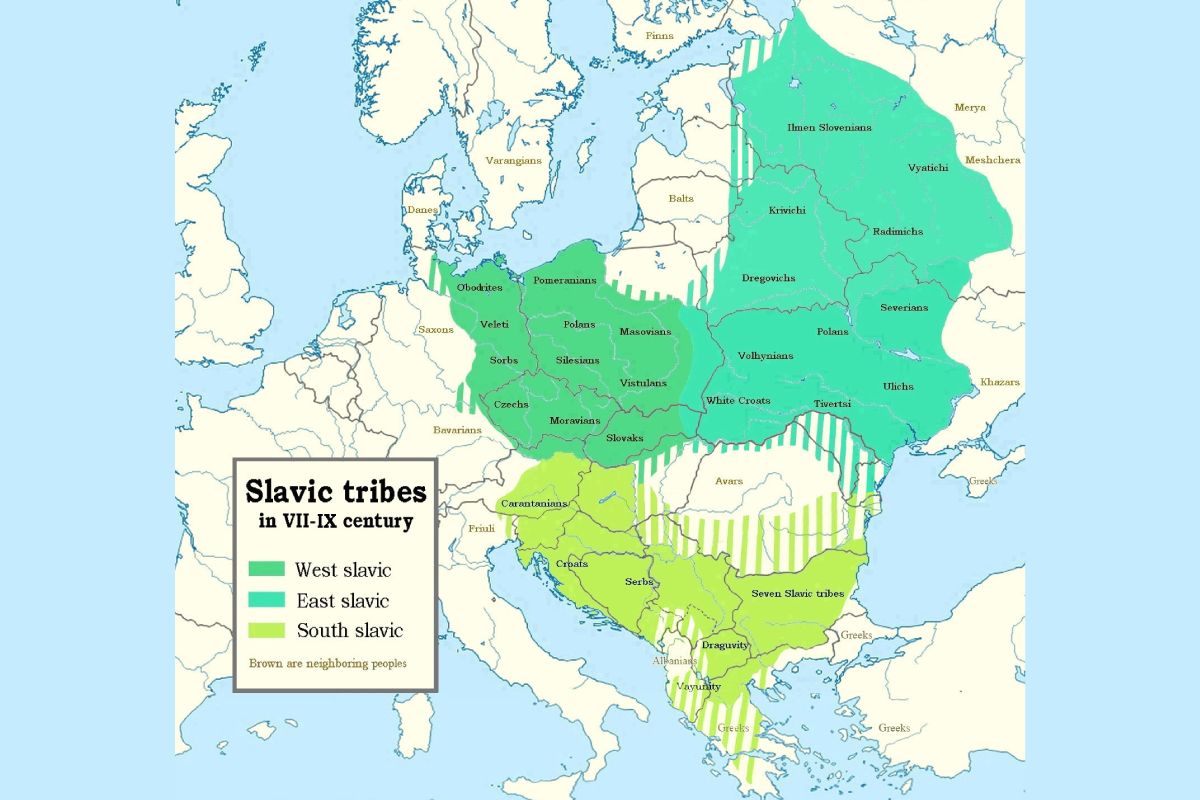
The map displays where Slavic tribes settled in the 7th to 9th centuries as they established new communities throughout Europe. Source: Jirka.h23
The coming of Christianity
Whilst power, riches, and territory were often at the center of the relationships between people from Viking societies and the Slavs, there was also a spiritual aspect to this complex relationship.
Originally, both the Slavic tribes and their northern neighbors held a wide range of polytheistic religious beliefs centered on deities associated with fertility and harvest, such as Perun and Mokosh for the Slavs and Thor and Freyja for the Norse.
Possessing similar religious beliefs helped foster and facilitate cultural integration.
During the latter stages of the Viking Age, Christianity succeeded not only in securing a grip on Viking societies but also in spreading into large parts of Eastern Europe.
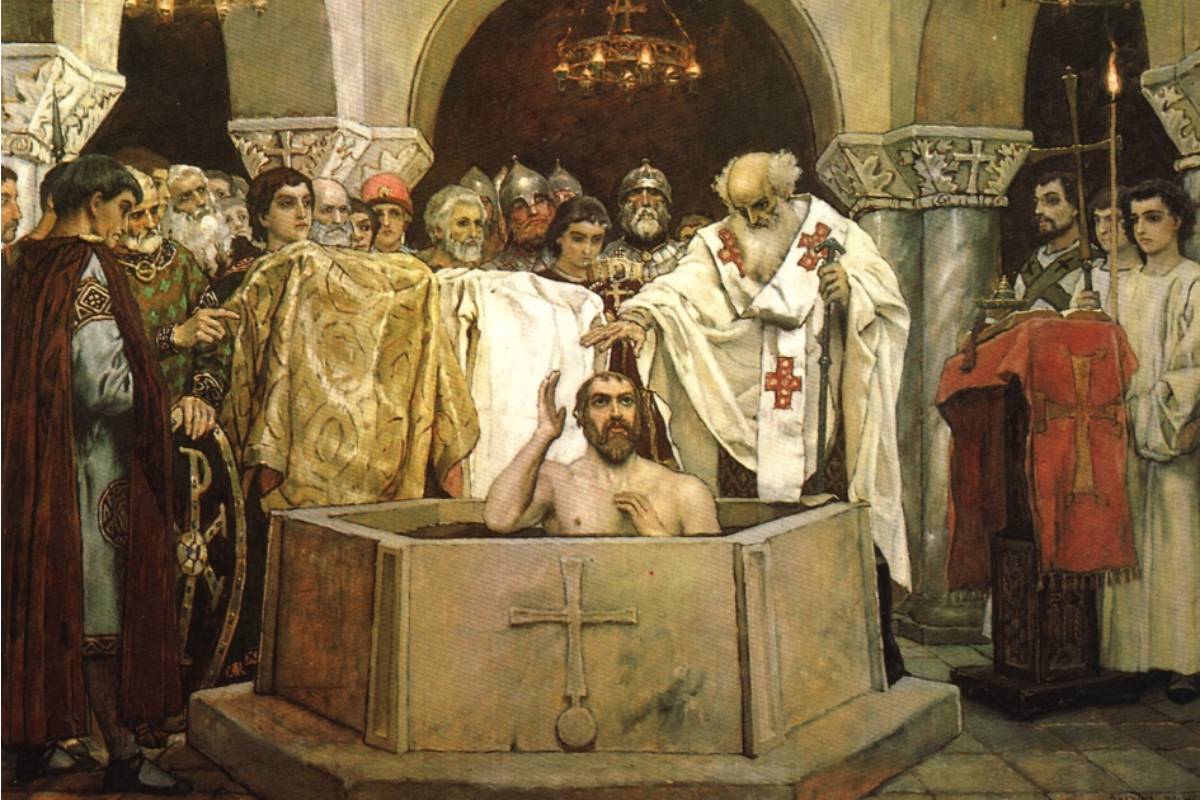
Christian influences from the north as well as the south – through the Byzantine Empire – eventually led to the total Christianization of the Rus when ruler Vladimir the Great was baptized in 988 CE.
Unlike Scandinavia, however, Christianity was influenced not by Rome but by Constantinople.
A distinctly Slavic Christian tradition emerged that incorporated elements of earlier paganism and was shaped primarily by Eastern Orthodox Christianity.
This shift resulted in the loss of cultural and religious influence of people from Viking societies in Slavic societies.
- READ MORE: Tracing Norse and Slavic religious parallels
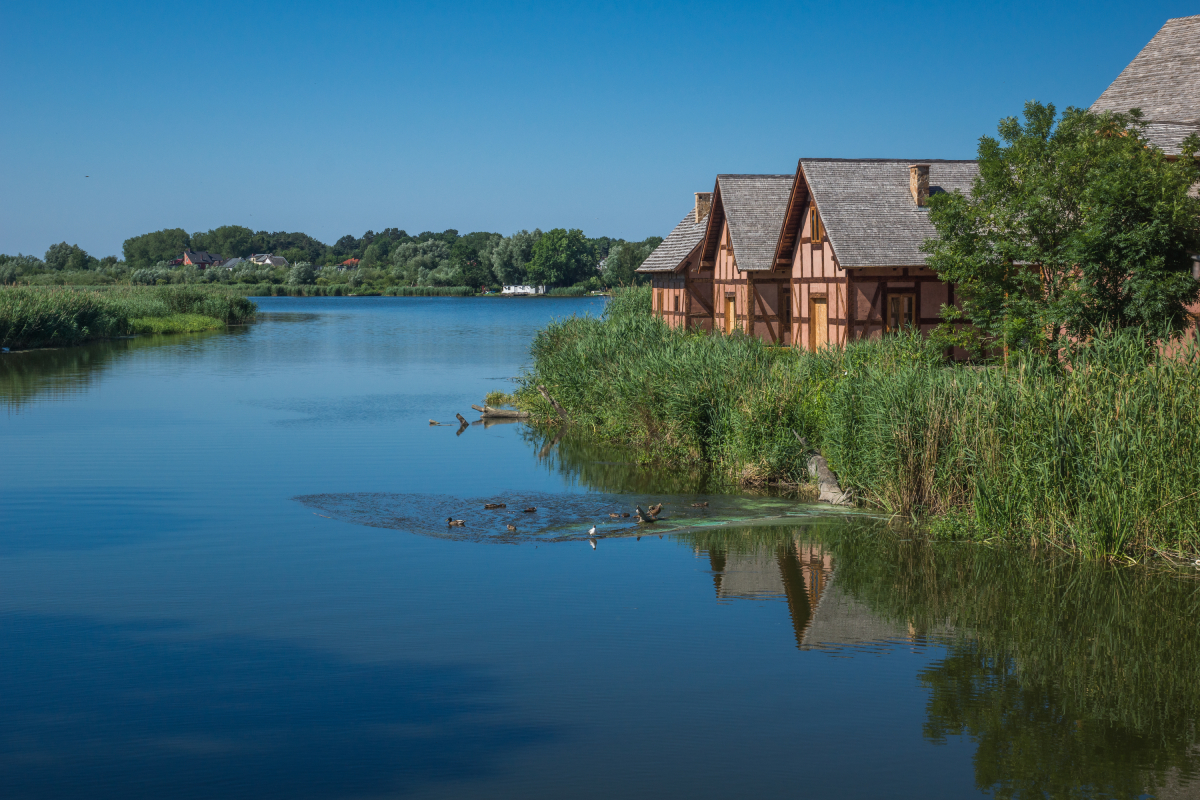
Situated in Poland, Wolin Island served as a major Viking trade center, remembered today through the annual Slavic and Viking Festival. Photo: Artur Bociarski
A complex relationship produces a lasting legacy
By the end of the Viking Age, in the early 12th century, people in Slavic and Viking societies were to march down two divergent paths.
The close bonds between these two peoples would eventually be severed as Scandinavia looked westward across the North Sea to the British Isles and the Frankish and German realms for inspiration and influence.
For the Slavic peoples, it was the pull of the Byzantine Empire that shaped their medieval history.
The complex relationship between people from Viking societies and the Slavs was as deep as it was intricate. What started as a relationship built upon profit and plunder soon turned into governance and settlement.
Add in common earlier pagan beliefs and the fact that both peoples were experiencing an influx of Christianity from outside at the same time, and the links between these two societies were stronger than they may first appear to us in modern times.
People from Viking societies left a legacy by helping to open large parts of Eastern Europe to trade and contributing to the establishment of the Kievan Rus – a powerful medieval regional power.
This complex relationship lives on in the shared cultural and historical roots of three Slavic countries – Belarus, Russia, and Ukraine – which trace back to the Kievan Rus period when Slavs and Vikings coexisted.
This common ancestry makes the current war in Ukraine even more tragic.
For more information on the mystery surrounding the ethnic identity of a Viking-era skeleton discovered in Prague Castle, visit the BBC here.
We get to provide readers with original coverage thanks to our loyal supporters. Do you enjoy our work? You can become a PATRON here or via our Patreon page. You'll get access to exclusive content and early access.
Feel free to reach out to discuss potential stories that may be in the public interest. You can reach us via email at hello@thevikingherald.com with the understanding that the information you provide might be used in our reporting and stories.