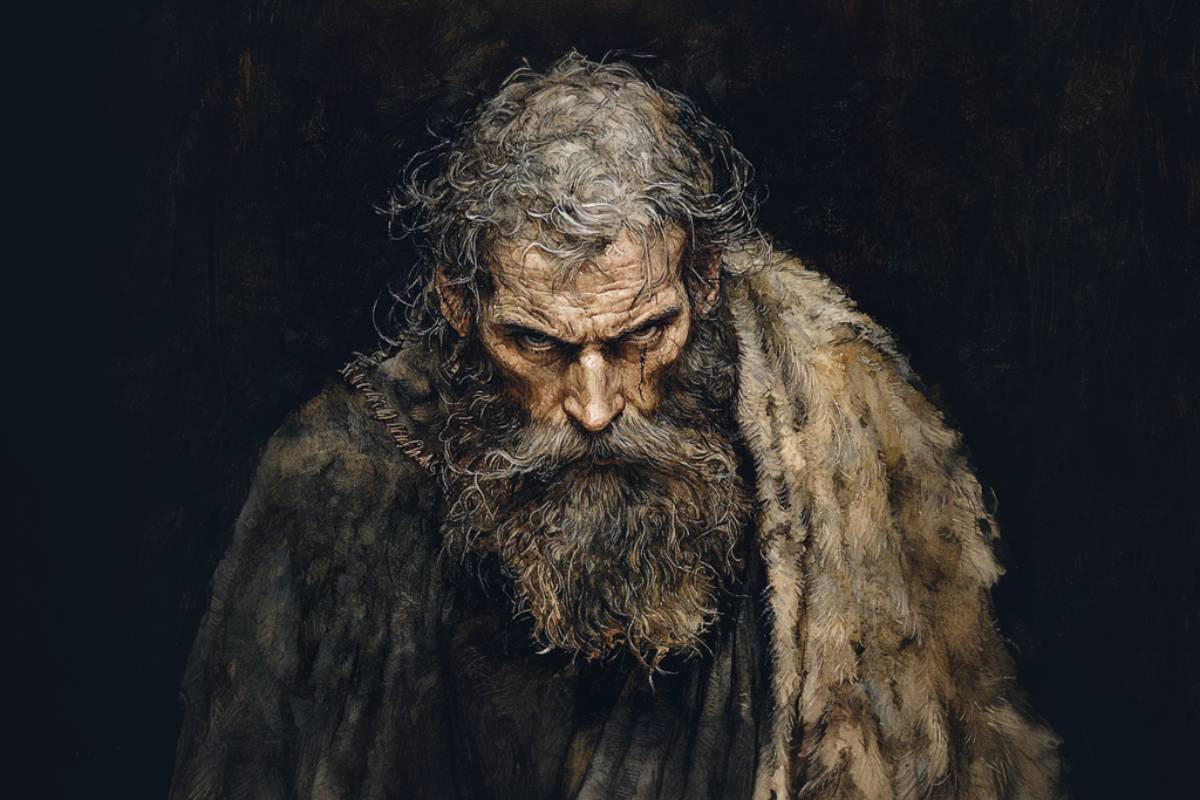


One of the surprise Hollywood hits of 2021 was the Ridley Scott film The Last Duel.
Written by Hollywood A-listers Matt Damon and Ben Affleck and starring Damon, the film traces the story of a knight who challenges his former squire to a duel to the death following an accusation of rape.
This Ridley Scott film – his second that deals with the medieval period after the Kingdom of Heaven – is a fairly accurate portrayal of life in the medieval period, as Thomas Hobbes might call it, "short, nasty, and brutish," and, we might add, smelly.
What we found interesting at The Viking Herald was that Hollywood often isn't bothered with the medieval period at all, let alone a feature film detailing the intricate aspects of this form of justice, which was bound up with bloody violence and personal honor.
Whilst The Last Duel is set in 14th-century France, the concept of a judicial duel – sometimes also called "trial by combat" – has a long history that, you guessed it, stretches back into the early medieval period when Vikings roamed.
We know that Viking societies were structured around the concept of honor as well as an almost cult-like worship of a warrior ideal.
It should be no surprise, then, that their version of trial by combat, called a holmgang, was part of how people in Viking societies settled disputes, defended slighted personal or familial honor, and often served as a last resort for complicated legal conflicts.
So, grab your sword, gird your loins, and let us venture back to the early medieval period to explore holmgang, the Viking trial by combat.
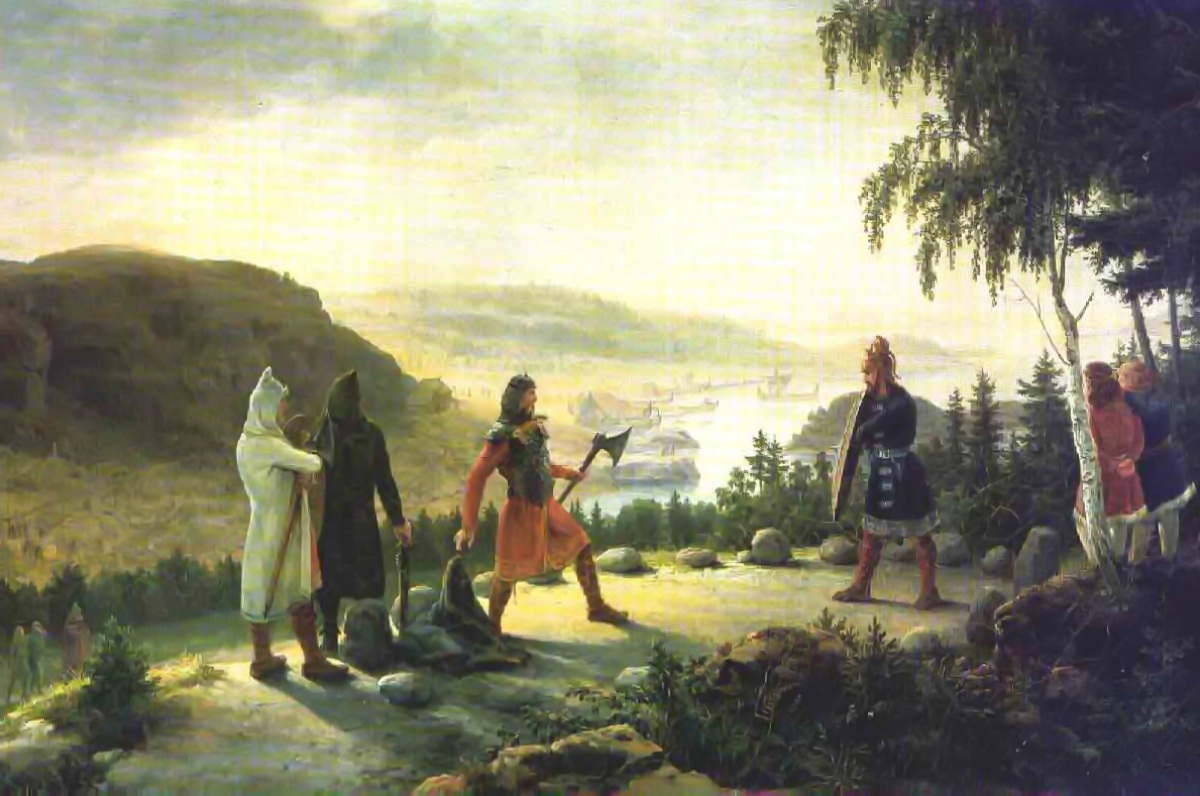
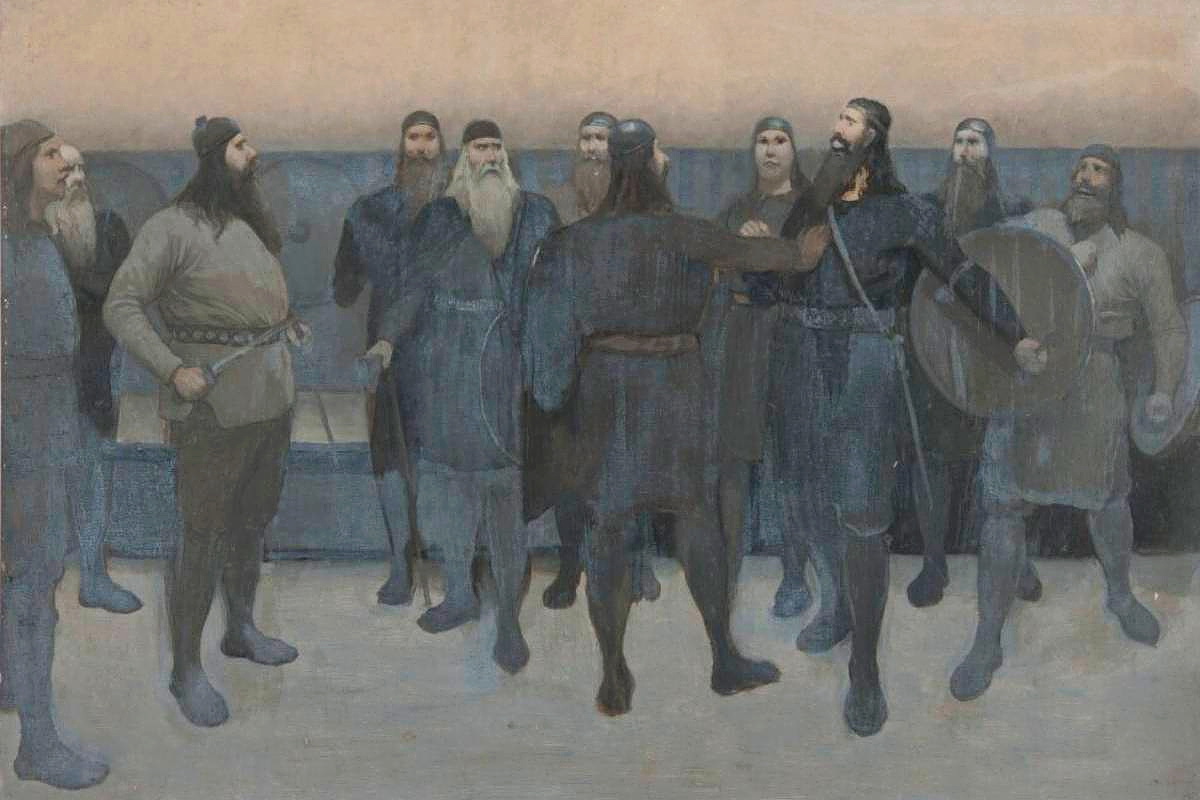
The painting depicts Egill Skallagrímsson engaging in a holmgang with Berg-Önundr, a duel central to Egil's Saga. Source: Johannes Flintoe (1787–1870)
A bloody duel
The literal translation of the Old Norse term holmgang, in English, is something akin to "island walk," but perhaps a better translation is "small island duel."
Now, let's be clear – this has nothing to do with any sort of beach bum or Pacific paradise.
Whilst this name might specifically refer to a duel held by the eponymous hero of Egil's Saga – which took place on a small island – it is commonly thought that most of these duels were held in an isolated place, away from the local community.
The holmgang was, in many ways, a form of justice that was to be administered only when all other legal avenues had been exhausted.
Whilst we might turn our noses up at the barbarity and violence inherent in Viking societies' judicial and legal institutions and practices, it is true that these were, for the medieval period, quite sophisticated and developed.
A holmgang was the only recognized method for individuals to assert their rights and defend themselves against accusations or slights when evidence was lacking or challenged.
This could stem from accusations of theft or physical or sexual violence (as portrayed in The Last Duel) or, indeed, more mundane matters regarding property disputes.
How did a holmgang unfold?
What we know of the rules and regulations comes from a combination of obscure medieval laws and Norse sagas.
Viking societies had a long history of feuding, as Jesse Byock details in his 1993 book on the subject.
Scouring the sagas and medieval legal fragments (see below), we find different descriptions of a holmgang, but some commonalities link them all.
Firstly, there had to be a formal declaration or challenge to a holmgang. This was the right of the person who felt insulted or sought to appeal a legal decision.
However, there was to be no martial mismatch, as the challenged party could nominate someone to fight in their place if their warrior skills were lacking.
Next, a location had to be chosen. This was often an isolated place, as previously mentioned.
The weapons were then selected – typically a sword or an axe – though sometimes both combatants could have a shield bearer or a support person.
The fighting could take two forms: an open battle where both sides traded blows freely or a more formalized affair with a structured sequence of attacks.
Finally, the fight ended when one side was wounded, killed, or declared they were unable to continue.
Sometimes, a fight to the death was enforced, whilst in other cases, a combatant could concede defeat.
Following the duel, some form of restitution was often required, with the losing party providing compensation, which could include property – or even enslaved people.
A holmgang could also escalate into further violence, as the losing side's family or supporters might seek revenge, leading to a prolonged blood feud.
It should be noted that, as Garfield Matson states in their 1995 article Holmgang – Its Use, Abuse, and Fictionalization Part One, any rules for a holmgang “…never had a uniform character. They varied from region to region and could change over a period within a region.”
We now turn to two very different descriptions of a holmgang bequeathed to us from medieval sources.
- READ MORE: A complete guide to Viking weaponry
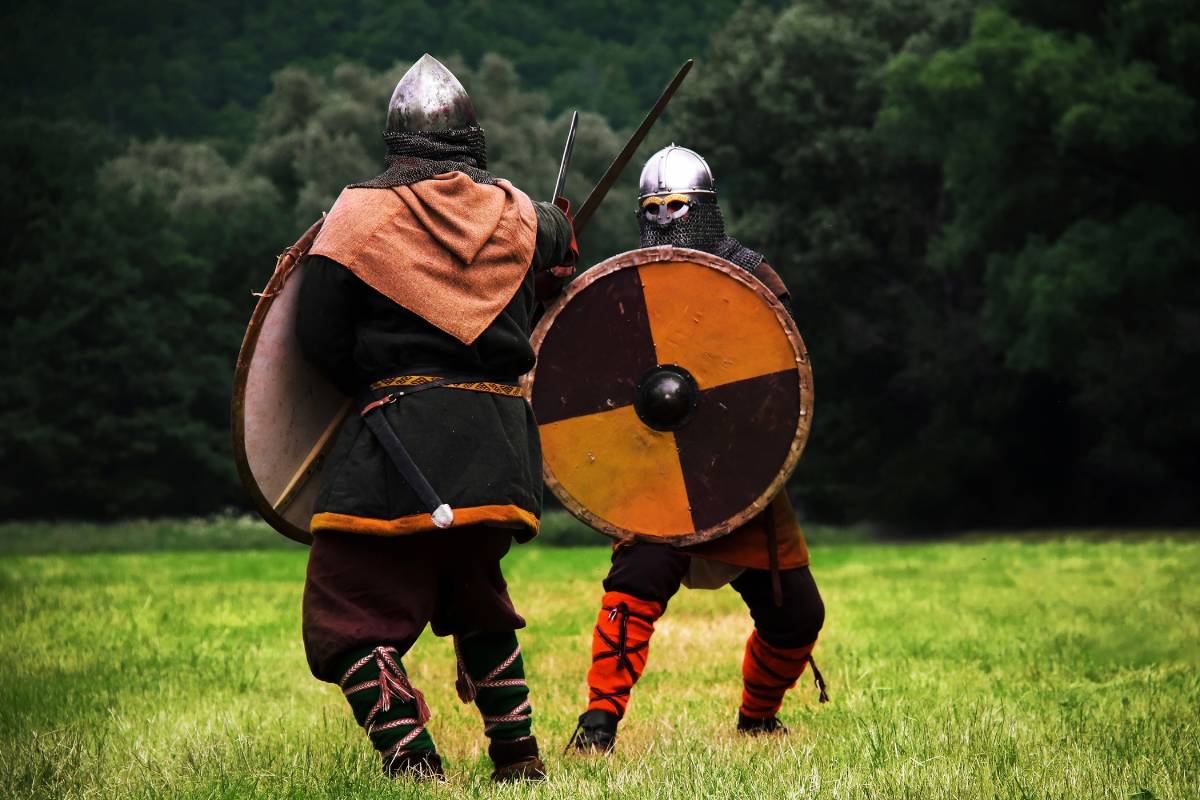
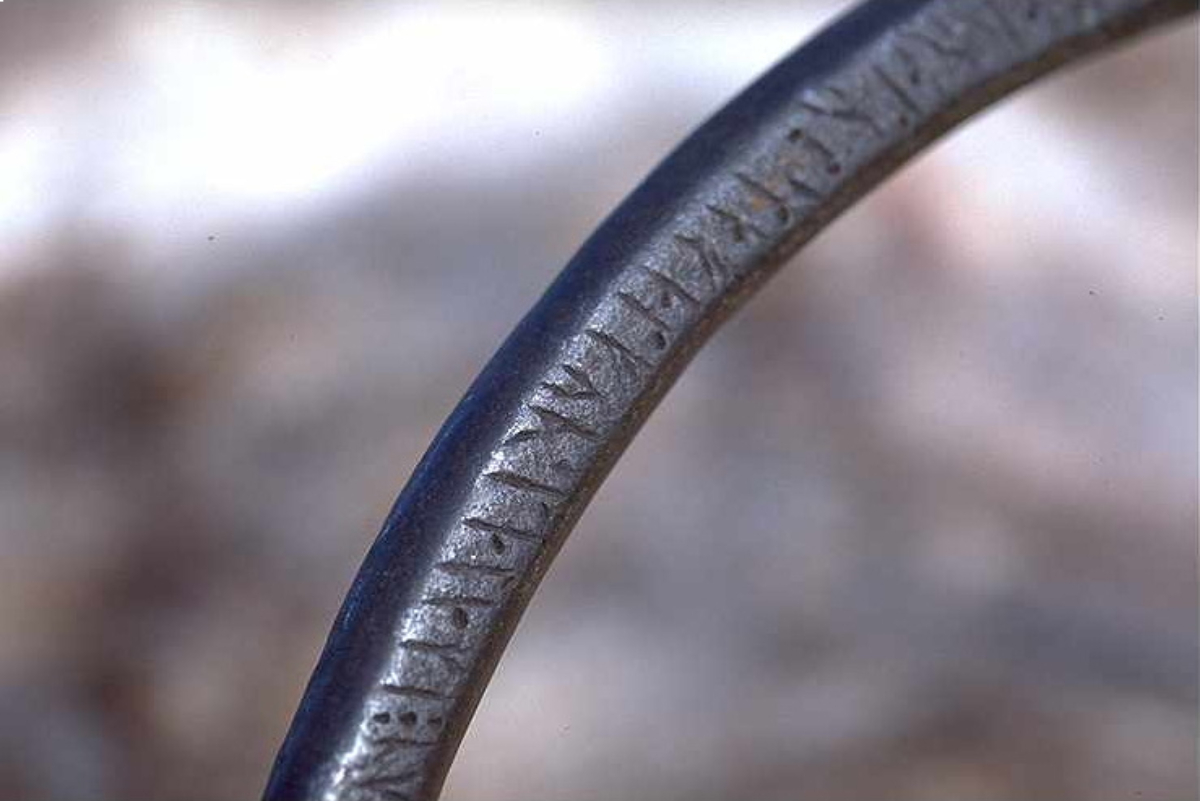
According to Egil’s Saga, holmgangs were sometimes fought with strict turn-based strikes rather than open combat. Photo: Michaela Pilch / Shutterstock
Are there any descriptions of the holmgang?
Given that a holmgang was a medieval form of justice last fought centuries ago, we have some very vivid and colorful descriptions left to us.
Through a combination of medieval legal texts and the rich tapestry of Norse sagas, we can be transported back to the Viking Age and see precisely how a holmgang was said to have taken place.
From a legal point of view, we have only a fragment of an early medieval Swedish law known as Hednalagen (Pagan Law).
This is not a fully preserved legal code but a surviving fragment from an unknown older law, cited in later sources, including Olaus Petri's Svenska krönika and the 1607 printed edition of Upplandslagen.
The fragment outlines the conditions under which a duel, or envig, could take place when a person had been insulted.
We can see how this is described in the 1970 book Viking Achievement: The Society and Culture of Early Medieval Scandinavia by Peter Foote and David M. Wilson (Available on Amazon here).
In this book, they provide an English translation of the part of Hednalagen that describes a holmgang. This reads:
"A man uses an unutterable word to another: 'You are not a man's equal and not a man at heart.' [He answers:] 'I am as much a man as you.' They are to meet at a place where three roads join. If the one who comes gave the insult and the other who received it does not come, then he will be what he is called: he cannot swear a legal oath or hear witness on the behalf of either man or woman. If he comes who received the insult and not the one who gave it, then let him shout three niðing-shouts and mark the other man in the ground. Let him who spoke what he did not dare maintain be so much worse a man in consequence. If they meet both fully armed, and the one falls who received the insult, atone for him with half-price for manslaughter. If he falls who gave the insult (the crime of words is worst, the tongue a prime slayer), let him lie in the valueless field [i.e. no atonement is paid for his death...]" (pp. 379–380).
Now, for those who aren't quite up to scratch with their obscure Viking insults, the term niðing refers to a loss of honor and the status of a societal ne'er-do-well or villain.
It is interesting that in this description, we see that the location of the holmgang is described as a "place where three roads join." One can assume that this would be safely out of the village and away from polite society.
Turning to the sagas, we have a vivid and detailed description of the actual rules and regulations regarding the dueling itself.
What do the sagas tell us?
We now turn, as we always do, to the rich tapestry of Norse sagas in our quest to understand all aspects of Viking history and society.
In Kormáks saga (The Saga of Cormac the Skald), we find a vivid description in Chapter 10. Using a 1901 English translation by W. G. Collingwood and J. Stefansson, we find an account of a holmgang between the titular character and Bersi, a warrior, over a slighted marriage proposal.
Bersi warns Cormac, "...thou art a young man and little tried; the holmgang needs craft and cunning, but sword-play, man to man, is an easy game..."
It appears that a holmgang, this bloody fight, was as much a battle of wits as one of martial skill.
Further on in the chapter, we have another description of the finer points of a holmgang that states:
"It was the law of the holmgang that the hide should be five ells long, with loops at its corners. Into these should be driven certain pins with heads to them, called tjosnur. He who made it ready should go to the pins in such a manner that he could see sky between his legs, holding the lobes of his ears and speaking the forewords used in the rite called 'The Sacrifice of the tjosnur.' Three squares should be marked round the hide, each one foot broad. At the outermost corners of the squares should be four poles, called hazels; when this is done, it is a hazelled field. Each man should have three shields, and when they were cut up he must get upon the hide if he had given way from it before, and guard himself with his weapons alone thereafter. He who had been challenged should strike the first stroke. If one was wounded so that blood fell upon the hide, he should fight no longer. If either set one foot outside the hazel poles 'he went on his heel,' they said; but he 'ran' if both feet were outside. His own man was to hold the shield before each of the fighters. The one who was wounded should pay three marks of silver to be set free..."
This description is interesting because the duel was to be held on a large cloak. This meant that the fighting was very much up close and personal, with each combatant probably smelling the other's blood, sweat, tears, and fear.
Sadly, we have no contemporary accounts of a holmgang – i.e., those that have survived from the Viking Age (c. 750–1100 CE).
What we know comes to us from the later medieval period when the notion of honor was very different from that of the early medieval period.
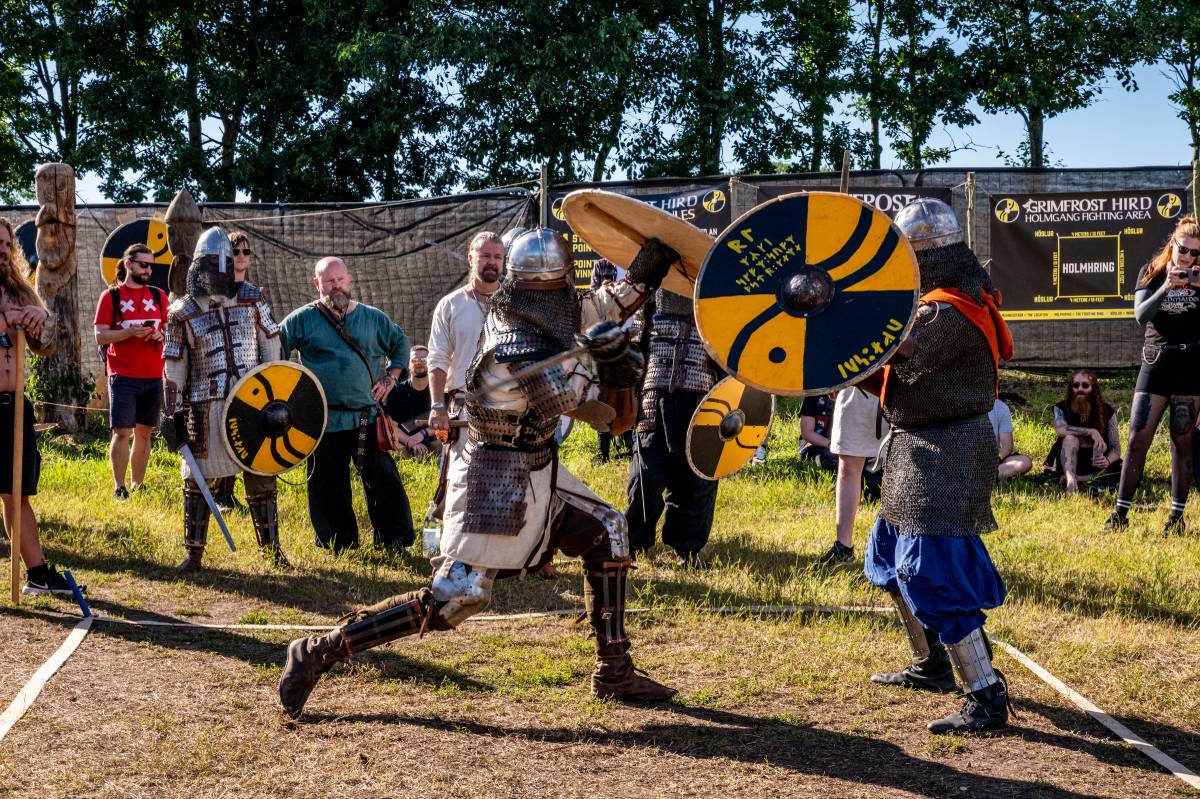
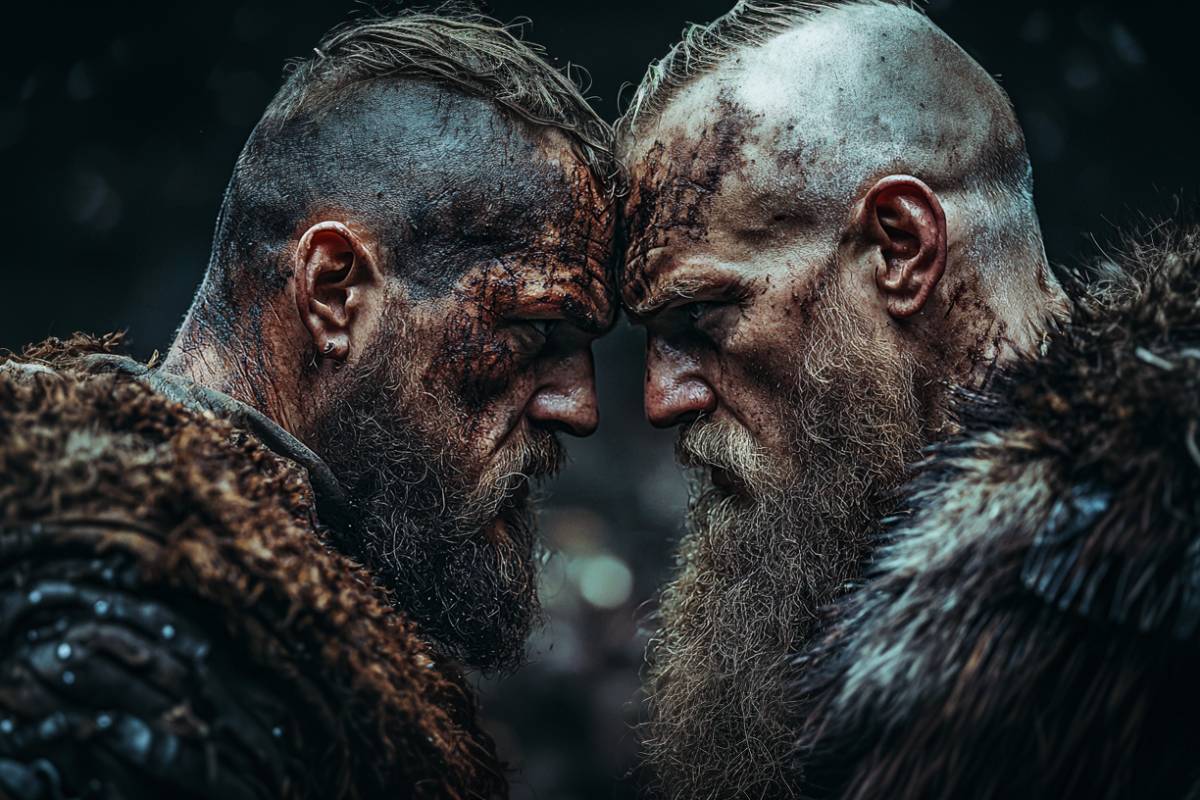
Members of Swedish Grimfrost reenact a holmgang duel at the 2023 Midgardsblot festival in Norway. Photo: Birdesigns (CC BY-SA 4.0)
Could this form of justice be abused?
Despite the highly regulated nature of a holmgang, the practice was indeed open to abuse.
One commonality we share with the medieval period is that money talks. The rich and powerful members of the community had the means to influence judicial or legal decisions – this was very much a time of rampant corruption.
This meant that, for example, a holmgang could be avoided by simply paying off the slighted party, hiring a skilled warrior to fight in their place, or even having the slighted person murdered.
Greed and avarice also played a role in the calling of a holmgang, as powerful or influential members of society could use it to acquire the goods or property of others.
As in the jungle, Viking societies often saw the strong prey on the weak.
This abuse of the system led to its decline, and holmgangs were banned throughout the Viking world toward the end of the Viking Age.
However, whilst the holmgang may have fallen out of favor, later medieval Nordic societies saw the widespread practice of judicial duels – just not with this earlier distinct Viking character.
Reminiscent of a societal warrior ethos
In an age when violence and lawlessness were rife, a holmgang was one of the ways to, ironically, ensure communal peace.
This was more than just a violent spectacle; it was an integral part of Viking legal culture, allowing disputes and slights to be settled.
The holmgang also encapsulated the warrior ethos that permeated Viking societies and has made them, from the safety of centuries, so fascinating to study.
For more information on the historical background behind The Last Duel, visit the Smithsonian Magazine website here.
We get to provide readers with original coverage thanks to our loyal supporters. Do you enjoy our work? You can become a PATRON here or via our Patreon page. You'll get access to exclusive content and early access.
Feel free to reach out to discuss potential stories that may be in the public interest. You can reach us via email at hello@thevikingherald.com with the understanding that the information you provide might be used in our reporting and stories.