

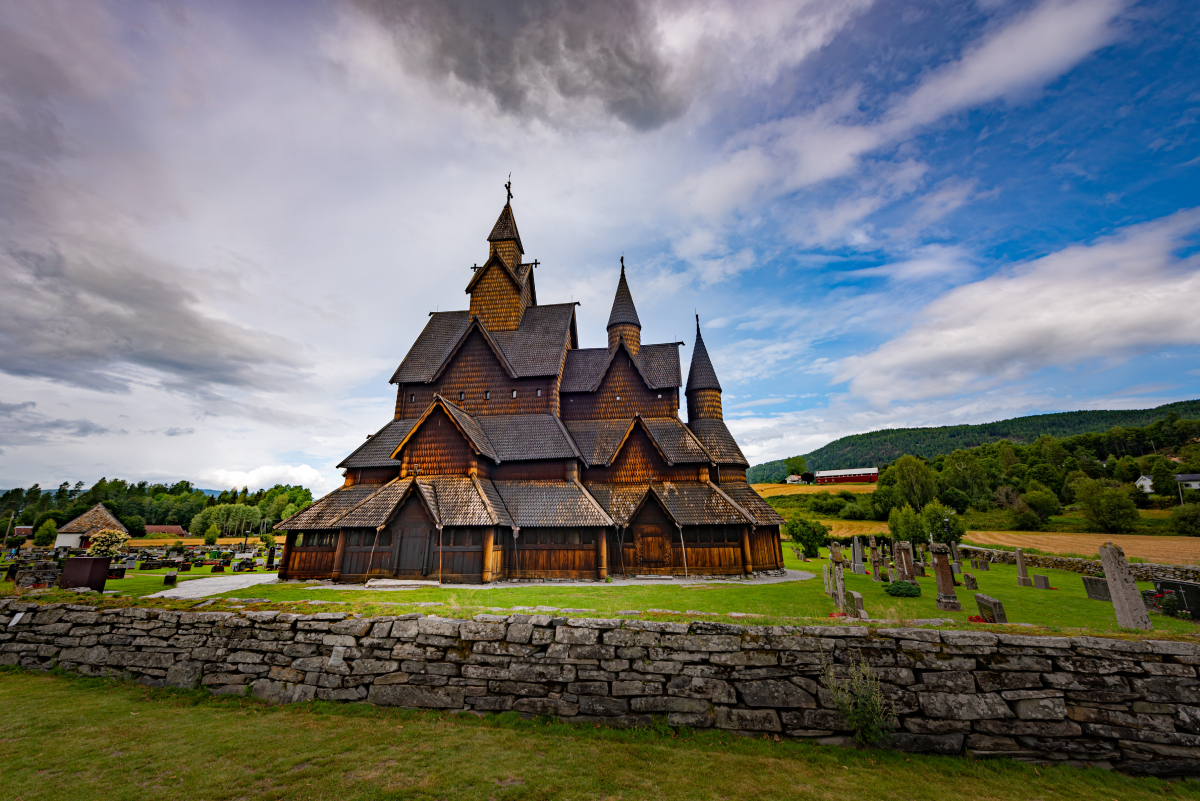
Let us dive into the storied history of Norway’s medieval mammoth.
Swapping hordes of Vikings for scores of tourists
Every year, scores of tourists flock to Heddal, a small village in the Telemark region of Norway.
Whilst the municipality that the village belongs to only has a population of close to 5,000, Heddal houses a cultural institution that is worthy of any of the larger cultural hubs, like Bergen, Oslo, or Trondheim.
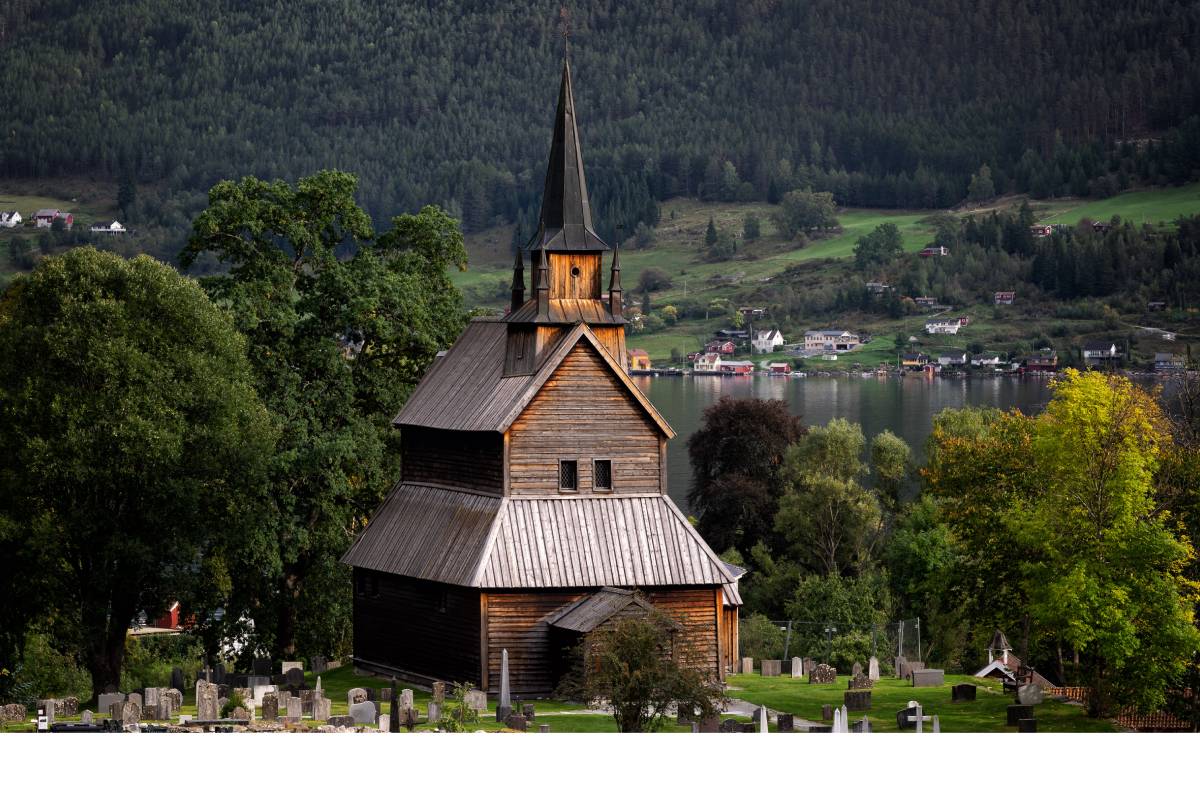
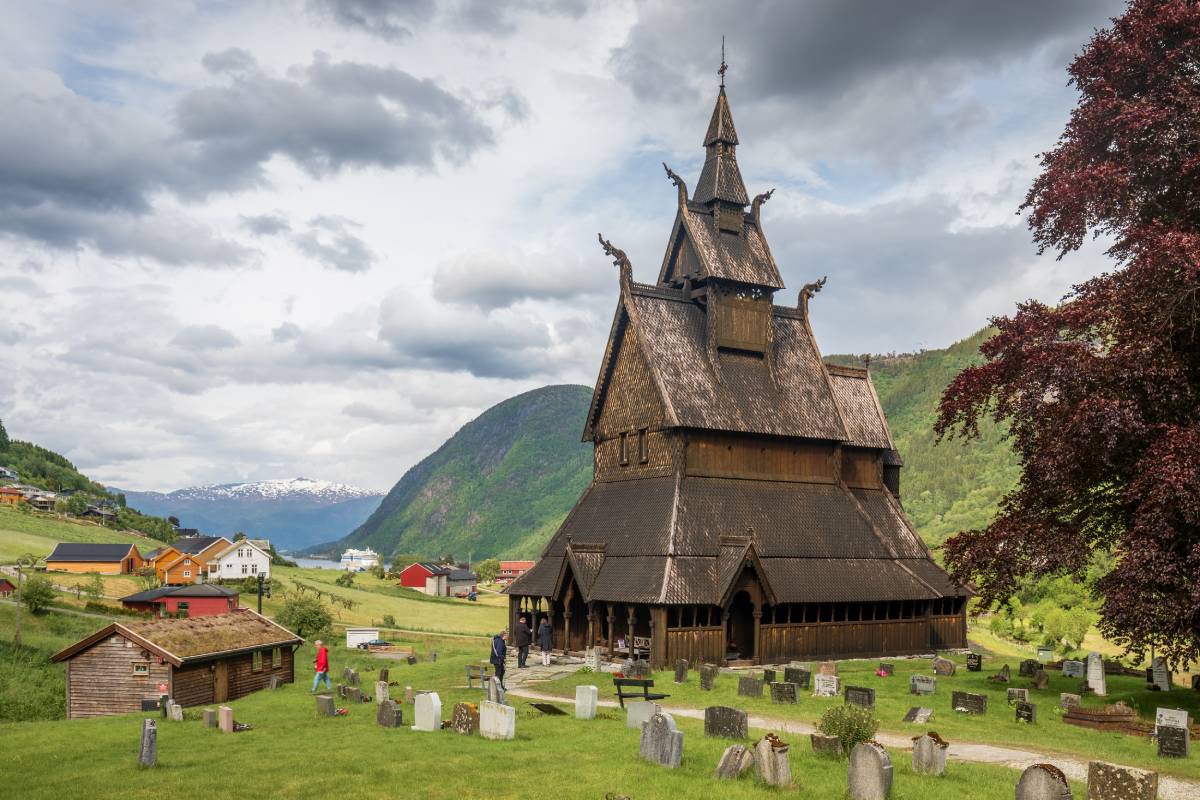
For it is in Heddal that there stands today, after more than eight centuries, the largest surviving stave church. Linking present-day Heddal with the medieval period, this church has breathed new life into the Telemark region, allowing countless tourists to flood in and witness firsthand the majesty of this medieval mammoth.
The stave church is not only a tourist attraction in its own right—who wouldn’t want to see one of Norway’s largest pieces of medieval religious architecture—but its restoration work over the past three centuries has played an important role in the further preservation and restoration of other ancient monuments and structures.
First, though, let’s wind back to the medieval period when construction on this church began.
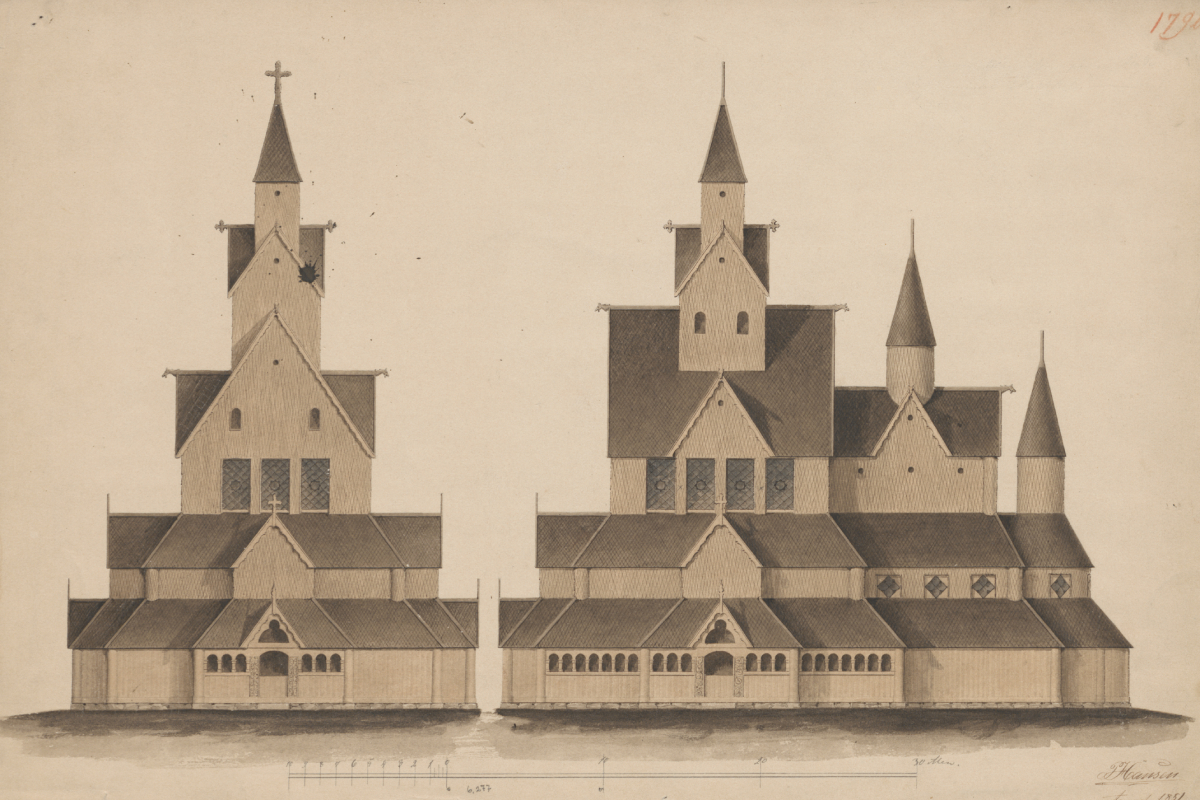
Painted in 1850, this watercolor shows the south and west façades of Heddal Stave Church as it appeared in the 19th century. Illustration: P. Hansen
Huge size spoke of a bustling region
The Heddal Stave Church was constructed, we believe, at the turn of the 13th century CE. Like so many other medieval monuments in Norway, we do not know who designed or built the church.
One can assume that the latter were probably locals from the village, whilst the mystery of the former will, frustratingly, probably never be revealed.
Like other stave churches throughout Norway, this huge church was constructed of pine wood, supported by load-bearing poles (staves), and built on a stone foundation.
The construction of a church that is over 42 meters (138 feet) long, 15 meters (49 feet) wide, and, at its highest point, 26 meters (85 feet) tall would have taken a large amount of not only labor but also organizational skill and effort.
This speaks to the central role that the church would have had in daily life, not only during its construction but for centuries after as the center of communal worship and celebration.
We do not know how long the church took to be constructed, but countless hours must have been spent cutting down the pine, crafting it, and then assembling each piece of this colossal church.
According to Maia Marie Langley in her 2000 tome, Sacred Wood: A Study of the Norwegian Stave Churches, we may have expected such a large church to be constructed in a larger town—perhaps in the then capital Nidaros (Trondheim) or Bergen.
Yet it was here in Heddal, a village that lies between Oslo and Bergen, that this monument was built. But why?
Well, unlike in more recent times, when the only bustling is that of the steady flow of tourist buses, this region during the medieval period must have experienced a significant flow of trade, commerce, and people to enable the creation of such a large church.
The network of trade between the bustling town of Bergen—the window through which foreign trade often entered Norway—and the burgeoning town of Oslo, far away in the east of the country, was, by the 13th century CE, becoming a lucrative route.
Whilst it is now the largest stave church in Norway, it was not necessarily the largest stave church ever constructed. Sadly, though, only 28 stave churches still stand in Norway, so we will never know if the Heddal church was truly the largest stave church ever erected.
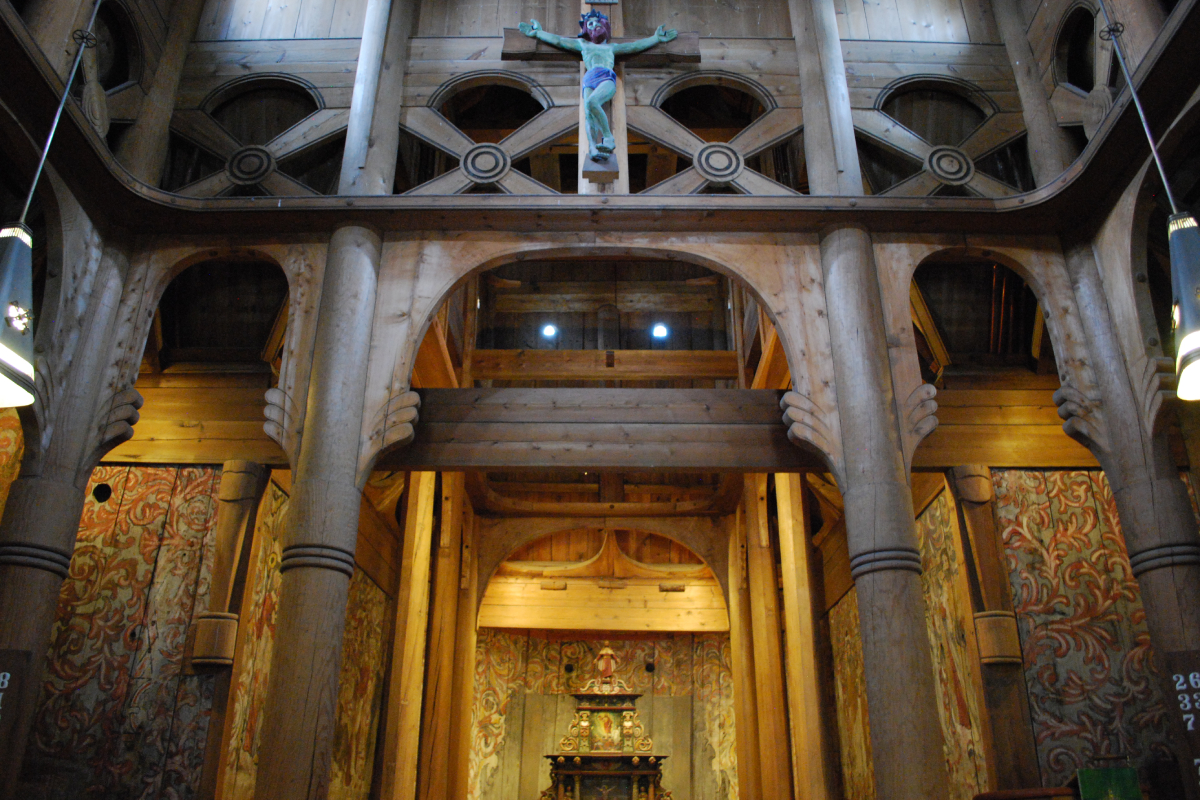
The interior of Heddal Stave Church features a wooden crucifix and altar, framed by original 13th-century timber architecture. Photo: Concierge.2C (CC BY-SA 3.0)
Built in an era that craved the old Viking days
Although the church was constructed more than a century after the traditional end of the Viking Age—marked by the death of Harald Hardrada on a battlefield in northern England—it still harks back to that earlier era.
It recalls a time when Christianity had not yet become the dominant religion in Norway and was still waging a spiritual (and often literal) war against the Old Norse faith.
As Sverre Bagge wrote in his 2005 article in the Scandinavian Journal of History, Christianity had, by the church’s construction, eventually won that war and gained supremacy over the hearts and minds of all those in the medieval Kingdom of Norway.
Yet despite the supremacy of Christianity, there was still a long cultural memory and affiliation with aspects of what was then seen as pagan beliefs.
The church was built in an era when new understandings and analysis of the Viking period were being undertaken. Much of what we now know as the rich tapestry of Norse sagas was, if not told, at least recorded for the first time during this century by poets and authors like Snorri Sturluson.
The construction of a stave church in Heddal, mixing elements of the old world and new, must then have satisfied a cultural and spiritual hunger among the local villagers to hark back to an age when much of their cultural identity was defined and formed.
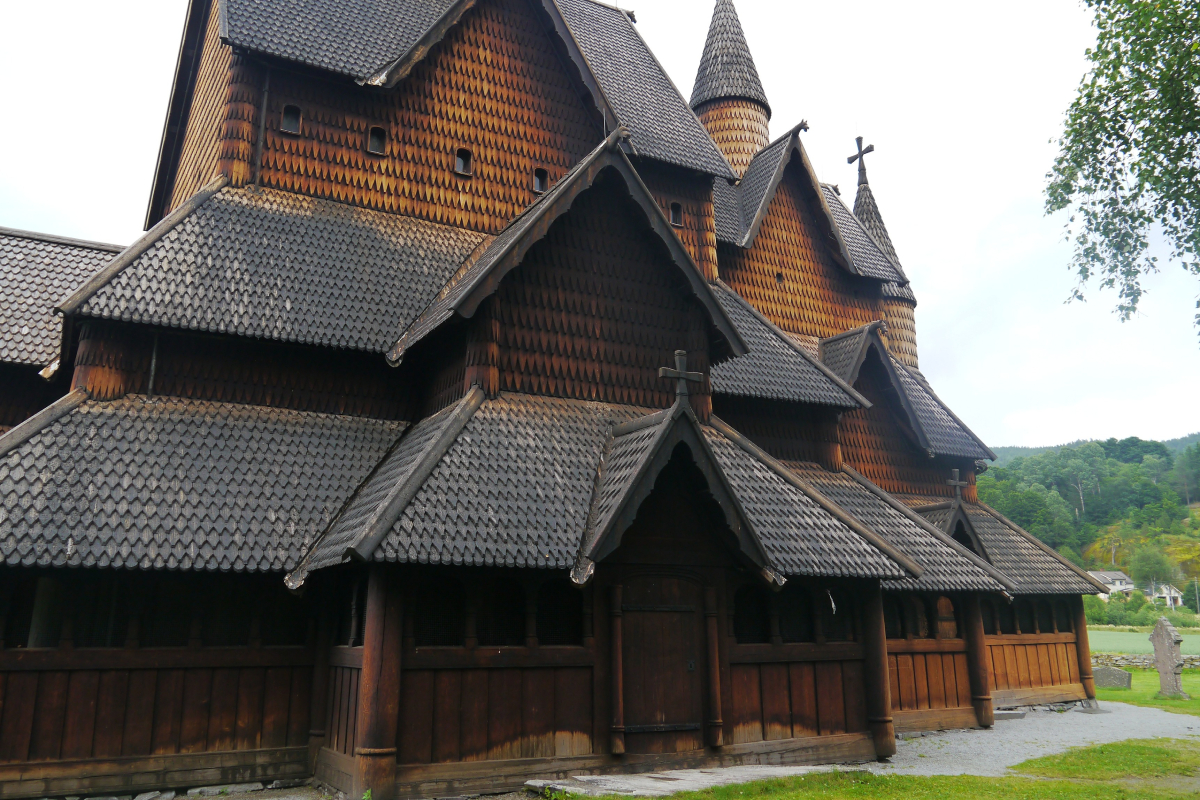
Multiple gables and steep shingled roofs emphasize the structural complexity of the church's western side. Photo: Zairon (CC BY-SA 3.0)
Changing hands and the importance of its restoration
Since the 13th century CE, the church became a focal point of all communal celebration and worship.
Countless births, marriages, and funerals took place under its three-tiered roof. However, following the political fallout from the Protestant Reformation—which would eventually lead to the dissolution of the Kalmar Union—the church fell into a dire state of disrepair.
During the next century, many of these old, decrepit churches were sold by the monarchy. At the time, Norway was in a real union with the Kingdom of Denmark.
Following the success of the anti-Swedish coalition that included Denmark-Norway, the war had severely strained the coffers of the realm, and a fire sale of state assets was needed. Heddal Stave Church was part of this cash grab and was sold to a private individual who became responsible for its upkeep.
Yet despite falling into private hands, the condition of the church improved little. By the mid-19th century, major renovation and repairs were needed.
By this period, most stave churches had been demolished to make way for newer buildings, and there was little understanding of how this style of church had originally been constructed.
The restoration of the Heddal Stave Church was a godsend (pun intended) for the newly formed Society for the Preservation of Ancient Norwegian Monuments.
The work carried out on this church gave the Society practical knowledge about how best to preserve medieval monuments and buildings.
The hands-on insight gained from the restoration of the Heddal Stave Church helped the Society restore countless other precious cultural artifacts, institutions, and monuments from Norway’s ancient past.
Thanks to the Society’s efforts, the church remains an active part of the Heddal community, as it has for almost a millennium. It is a popular venue for weddings, and should you want to tie the knot with a Viking theme, there surely is no greater place to do it than in Norway’s largest surviving stave church.
Forbes has written more information on the Heddal Stave Church, available here.
We get to provide readers with original coverage thanks to our loyal supporters. Do you enjoy our work? You can become a PATRON here or via our Patreon page. You'll get access to exclusive content and early access.
Feel free to reach out to discuss potential stories that may be in the public interest. You can reach us via email at hello@thevikingherald.com with the understanding that the information you provide might be used in our reporting and stories.