

We uncover the lesser-known aspects of it, including a goddess who shames even Lazarus with her recovery, a godly bunch of ungodly spitters, and how not to treat a hostage.
War, war everywhere
Sadly, for us in this modern era, war is an ever-present part of our lives. Take a simple scroll down your socials, and you'll no doubt see videos and images from the battlefield, be they in Chad, Syria, or Ukraine.
The current geopolitical climate is not looking great, and many fear that a great war of epic proportions may be brewing in the times ahead.
It is with this rather gloomy outlook that we have been thinking of epic battles lately.
Of course, our first thought was to turn to the Norse sagas. Like all good stories and ripping yarns, there is plenty of blood, gore, and sex to titillate any reader of these tales.
Perhaps this is why they have remained so popular over a millennium since they were first told over the warmth of a fire on a cold Nordic night.
People in Viking societies were a violent lot.
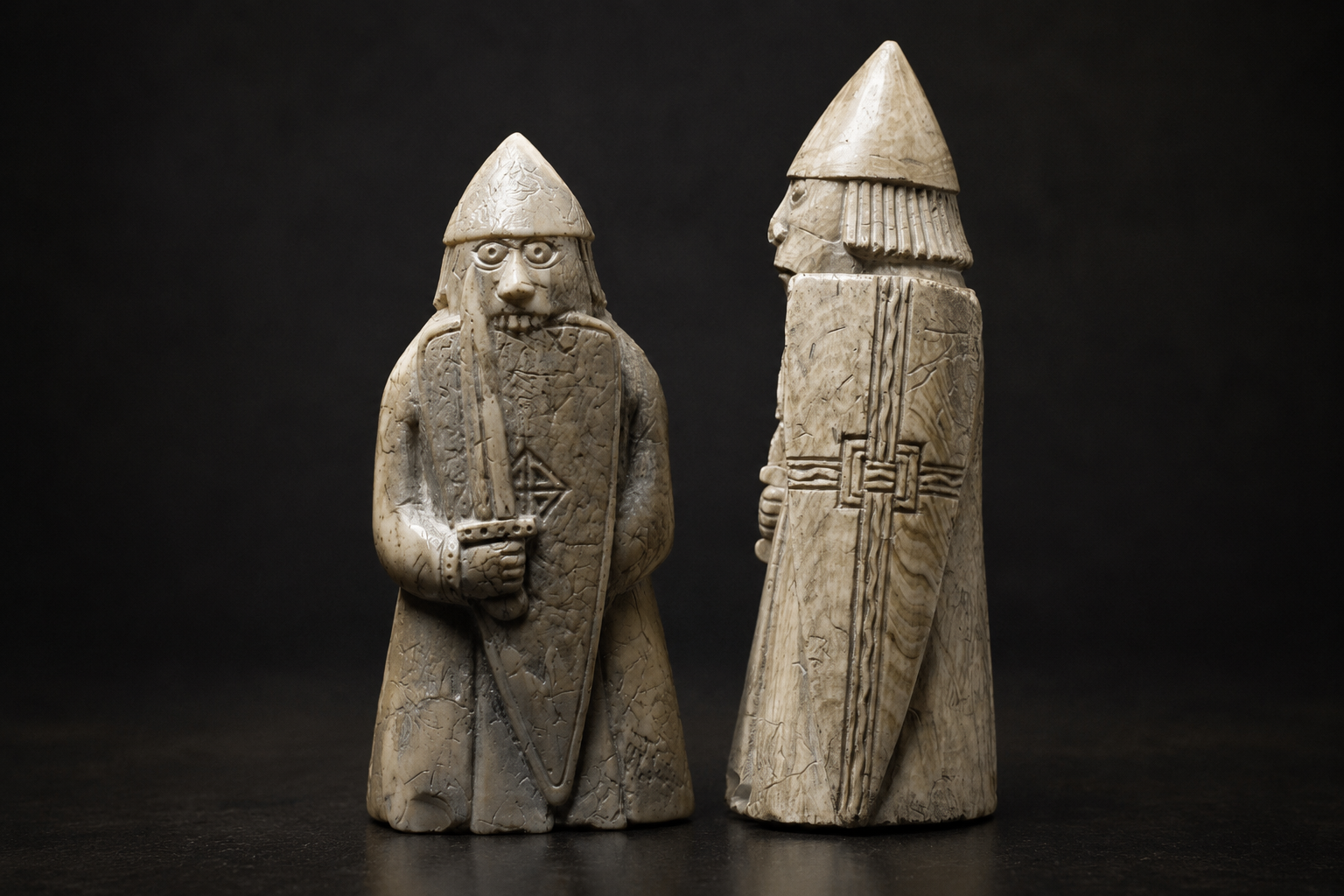
Despite their recent historical gloss-over as explorers, traders, and merchants, the fact remains that the warrior minority in these societies—the Vikings—was a nasty and brutish lot.
Theirs was a culture so steeped in a warrior ethos and honor that many of the tales they told one another, and even their spiritual beliefs, revolved around war.
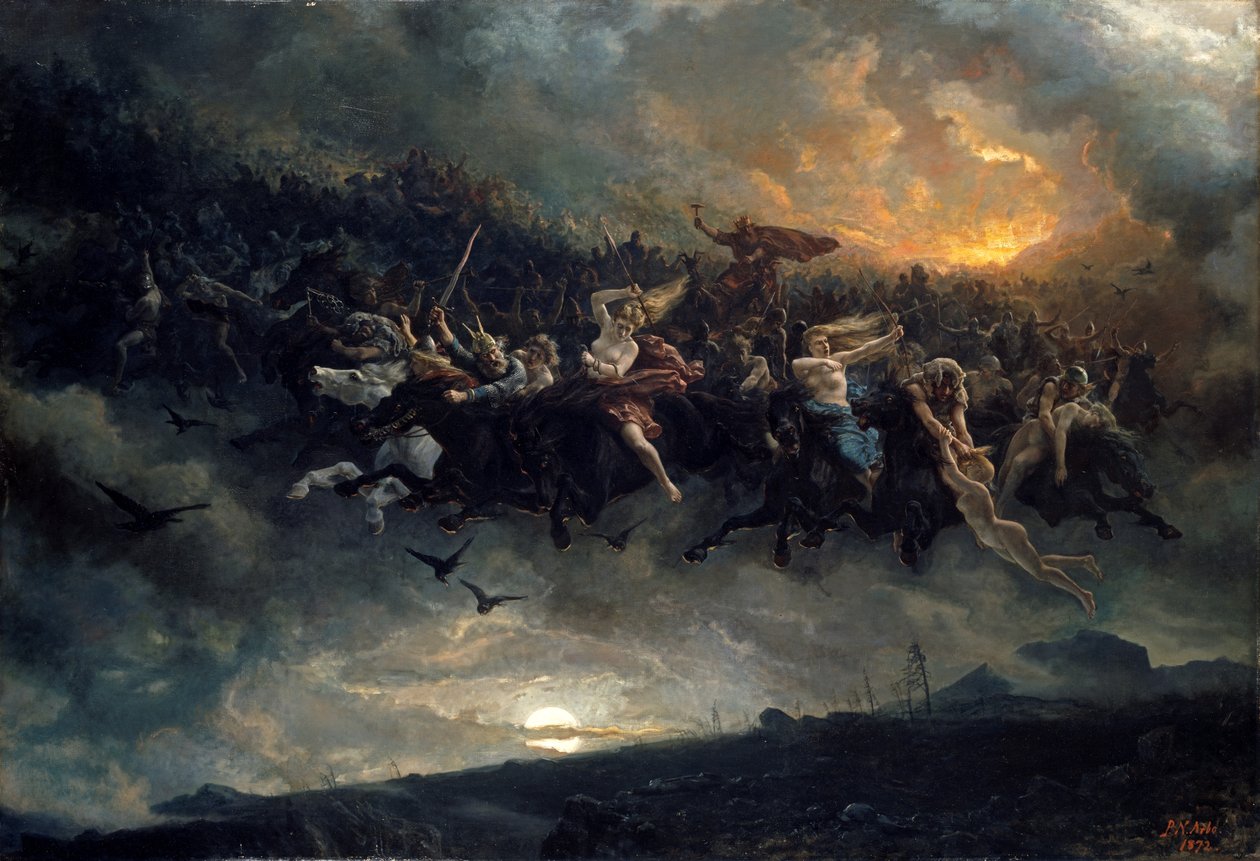
One of the most compelling tales in the rich tapestry of the Norse sagas is the mighty Æsir–Vanir war. Let us wind the clock back centuries and delve straight into the sagas to explore this legendary conflict in more detail.
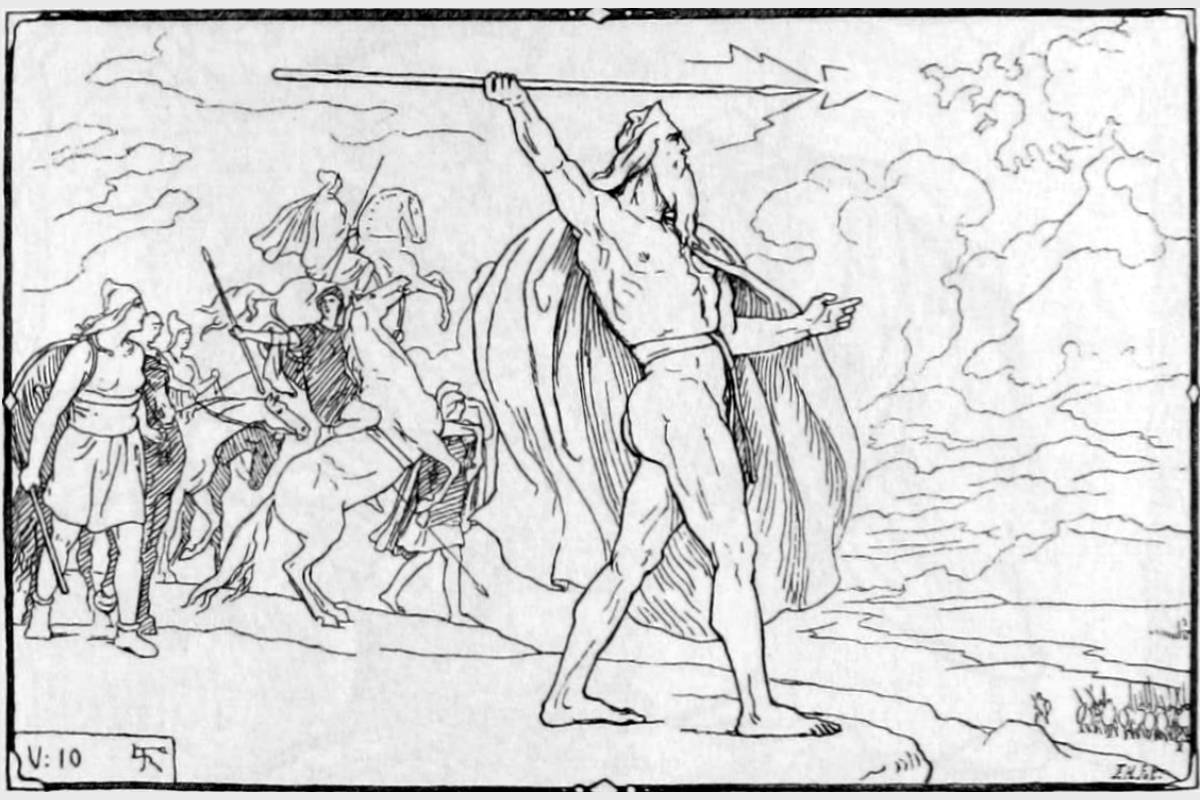
Odin is shown throwing a spear into the Vanir ranks in this depiction of the Æsir–Vanir war. Source: Lorenz Frølich (1820–1908)
Stabbing is generally frowned upon
As with all wars, the first victim, they say, is the truth. However, we have scoured the sources for some facts about this battle.
Despite this being one of the more famous battles related to the Viking Age (albeit fictional), it is little understood.
As Kees Samplonius writes in his 2001 article in the journal Tijdschrift voor Skandinavistiek, it is "partly due to the paucity of our sources, partly to the preoccupation of earlier generations of scholars, who saw the myth primarily as a memory of primeval history preserved in the garb of myth."
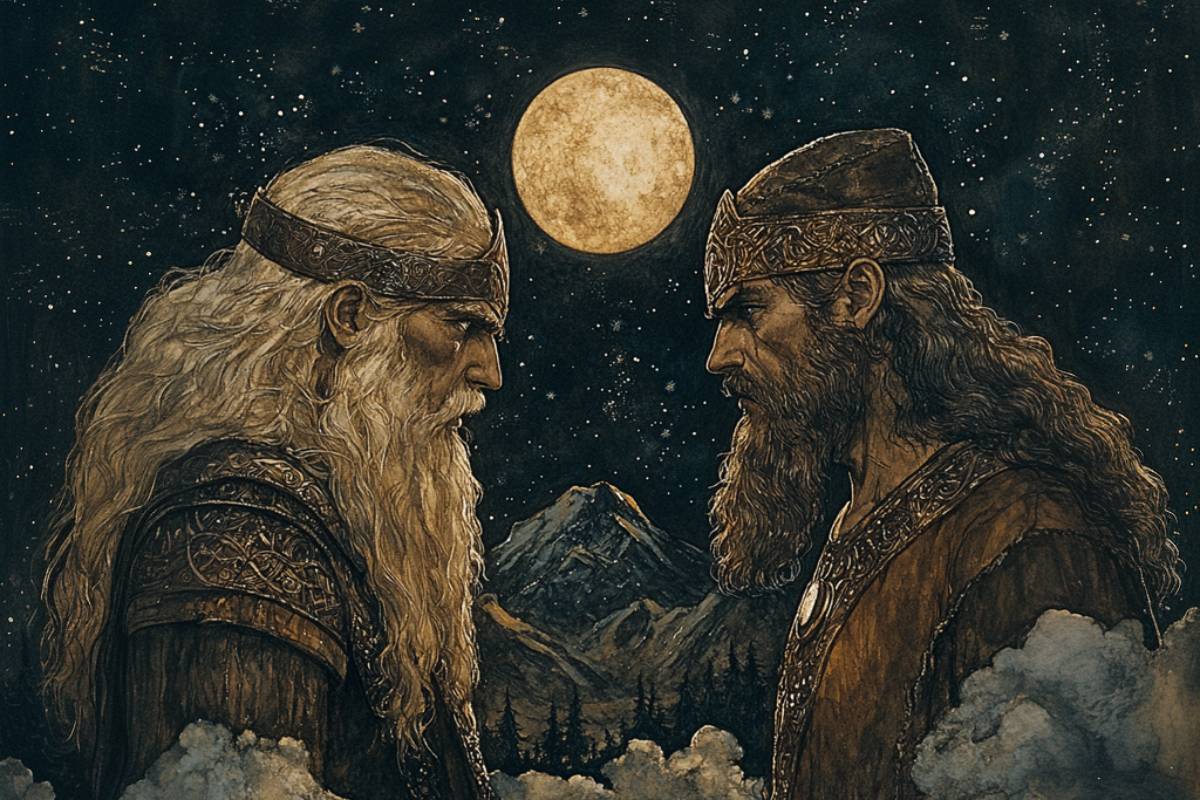
All sources, however, agree that this war was between the two pantheons of Norse mythology, the Æsir and the Vanir. Following the war's conclusion, the two pantheons roughly merged into one.
Turning first to poetry before prose, let us look at the Vǫluspá. This poem appears in what we moderns call the Poetic Edda, a collection compiled by unknown hands in medieval Iceland.
The cause of the conflict was the murder (by stabbing) of Gullveig. This goddess managed to be stabbed, burned, and then reborn not once, not twice, but three times (some party trick!)
Using the 1936 Henry Adams Bellows English translation of this classic Norse poem, a völva narrating the poem recounts how she:
"...remembers the war of peoples,
the first in the world,
when they stuck
Gullveig with spears
in the hall of Hárr
burnt her,
three times burnt,
three times born,
often, not seldom,
yet she still lives..."
[Stanzas 31 and 32]
Even during the early medieval period, stabbing people was generally frowned upon. The rest of the poem deals with the fallout from the death but is rather short on detail.
Much of the war seems to be lost in detail, but we do have a result.
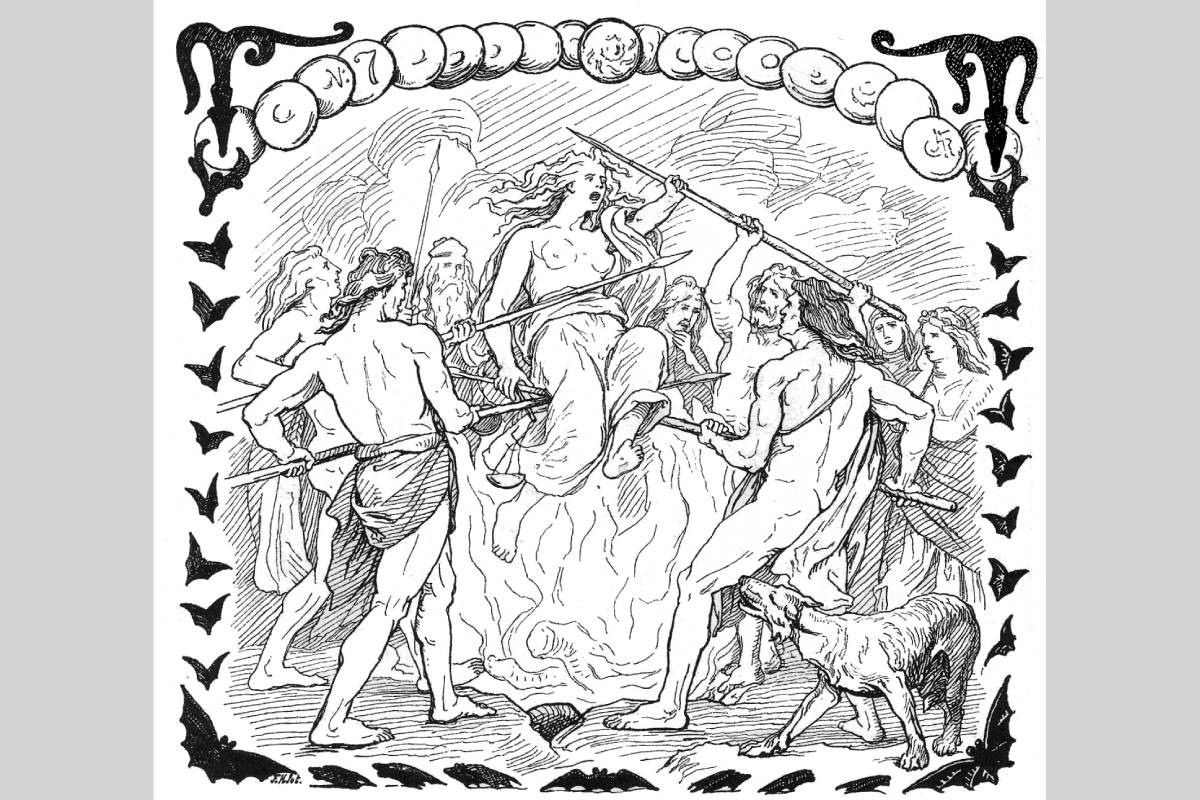
This illustration depicts Gullveig's execution by the Æsir, an event that led to the divine war. Source: Lorenz Frølich (1820–1908)
The action and fallout
Further down in the poem, we learn a few more things about the war. Not only did the Vanir emerge victorious, but they were apparently on the defensive, meaning the Æsir were the aggressors.
Furthermore, it was only after failed negotiations that this great war took place. The result was the merging of the two pantheons into one.
Further down, using the English translation in John Lindow's marvelous 2002 book, Norse Mythology: A Guide to Gods, Heroes, Rituals and Beliefs, we find that:
"...all the powers went to the judgment seats
the very holy gods, and discussed this:
whether the æsir should pay a fine,
or all the gods should have tribute.
That was yet the battle of armies, the first one in the world.
Odin let fly and shot into the army,
The shield wall of the fortress of the æsir was broken,
The battle-wise vanir knew how to tread the field..."
[p. 317]
This is a very thrilling description of the (very fictional) war. You can imagine yourself on the battleground, perhaps in the front line with the Vanir, when you hear the crunch as "the shield wall" of the Æsir is broken.
You look up, and you see Odin hurling a spear overhead and wading deep into the violence, dealing death and destruction.
What is tragic is that, like most wars, the fighting often comes after a prolonged period of negotiations.
Whilst we agree, especially in this current geopolitical climate, with the words of Winston Churchill that "meeting jaw to jaw is better than war" [i.e., talking and negotiations are always superior to fighting], never has war been described as thrilling as in the Norse sagas.
Snorri's spin on the war
We also have a reference to the war in the Heimskringla, compiled in the 13th century by Snorri Sturluson.
Whilst this is a chronicle of the Viking rulers and kings from the early medieval period spanning right up until the late 12th century, it is interesting because later medieval Scandinavian monarchs were keen to link their heritage—their bona fides, if you will—back to the Viking Age.
In turn, these Viking Age rulers were also keen to link their heritage back to the Norse gods themselves.
In the Heimskringla, Sturluson does mention the war but lays the blame on an aggressive Æsir for starting it.
According to Sturluson's account, after a prolonged period of battle in which neither side could gain the upper hand, peace negotiations were entered into, including an exchange of hostages.
Yet the Vanir were suspicious of the Æsir's motives and decapitated their hostage, Mimir. Odin would go on to use Mimir's head (having embalmed and put a spell on it) to gain further knowledge and secrets of the universe.
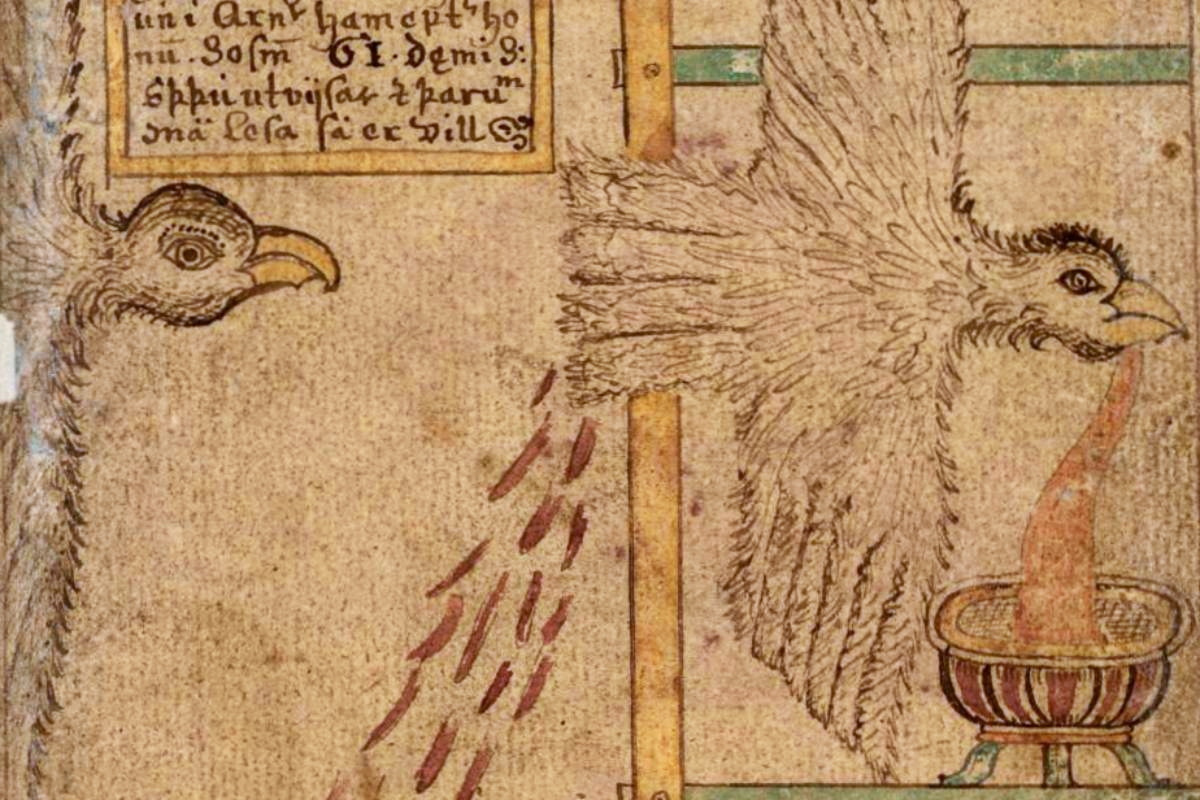
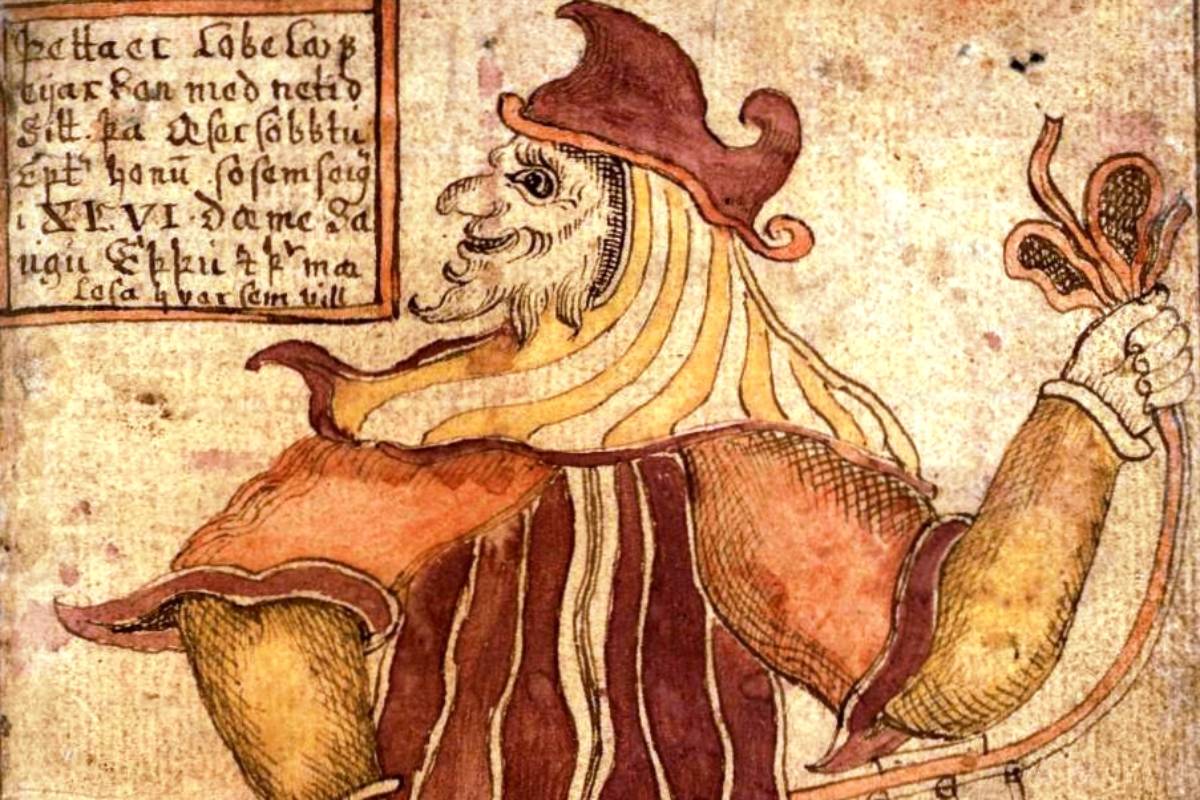
In this 18th-century manuscript, Odin, in eagle form, escapes with the mead of poetry, a product of the Æsir–Vanir war. Source: Unknown author
The birth of poetry
Even though war is abhorrent, there is a silver lining—or should that be a "saliva lining"—to this epic feud.
We now turn to the Prose Edda, where the poem Skáldskaparmál lays out what happened following the postbellum peace negotiations. In the 1916 English translation by Arthur Gilchrist Brodeur, we find that:
"The gods had a dispute with the folk which are called Vanir, and they appointed a peace-meeting between them and established peace in this way: they each went to a vat and spat their spittle therein. Then at parting the gods took that peace-token and would not let it perish, but shaped thereof a man. This man is called Kvasir, and he was so wise that none could question him concerning anything but that he knew the solution. He went up and down the earth to give instruction to men; and when he came upon invitation to the abode of certain dwarves, Fjalar and Galarr, they called him into privy converse with them, and killed him, letting his blood run into two vats and a kettle. The kettle is named Ódrerir, and the vats Són and Bodn; they blended honey with the blood, and the outcome was that mead by the virtue of which he who drinks becomes a skald or scholar. The dwarves reported to the Æsir that Kvasir had choked on his own shrewdness, since there was none so wise there as to be able to question his wisdom..."
[Stanza 5]
So not only do we have the rather disgusting image of a large number of deities spitting, but the rather gruesome image of blood being made into a concoction.
Whilst there truly are no winners in any sort of warfare, at least this mythical battle produced the source of artistic inspiration that many of us (including we humble writers at The Viking Herald) have been able to tap into ever since.
For more information on the beliefs that fueled Vikings on the battlefield, visit the History Channel here.
We get to provide readers with original coverage thanks to our loyal supporters. Do you enjoy our work? You can become a PATRON here or via our Patreon page. You'll get access to exclusive content and early access.
Feel free to reach out to discuss potential stories that may be in the public interest. You can reach us via email at hello@thevikingherald.com with the understanding that the information you provide might be used in our reporting and stories.