

We refer to the early medieval societies of the Nordic region and surroundings as "Viking societies."
It is true that these societies produced some of the most feared and brutal raiding warriors – what we moderns call Vikings – that haunted coastal and river-bound communities from the Iberian Peninsula to the Caspian Sea.
We have spoken widely on how, despite the nomenclature of these societies that we use, it was only a small minority that were engaged as Viking warriors. Most inhabitants were engaged in largely agricultural work, as was common in other contemporary early medieval societies throughout Europe.
Much of the rich tapestry of Norse mythology is built upon ancient foundations, harking back to the earlier Germanic roots of Viking societies.
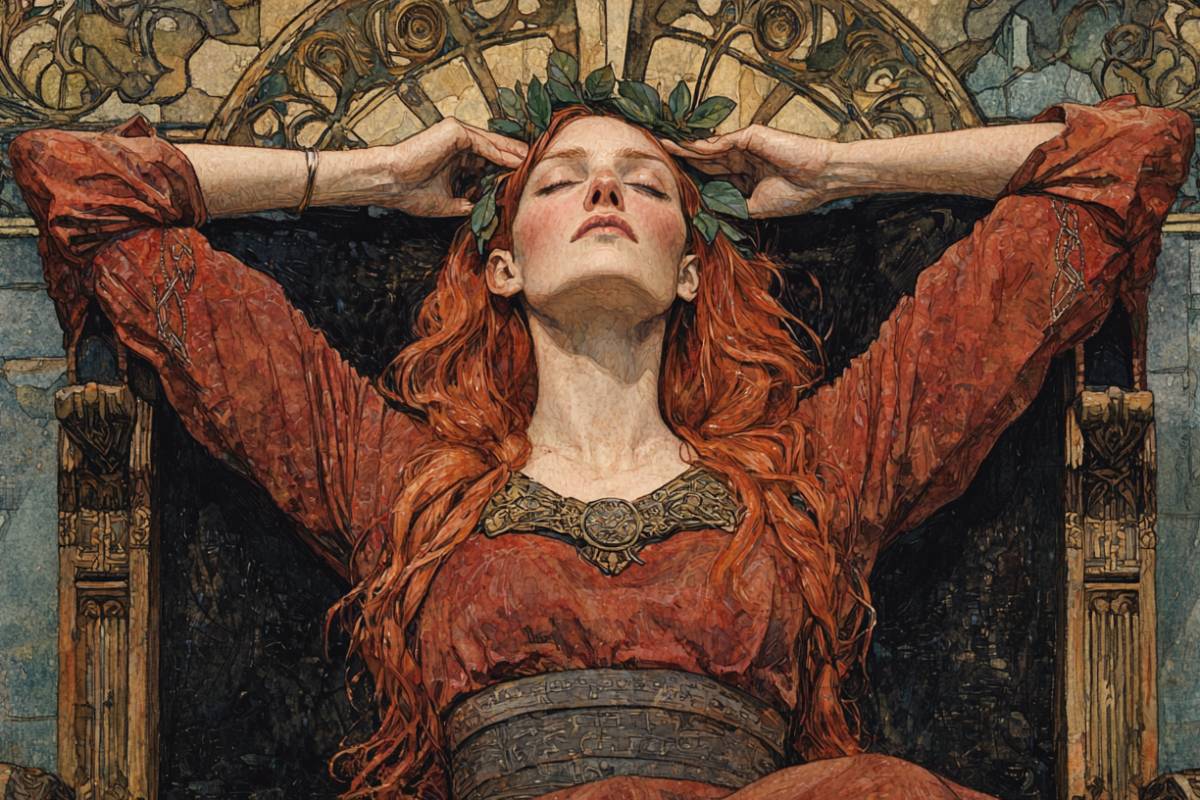
Gerðr is certainly one of the lesser-known figures, at least to us moderns, from the Norse pantheons. In the extant sources, she is a jötunn, the daughter of the giant Gymir, who later marries the Vanir god Freyr.
As Dr. Hilda Ellis Davidson writes about in her 1988 book, Roles of the Northern Goddess (available on Amazon here), Gerðr was, like other Norse mythological goddesses, "...a powerful figure closely concerned... with the destiny of individuals."
This earth goddess, though rather obscure, was celebrated by people from Viking societies not only for her beauty and association with fertility but also for the founding of a royal dynasty that controlled Norway and Sweden.
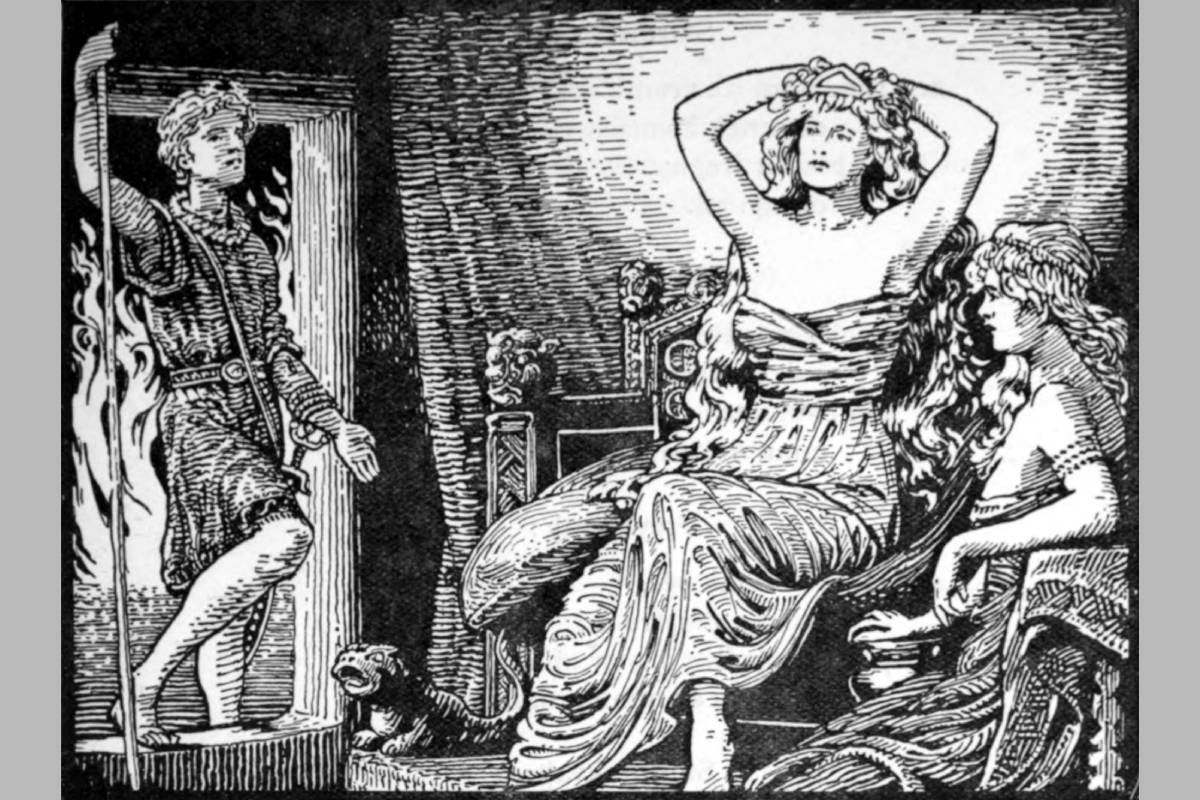
Skirnir steps through the doorway to deliver Freyr’s message to Gerðr in this early 20th-century illustration of Skírnismál. Author: W.G. Collingwood (1854–1932)
Rivals for love and golden apples
Though modern audiences may be unfamiliar with Gerðr, she is well represented in Norse literature and lore. Turning to the Poetic Edda, a compilation of poems that people in Viking societies once regaled each other with, we find the Skírnismál (The Ballad of Skirnir).
Using an online version of the 1936 English translation by Henry Adams Bellows, we have a vivid description of the beauty of Gerðr as described by Freyr. Much of the poem revolves around the competing courtship of both Freyr and Skirnir for this beautiful goddess. Freyr explains how he saw:
"...A maiden dear to me;
Her arms glittered, and from their gleam
Shone all the sea and sky.
To me more dear | than in days of old
Was ever maiden to man;
But no god or elf will grant
That we both together should be." [Stanzas 6–7]
This tale of forbidden love is not the end of Gerðr's suitors. Later on in the poem, we find that she is presented with several gifts from Freyr and Skirnir, including 11 golden apples, which are said to be the source of everlasting life for the Norse deities.
She politely declines the offer and rebuffs Freyr's advances as:
"I will not take at any man's wish
These eleven apples ever;
Nor shall Freyr and I one dwelling find
So long as we two live." [Stanza 20]
Having rebuffed meeting Freyr for much of the poem – and being scared off from Skirnir due to his borderline abusive courtship – she finally relents and agrees to meet Freyr, this "son of Njord."
This is the mythological explanation of the beginning of a union that would be traced back to by the rulers of both Norway and Sweden.
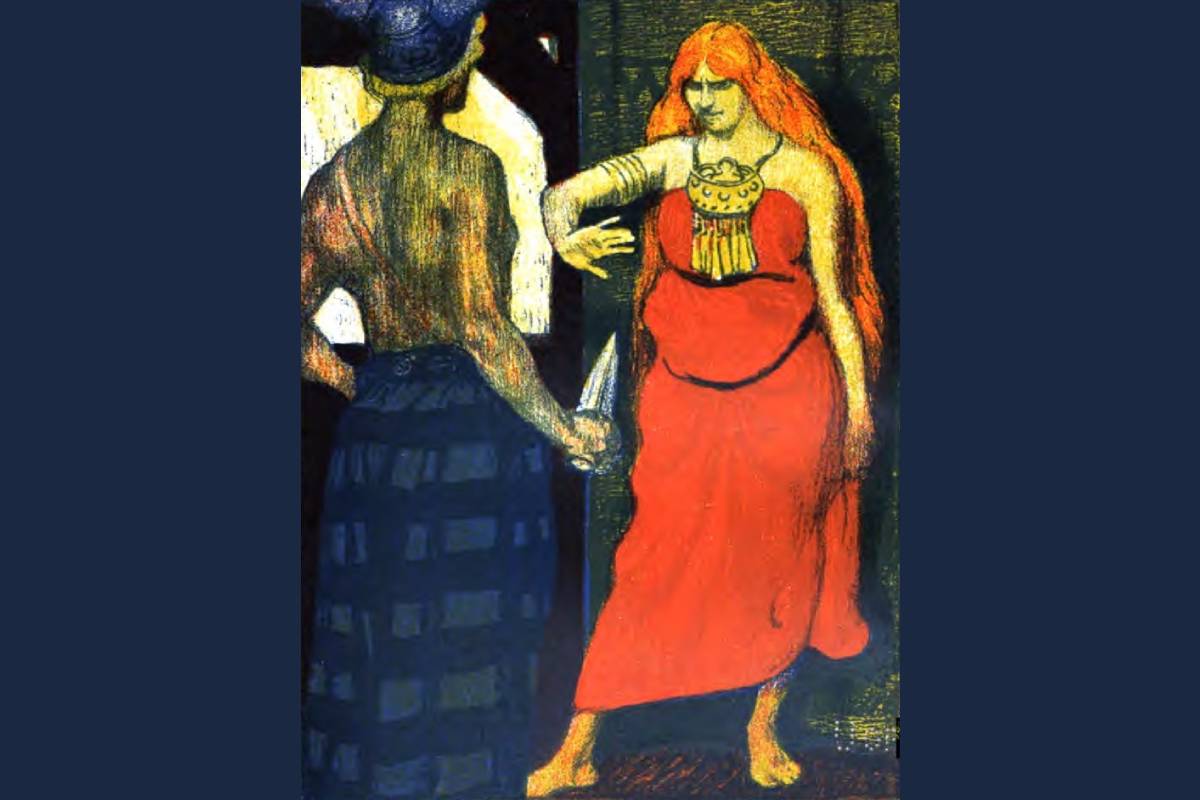
Skirnir stands before Gerðr in a vivid 1903 color illustration of their encounter from Skírnismál. Author: Robert Engels (1866–1920)
The Ynglings: Scions of Freyr and Gerðr
We know that rulers in Viking societies needed legitimacy more than that which was delivered by the pointy end of a sword.
This is, in part, why Christianity was adopted by the ruling elites of the Viking societies as they could tap into a broader pan-European system of authority that conferred divine sanction.
In the period before the Christianization of Scandinavia, rulers and monarchs still garnered their legitimacy from the heavens, but it was through the many Norse gods.
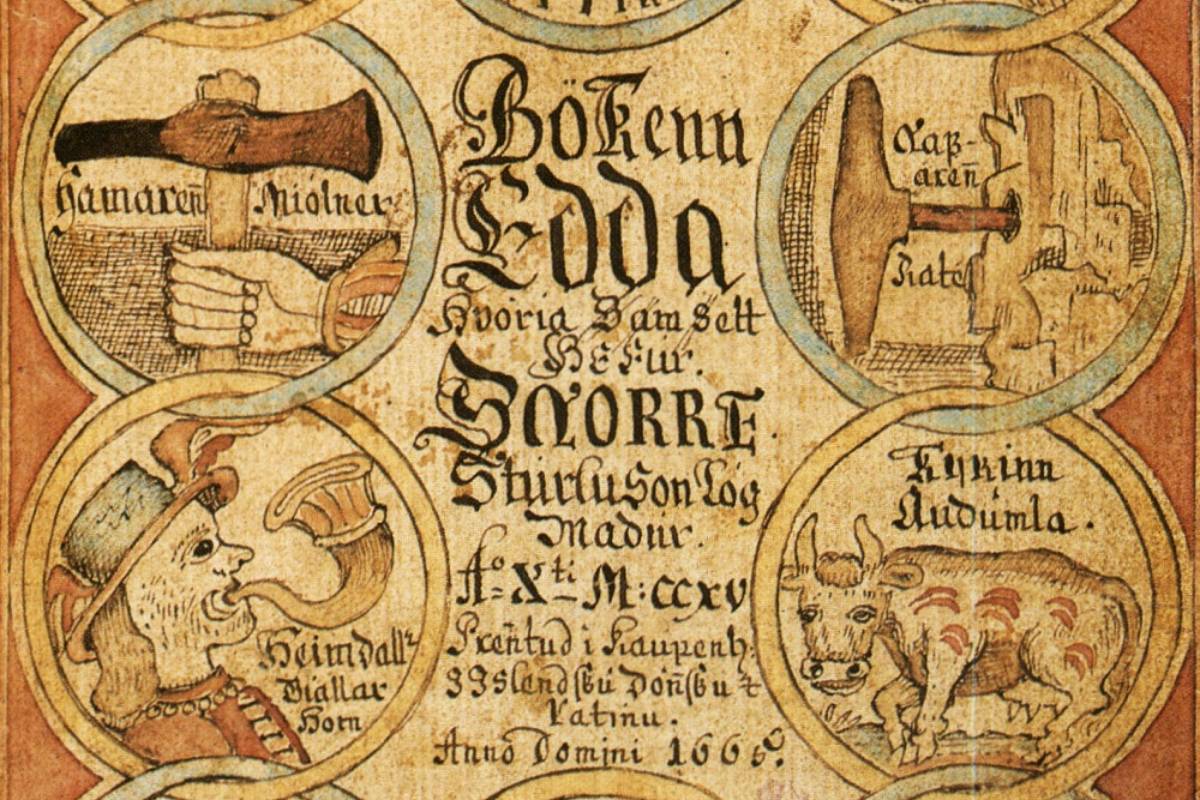
Turning to the Heimskringla, a sort of history of early medieval Scandinavian rulers compiled by Snorri Sturluson in the 13th century, we find the first section – the Yngling Saga – dealing with the origins of Scandinavian rulers.
Here it was said that this union of Freyr and Gerðr produced a son who would found the Yngling dynasty – a semi-legendary royal dynasty that many early medieval rulers in both Norway and Sweden would trace their ancestry to and thus receive their legitimacy to rule from.
Using an online version of the 1844 English translation by Samuel Laing, we find that Freyr and Gerðr are now together and their union has produced a son:
"His wife was called Gerd, daughter of Gymis, and their son was called Fjolne. Frey was called by another name, Yngve; and this name Yngve was considered long after in his race as a name of honour, so that his descendants have since been called Ynglinger..." [Stanza 11]
For those who are fans of early medieval literature, the Ynglings are to be found in that epic poem, Beowulf, but named as the Scylfings.
It is believed that Beowulf and much of the Yngling Saga were composed around the same time, sometime between the 8th and 10th centuries, when people from Viking societies expanded outwards from their Scandinavian homeland.
We can see that despite her modern obscurity, Gerðr plays an important – albeit mythical – role in the establishment of one of the legendary royal dynasties not only in Scandinavian history but also in early medieval literature.
Revered and respected
Whilst not one of the most revered or remembered Norse deities, Gerðr should be righteously recognized as an important character due to her ancient agrarian links as well as her role in the founding of a semi-legendary royal dynasty.
Her role as an earth goddess contrasts with her union with Freyr, who derives his power from the sky. Their marriage then was the fruitful union between heaven and earth, sky and soil.
In an era where a good harvest was the difference between fortune and famine, the soil beneath their feet was personified in Gerðr as a powerful and autonomous force.
Reverence for her, by people in Viking societies, was only increased when she was said to be instrumental in the founding of the Yngling dynasty, famed throughout the north during the early medieval period.
For more information on other obscure Norse deities, visit BBC History Extra here.
We get to provide readers with original coverage thanks to our loyal supporters. Do you enjoy our work? You can become a PATRON here or via our Patreon page. You'll get access to exclusive content and early access.
Feel free to reach out to discuss potential stories that may be in the public interest. You can reach us via email at hello@thevikingherald.com with the understanding that the information you provide might be used in our reporting and stories.