

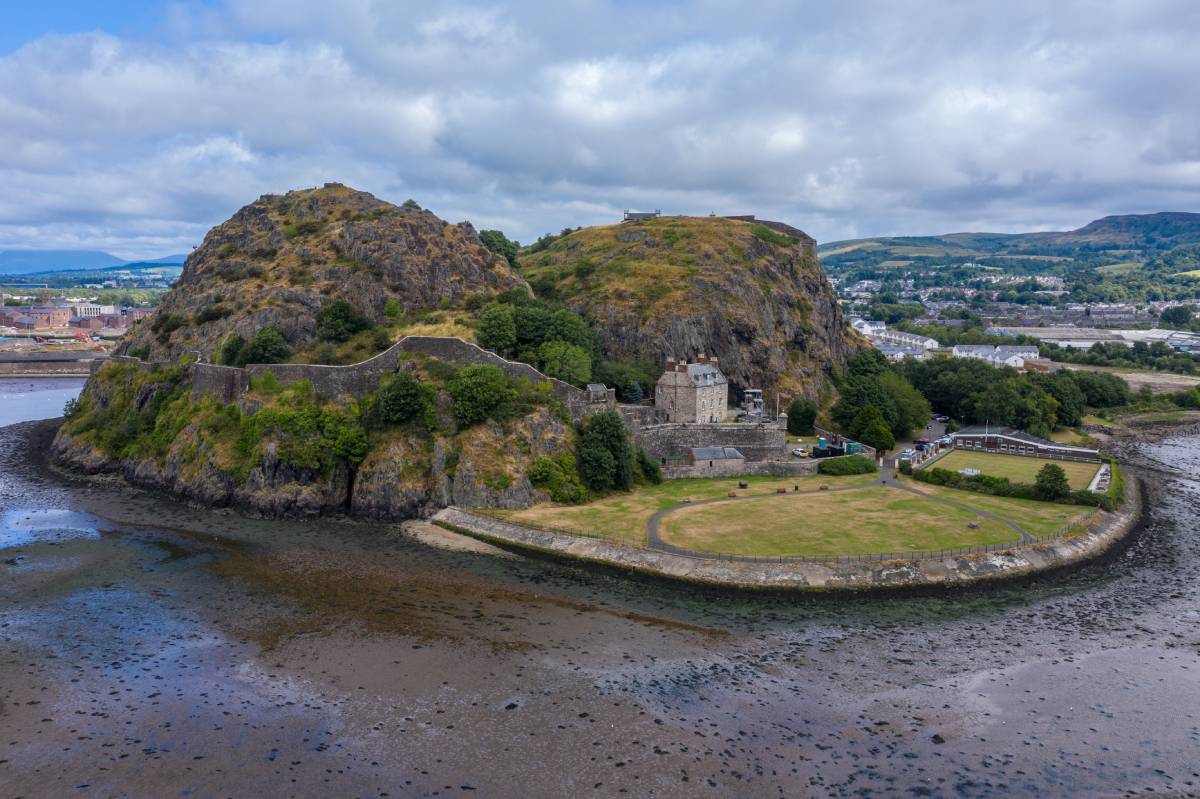
Anyone lucky enough to visit Scotland knows that the country is steeped in a rich history that is ever present.
However, the idea of Scotland—as nice as the lochs and the lakes, the cobbled old streets of Edinburgh, and the rollicking bar-filled hills of Glasgow are—almost didn't exist until the late medieval period.
We know that humans inhabited this northern part of the British Isles for centuries before the world, in the form of the Roman Empire, ventured to these parts.
For the Romans, the local Gaelic and Celtic populations were seen as wild barbarians, not worth a single drop of Roman blood in civilizing or conquering.
Their solution was a sort of cross between Bob the Builder and F.W. De Klerk: build a series of walls to separate Romano-Britain from the "wild north."
A series of walls was constructed between 122 and 142 CE, ordered first by Emperor Hadrian and then by Antoninus Pius, to ward off these unruly barbarians from the Roman provinces of Britannia further south.
This was to be the northern limit of Rome's expanse and would be a defining part of Scotland's history. It marked the first permanent separation from other polities in the south of the Isles and has shaped Scotland's identity ever since.
The withdrawal of Rome from Britannia occurred between 383 and 410 CE (Rome had scurried off from areas in what is now Scotland about a century before) and was the key event of the British Isles' early medieval history.
This withdrawal, not unlike NATO's disastrous withdrawal from Afghanistan, left a power vacuum and widespread political insecurity and violence.
The southern part of the British Isles then entered their so-called "Dark Ages," plagued by centuries of political fragmentation, warlords, and invasions from across the seas.
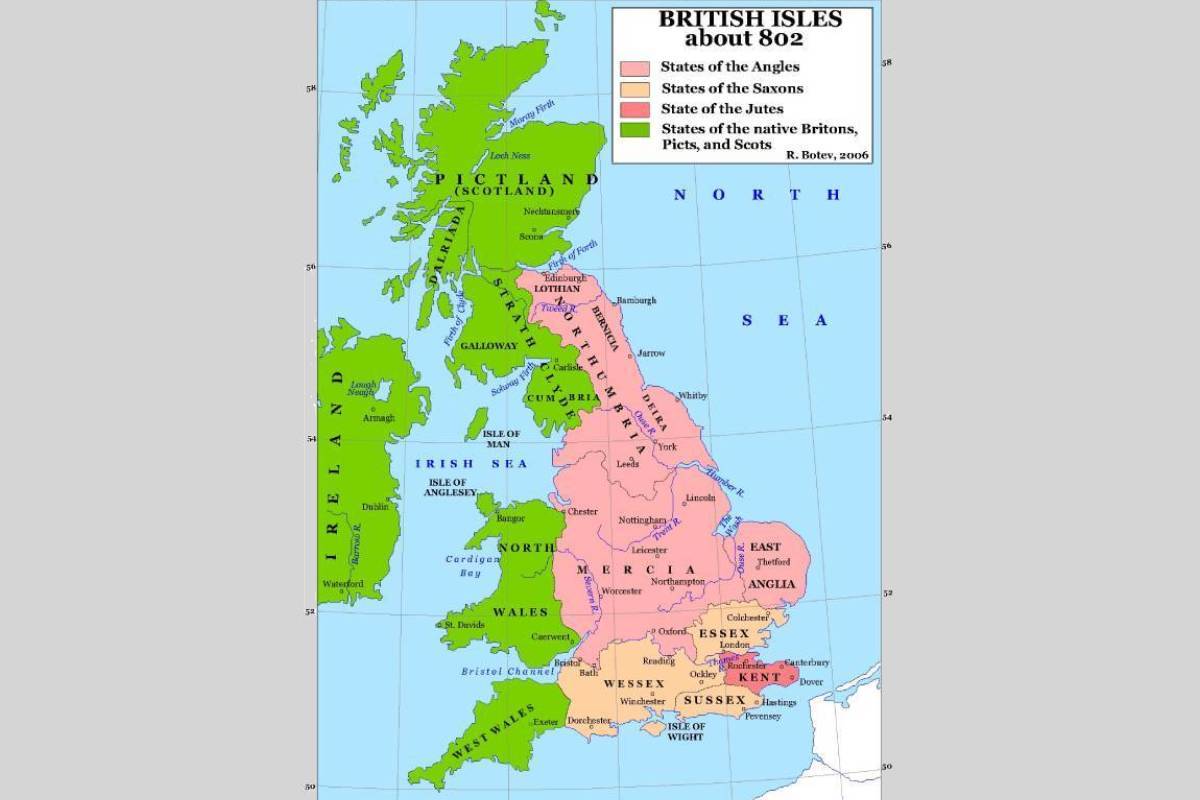
The Kingdom of Strathclyde, shown on this map of Britain in 802, ruled the region where the fortress of Alt Clut later fell to Viking forces in 870. Source: Lotroo
A hodgepodge of polities in early medieval Scotland
Whilst the Anglo, Saxons, and Jutes dominated what is now much of England, a Brittonic kingdom known as Alt Clud emerged further north from the early 5th century CE onwards.
With its foundation on the western seaboard of modern-day Scotland, it was traditionally said to have been founded by the Damnonni people, whom we find mentioned in Ptolemy's illustrious tome Geography.
Using an online version based on a 1932 English translation by Edward Luther Stevenson, according to this famed 2nd-century CE ethnographer, geographer, and historian, we find that,
"From these [the Selgovae] toward the east, but more northerly, are the Damnoni, among whom are the following towns: Colanica, Vindogara, Coria, Alauna, Lindum, Victoria..."
These supposed towns roughly correspond to the region where Alt Clud would form some centuries later.
Fast forward to the kingdom's foundation, steeped in mystery and myth, and we can see that from the 5th century onwards, the kingdom soon became powerful thanks to its position near the River Clyde.
This was an era when the fastest and safest way to travel and transport goods or people was on the water and not overland. Scotland was a hodgepodge of different cultures, peoples, and polities.
As Alt Clud emerged in the west, much of the region was inhabited by the Picts, an ancient Celtic-speaking people known for their tattoos and symbolic stone carvings (similar stone carvings would appear across the North Sea).
A Gaelic kingdom, Dál Riata, also emerged on the western seaboard of Scotland that, at its expanse, would reach as far as the northern coast of the island of Ireland.
Further southeast, the Anglo-Saxon kingdom of Northumbria soon took form and would dominate what is now the borderlands between Scotland and her English "frenemy."
Yet a new player would soon emerge from across another sea, on the eastern flank of the British Isles: the Vikings were coming!
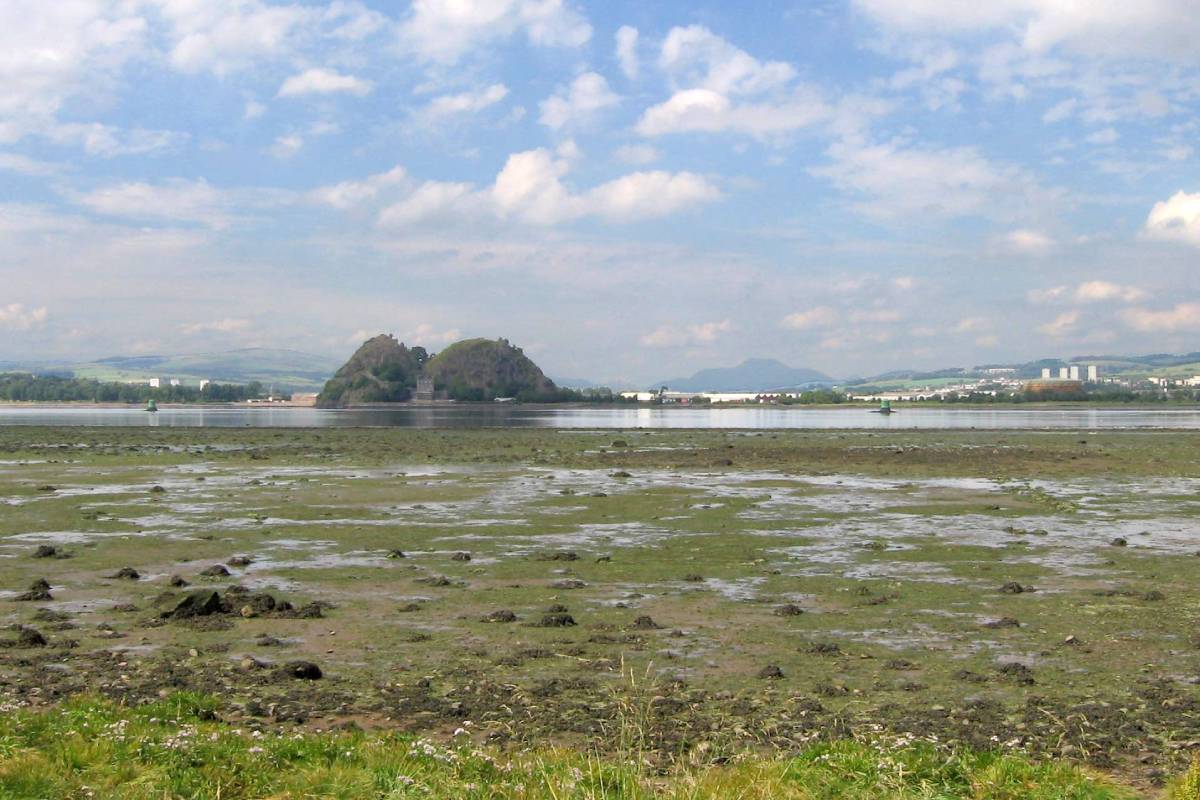
Seen here across the Clyde, Dumbarton Rock’s position made it ideal for controlling river traffic and regional expansion. Photo: Dave souza (CC BY-SA 2.5)
Enter the dragon(boats)
Whilst 793 CE is a formative year in English history (the first recorded Viking raid on the island of Lindisfarne), coastal and river-bound communities in Scotland had to wait two years until they felt the wrath of early medieval Europe's most feared warriors.
The traditional start of the Viking Age in Scotland begins with an attack on Iona, an isolated island-bound monastery (sound familiar?) in 795.
Over the next eight decades, Scotland would see countless Viking attacks and incursions as much of Scotland was put to the sword.
It was their expansion first into Ireland that set the scene. As Peter Fraser Purton writes in his 2009 book, A History of Early Medieval Siege c. 450–1220, here the Vikings, "...found a country without towns and left their mark on its future by creating the forerunners of the modern cities of the island."
Having established a trading hub at the mouth of the River Liffey across the Irish Sea—later to become the Irish city of Dublin—Irish-based Vikings could strike around the western seaboard of Scotland.
For most of the 9th century, the Kingdom of Alt Clud had escaped the ravages of Viking attacks. Much of this resulted from the fact that they had built a fortress on a rocky island in the middle of the River Clyde, the famous Dumbarton Rock.
This had been the key to the kingdom's growth, as from here, Alt Clud could not only dominate the lucrative river-bound traffic but also use it as a springboard for further expansion along the Scottish coast and into the Irish Sea.
Whilst much of the northern regions of the British Isles had fallen under the direct domination and sway of people from Viking societies, Alt Clud was a sore on the Vikings' side.
Whilst first, they had come as mere predatory raiders, the latter 9th century saw more organized military expeditions by Viking leaders throughout the British Isles (think the Great Heathen Army further south).
An organized force was needed to take the fortress at Dumbarton Rock, the key to dominating the northern British Isles. In 870, a Viking force sailed from Dublin to lay siege to the fortress.
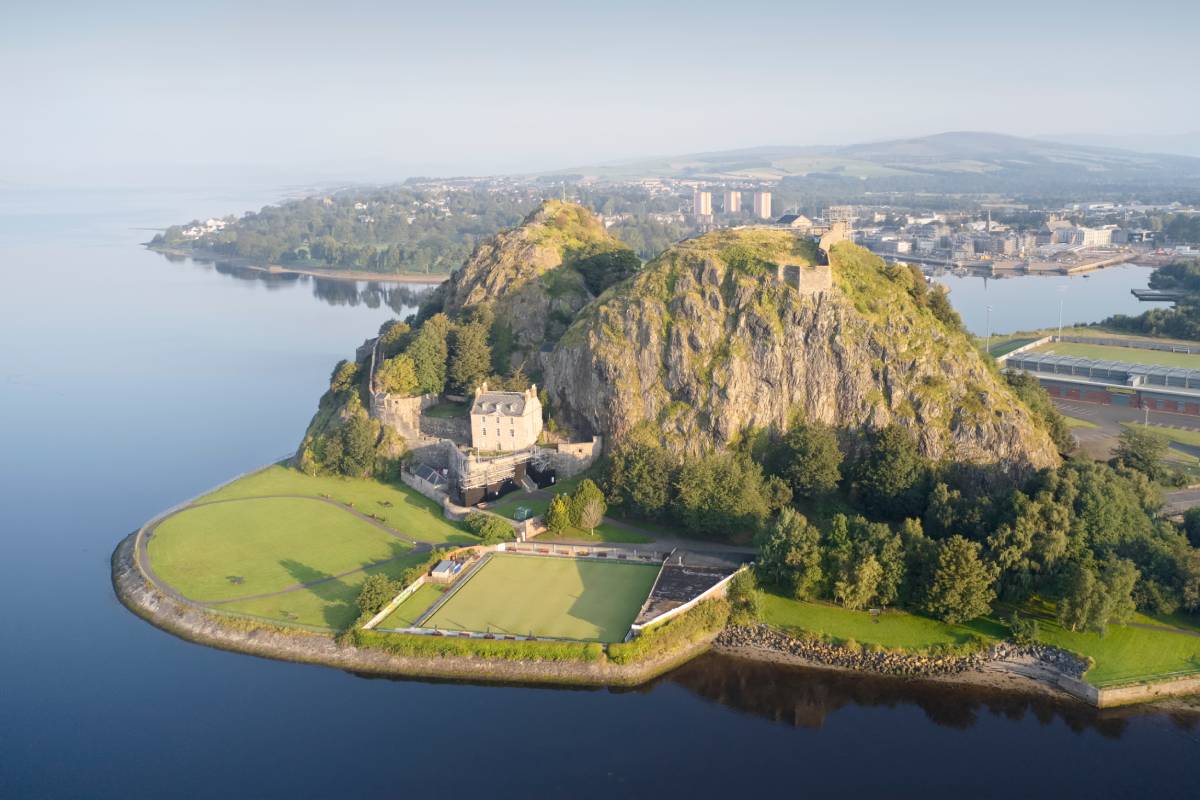
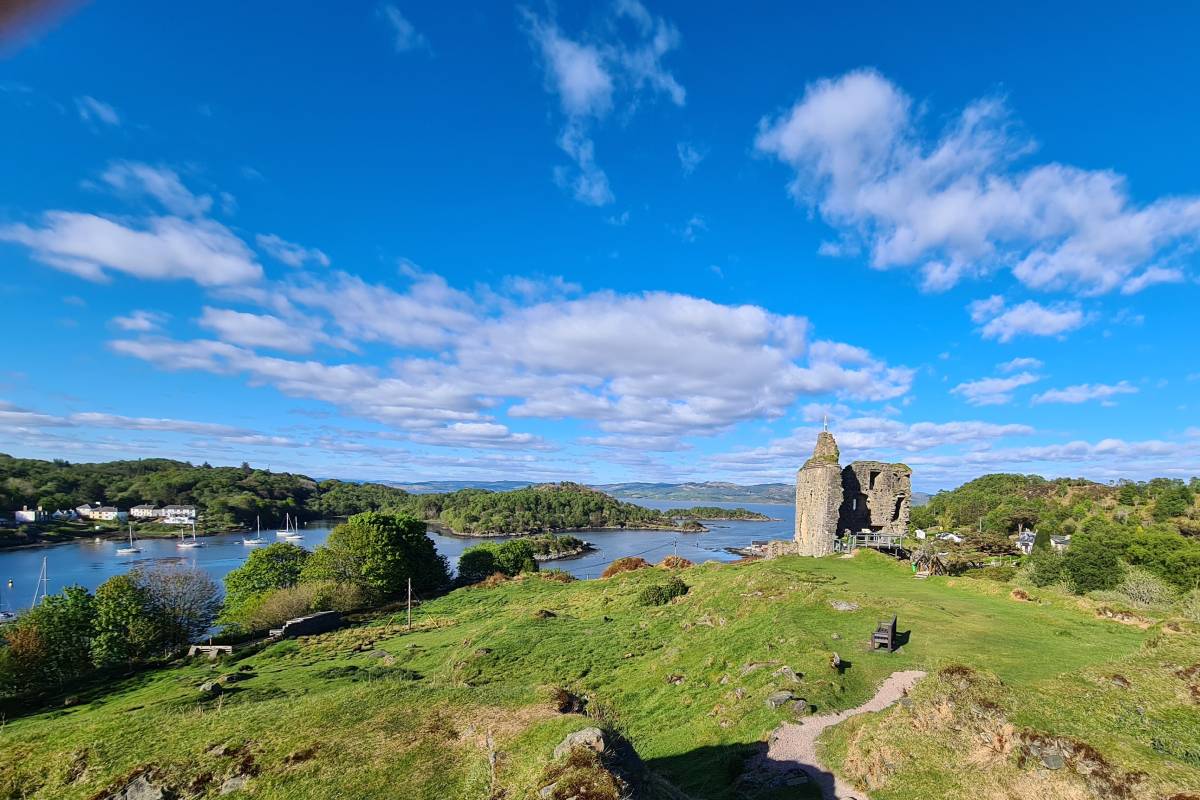
The visible ruins on the right-hand summit are the remains of Alt Clut, the fortress besieged by Vikings in 870. Photo: richardjohnson / Shutterstock
An epic siege
According to the Annals of Ulster, the preeminent chronicle of events in the Irish Sea region, the Viking force was led by Amlaíb, the Viking King of Dublin, and Ímar, a renowned warrior and leader of Vikings throughout the island of Ireland and Scotland. Opposing this Viking force was the King of Alt Clud, Arthgal ap Dyfnwal.
Using a 2000 online edition of the Annals, overseen by the University of Cork, we find this entry in the annals for the year 870:
"The siege of Ail Cluaithe by the Norsemen: Amlaíb and Ímar, two kings of the Norsemen, laid siege to the fortress, and at the end of four months they destroyed and plundered it..." [U870.6]
This marks an unprecedented expedition for Vikings in the British Isles, who usually, at this stage, did not have the expertise to engage in prolonged siege warfare.
It was said that the siege was only lifted when the defenders ran out of water. The fact that they could endure for more than four months pays tribute to the bravery of the defenders, as well as to the fact that Vikings preferred lightning attacks.
What we can safely assume is that on both sides, this was four months of fire and brimstone, of death and destruction.
Further down in the Annals, for the year 871 CE, we find that,
"Amlaíb and Ímar returned to Áth Cliath from Alba with two hundred ships, bringing away with them in captivity to Ireland a great prey of Angles and Britons and Picts..." [U871.2]
If we take this entry at face value (early medieval chronicles may well be notoriously unreliable but do have a large dose of historical truth in them), then those who did not die during the siege ended up enslaved and sold through slaving markets, like Dublin.
As sad as this fate was, the Viking victory at the siege of Dumbarton Rock proved a death blow for Alt Clud.
The fall and rise of kingdoms
Whilst the Viking leaders remained unscathed from this attack, there is some debate about the King of Alt Clud.
Whilst he may have managed to escape the siege, he would later be assassinated, apparently on the orders of the King of Alba, Constantine I.
His kingdom, following the siege, lay in ruins, and he moved into what is now Govan, which would become the Kingdom of Strathclyde.
Without access to its mighty fortress in such a strategic location, this kingdom eventually withered and died, subsumed by the Kingdom of Alba in the 11th century CE.
As is ever the case with history, one kingdom's downfall is another one's rise.
The modern nation of Scotland traces its lineage back to the Kingdom of Alba, and had the Vikings failed to take the fortress on Dumbarton Rock, the history of the British Isles—indeed, Northern Europe—would be very different.
For more information on Viking Age Scotland, visit the BBC here.
We get to provide readers with original coverage thanks to our loyal supporters. Do you enjoy our work? You can become a PATRON here or via our Patreon page. You'll get access to exclusive content and early access.
Feel free to reach out to discuss potential stories that may be in the public interest. You can reach us via email at hello@thevikingherald.com with the understanding that the information you provide might be used in our reporting and stories.