

On February 4, 2026, Cambridge University announced the discovery of a Viking-era burial pit at the Wandlebury archeological site. As reported by The Viking Herald, the pit contains the remains of an unusually tall man who had undergone cranial drilling.
The excavations unearthed as many as ten bodies in total, some of which appear to have been severely mutilated.
As investigations continue into the possible origin of these men, The Viking Herald speaks exclusively to Cambridge archeologist Dr. Oscar Aldred about what it's like to find a 1,100-year-old burial pit.
Trepanation and the BBC
As Oscar explains to The Viking Herald, Cambridge University has a series of trenches at Wandlebury which they use to help train student archeologists.
"We receive special permission from Historic England to excavate there," Oscar says. "We've been running the training field school for first-year undergraduates for the last couple of years. Wandlebury is actually the site of an Iron Age hill fort, so it's much older than the 8th or 9th century finds we're discussing here."
The most recent digs at Wandlebury took place in the spring and summer of 2025. The initial investigations revealed what appeared to be the remains of two bodies.
When the archeologists excavated the first of these bodies, they found a man with an unusual spherical hole in his skull. The aperture appears to be evidence of trepanation – the practice of drilling, cutting, or scraping a hole in the human skull to treat health issues or relieve intracranial pressure.
"When we lifted the trepanned individual out, word soon got out that we had a really interesting individual," Oscar tells The Viking Herald. "He was extremely tall and also had this unusual hole in his head. We immediately applied for an extension to do more digging."
"On the first day of the second part of the excavation, we began seeing human remains coming up. On the second day, the BBC series Digging for Britain came out to film us."
"The cameras were rolling, and we started to see skulls and everything else emerging. I phoned my colleague and told them we were going to be there longer than just a week!"
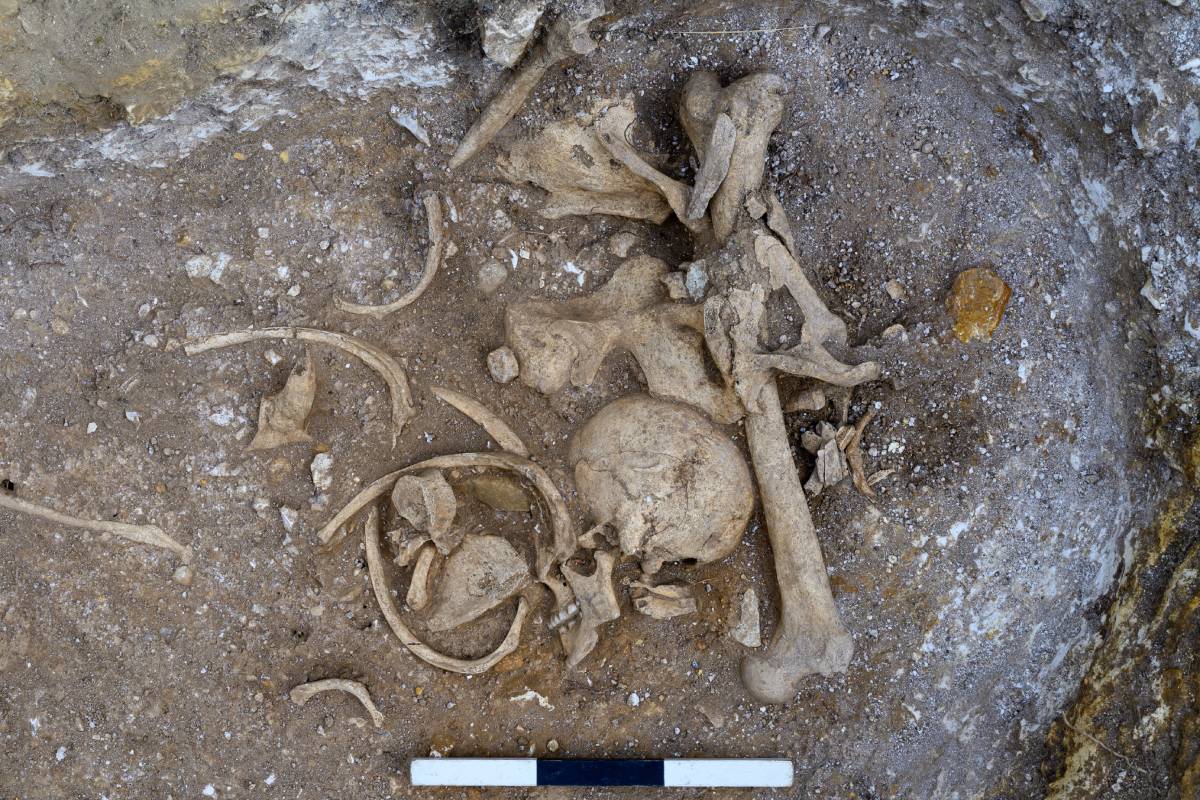
Disarticulated human remains in situ within the Wandlebury burial pit. Photo: David Matzliach / Cambridge Archaeological Unit
A pile of bodies
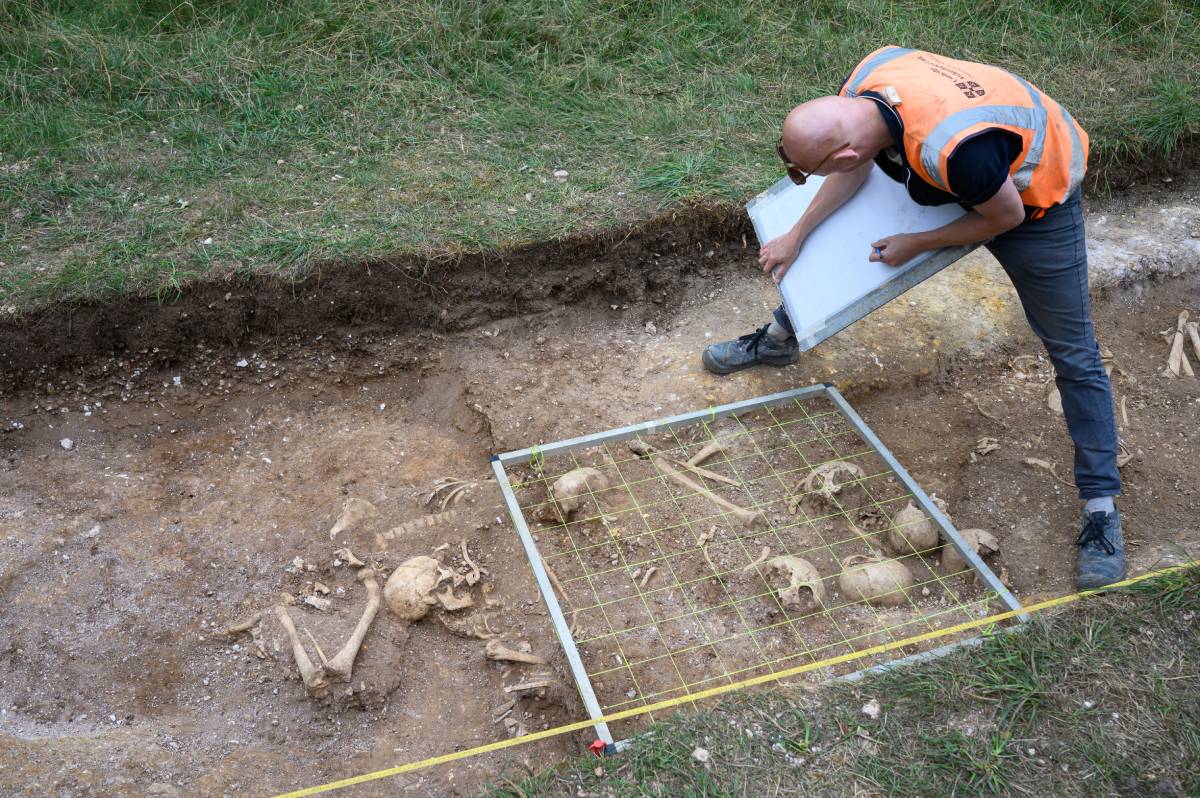
Over the next few days, a somber and at times confusing picture began to emerge. "We found at least ten individuals," Oscar confirms.
"At the bottom of the pit, there were four articulated skeletons. There was also a "quarter" – the lower legs of an individual – alongside them. In addition, we found at least six other bodies, with six heads. We counted the number of heads rather than the other body parts."
Although the hillfort was built in the Iron Age, early indications suggest the bodies were deposited in the burial pit in the 8th or 9th century.
"We've only got one result from the radiocarbon dating so far," Oscar admits. "But it's worth noting that there was another group of five individuals found in a burial here in 1976."
"For a long time they were suspected to be from the Iron Age. Around five years ago, however, we got them dated, and they also turned out to be 8th or 9th century. So we had an inclination that our burial group might be similar."
"We didn't actually know the precise location of this 1976 excavation," Oscar adds. "It only came about after a tree had blown down, and the warden at the park saw something interesting and called an archeologist."
"This same warden, now much older, came down to our dig and said, 'Oh, it's just there, it's literally five meters from the other spot!'"
"We have since begun to think we might have something even bigger than a single pit with ten individuals – exceptional as that is in itself."
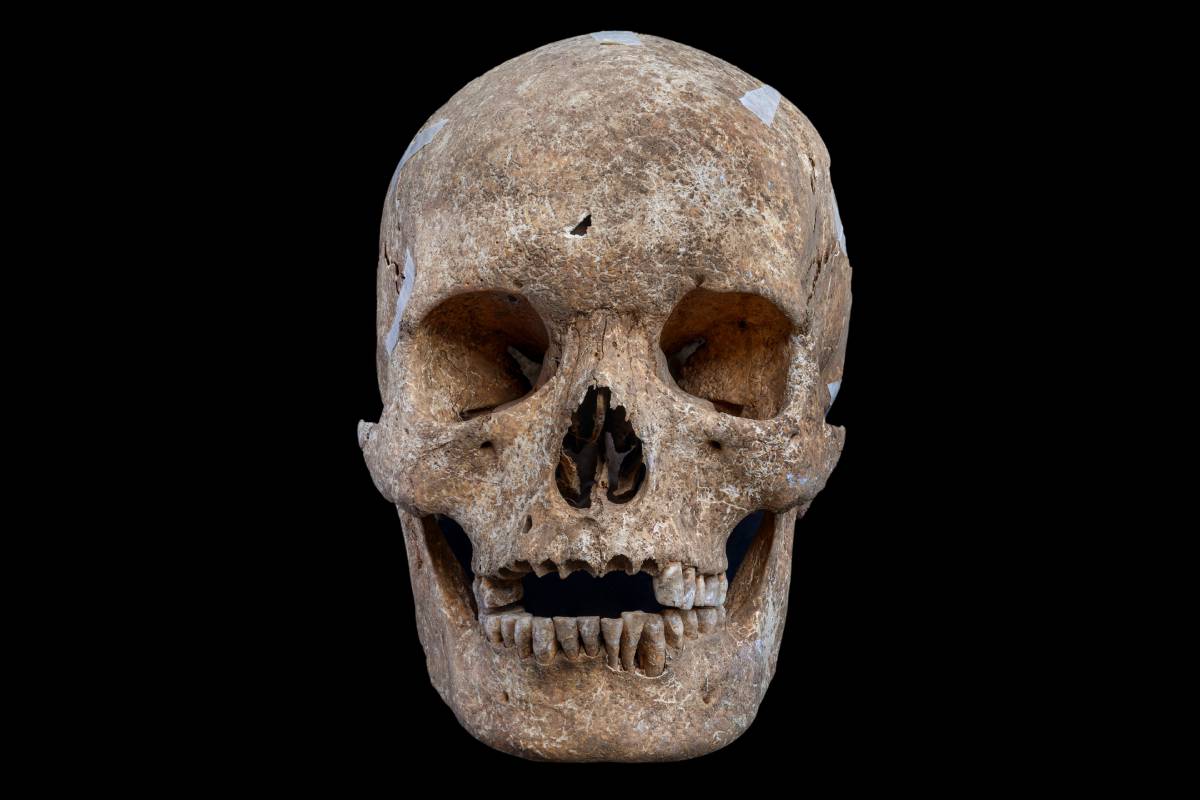
Oscar says the trepanned individual lay face down, with signs he may have been bound. Photo: David Matzliach / Cambridge Archaeological Unit
Bound and thrown in the pit
The trepanned individual, in particular, has caught the attention of the press. So what can Oscar tell us about the find?
"In terms of his burial, he was prone – he was face down in the pit and one of the last articulated individuals to go in," Oscar states. "He was probably put into the ditch immediately after his death."
"Judging by the positioning of the body, it looked like his legs and hands could have been bound. So it was probably quite a bad death."
"He was between 17 and 24 in age," Oscar continues. "My colleagues from the Duckworth Institute studied the individual and examined the large hole in his head. They found it had healed, which suggests an earlier trepanation procedure."
"We don't know what the method was. The hole could have been bored, but also scraped or cut. Trepanning is usually used to release pain, or sometimes demons. This practice is found in many places, including across Europe and also in South America."
"The other major feature is that he was exceptionally tall – up to six foot five. One theory is that he had a genetic disease that meant his hormone production didn't stop his bones from fusing, and they kept growing."
"It is also possible he had a cancer at the base of the skull that affected the pituitary gland, and that this exaggerated the growth of his bones."
"This may also have made him more aggressive. Other than that, he seems to be relatively healthy. The fact that he survived his trepanation is interesting, though we don't know how he actually died."
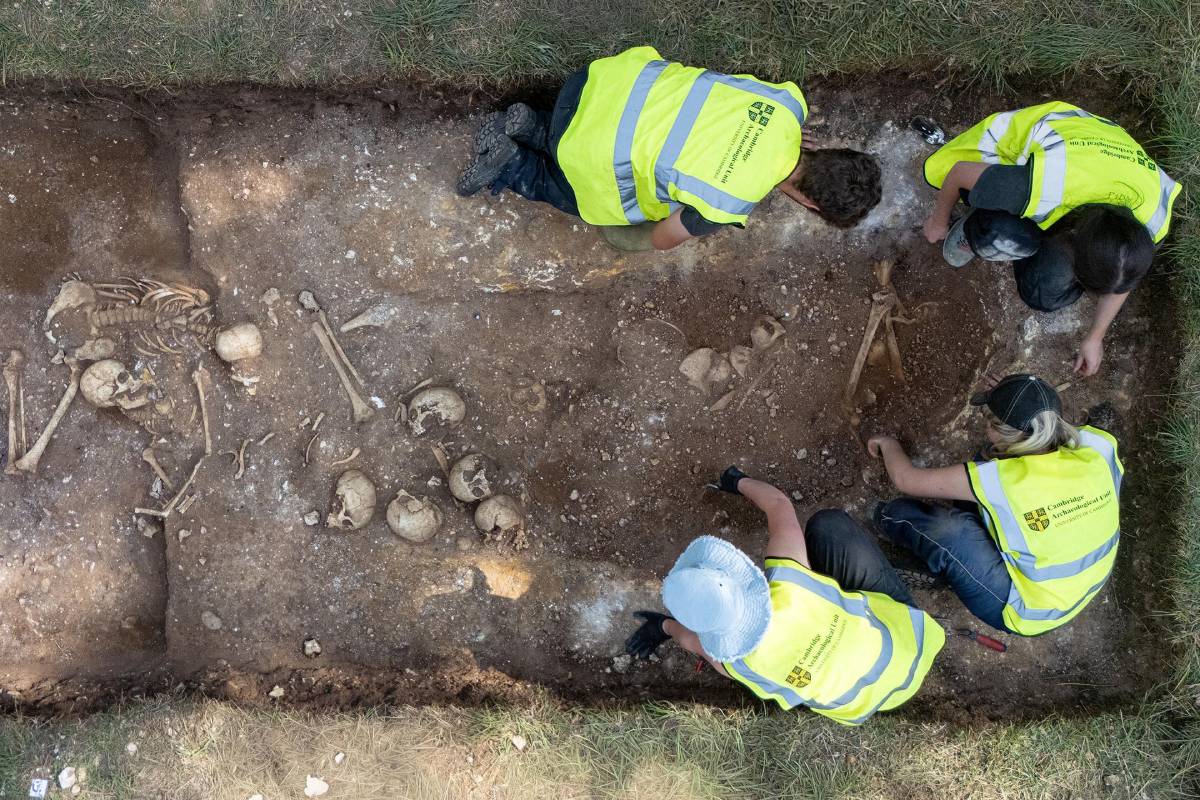
DNA and isotope tests now aim to clarify whether the men were Scandinavian or Anglo-Saxon. Photo: David Matzliach / Cambridge Archaeological Unit
Examining Viking links
Given that the preliminary dating of the burial pit places the event in the early Viking Age, there has inevitably been speculation about the possible Norse origin of the men.
In the 9th century, Cambridge was a strategic spot on the boundary between the Anglo-Saxon kingdom of Mercia and the Viking-controlled kingdom of East Anglia. In 874 or 875 CE, the Great Heathen Army seized the Anglo-Saxon town and used it as a winter base.
"The Viking connection has also been made because of the size of this individual," Oscar points out. "The bones of this man and other individuals were quite robust. In this period, individuals from Scandinavia are generally much bigger."
"We see that in Iceland, and you can also see the correlation in Norway and Sweden, too. It would make sense – it fits within the time frame of the Viking incursions into Britain."
"One could imagine a situation where Wandlebury was the site of a battle, and these Viking individuals were then buried."
"But they could also be Anglo-Saxon," Oscar points out.
"We will try to find out by doing isotope and DNA analysis on the human bones. We also want to really narrow down the time frame within which these individuals were buried, and the event of their deaths."
"We will also look at the health of the individuals and where they grew up as children. Finally, we will try to track their genetic connection with others in the burial pit – the possible kinship relationships."
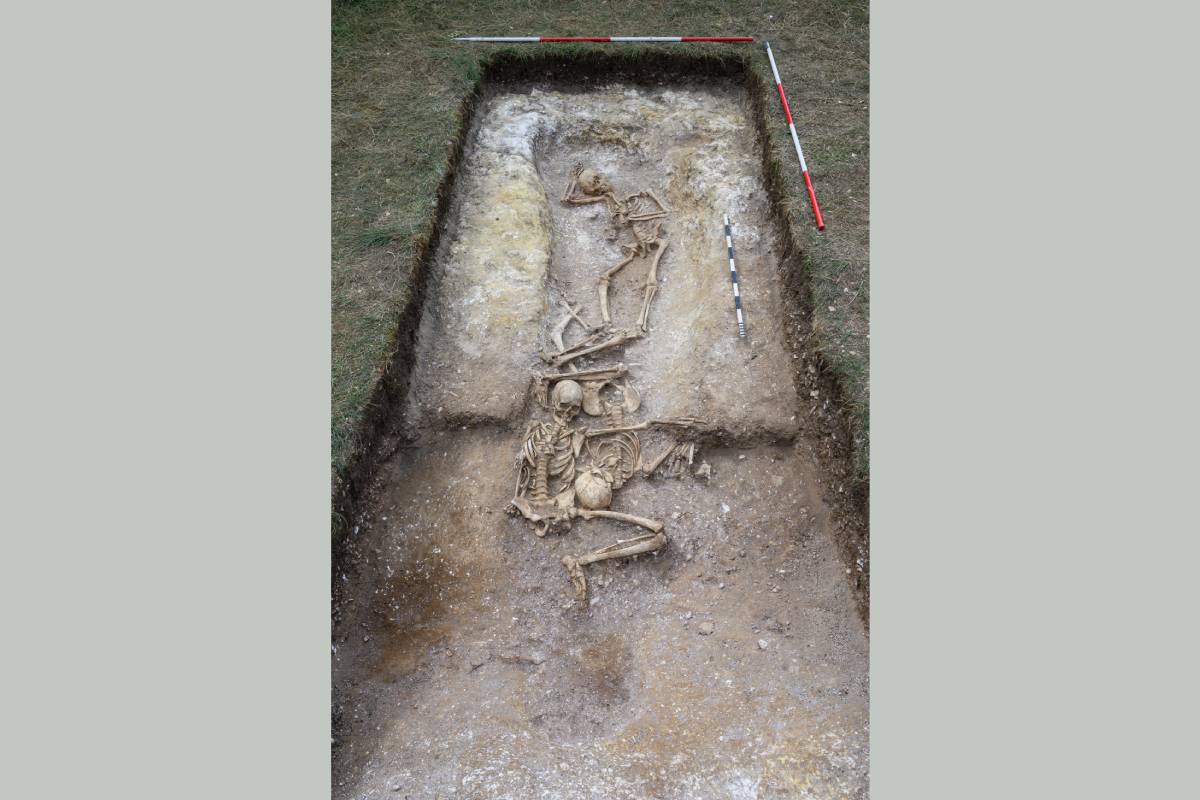
Oscar outlines three main theories for the pit: execution, a battlefield burial, or a mix of both. Photo: David Matzliach / Cambridge Archaeological Unit
What happened here?
Naturally, the team is seeking to build a clearer picture of what exactly happened to these unfortunate individuals. As Oscar explains to The Viking Herald, there are three main theories.
"The first is that this is an execution site," Oscar states. "One of the four articulated individuals has been beheaded – you can see there's a very clear chop mark into the jaw. We don't yet know the means of death for the others, but they seem to have been buried quite quickly after death because they're fully articulated."
"So we can explain these four articulated bodies – and the quarter to some extent – as a possible execution," Oscar continues. "However, what's more troubling in this context is that executions usually have singular burials."
"We're in the Christian era, and people are usually buried in cemeteries. But these individuals have been buried together, which is quite uncommon."
"The other problematic elements for execution are the other disarticulated elements – I don't really understand this yet properly."
"Then there is the battlefield scenario. They all seem to be young men, though some could be potentially a little bit older. It is possible that the body parts were collected and put into the burial pits with other individuals who had been injured and killed in battle."
"But that doesn't explain the individual who is face down. And it doesn't really explain the beheaded individual, though he could potentially have had his head chopped off in battle."
"In this context, it's possible the dismembered body parts were collected later and deposited into the burial pit. But still, we'd expect there to be more visible battle wounds."
"The third theory is that we have a combination of both. Maybe we have prisoners that were executed and put in the pit, and then we also have debris from the battle put in as well."
"Of course, we are also assuming that all the individuals are of the same ethnicity. This is possible, but it might not be the case. There are various complications that we would still like to resolve."
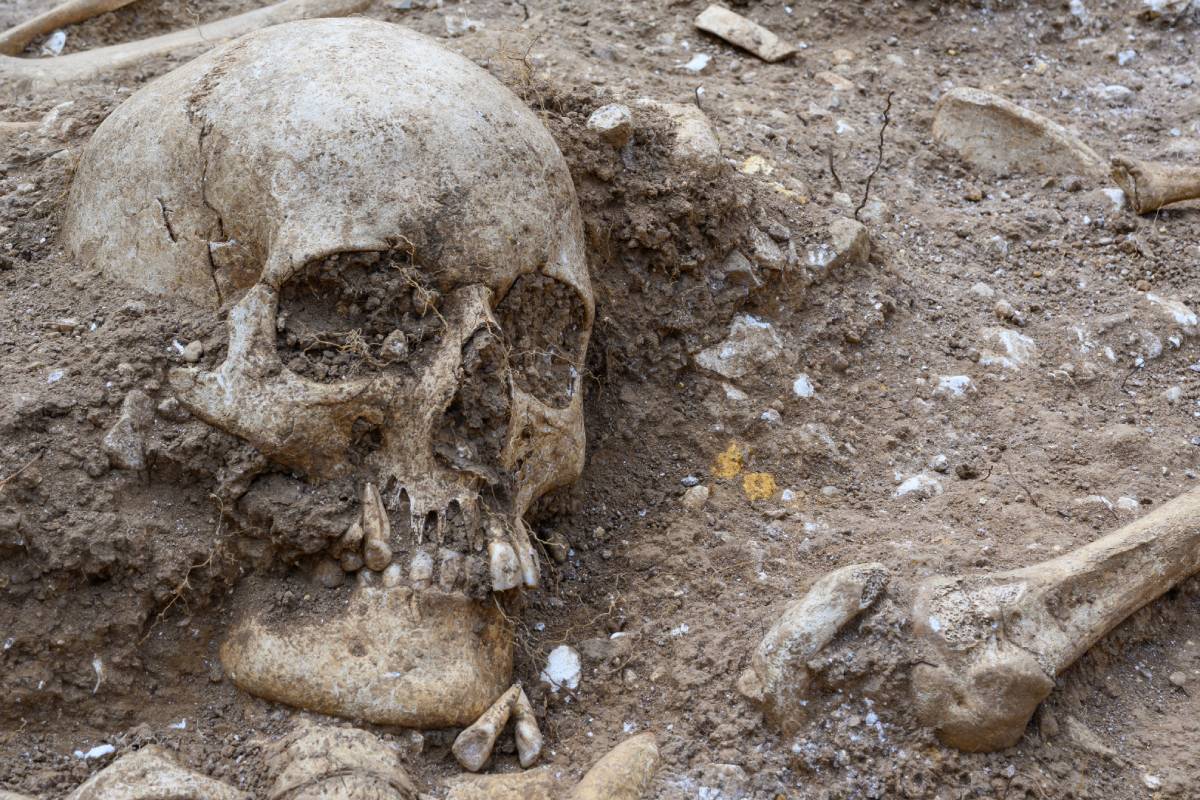
Oscar says the dig was a rare training opportunity, but also an uneasy lesson in real human violence. Photo: David Matzliach / Cambridge Archaeological Unit
Temporal collapse
Though the historical value of the excavation is unquestionable, there was also an unsettling element to the archeological work at the site, given the nature of these deaths.
"I think the approach I always take is to be really respectful to the dead," Oscar tells The Viking Herald.
"At the end of the day, these are individuals who have died. We are recording them in order to recreate their lives, to rehumanize them, and not just to focus on their end, their death."
"From a professional point of view, excavation is very technical," Oscar adds.
"A bit like with a medical doctor, we try to focus on the technique. You are recording, photographing, drawing, and taking notes. You become involved in that kind of objective stance where you create a distance between yourself and the event."
"At the same time, there was a moment on the second day, when Digging for Britain were filming me. By this point, I had worked out what was going on and what we were doing. Suddenly, it hit me about the macabre nature of what happened here."
"The huge interpersonal violence that these individuals suffered and the tragedy of that. I had to take a moment to center myself and just go 'Okay, this is quite difficult.'"
It was also a challenge for the young people working on the dig. "I had the same conversation with our students," Oscar admits.
"They were fascinated by the work, of course. But I think they also began to realize that the death and the event that happened here was quite awful."
"They also had a moment where it became hard. They were excavating people who were literally the same age as them. You have a moment of temporal collapse, where you go 'Yes, this actually happened.'"
"At the same time, it was also a special opportunity. They might never dig anything like this again in their lives. What a place to start!"
We get to provide readers with original coverage thanks to our loyal supporters. Do you enjoy our work? You can become a PATRON here or via our Patreon page. You'll get access to exclusive content and early access.
Feel free to reach out to discuss potential stories that may be in the public interest. You can reach us via email at hello@thevikingherald.com with the understanding that the information you provide might be used in our reporting and stories.