

For hundreds of millions of Christians worldwide, the coming of spring normally signals the celebration of Easter.
The feast of Easter
Somewhat infuriatingly for we lovers of history, people in the past just didn't record the exact details we need nowadays. Take, for example, the death of Jesus Christ, the man who is credited with founding a new religion and being the Son of God.
We know that Jesus was crucified, a little for his beliefs, a little for political reasons, and a little to protect the status quo in Judea, sometime after Passover. This Jewish holiday, celebrating the freedom of the Israelites from tyranny and enslavement in Egypt, is celebrated in spring.
However, our records for the crucifixion of Jesus are, at best, rather murky. We only have four accounts (each of the Gospels in the New Testament of the Bible), and these are highly subjective affairs of the spirit, heart, and mind and not historical records.
What we do know about the death of Jesus is that it occurred sometime in spring. The arrival of spring, often after the end of a long and harsh winter (in much of the northern hemisphere anyway), has traditionally been a celebration of life and renewal long before Jesus was born.
Many cultures, civilizations, and religions celebrated a spring festival, including the Celtic festival of Imbolc, the Roman celebration of Lupercalia, and the Greek (drunken) honoring of Dionysus during Anthesteria.
The new religion (it was, comparatively speaking, a newcomer in Late Antiquity) of Christianity didn't develop in a vacuum and, as we shall see, had been influenced by paganism.
Out or in?
Around the beginning of the 1st century CE, the map of Europe looked extremely different than it does today. In fact, there were only really two divisions - you were either living in the Roman Empire, with all its civilizational "benefits" from hot baths to straight roads – or you weren't.
People living in the Scandinavian peninsula were not, though they did have some indirect trade contact and, over the new few hundred years, some of their men would gain employment as mercenaries in the legions.
The story of the first half of the 1st millennium CE is one of the great migratory movements of peoples, which led, in part, to the collapse of Roman power and authority.
The traditional view is that Germanic peoples began to move southward, from Northern Europe, including Scandinavia, setting off a chain of events that would result in what the Germans have called Völkerwanderung (now called the rather less dramatic, in English anyway, "Migration Period").
Yet it wasn't just Germanic peoples heading south. Over the course of the previous centuries, Germanic peoples had been creeping northward into the Scandinavian peninsula, taking with them a belief system that would develop, by the fall of Rome, to become what we know now as the "Old Norse religion."
Stemming from Germanic pagan practices and beliefs, it included a rich pantheon of Gods, including Wodin (who would evolve into the Father of all Norse Gods, Odin), a hammer-wielding God of Thunder (who would become the Norse God Thor for many people in the Scandinavian peninsula) and a spring goddess.
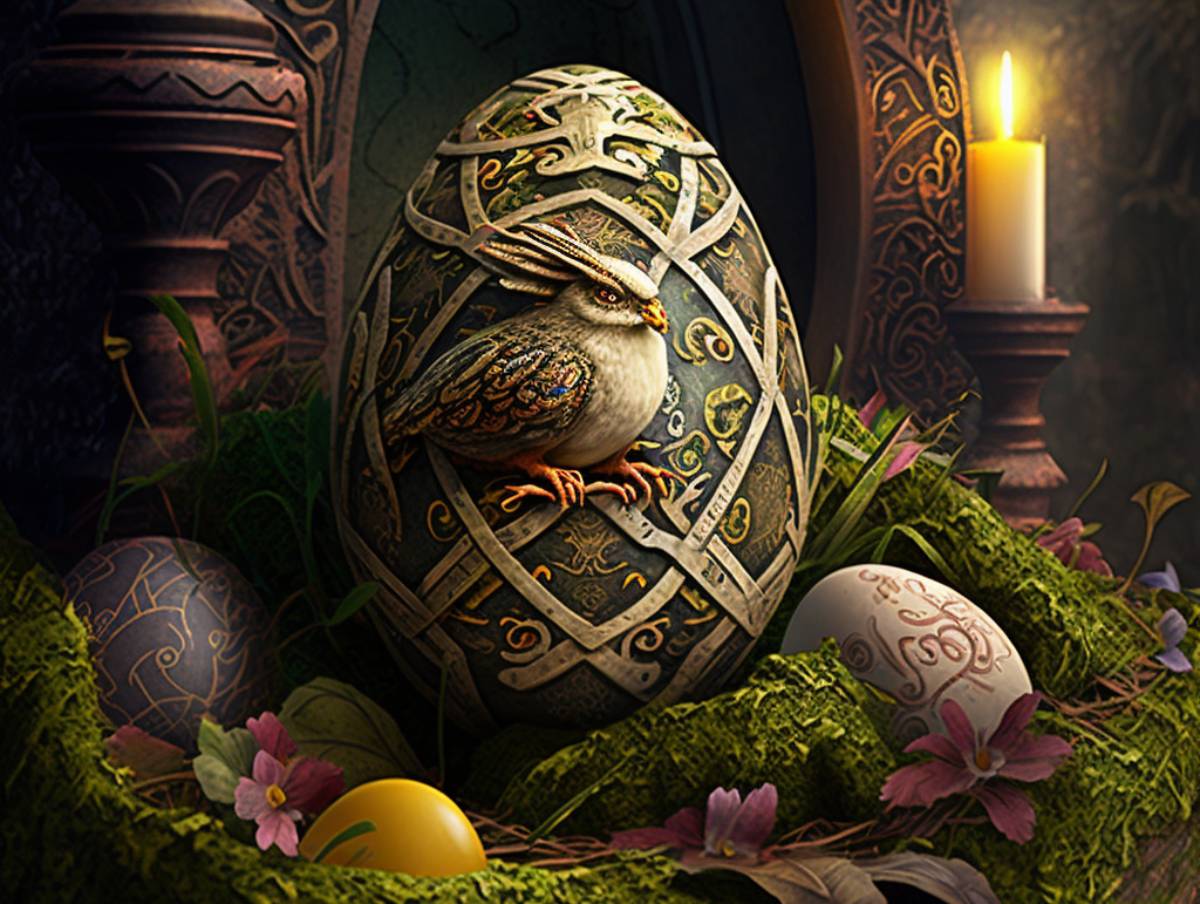
The goddess Ostara, known to many peoples in Viking societies, left a big imprint on the modern celebration of Easter. Illustration: The Viking Herald
Germanic spring goddesses
The Germanic goddess, Ostara, was supposedly a goddess revered in many Germanic societies throughout Late Antiquity and into the Early Medieval Period.
Her name is derived from a Proto-Germanic word for "dawn," and she was celebrated as being the goddess of spring, the harbinger of new life and fertility.
Whilst there is an ongoing historical debate about her existence - there is some historical debate ongoing – the only contemporary written record we have of her is from a 7th century CE Anglo-Saxon chronicler (and later Christain saint) Bede – this is not the case for her equivalent in the Old Norse religion, Idunn.
The Norse goddess Idunn was associated with delicious apples and everlasting youth but may have stemmed from an earlier Proto-Indo-European worship of fertility cults. Alongside Idunn was the goddess Freyja, famous for her beauty but also revered as the goddess of sex, love, and fertility.
It was the goddess Ostara, not unknown to many peoples in Viking societies, that would ultimately leave the biggest imprint on the modern celebration of Easter.
Ostara or Easter?
The Jewish festival of Passover, celebrated for millennia, has left its legacy on the lexicon of Easter in many European countries.
The term Påske (Norwegian), Pasqua (Italian), and Paques (French) are all derived from the term for Passover. In the Anglophone world, however, the term for the solemn festival celebrating the crucifixion, and miraculous resurrection, of Jesus Christ is Easter.
This is derived from the name of the Germanic goddess, Ostara, a nod to the many Germanic invasions of the British Isles that are bookended with the Viking invasions from the mid-9th century CE onwards.
Yet this is not all ancient history. In the German language today, the term for Easter (Ostern) shows how an ancient pagan goddess is still very much a part of our modern world.
As Christianity crept into the Germanic world, there is no doubt that the celebration of the death of Jesus Christ was conveniently celebrated to coincide with many of the pagan spring festivals.
In fact, the actual celebration of Easter, at the vernal equinox, was only officially decided at the Council of Nicaea, in 321 CE, with Christianity just the latest in a long line of religions and belief systems that have been influenced by earlier traditions.
This synthesis was one of the reasons why Christianity was taken up by so many pagans throughout the early medieval period – including in the Viking societies of Northern Europe.
Regardless of your faith or persuasion, the Christian festival of Easter is more than just an excuse to eat your body weight in chocolate. It is a time to reflect on how religions and belief systems, both ancient and modern, are the process of the synthesis of religious, cultural, and societal traditions.
The New European has published a recent article on the pagan origins of Easter, available to read here.
This deep-dive article was written thanks to the support of subscribers to The Viking Herald's Facebook page. Do you enjoy our work? You can SUBSCRIBE here or via our Facebook page. You'll get access to exclusive content and behind-the-scenes access.
Feel free to reach out to discuss potential stories that may be in the public interest. You can reach us via email at hello@thevikingherald.com with the understanding that the information you provide might be used in our reporting and stories.