


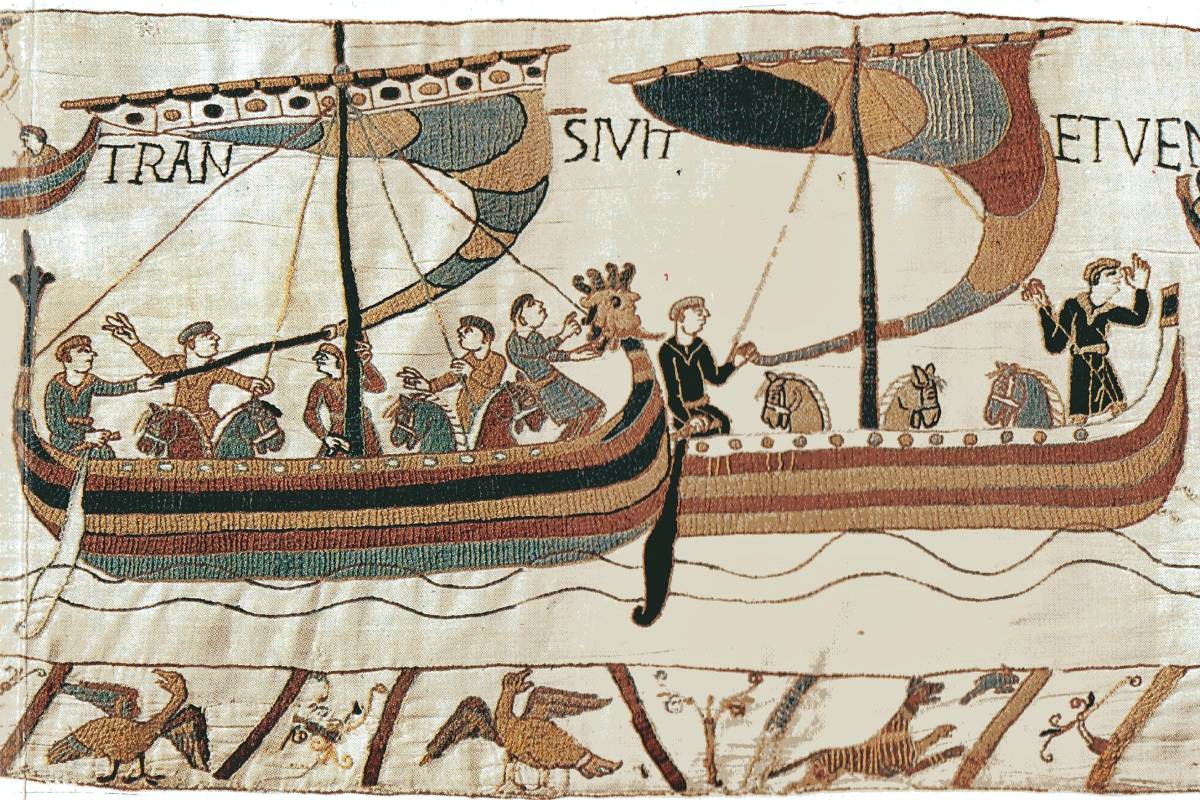
From the mid-8th century CE onwards, spotting a Viking ship upon the horizon was almost a daily occurrence for the early medieval inhabitants of the British Isles.
The outward expansion of people from Viking societies during this period had historical and far-reaching consequences for the British Isles, particularly what is now England.
The very idea of an English identity and the formation of England as a nation-state was, in part, a direct response to centuries of Viking incursion, invasion, and subjugation.
By the mid-11th century CE, much of what is now England had witnessed firsthand what it meant to live life under Viking law and rule, and they were fed up with it.
Whilst a nascent kingdom had been created, thanks in no small part to the heroics of King Alfred of Wessex and his grandson Athelstan (credited as the first king who ruled over all of England), it had suffered many defeats at the hands of Viking marauders and warriors.
By the early 11th century CE, things had only gotten worse. Not only was there a Viking presence throughout much of England, but the Viking king of Denmark, Sweyn Forkbeard, went one step further by capturing the English throne, securing a royal dynasty, and looking to forge England into Scandinavia permanently.
Yet all English hope was not lost. Harthacnut, Forkbeard's grandson, was the last ruler of the House of Knýtlinga, with the throne passing back to the Anglo-Saxons with the coronation of Edward the Confessor in 1042 CE.
Hardrada's huge flotilla
By 1066 CE, Edward was a sickly man, on his deathbed. His cousin across the English Channel, William, Duke of Normandy, felt he was a shoo-in for the succession.
Upon his death, it was not William but Harold Godwinson, scion of a rich and powerful Wessex family, who ascended to the English throne. Almost as soon as he had the crown on his head, he had quickly fended off external challenges to his throne.
Across the Norwegian Sea, Harald Hardrada, who was king of Norway, had assembled a force and landed in northern England just months after Harold's coronation in a bid to usurp the throne and bring England back into the Scandinavian fold.
As John Marsden writes about in his 2011 book, Harald Hardrada: The Warrior's Way (available on Amazon here), Hardrada was "acknowledged by historians, ancient and modern, as the most feared warrior of his world and time."
Sadly, we have no television footage (nor an Instagram reel or a TikTok) of this event, so we must turn to the next best thing: the Norse sagas (we would argue these are just as addictive as TikTok).
According to the Saga of Harald Hardrada (we use an online version of the 1844 English translation by Samuel Laing) contained in the Heimskringla, a collection of royal Scandinavian sagas compiled in the early 13th century CE by Snorri Sturluson, Hardrada had:
"...sailed with his ships... and a great fleet was collected; so that... King Harald had nearly 200 ships besides provision ships and small craft."
A more contemporary account, the Anglo-Saxon Chronicle (we use an online version based partly on an English translation published in 1692 by Edmund Gibson), details how, in the entry for the year 1066:
"...then came Harald, King of Norway... with a very great sea-force – no small one; that might be, with three hundred ships or more..."
Taken together, these accounts suggest Hardrada may have commanded somewhere between 200–300 Viking ships, a massive naval force for the period and, if true, dwarfing the famed Spanish Great Armada, more than half a millennium later!
- READ MORE: All you need to know about Viking ships
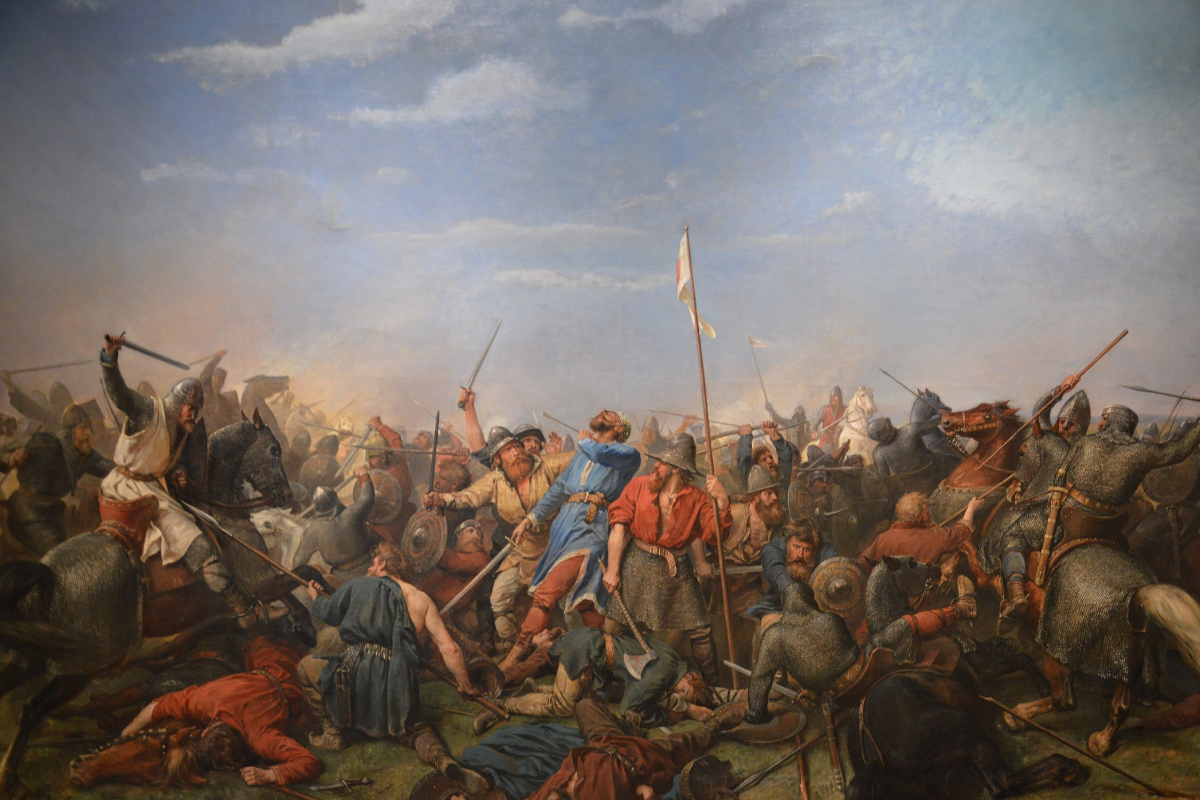
A 19th-century painting of the Battle of Stamford Bridge that shows a central figure struck in the neck by an arrow. Source: Peter Nicolai Arbo (1831–1892)
Clement English weather spells defeat
Having landed in the north, Hardrada's men, in some accounts, fought at Scarborough and followed the Humber River on their way to York, the region's most important city and a former Viking foothold.
However, remarkable for England, hot weather would prove to be the bane of Hardrada's invasion force. Turning to the saga again, we find that:
"The weather was uncommonly fine, and it was hot sunshine. The men, therefore, laid aside their armour and went on the land only with their shields, helmets, and spears, and girt with swords, and many had also arrows and bows, and all were very merry."
This sense of merriment would soon fade as:
"...they saw a cloud of dust as from horses' feet, and under it shining shields and bright armour..."
Harald Godwinson had assembled a huge force of infantry and, in some accounts, mounted troops (a feature less often emphasized in descriptions of Anglo-Saxon armies) and had raced the length of the country to fend off Hardrada.
Caught unprepared, the two sides were said to have fought somewhere alongside the River Derwent. Some later accounts place much of the action at a small bridge, with Hardrada felled by a pikeman from below, but one saga account states that he was felled by "an arrow in the windpipe".
Regardless of how he died, die he did, and with Hardrada's death, his force panicked and began to flee. A rout ensued, and only a minority of his warriors made it back to the safety of their ships.

Harald Hardrada portrayed in stained glass at Kirkwall Cathedral, Orkney. Photo: Colin Smith (CC BY-SA 2.0)
Remains of a force
Despite Hardrada's death and the vanquishing of much of his invasion force at Stamford Bridge, a small sliver of Vikings escaped. Hardrada had left his son, Olaf Haraldson, back guarding the rear where the flotilla had beached.
We have two different accounts of what happened. In the Anglo-Saxon Chronicle, towards the end of the entry for 1066 CE, it states that:
"...the king [Harold Godwinson] let them [the remains of Hardrada's force] go home with twenty-four ships."
No mention is made of what happened to the huge flotilla that had landed beforehand. Were they destroyed by Godwinson's forces following the rout at Stamford Bridge? Did they set sail the moment they heard the news that Hardrada had fallen?
Written centuries after the battle, the saga recounts how, following Stamford Bridge:
"Olaf Haraldson had not gone on land with the others, and when he heard of his father's fall, he made ready to sail away with the men who remained... he sailed with his fleet from England, from Hrafnseyr, and came in autumn to the Orkney Isles... after he proceeded east to Norway..."
Unlike the Chronicle, there is no specific mention of numbers here, or how much of the huge flotilla Olaf and the remainder of his father's force sailed back to the Orkneys and then on to Norway.
Both accounts agree that there was a great slaughter of the Viking force, so, naturally, only a smaller number of ships were needed to ferry the failed usurpers back home.
Some no doubt were lost to the perils of the natural environment, through rot, decay, shallow rivers, and/or rocks. Some may have been destroyed during the aftermath of the rout at Stamford Bridge.
Furthermore, some may have been captured by the Anglo-Saxon forces, as war booty or even sold to them. And finally, some were no doubt lost on the perilous journey back across the rough North Sea, first to the Orkneys, then back to Norway.
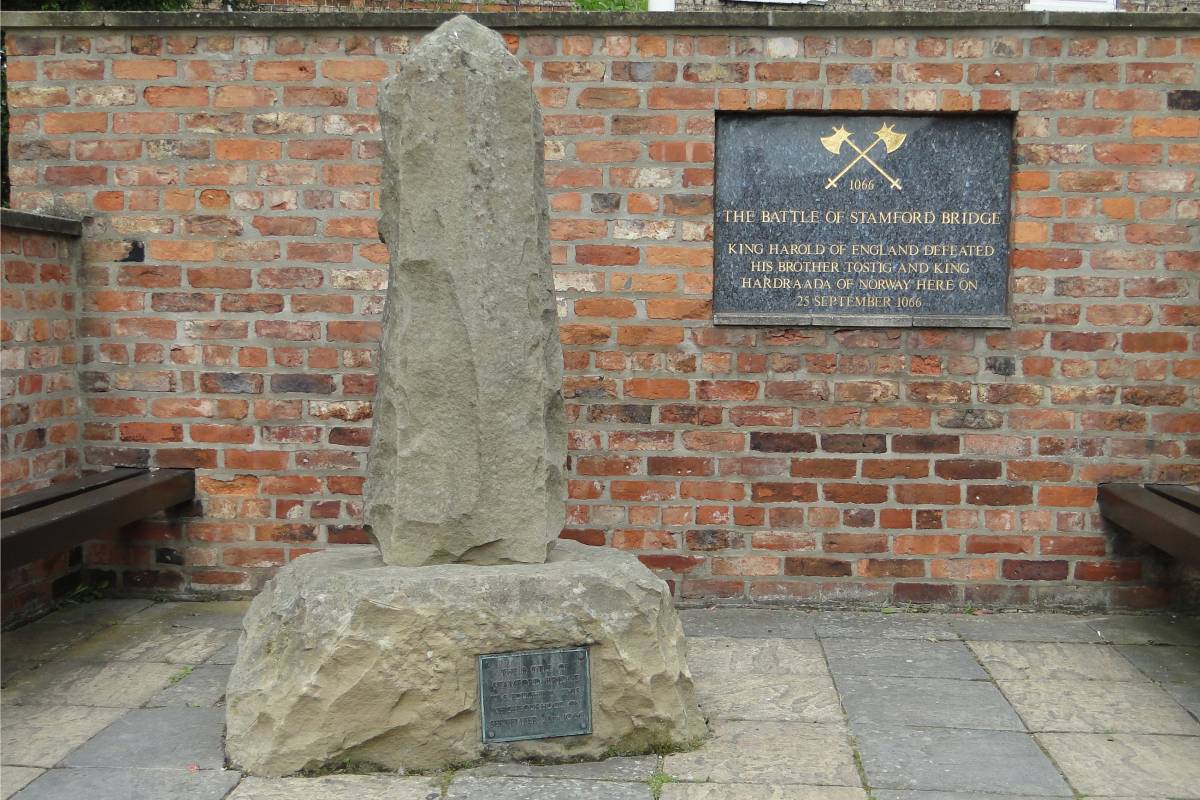
A plaque in Stamford Bridge, East Riding of Yorkshire, England, commemorating the Battle of Stamford Bridge in 1066. Source: Egghead06
Symbolic of the end of the Viking Age
Unlike the fate of the man who commissioned the great flotilla, there is a great deal of historical speculation and mystery surrounding the ships themselves, whose disappearance is almost silent in contemporary sources and never described in full.
Rather like the supposed end of the Viking story of England, the ship's disappearance is fittingly anticlimactic. The last of the great Viking fleets to terrorize England, they simply disappeared and vanished, with some pieces lying six feet under English soil.
Little more than 3 weeks later, another flotilla carrying a would-be usurper appeared on the English horizon, not from Scandinavia but from Normandy.
For more information on a recent attempt to understand more about Viking voyages, visit The New York Times here.
We get to provide readers with original coverage thanks to our loyal supporters. Do you enjoy our work? You can become a PATRON here or via our Patreon page. You'll get access to exclusive content and early access.
Feel free to reach out to discuss potential stories that may be in the public interest. You can reach us via email at hello@thevikingherald.com with the understanding that the information you provide might be used in our reporting and stories.




.jpg)

