Earlier this year, Viking Herald reporter Brian Talgo had the opportunity to encounter the Draken Harald Hårfagre Viking ship during its stay at Bjørvika Dock in Oslo. During his visit, Brian spoke to members of the crew about their experiences, including preparations for the vessel’s star turn as an Ancient Greek ship in summer blockbuster, The Odyssey.
With the Draken potentially now the most famous replica Viking ship in the world, Brian decided it was high time that The Viking Herald investigated its story in more detail. Read on for an in-depth exploration of the Draken Harald Hårfagre, also known as the Dragon Harald Fairhair.
So, what exactly is the Draken Harald Hårfagre?
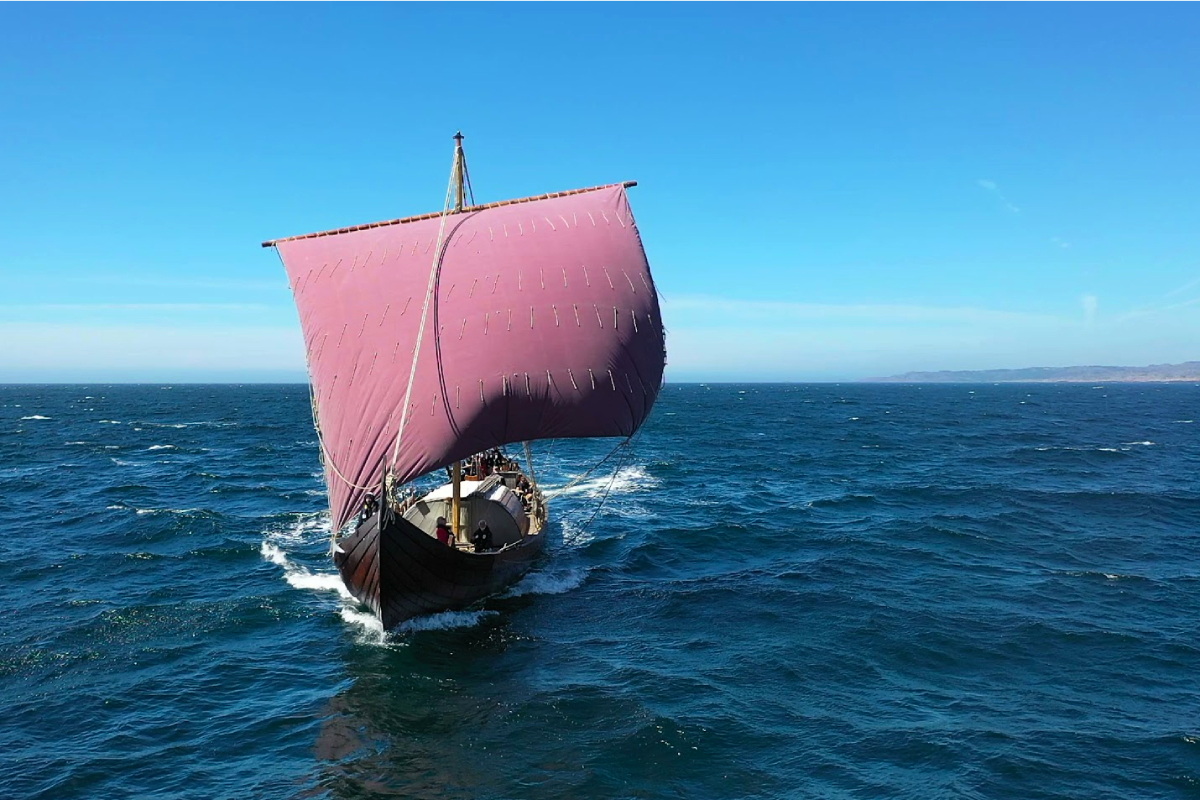
The Draken Harald Hårfagre, named after the Norwegian King Harald Hårfagre (Harald Fairhair), 860-940 CE, is the largest Viking longship replica currently in existence. It measures in at 115 feet (35 m.) in length, by 26 feet (8 m.) in width, and 95.5 metric tons in weight. In other words, it is enormous – something you can truly feel while standing on deck. Indeed, every aspect of the ship seems oversized, from the mast down to the rudder, aka steerboard.
Construction of the Draken Harald Hårfagre began in Vibrandsøy, Norway in 2010. The vessel was officially launched on June 4, 2012. It is worth noting that the Vikings didn’t leave behind plans or drawings concerning construction, and other than descriptions from the saga literature, written hundreds of years after the Viking Age, also left no records or instructions on how to build, rig, or sail their ships.
This means that boatbuilders who attempt to recreate replicas of these ships have to mostly rely on archaeological finds, none of which are completely intact, and Scandinavian traditional boatbuilding techniques that have passed down through time, such as clinker construction.
This, in combination with the fact that the Draken was not precisely modeled on a Viking Age vessel (though it did take inspiration from the Gokstad), means we should view it more as a conceptual reimagining of what a large Viking ship might have been like based on our limited knowledge, rather than an exact historical replica.
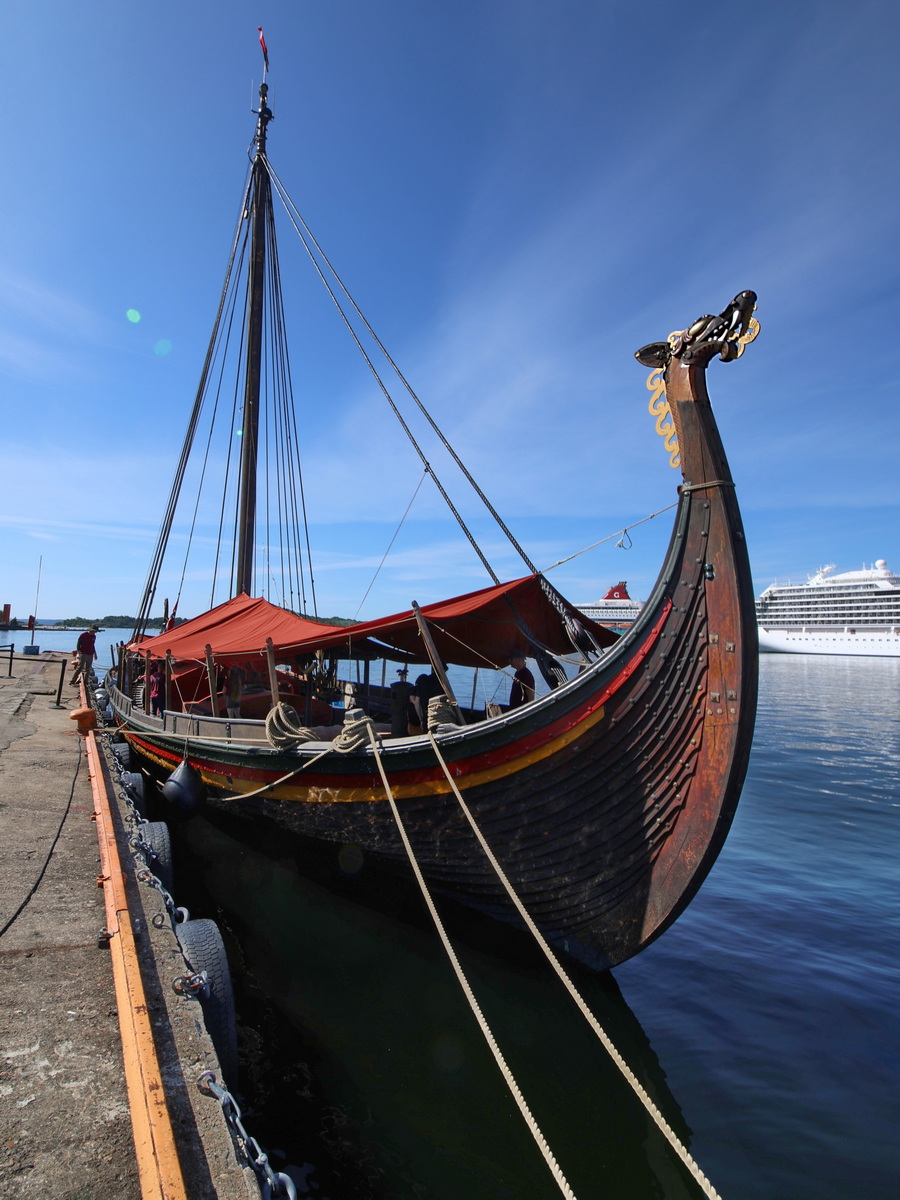
The Draken in Oslo. Source: Brian Talgo
Mast and sails
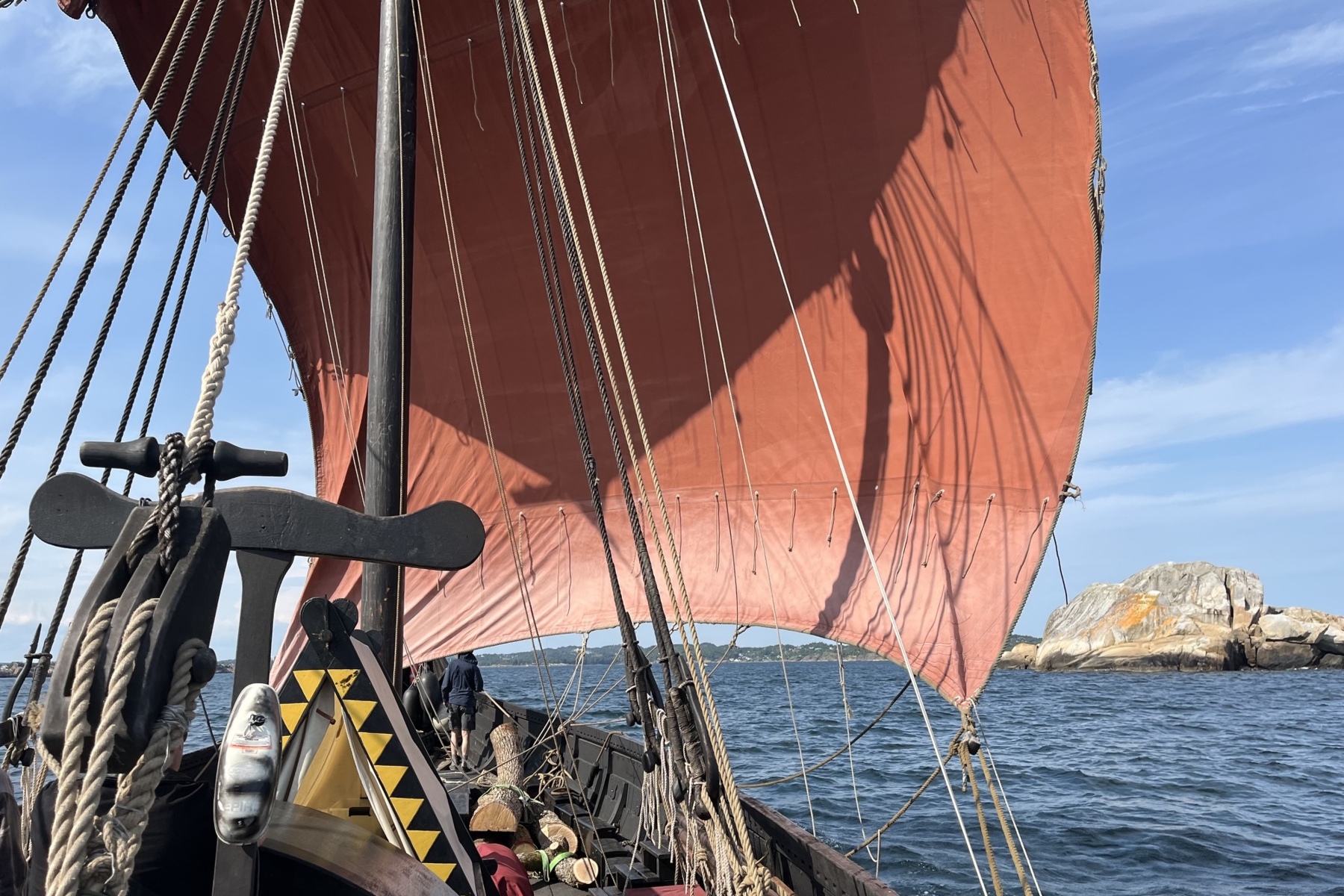
The Draken is constructed entirely of oak, except for the mast, which is a single, continuous piece of high-grade timber. Towering 79 feet (24 m.) over the deck, the current mast is made of Scottish Douglas fir, a strong but lighter, more flexible wood than oak, and which tolerates the load from the massive sail.
The original mast, also made of Swedish Douglas fir, snapped under heavy winds in 2014 southeast of the Shetlands during the ship’s maiden ocean-crossing. Travelling to Liverpool, the crew eventually found a stronger replacement in a Douglas fir grown in Galloway, Scotland.
One interesting aspect The Viking Herald learned from the crew of the Draken was that masts on Viking longships were not permanently fixed to the hull. Rather they were plugged into a kind of a wooden socket attached to the deck and otherwise held into place by the rigging.
This allowed for the mast to be lowered and raised, which could be advantageous in dangerous high winds and to otherwise reduce wind resistance when merely propelling the ship using the oars.
Additionally, a lowered mast decreases visibly when approaching an enemy shore, and it also allows ships to pass under low bridges when navigating rivers. Finally, the mast could more easily be replaced if damaged, and an unattached falling mast would not rip open the hull, as a fixed one might.
Sails for Viking ships were generally made of tightly woven wool or flax and treated with fat and were therefore quite heavy. The Draken features a 260-square-meter (approximately 2,800 to 3,000 square feet) sail made of red-dyed silk, which is both strong and light in weight.
Canvas sails, however, have also been employed. Other than the sail, there are 25 pairs of oars for use of up to 100 rowers, allowing the ship to continue under wind still conditions and maneuver in tight spots.
Finally, the ship is equipped with two diesel engines to meet maritime safety regulations and to allow it to be manned by a smaller crew as well as to navigate under certain modern conditions, such as city harbors and canals.
The Draken’s hull speed is about 14 knots, approximately 16 mph (26 kph), and by employing its oars it can reach a speed of three to four knots, approximately 3.5 to 4.5 mph (5.5 to 7.5 kph).
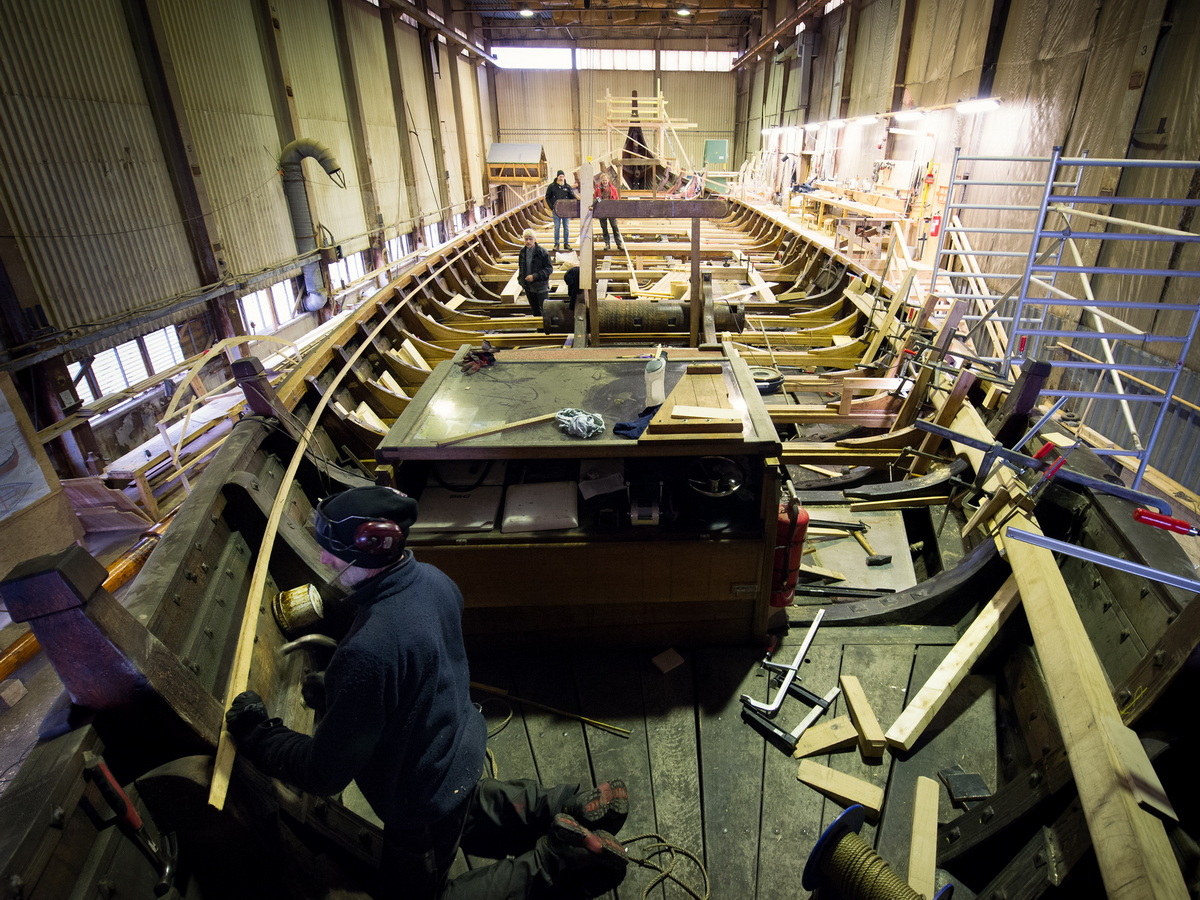
Constructing the Draken. Source: Draken Harald Hårfagre
Building the hull
Clinker construction, a traditional Norse ship-building technique dating back to the Iron Age, was followed in assembling the hull. Employing a modern variant of this technique, the ship’s outer wooden planks – referred to as “strakes” – overlap each other.
The seams of the strakes are caulked with pine tar-soaked hemp, wool, hair, or some other absorbent material. The strakes are then joined together with metal rivets. In the case of the Draken, over 10,000 hand-forged rivets (klinks) were used to fasten the oak planks along the hull.
Despite dating back 2000 years, clinker ship construction can be viewed as a fine example of advanced maritime engineering. When seawater comes into contact with the filling in the caulked seams, it swells, making the joints completely water-tight.
At the same time, these seams remain flexible, making the ship’s entire hull more plyable, and therefore less likely to break when being battered by rough seas.
Another interesting aspect of building a ship using clinker technique is that the hull is built first, with the internal ribs and supports that will make the ship stable being added in afterwards.
A hybrid ship in the clinker tradition
As noted above, the boatbuilders used the Gokstad ship, the 9th-century Viking longship discovered in Norway in 1880, as a kind of prototype. As the Gokstad ship is only 78 feet long (23.8 m.), the Draken builders scaled the ship up to 115 feet (35 m.) to create a larger, ocean-going ship.
However, the ship was not built dimension-wise to represent any known Viking ship. Instead, it is more a hybrid of several Norse ship styles. Viking warships, outfitted with both sail and oars, were generally long and narrow, built for speed, and with a shallow draft, allowing them to operate in very shallow water, including beaching.
The Draken, however, while generally modeled after the Gokstad Viking longship, was built with cross-ocean sailing in mind. This means that it was constructed with certain attributes of transport/merchant ships, with a wider breadth, a deeper keel, and deeper draft. Knarrs were more or less exclusively sail-driven and were not equipped with oars, with the deck and hold reserved for cargo.
In sum, the Draken Harald Hårfagre is a modern amalgamation of several different types of ships from the Viking period (a fact that leaves some critics claiming that as such it’s not truly a ‘Viking’ ship).
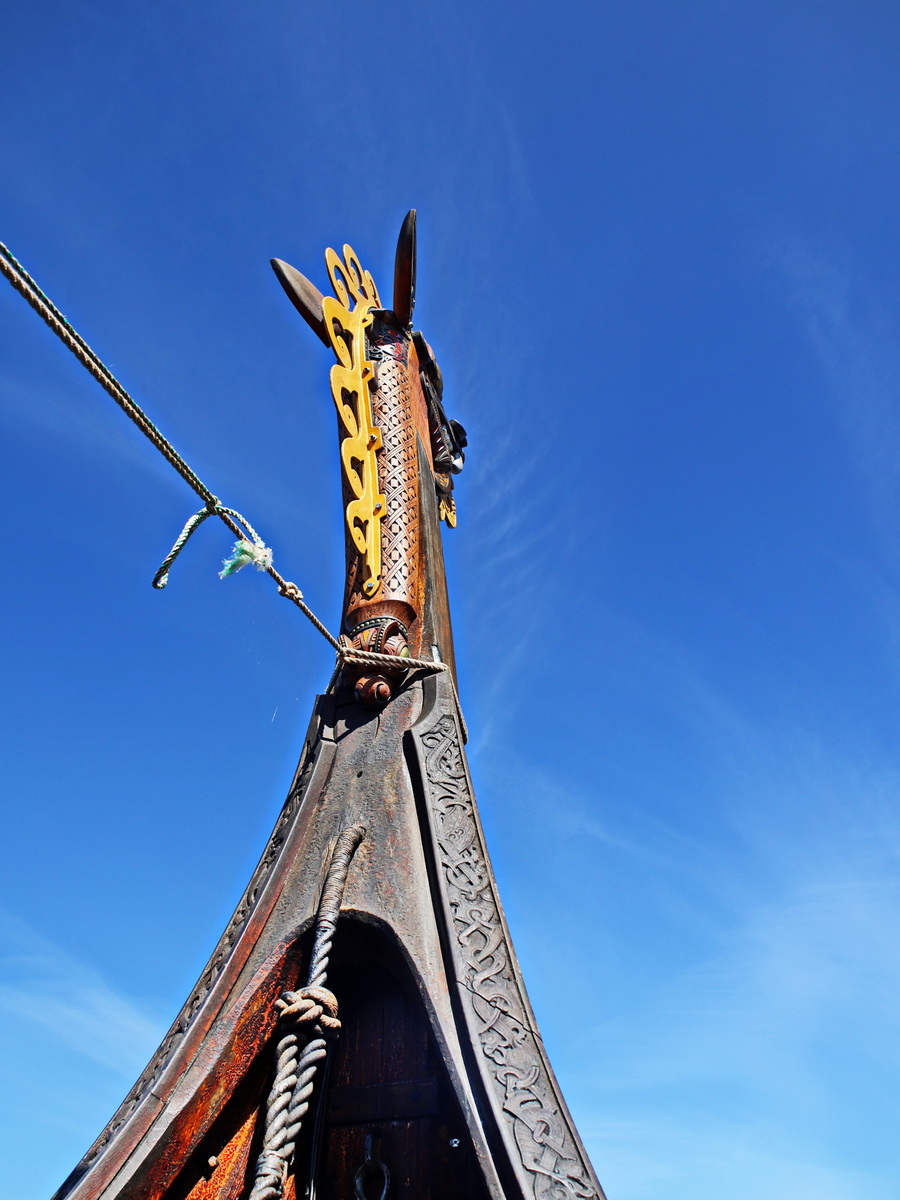
The Draken's prow. Source: Brian Talgo
Viking and other Norse ships
A ‘dragon ship’, or ‘Draken ship’ (Old Norse drekaskip), is usually decorated with a raised, carved dragon head (ON: drekahofud) on the prow, with a ‘tail’ mounted on the stern, while the sail would be considered the dragon’s ‘wings’. The dragon head and tail are both detachable, and were generally only fastened in place when sailing into battle or to otherwise frighten an enemy.
These figureheads were considered a form of apotropaic magic, i.e. protective magic used to ward off evil forces and bad luck, repelling these by confronting them with fearful and powerful magical symbols.
A dragon ship was not a class of ship, however – the term was used to denote any type of Viking ship that featured a dragon head. It should also be noted that there were other types of carved heads, which included the likenesses of serpents, bears, and other mythical animals.
The large Viking warships comparable in size to the Draken Harald Hårfagre were longships of the skeide (ON skeið) class. The largest skeide ships were approximately 50 meters or more in length, and could probably carry a crew of up to 200 to 300. The Vikings also built and used a variety of smaller ships, each designed for specific tasks.
The karve (ON karfi), was used as a smaller multi-purpose longship, while the snekke (ON snekkja), meaning snake or slender, had a shallow hull allowing for beaching during coastal raids, and for negotiating rivers.
Additionally, there was the knarr (ON knórr), which had a deeper hull and was wider in breadth, a merchant type of ship used for cargo and transport, and the busse, which like the knarr had a large cargo hold, but was also a longship designed for war that could carry a large crew manning up to 35 pairs of oars.
The Draken’s backstory
All stories have a beginning, and the Draken Harald Hårfagre’s began to take shape around 2008, in Haugesund, Norway. Avaldsnes, located on Karmøy island, close to modern Haugesund, was central in Norwegian Viking history, and is often referred to as the "Homeland of the Viking Kings".
King Harald Hårfagre, after whom the Draken was named, and considered to be Norway’s first true king, had his home in Avaldsnes. Tradition has it that he is locally buried in Haraldshaugen (Harald’s Mound).
Sigurd Aase, a Norwegian entrepreneur, who was born and grew up in Haugesund, had a Viking inspired vision, or "daydream" as he has called it. He has stated that, “We know for sure that the oak used to build the Oseberg, the gemstone of Norway, that oak came from the area where I live, where I'm born. The Viking ship has been a part of my journey in life since I was three years old.”
Part of that vision touched on unanswered questions concerning the Viking exploration of the North Atlantic – referred to as the Western Seas by the Vikings – extending westward to North America. In particular was the famous Norse site at L'Anse aux Meadows, Newfoundland.
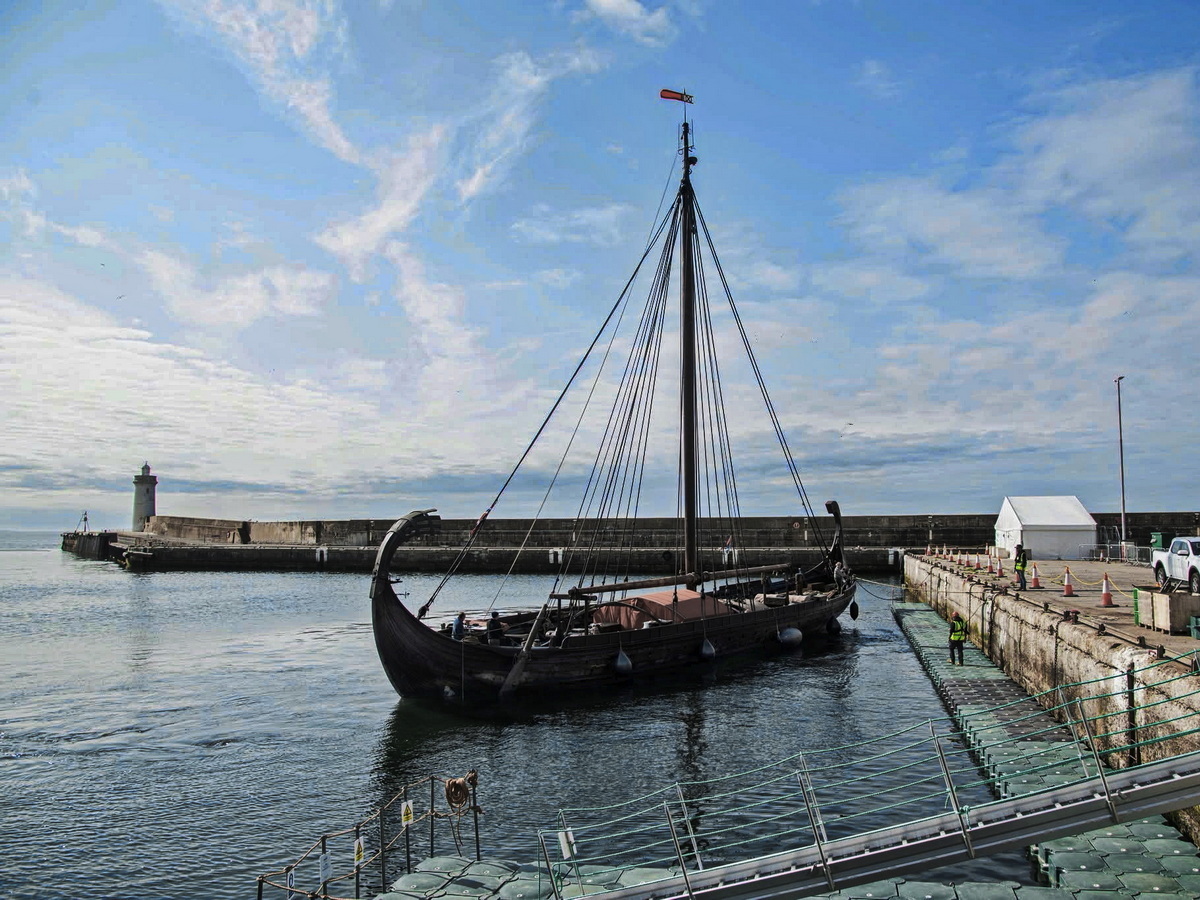
The Draken in Scotland. Source: Draken Harald Hårfagre
Realizing a dream
Aase decided in 2008 to embark on an ambitious shipbuilding project, to recreate a “Great Ship”, similar to those described in the Norse sagas. One of his objectives was to explore how a large Viking-style ship could function as an ocean-going, transatlantic vessel, such as a Vikings sailing to North America.
There was also the challenge of learning how to build, rig, and sail such a large ship. “Shipbuilding was the rocket science of the Viking era,” Aase has stated. Before starting on the main project itself, his team of boatbuilders experimented with three smaller ships that they built, each different, to test variables such as optimal hull and sail shapes as well as testing out masts.
The other aspect of his vision was succinctly stated by Aase himself. “The aim of the Draken Harald Hårfagre project is to explore the world and embrace the Viking spirit – to look beyond the horizon and seek adventure and to inspire people to take on challenges.”
In 2016, the 26th of April, the Draken Harald Hårfagre set sail across the North Atlantic for Canada. The crew of 32 followed a route across the ‘Western Sea’ that would not have been uncommon for Viking explorers a 1000 years ago. Leaving from Haugesund, they sailed first on a kind of test run to the Shetland and Faroe Islands. Satisfied the ship could tackle the open seas, they proceeded to Iceland, docking at Reykjavík.
Full-scale adventure
A particularly hazardous part of their journey was the route from Iceland to Greenland. It was the same dangerous stretch of sea where Norseman Eirik the Red’s flotilla of 25 ships sailing from Iceland was decimated on their journey to colonize Greenland in 985 CE.
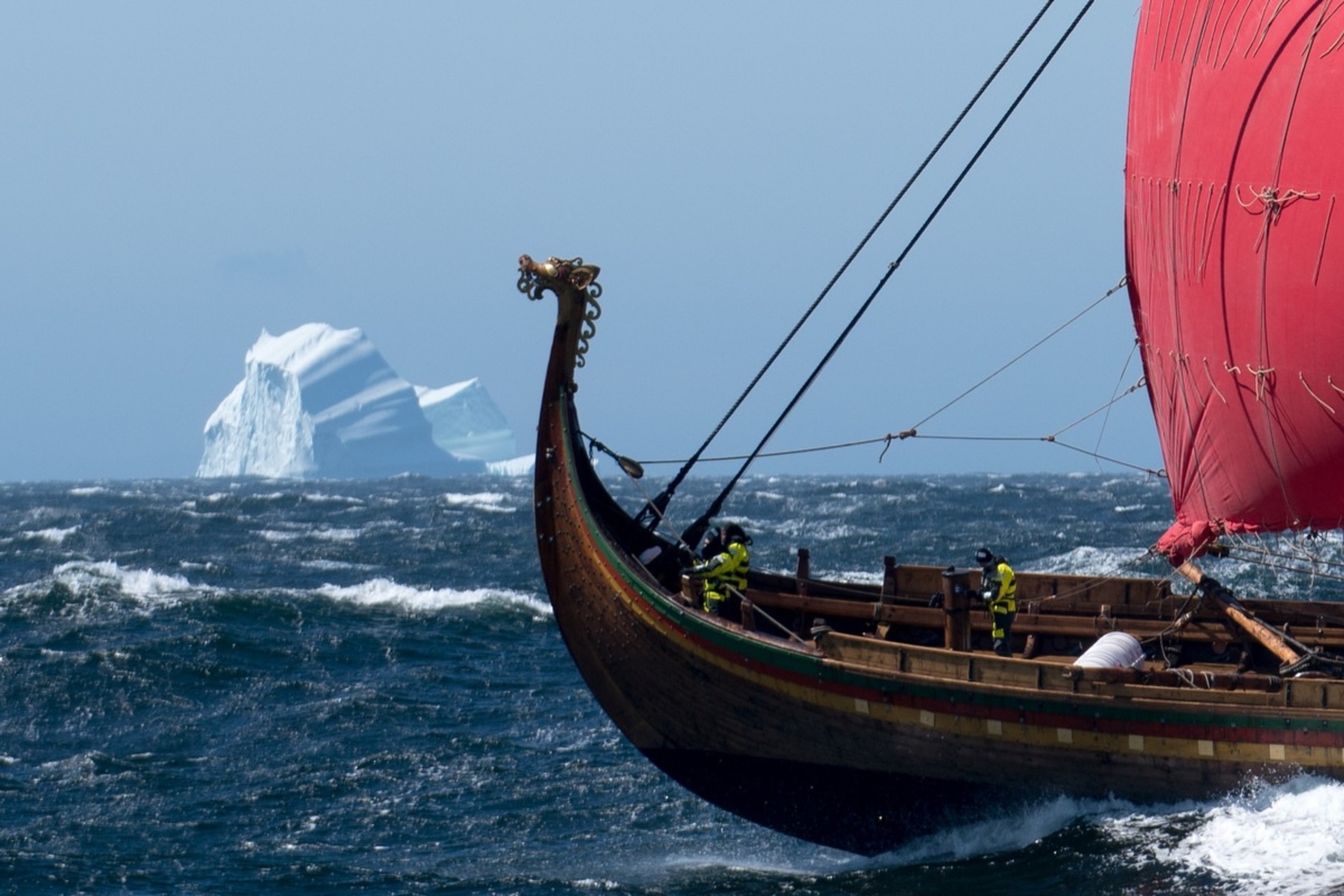
The Draken Harald Hårfagre encountered icebergs, inclement weather, and rough seas as the team sailed around Cape Farewell on the southern tip of Greenland, before finally finding safe harbor in Qaqortoq.
The area surrounding Qaqortoq is the historic location of the Norse Greenland Eastern Settlement (ON Eystribyggð), with Hvalsey Church, the largest and best-preserved Norse ruins on Greenland, only a handful of miles away from the town.
However, it turned out that the six-day sailing router across the Labrador Sea turned out to be the most difficult and stressful of all. Due to special adverse weather conditions the Draken encountered an impenetrable fog and high winds, forcing the crew to rely on their onboard radar system to avoid colliding icebergs.
Running visually blind through the freezing Arctic fog, they were well aware that an unlucky encounter with a submerged iceberg could sink the ship.
The Draken finally arrived in St. Anthony, Newfoundland on June 1, 2016, completing their transatlantic voyage approximately five weeks after leaving Haugesund. St. Anthony is a short distance from L'Anse aux Meadows. In many ways, it was the culmination of Sigurd Aase’s daydream.
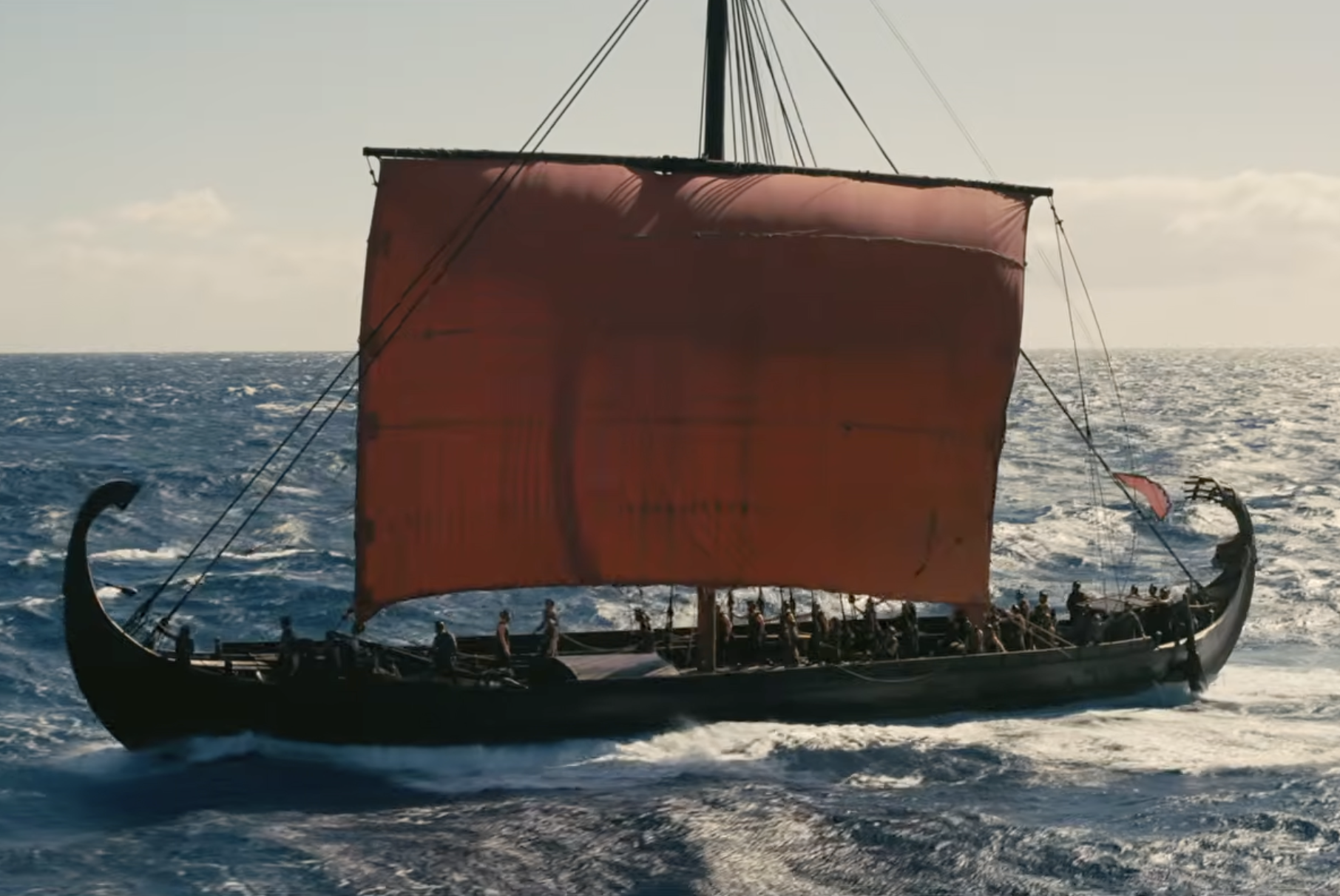
The Draken as movie star. Source: Universal Pictures
The Draken and The Odyssey
As many movie-goers will have noticed, at least those with some knowledge of ancient ships, Odysseus’ ship in Christopher Nolan’s recent film, The Odyssey, was not a Bronze Age Greek warship. Indeed, it was a stripped down, modified version of the Draken Harald Hårfagre. You might wonder why Nolan didn’t use a more authentic ship, especially since there are a number of replicas already in existence.
A quick look at several of the available reconstructed Hellenistic ships seems to indicate that none of them were a good fit for the movie, being either too small, or too closed in. The Draken Harald Hårfagre, on the other hand, is a large, open, functional ship. There is, however, one glaring problem.
The Draken is a Viking-style ship belonging to the 10th century CE, whereas the Odyssey takes place in the Hellenistic Mediterranean in the 12th century BCE. By removing the Draken’s dragon head and tail, and replacing them carved endpieces in the Ancient Greek style, Nolan, known for steering away from CGI effects and green screens, achieved what he was looking for; a large, ancient, single-masted wooden ship that would serve as a stage and centerpiece for his epic film.
He was apparently less interested in pure historical authenticity than in placing both his actors and crew in scenes and situations that created the feeling of participating in the story itself.
“We found a Viking ship that had been built exactly according to those ancient specifications. And it was very much the whole shape and the rig that we needed to do a Bronze Age ship,” Nolan said. “We needed something wooden-hulled, built with ancient technology that could be out there in open ocean water, in giant swells,” he later explained in an interview with the Los Angeles Times. “And the Draken has crossed the Atlantic.”
“Most of the scenes would be completely different if it wasn’t for us being there, doing the real thing with the real ship and the real crew in the real ocean and real weather,” explained Emanuel Persson, expedition director for Draken. “I think the viewers can actually feel the genuine materials. I don’t know if you can really smell the tar, but you can tell it’s really genuine handicraft instead of being a digital creation,” he added.
Of course, while some purist Norse (or Greek) history fans might frown at the inauthenticity of it all, the movie’s – and the Draken’s – resound success at the box office and in the eyes of critics is beyond doubt.
The only question is, where will the Draken go next?
You can read our interviews with the crew of the Draken here: https://thevikingherald.com/article/meet-the-crew-an-interview-with-sailors-from-the-draken-harald-haarfagre-ship/1438
We get to provide readers with original coverage thanks to our loyal supporters. Do you enjoy our work? You can become a PATRON here or via our Patreon page. You'll get access to exclusive content and early access.
Feel free to reach out to discuss potential stories that may be in the public interest. You can reach us via email at hello@thevikingherald.com with the understanding that the information you provide might be used in our reporting and stories.