

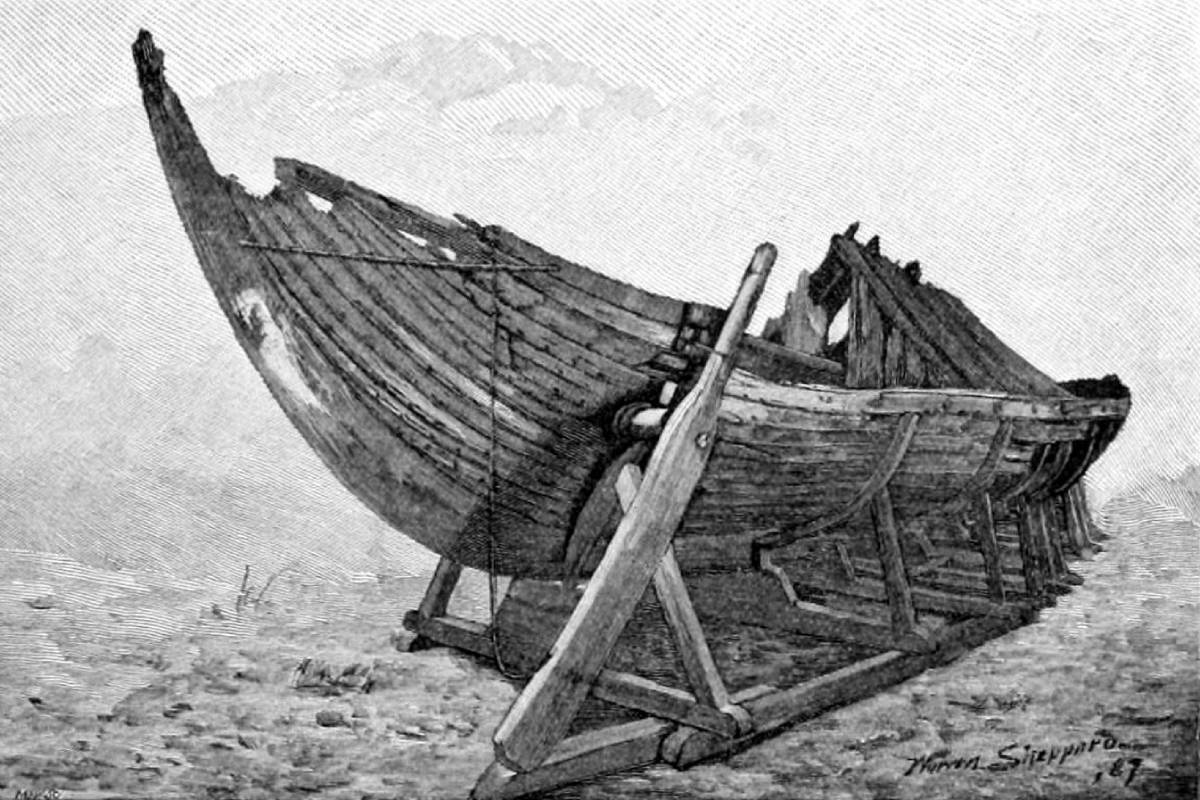
In part one, we spoke to Viking Age archeologist Jan Bill about the plunder of the two famous ship burial sites in southern Norway.
In both instances, the perpetrators left a long, visible trench, almost certainly removed valuable weapons and jewelry, and displayed a blatant disregard for the dead.
Now, we continue our investigation as Jan explores elements of precise archeological analysis, ancient origin myths, and Viking Age power struggles.
Meanwhile, in Denmark…
The Viking Herald asks Jan if the desecration of the two sites could have been part of a Christian destruction of a heathen memorial.
"This is possible," he admits. "However, in the third quarter of the tenth century, Norway was not yet a Christian country – it was in a phase of transition."
"What we would have to look for is someone who had the power to destroy these monuments of a ruling family."
"The fact that we are still in this phase of transition becomes very clear when we look at Denmark, which was ahead of Norway in the Christianization process," Jan continues.
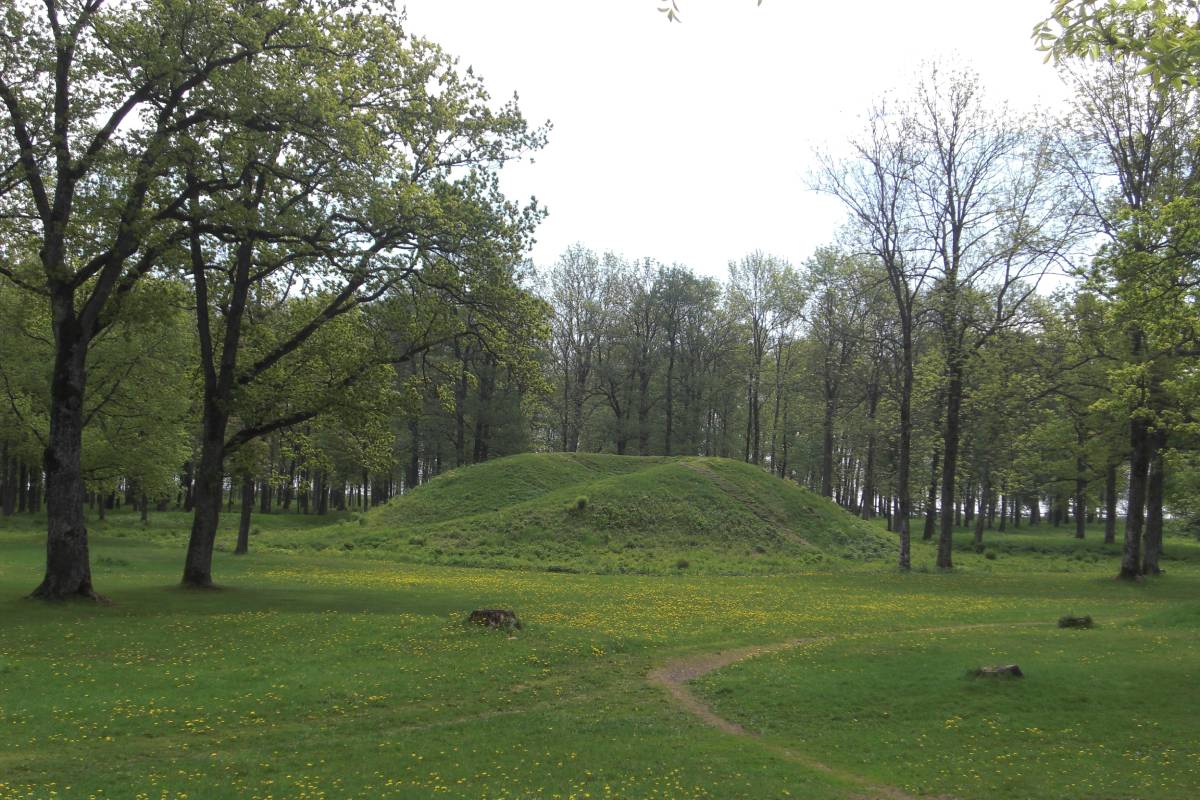
"Here, the royal family that came into power at the start of the tenth century – Gorm the Old and then his son Harald Bluetooth – constructed the Jelling memorial."
"Jelling is actually very heathen in its origin. You have a huge stone ship setting, which is a traditional memorial type in Denmark and southern and eastern Sweden in the Viking Age."
"But the special thing about Jelling is that it is 356 meters long – it's gigantic. A burial mound is then placed in the center of the stone ship setting with a chamber inside."
"At Jelling, the chamber is situated in the stone ship exactly the same way you would place the chamber in a real ship in a Norwegian ship burial."
"So we have a deeply heathen monument constructed by Harald Bluetooth for his father in the middle of the 10th century that probably demonstrates his affinity to a certain origin myth," Jan continues.
"Later, another mound was added, and the whole thing was turned into a Christian monument."
"They built a church and Harald Bluetooth's famous runestone that declared that he had won all of Denmark and Norway for his kingdom, and turned the Danes into Christians."
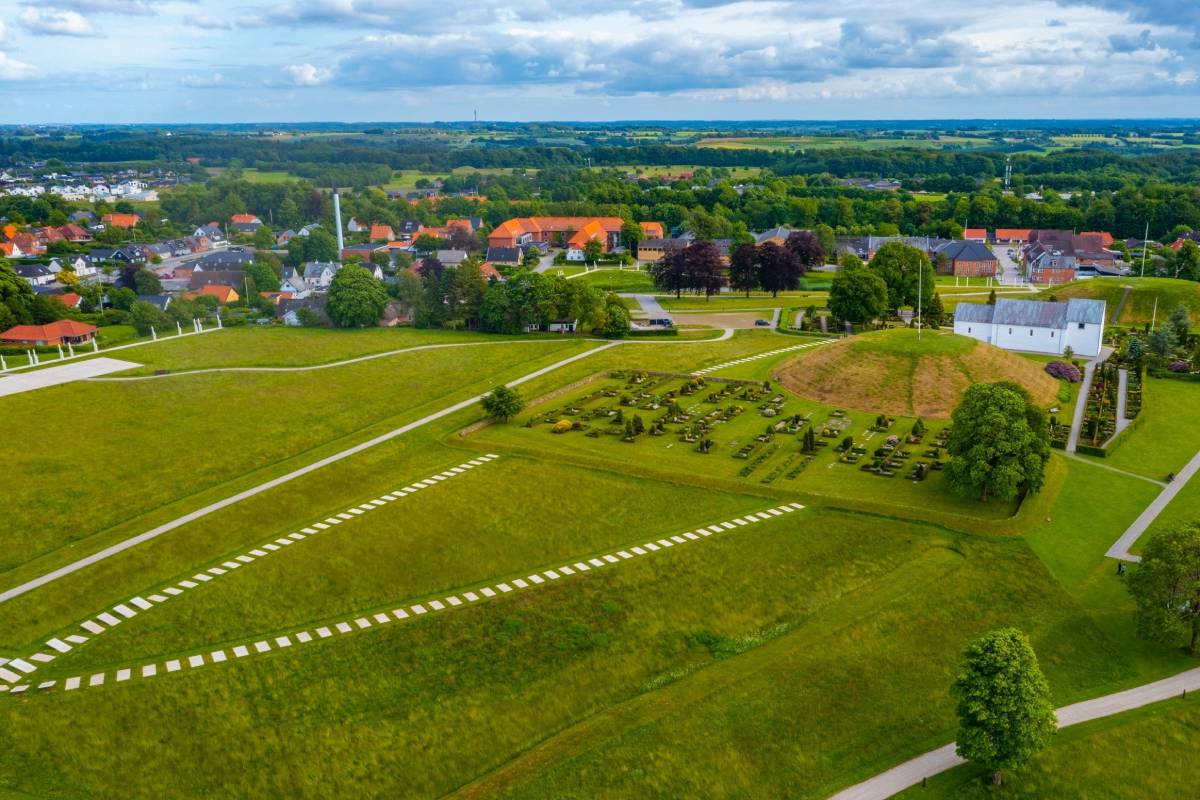
The burial mounds at Jelling, part of a larger memorial complex, feature a 356-meter-long stone ship setting. Photo: trabantos / Shutterstock
A disputed land
In other words, just south of Norway, a powerful dynasty was taking shape across the narrow seas that initially celebrated its grandeur through ship burials constructed on a bewildering scale.
"I don't think it's very easy to say what happened, but the mounds in Norway certainly also had a huge symbolic power," Jan admits.
Oslofjord, the area of Norway where the Gokstad and Oseberg ship burials were discovered, is just a short ride across the North Sea from the northern tip of Denmark.
"We know the Oslofjord area was hotly contested throughout the Viking Age, and shifted hands between the Norwegians and the Danes," Jan tells The Viking Herald.
"It was Danish in the 9th century, then it came into Norway's possession. It was shifting back and forth."
Jan emphasizes that at a distance of more than a thousand years, we can only form an idea of what could have happened by studying the available evidence from the graves, in combination with our limited historical knowledge of this era.
"We have to look at who would have actually been in power at the different places at the time when the mounds were broken into," Jan states.
"We have a date for Jelling thanks to dendrochronology. So how does that compare with the plundering of the Norwegian ship burials?"
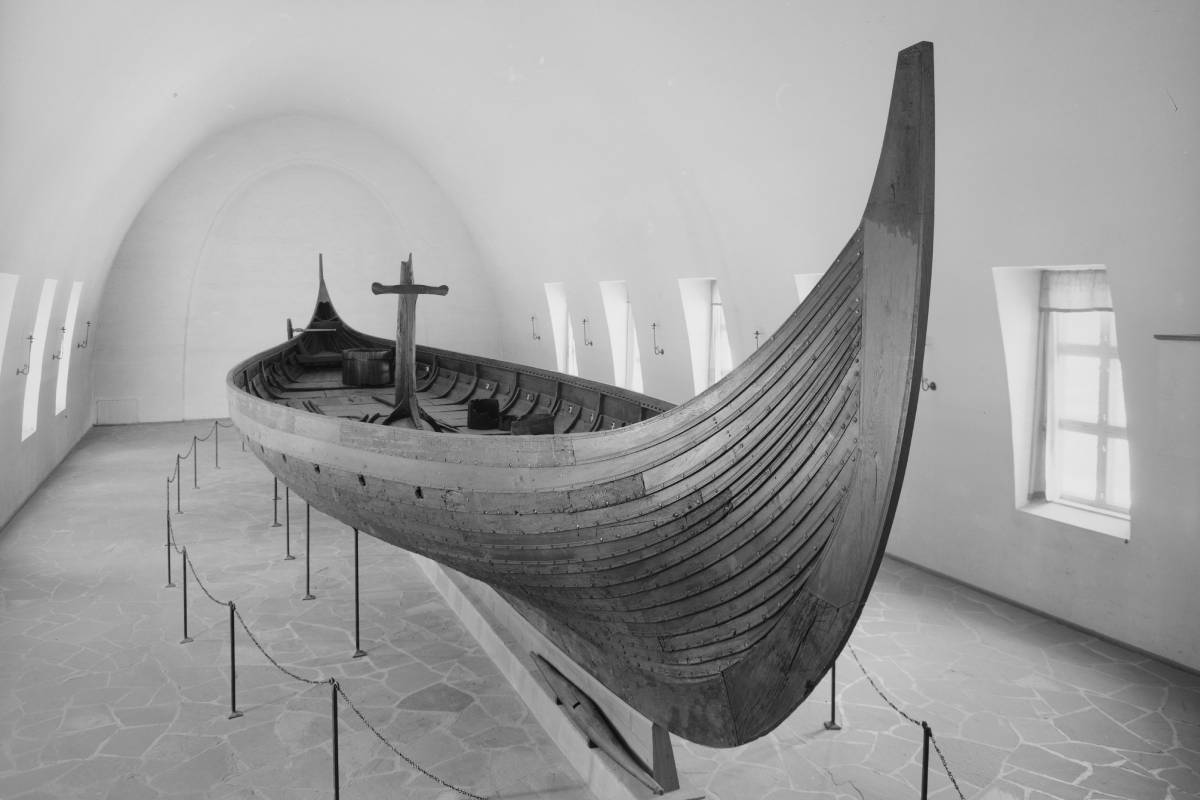
Analysis of the wooden tools left by grave robbers reveals the Oseberg and Gokstad break-ins likely happened between 953 and 975. Photo: Jac Brun (1921–1995)
If the date fits
Dendrochronology is an innovative dating process that determines the age of a piece of wood by analyzing its rings.
Although it cannot provide a precise date for when a piece of timber or wooden tool was made, it is able to tell us with a high degree of accuracy the earliest point when the tree it came from could have been felled.
As Jan indicates, dendrochronology was used to help date the Jelling ship burial to the middle of the 10th century.
In 2010, Jan was involved in research that looked to date the spades and other tools used by the grave robbers at Gokstad and Oseberg.
"We had tools that had been used by the people who broke into the mound," Jan explains.
"We can see that some of the wood at Gokstad seems to be very, very similar to the wood of the tools at Oseberg. This indicates the trees that provided the timber must have been standing very close to each other."
"This simple fact links the two events. This is, of course, a hypothesis, but I believe it is a good one. We have this degree of similarity, further supported by the similar way the break-ins were made – in this very spectacular and demonstrable manner."
"Some of the tools were made of oak and had been well-preserved within the trench, so we were then able to date them."
"It turned out that the youngest growth ring preserved from Gokstad showed the tree could not have been felled earlier than 939. At Oseberg, the youngest date obtained was from 953."
"In each case, they could have been felled later, so these are the earliest possible dates for the break-ins. Some of the wood used was also significantly older."
"This suggests the plundering did not take place beyond the year 1000, and probably somewhere between the years 953 and 975."
"This is more vague, but it's an indication. And this is exactly the time that Harald Bluetooth was ruling in Denmark."
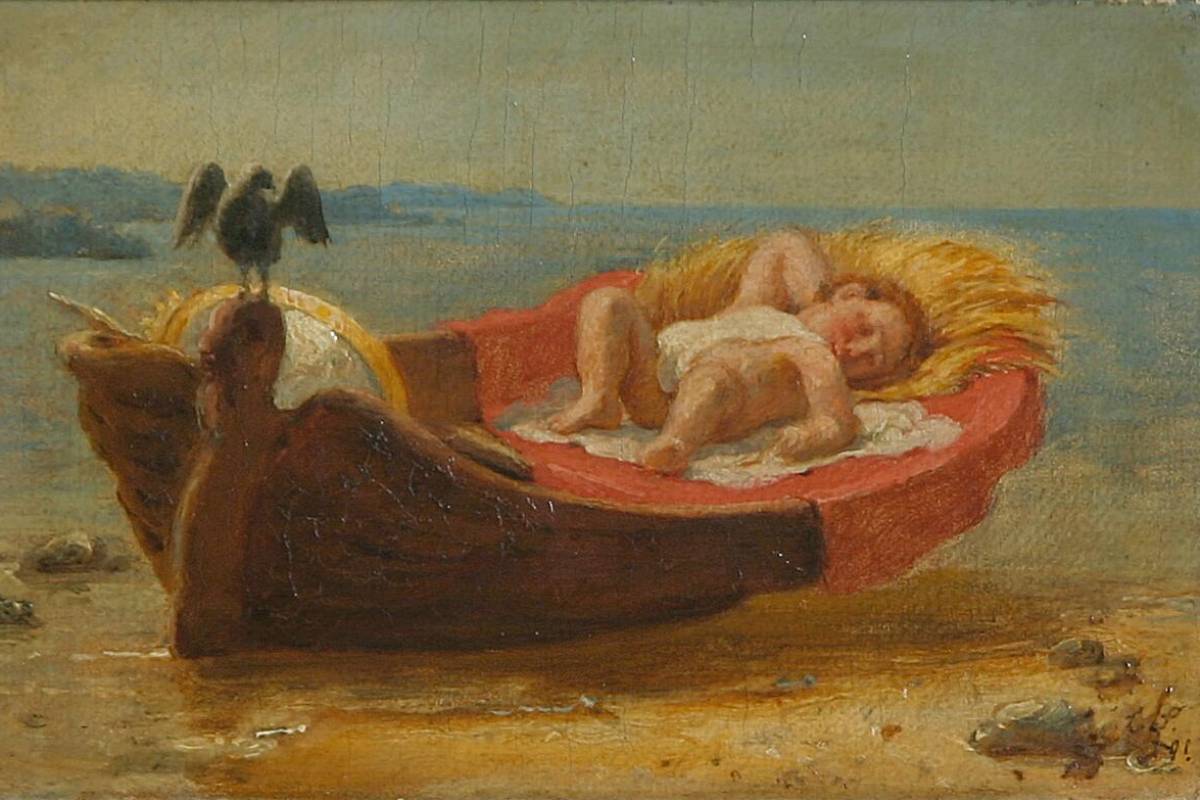
In Beowulf, King Scyld’s life begins and ends with a ship, creating a myth about Danish kings being chosen by the gods. Source: Herman Siegumfeldt (1833–1912)
The origin myth
Even so, the question remains: why would Bluetooth devote precious time and resources to extensive grave-digging?
Jan believes a clue may be found in the first lines of the 8th-century Anglo-Saxon poem Beowulf.
"The poem starts with an origin story about the Danish royal family," he explains.
"In Beowulf, the Danish king, Scyld, came to Denmark as a small child on a drifting boat, surrounded by beautiful weapons, and was adopted by the king of Denmark. Then, when the old king died, Scyld became the new king."
"When Scyld – or Shield – sensed he was going to die soon, he instructed his followers that when he was dead, they should put him on a ship with beautiful weapons, just like when he arrived. They should push out the ship, and it would sail away on the currents."
At the hour that was fated
Scyld dies at the hour appointed by Fate.
Scyld then departed to the All-Father's keeping
Warlike to wend him; away then they bare him
To the flood of the current, his fond-loving comrades,
As himself he had bidden, while the friend of the Scyldings
Word-sway wielded, and the well-lovèd land-prince
Long did rule them.
The ring-stemmèd vessel,
Bark of the atheling, lay there at anchor,
Icy in glimmer and eager for sailing;
The belovèd leader laid they down there,
Giver of rings, on the breast of the vessel,
The famed by the mainmast. A many of jewels,
Of fretted embossings, from far-lands brought over,
Was placed near at hand.
"This is a clear origin myth of the family of the Danish king," Jan tells us.
"The motif here is quite obvious – the king was sent from the gods to initiate a new royal family, and when he dies, he should be sent back to the gods through his ship burial."
"We also know from later high medieval sources that the Danish kings considered themselves descendants of King Scyld, and the Danes were called Scyldings for this reason."
"In other words, we have very good evidence of the Danish kings making use of an ancestor cult with a ship burial motif. So it's very easy to interpret these large ship settings in Denmark as expressions of this mythology."
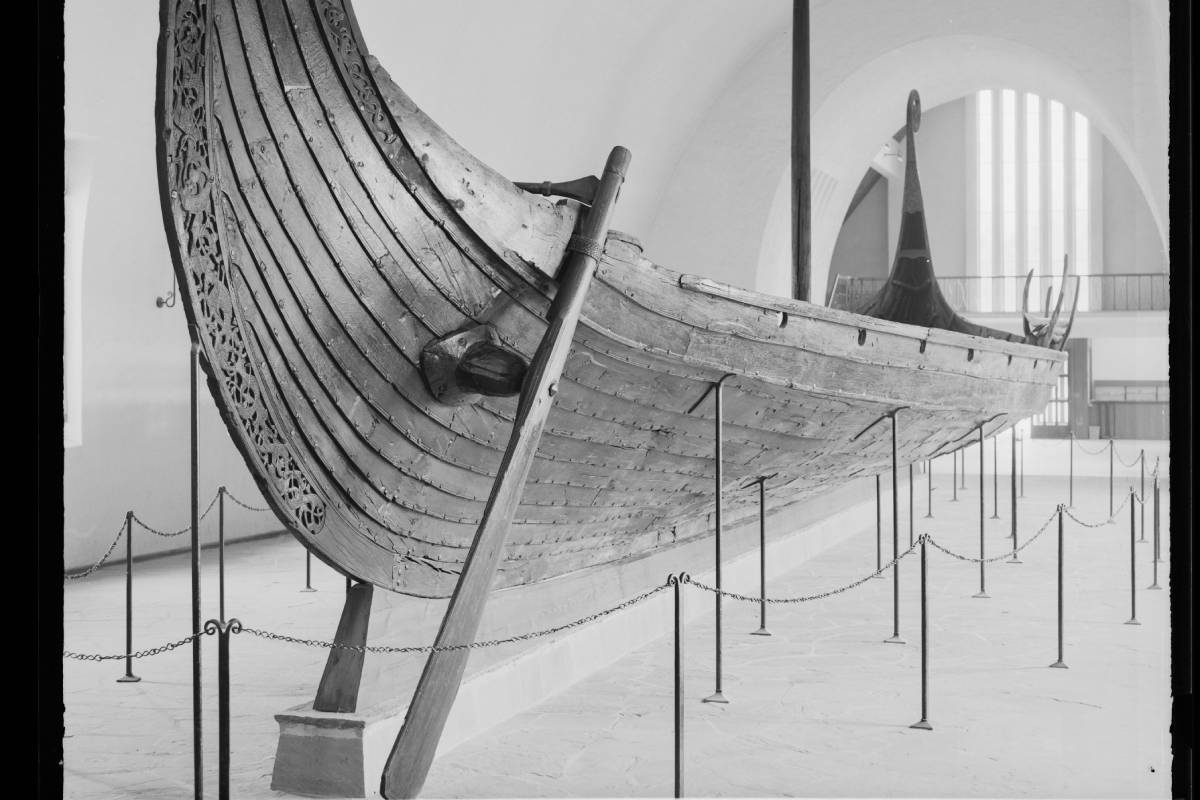
The Oseberg ship burial included oars positioned in the oar holes, symbolizing a vessel ready to sail into the afterlife. Source: Jac Brun (1921–1995)
The final gangway
He leaves Daneland on the breast of a bark.
Who when first he was born outward did send him
Lone on the main, the merest of infants:
And a gold-fashioned standard they stretched under heaven
High o'er his head, let the holm-currents bear him,
Seaward consigned him: sad was their spirit,
Their mood very mournful. Men are not able
No one knows whither the boat drifted.
Soothly to tell us, they in halls who reside,
Heroes under heaven, to what haven he hied.
"Now, if we are turning to the Norwegian ship burials, we don't have any historical evidence that makes the same connection," Jan admits.
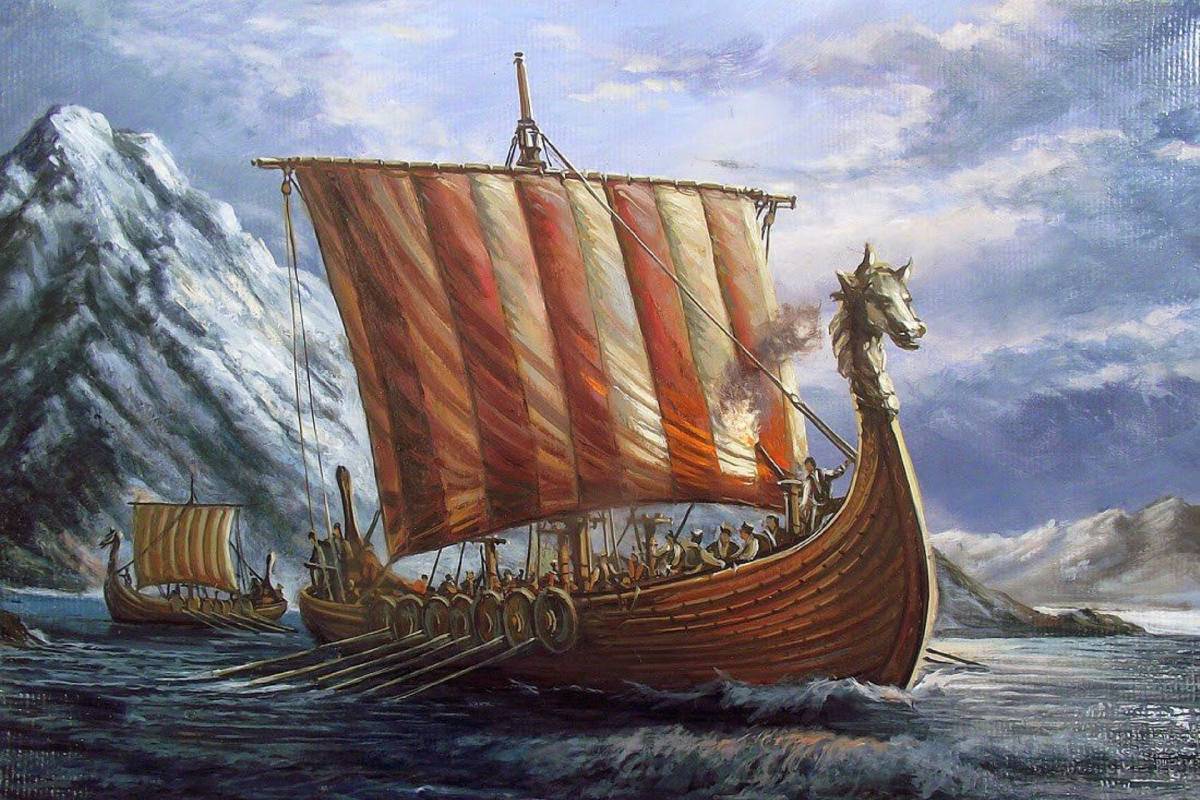
"But when we are looking at the best-preserved ship burials, like Oseberg and Gokstad, we do have the ship motif as a departing vessel – it's very clearly expressed."
"In Oseberg, we see that the ship is placed in the 'water line' in clay. It's also moored to a large stone, and some of the oars are placed in the oar holes so that the vessel is ready for departure."
"You make the burial, the mound, and everything. But the last thing you do before filling the ship with stones and clay is take the gangway – the plank used to get from land to the ship – and place it on top of everything else. This is a clear motif of sending someone away on the ship."
"And if we're looking at Gokstad, the whole mound was actually preceded by a hole with wet clay in which the ship was standing."
"So, it even more clearly illustrated that the ship was placed in the water for the burial ritual."
"You also had the gangway, except this time it was lying along the ship, not in it, and the remains of three boats that had been tossed onto the front of the ship. Once again, we find the means of connection between the water and the land."
- READ MORE: All you need to know about Viking ships
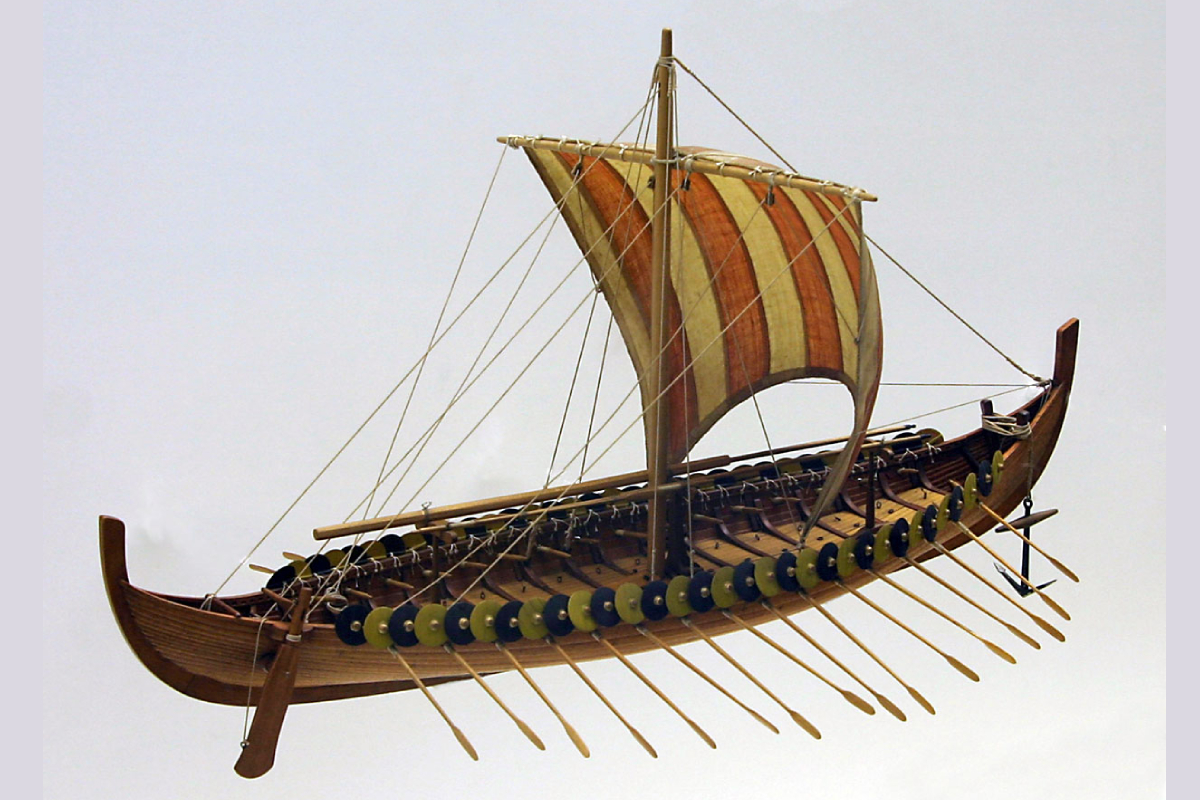
A model of the Gokstad ship shows how these vessels symbolized royal authority and power. Source: Softeis (CC BY-SA 2.5)
Norway's most wanted
It is not known which rulers commissioned the burials of Gokstad and Oseberg.
What we can say for certain, however, is that they would have been powerful leaders and that local people would have been keenly aware of the significance of the sites.
"My interpretation is that it was not only the Danish king but also some kings in Norway that wanted to use the narrative or myth of the ship to solidify their own rule," Jan asserts.
"They would have wanted to demonstrate how their clan or family would be a descendant, and therefore legal rulers, so to speak."
Naturally, as Harald Bluetooth struggled for supremacy in southern Norway in a bid to extend his kingdom, he would have been eager to demonstrate the full extent of his power.
"You have two different royal lines that are actually using the same simple lesson," Jan points out.
"If you then have one of these royal lines taking all the territory of the other, it becomes very important to destroy the memorials reminding people about the power and glory of the previous king."
"Instead, you turn them into something that signals the destruction and weakness of the former kings compared to the new one."
Of course, as with so much of Viking Age history, definitive answers are hard to find.
Nevertheless, The Viking Herald has one final question: If there were a detective on the case, would he point toward the Danish king?
"Let's just say that he would ask very serious questions of Harald Bluetooth's whereabouts at the time," Jan says with a laugh.
"Of course, we can't really be sure. There's still no real hard evidence that it was Harald Bluetooth. But if you're looking around for people who would have a motive for it, he definitely comes top of the list."
We get to provide readers with original coverage thanks to our loyal supporters. Do you enjoy our work? You can become a PATRON here or via our Patreon page. You'll get access to exclusive content and early access.
Feel free to reach out to discuss potential stories that may be in the public interest. You can reach us via email at hello@thevikingherald.com with the understanding that the information you provide might be used in our reporting and stories.