

At the entrance to the magnificent Venetian Arsenal, a complex of shipyards and armories that has been in operation since the 12th century, you will find a towering stone lion with an ancient and surprising heritage.
Though the casual or uninformed observer might easily presume the statue to be a fine example of Italian craftsmanship, perhaps of the Renaissance era, the lion was actually carved thousands of years ago in the historic port of Piraeus, near Athens.
Even more unexpectedly, across the shoulders and the flank, you will find the mark of the Vikings. Or, to be more precise, a set of unique runes thought to have been carved by the Varangian Guard, a group of Vikings that served as an elite unit of the Byzantine Army from the tenth to the 14th century.
Master craftsmen and fierce battles
The saga begins approximately 2,500 years ago in Ancient Greece. There, most likely in the city of Athens, local craftsmen set to work on creating a magnificent stone lion that stood approximately three meters in height.
We cannot be sure, but most experts believe it was produced to commemorate either the Athenian fleet's victory over the Persians at Corfu in 480 BCE or the battle of Marathon in 490 BCE.
The key port of Piraeus was likely established after the earlier battle, and the lion was placed at its entrance as an icon of Athenian power. It was so noteworthy that Piraeus soon became known as the Port of the Lion – the statue would remain in place for another 2,000 years.
In 1683, however, Venetian naval commander Francesco Morosini undertook a successful attack on the port as part of the Great Turkish War against the Ottoman Empire.
Together with three other leonine statues looted from other locations, the Piraeus Lion was spirited away to La Serenissima, where it found a new home outside the famous Venetian Arsenal as a symbol of St. Mark, Venice's patron saint.
A chance discovery
It was only another century later, in the year 1798, that a Swedish diplomat and linguist, Johan David Åkerblad, first drew attention to the runes.
Strolling through the city, perhaps pausing in the Italian sunshine to admire the entrance to the magnificent Arsenal just a short walk from St Mark's Square, Åkerblad saw something that appeared to be remarkably familiar.
On closer inspection, he was convinced: they may have been worn down by the ravages of time and damaged by cannon fire – likely fired by the Venetians at Piraeus – but these were runes, unmistakably, undoubtedly runes. Two years later, he published a paper on the subject in the Danish journal Skandinavisk Museum II.
- READ MORE: The Viking history of Italy: A primer
Åkerblad's discovery may have been notable, but it was not until 1852 that another Scandinavian, the Danish Carl Christian Rafn, attempted further interpretation.
The inscription has also been examined by the well-known Norwegian archaeologist Ingvald Undset, who was the first to say that the two inscriptions were likely not produced at the same time, and Erik Brate, who used a plaster cast of the runes to help complete his own interpretation.
Another expert, Sven B. F. Jansson, also examined the inscription in August 1948 but never published his readings and later claimed that the earlier interpretations were mainly fantasy, given that so many of the words were illegible.
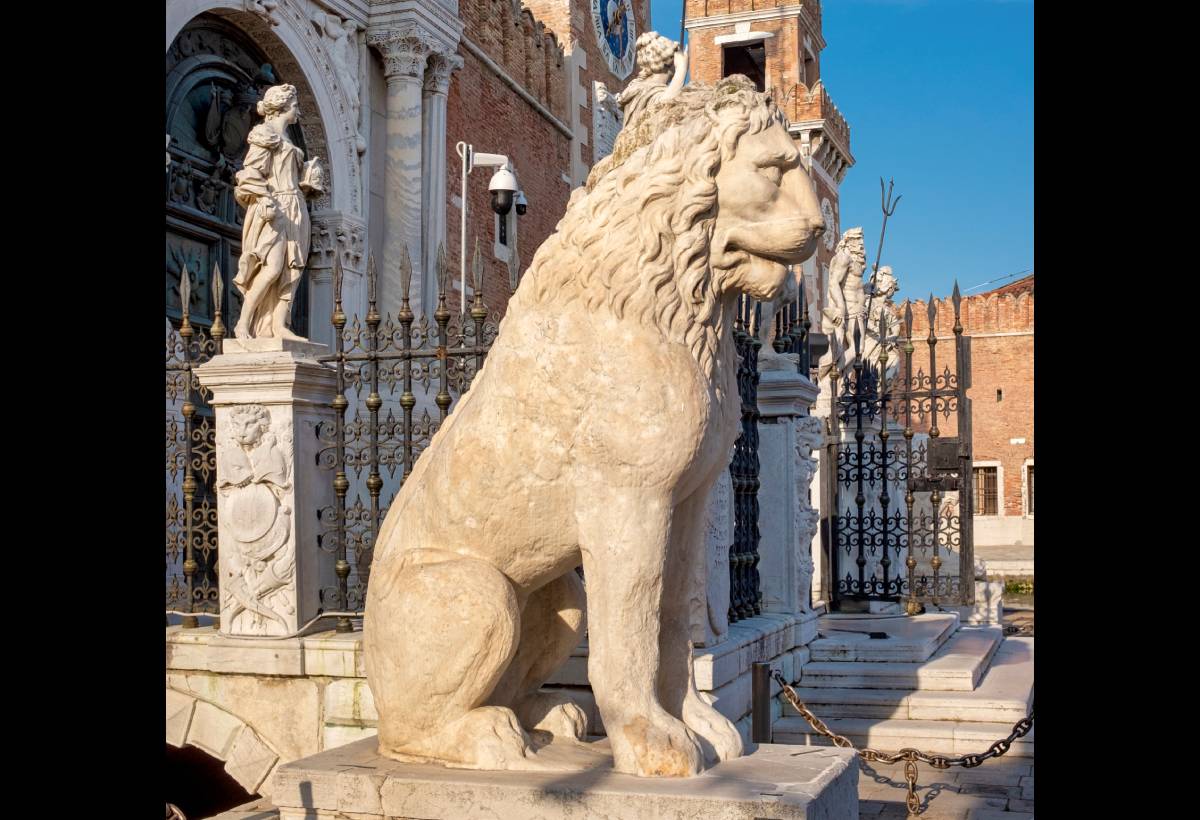
The Piraeus Lion is one of four lion statues on display at the Venetian Arsenal. Photo: Only Fabrizio / Shutterstock
Painstaking analysis
In 2008, however, conservator Anna Keller completed a restoration of the lion with funding from the Swiss Pro Venezia Foundation. The following year, the foundation asked the Swedish-Icelandic runologist Thorgunn Snaedal, currently a professor at Uppsala University, to travel to the city and provide her own study of the runes.
She would return a further three times to complete her analysis in order to overcome the challenges of reading it.
Indeed, Thorgunn believes that the lion's surface has deteriorated considerably in the last 300 years due to weathering, and many runes can now only be perceived in the right light, and even then with considerable difficulty.
Mythical writings
The letters of the runes are found within the shape of a lindworm, a mythical creature that traditionally takes the form of a giant serpent monster.
Thorgunn confirmed Undset's assertion the runes were carved at different times and believes that the first inscription on the left side of the lion is the oldest: "It is from the beginning of the 11th century and very similar to the inscriptions made in Sweden at that time."
"The second inscription can be dated to the end of the 11th century and is similar to the runic inscriptions in Sweden from that later period."
According to Thorgunn's interpretation, the inscription on the left side is as follows:
They cut (the runes), the men of the host ...but in these harbor those men cut runes after Horse, the farmer... Swedish men applied this on the lion... (He) fell/perished before he could receive a 'geld'
The heavily damaged inscription on the right side:
Asmund carved these runes, they, Eskil(?)…Torlev(?) and…
The third one is a brief piece of graffiti that reads, 'Young men/warriors cut the runes.'
An everlasting memorial
The fact that these Vikings went to the trouble of marking a prominent statue in a foreign city on two separate occasions is further indication of the noted Nordic reverence for those who die in battle.
"This example proves just how important it was for the survivors to commemorate their fallen friends in a runic inscription," explains Thorgunn, who has published several papers on the subject, including Reconsidering the Piraeus lion, published in Byzantium and the Viking World.
Today, there is a replica of the Piraeus Lion not only in the Piraeus Archaeological Museum but also at the Swedish Museum of National Antiquities in Stockholm.
"The inscriptions are as important as they are unique, and make a very valuable complement to the inscriptions on the runestones erected in Sweden during the 11th century," adds Thorgunn.
And so in this lion do we see the two faces of war: the glory and the triumph of victory, its plunder and spoils, and the sorrowful tales of its aftermath: triumphant trophies and touching tributes to fallen comrades.
We get to provide readers with original coverage thanks to our loyal supporters. Do you enjoy our work? You can become a PATRON here or via our Patreon page. You'll get access to exclusive content and early access.
Feel free to reach out to discuss potential stories that may be in the public interest. You can reach us via email at hello@thevikingherald.com with the understanding that the information you provide might be used in our reporting and stories.