

Nowadays, ultimate power on the island of Ireland lies within the democratic walls of the Dáil Éireann, in the south, and Stormont Castle, in the north.
Yet if we wind our way back to the early medieval period, when Vikings roamed, much of the island of Ireland was a patchwork of hyperlocal kingdoms and polities ruled over by kings and chieftains.
From the late 8th century CE onward, people from Viking societies began to make their presence felt at the periphery, undertaking predatory hit-and-run-style raids.
Following the pattern of Viking expansion elsewhere throughout Europe and beyond, what began as a mere nuisance soon became an existential threat for many local communities in Ireland.
Whilst fending off Viking raids was costly enough, in terms of blood and treasure (not to mention personnel), this situation worsened for the local, largely Gaelic population.
Like the situation across the Irish Sea in Britain, by the mid-9th century these raids turned into something more permanent: conquest and settlement.
Vikings established a trading hub at the mouth of the River Liffey, in medieval Irish Dubh Linn, in 841 CE, which soon grew into one of the most powerful towns in all of Viking Ireland. It was from here that great Viking kings would go forth to battle, conquer, and rule.
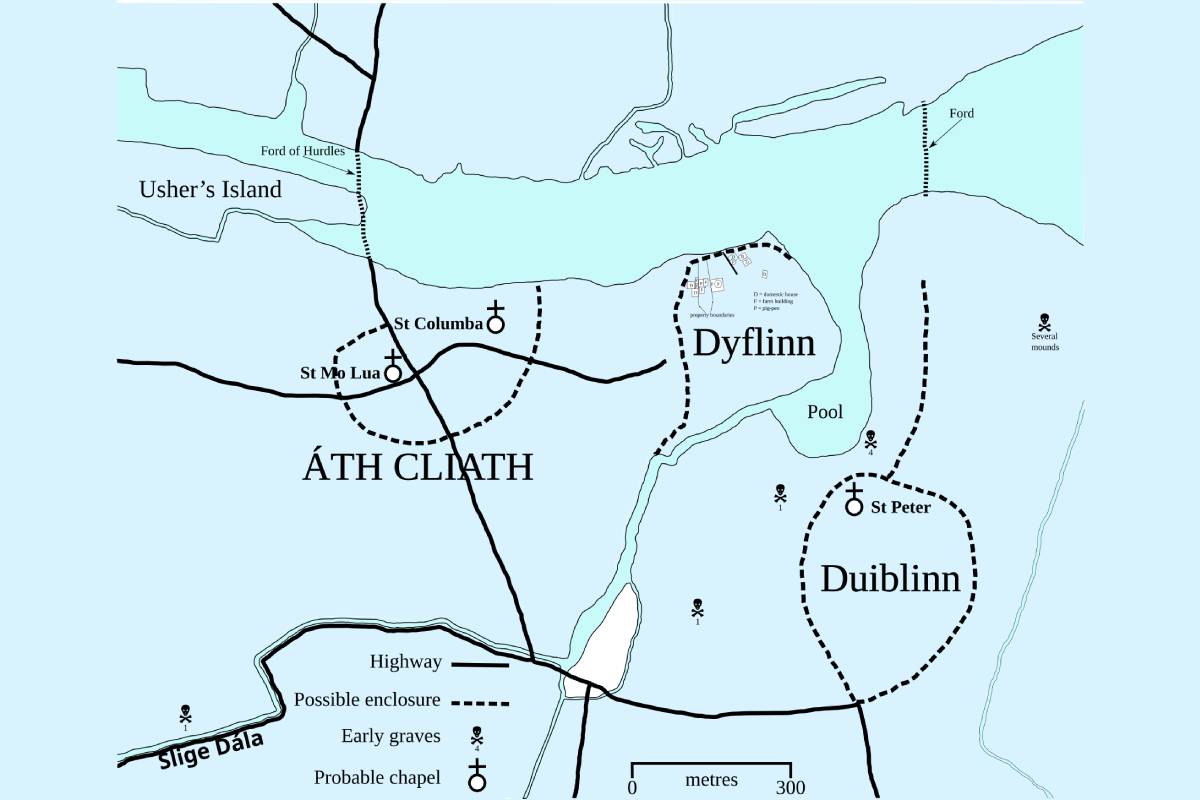
The layout of Dublin around 900, with the Norse stronghold at Dyflinn next to the older Gaelic site of Áth Cliath. Author: Erigena
Viking expansion and kingship
From this initial power base on the east coast of the island, Viking warriors soon began to carve out a kingdom from the mid-9th century right up until the Norman invasion of the island in the 12th century.
As Donnchadh Ó Corráin notes in his chapter in the 1998 volume Ireland and Scandinavia in the Early Viking Age, this new phase of Viking expansion saw "larger groups of raiders and deeper inland penetration that led to the establishment of Dublin and other coastal settlements in the mid-ninth century."
Turning to the Annals of Ulster, one of the best historical documents we have of the history of early medieval Ireland (we use an online version of the 1983 English translation by Seán Mac Airt and Gearóid Mac Niocaill), we find that in 851 a Viking battle between rival hordes took place, recorded as:
"The dark heathens came to Áth Cliath, made a great slaughter of the fair-haired foreigners, and plundered the naval encampment, both people and property. The dark heathens made a raid at Linn Duachaill, and a great number of them were slaughtered." [U851.3]
These dark- and fair-haired heathens (or Dubgaill and Finngaill in Gaelic, respectively) were the local names for people from Viking societies.
This battle among rival factions ultimately resulted in a Viking warrior named Amlaíb Conung emerging victorious by eliminating all rivals and securing a kingship from his base in Dublin.
It was his brother, Imar, who is traditionally said to have founded a dynasty, the Uí Ímair (or in English, the scions of Ivar), that saw Scandinavians ascend to ultimate royal power.
Yet despite this ascension, the Viking kings of Dublin were just one of many rulers on the island of Ireland during this time, albeit ones who held great economic and military power.
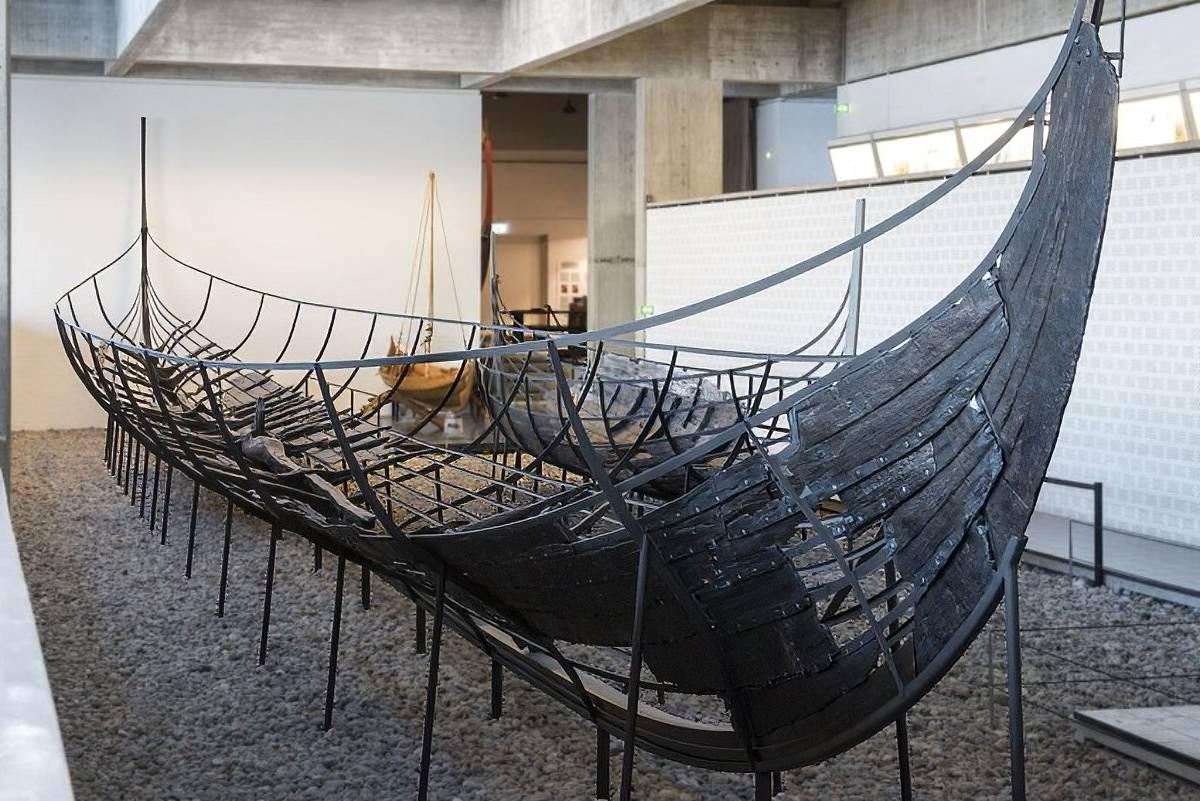
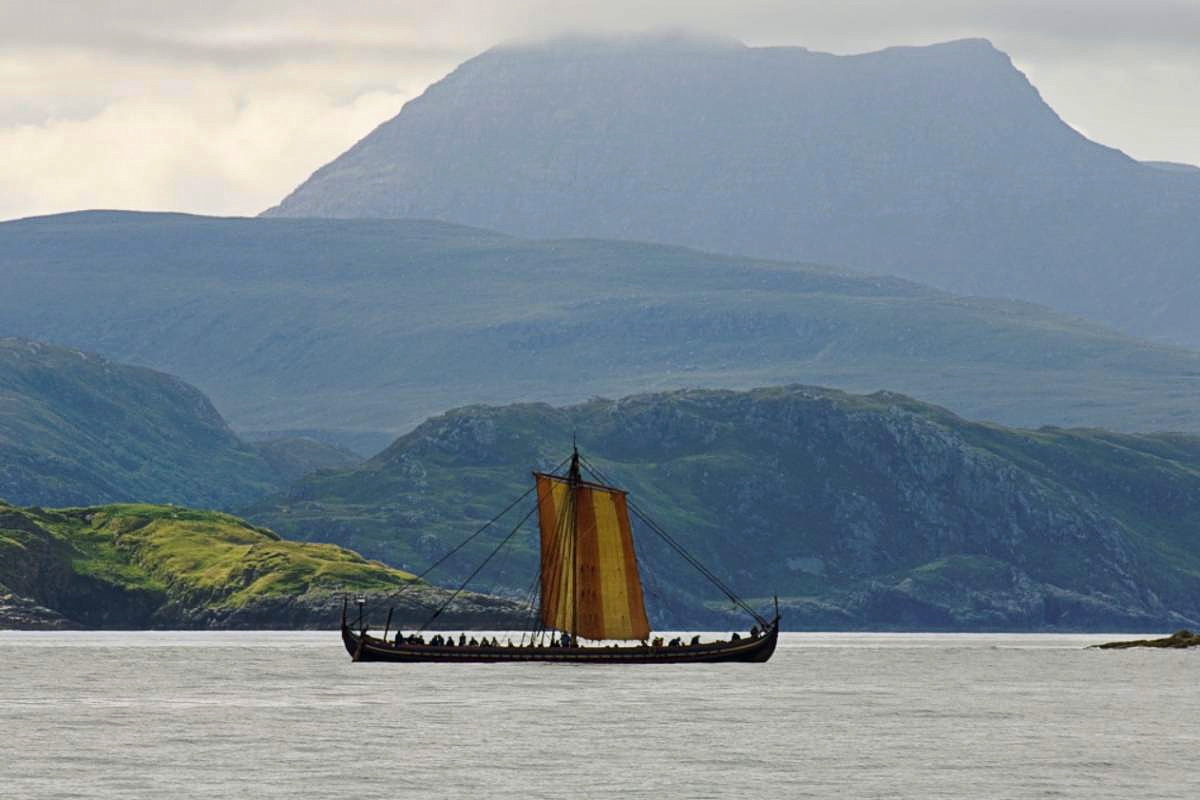
Built in the Dublin region around 1042, Skuldelev II was a large Viking warship later discovered in Denmark and conserved at Roskilde. Photo: Casiopeia (CC BY-SA 2.0)
Culture and collapse
Having secured a small kingdom centered around Dublin, the Viking kings then set about trying to expand their power and influence throughout the surrounding region.
The Uí Ímair would go on to dominate the nearby kingdoms of Leinster, Limerick, and Waterford, stretch across the Irish Sea to the kingdoms of Scotland and Strathclyde, and control the Kingdom of the Isles encompassing the Isle of Man and the Hebrides.
For a brief period in the 10th century they also laid claim to the Viking kingdom of Jórvík in faraway northeastern England.
To think of this, though, as a little slice of Scandinavia supplanted on an Irish isle would be wrong. Like the Viking expansion throughout continental Europe, this Viking kingdom saw a small minority of people from Viking societies live alongside the local Gaelic population.
Soon, intermarriage and mixing occurred, producing a Norse-Gael culture (often called Hiberno-Norse) that would last long after the last Viking ship ever sailed.
By the 11th century rulers like Sigtrygg Silkbeard had developed Dublin into a major economic and cultural hub of the Irish Sea, an important center of trade, commerce, and military power.
However, it was in this century that threats, both internal and external, would ultimately end the rule of the Viking kings. Stronger Irish kings, like Brian Boru, began to defeat Viking armies on the battlefield and chip away at their hold on Dublin.
Later in the century, the Norman invasions would sound the death knell of the Viking rulers of the island of Ireland. By 1171 Viking rule had collapsed, and the history of Ireland would be thereafter inextricably linked not with Scandinavia but with Britain.
For more on which Viking king is considered Dublin's finest, visit RTÉ here.
We get to provide readers with original coverage thanks to our loyal supporters. Do you enjoy our work? You can become a PATRON here or via our Patreon page. You'll get access to exclusive content and early access.
Feel free to reach out to discuss potential stories that may be in the public interest. You can reach us via email at hello@thevikingherald.com with the understanding that the information you provide might be used in our reporting and stories.