


Raised by Gorm the Old and his son, Harald Bluetooth, the Jelling runestones are a Danish icon.
The second stone, which features a runic inscription that describes how Bluetooth united Denmark and converted the Danes to Christianity, is known as the country's "birth certificate" and even features on the Danish passport.
As reported by The Viking Herald, however, a recent academic paper has called into question the assumed origins of the Bluetooth stone.
Now, we ask its author, the respected Norwegian archeologist Håkon Glørstad, about his reasons for questioning the narrative around the Jelling stones, his openness to further debate on the topic, and the importance of keeping an open mind.
A cornerstone of Scandinavian archeology
In On the dating of the Great Jelling Stone, published in Norwegian, Glørstad – a former director of the Museum of Cultural History – argues that the second Jelling runestone may have been raised around 200 years after the assumed date.
While this notion may prove controversial among some experts, Håkon insists he only has the utmost respect for the Jelling site, which has been recognized by UNESCO for its significance to the history of the Danish state.
"The Jelling site is important for Scandinavian archeology," Håkon tells The Viking Herald.
"It is a cornerstone, so to speak, where research history, modern national history, and the past are cast together. To work with Jelling is also to work with the origin of modern archeology. That is very inspiring."
Nevertheless, Håkon was intrigued by many of the inconsistencies around the stone.
"Many researchers have pointed out that the stone is not typical for the Viking Age and points forward in time," he explains. "I have tried to put all these arguments together."
"Based on this review, I asked myself if the reason for this untypical appearance was simply that the stone was not from the Viking period but from medieval times."

Håkon Glørstad's analysis highlights writing, styles, and symbolism that challenge the Jelling stone's Viking Age dating. Source: Kenneth Bagge Jorgensen
The claims
The second Jelling stone was found at the site of two enormous burial mounds in the town of Jelling in eastern Denmark and has been dated to the second half of the 10th century.
However, as reported by The Viking Herald, Håkon believes it is more likely that the stone was raised in the 12th century. In the paper, available online (in Norwegian), Håkon outlines the main reasons for his theory:
Horizontal writing: Håkon points out that runestones from the Viking Age were typically carved vertically, from top to bottom. With the Jelling stone of Harald Bluetooth, however, the runes are carved in a manner that more closely resembles a Latin text, reading horizontally from left to right.
The content: The fact that the stone refers to the achievements of "King Harald" has been taken by many as confirmation that it was indeed raised by Harald Bluetooth. Håkon, however, actually suggests the opposite: stone monuments boasting of one's own achievements were much more common in the 12th century than in the Viking Age.
Mix of styles: Håkon notes that all three sides of the stone are decorated – highly unusual for the Viking period. The stone also features a blend of different styles from different parts of the Viking Age that suggests a kind of collage – a reflection on the Viking Age rather than a uniform work made by a craftsman of the Viking era.
Sophisticated symbolism: Håkon states that the sophisticated nature of both the symbolic figures on the stone and the runic inscription – more archaic in form than most inscriptions from the era when it is said to have been raised – suggests a scholarly approach to the design, something that would be out of keeping with 10th-century craftsmanship.
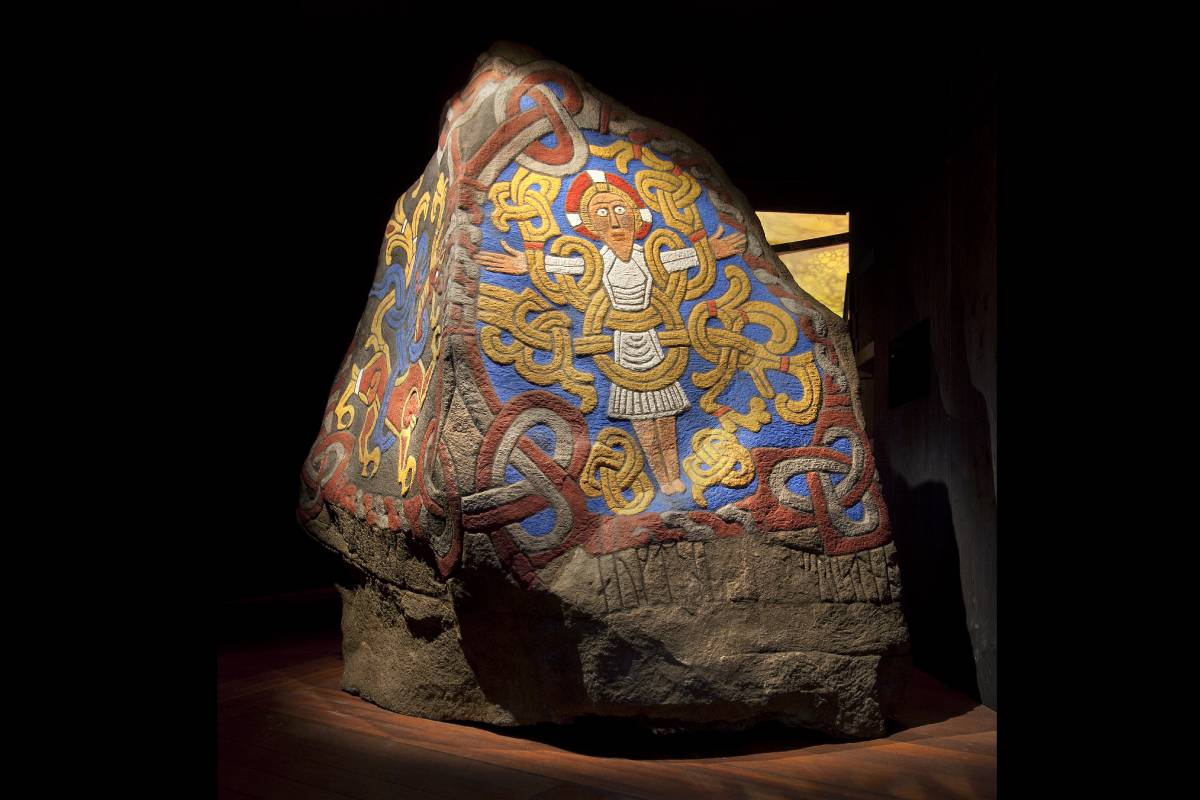
A colored version of Side C of Harald's stone, displayed in the VIKING exhibition at the National Museum of Denmark. Source: The National Museum of Denmark
A more likely candidate?
There is currently no way of conclusively dating the stones. Like many archeological finds, much of the analysis of the Jelling stones comes down to contextual interpretation and careful comparison with other artifacts.
Yet Håkon believes that if we look at the available evidence with an open mind, it becomes clear that Harald Bluetooth does not fit the profile of the person who commissioned and raised such a complex piece of art.
"Harald Bluetooth was certainly a powerful and innovative king," Håkon acknowledges. "However, the archeological record presents him as a good organizer and warlord, not a scholar."
"He was Christianized as an adult, and it looks like he also continued some pagan traditions, such as making mounds."
As The Viking Herald has noted, Håkon believes it is more likely that the stone was planned and raised by Bishop Absalon, a powerful 12th-century figure with the knowledge and education to create such a monument.
"Several scholars have emphasized that the Jelling stone expresses a scholarly attitude towards theology," Håkon tells The Viking Herald. "Such an environment was thriving in the days of Absalon."
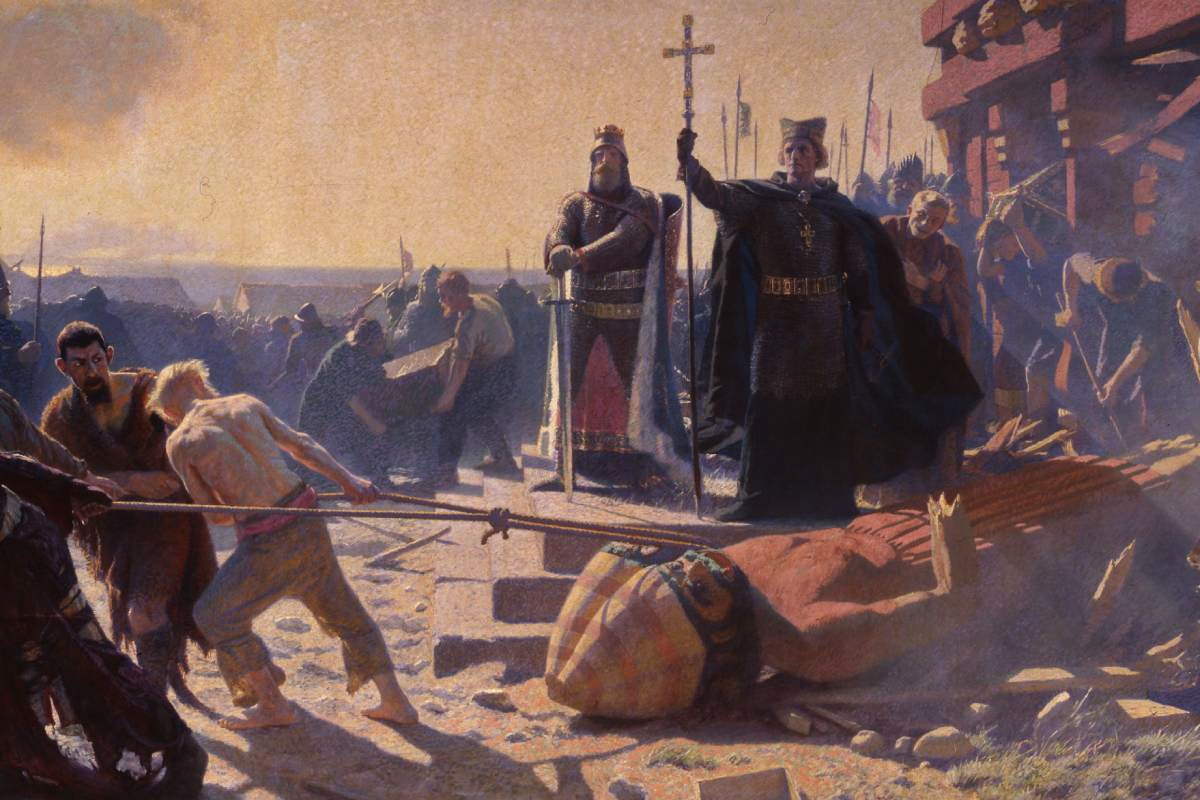
A detail from a painting showing King Valdemar and Bishop Absalon leading the destruction of Svantevit's statue in 1169. Source: Laurits Tuxen (1853–1927)
A symbol of nationhood
Absalon served for much of his adult life under King Valdemar I, who went a long way toward establishing Denmark as a united nation, and his son, King Knut, who would consolidate that power.
Håkon believes Bishop Absalon may have decided to raise the runestone in a bid to help establish the country's legitimacy.
To create a monument that reflected the traditions of the Viking Age, Absalon would have drawn on both his own knowledge and that of the artisans who worked on the stone.
"History was important for legitimizing political claims, and strategies and styles from the past were frequently used in art and architecture," Håkon explains.
"The court and scholars of the kings in the Valdemar period in the Danish Middle Ages were very interested in the past. They studied runes and kept antiquities."
"Bishop Absalon was both a skilled scholar and a mighty politician of his time who used the past actively in his political work," Håkon continues.
"He made runestones himself and did research for finding or recreating old laws that could benefit his and King Valdemar's reign."
A 12th-century tribute to a Viking leader
Håkon does not believe, however, that the stone was raised as a deception.
Instead, he believes it was a solemn tribute to the legendary Danish king, whose fame was already widespread in the Middle Ages.
"I would certainly not call it a forgery," he explains. "On the contrary, all the atypical features of the stone indicate it was not made to fit perfectly into the time of King Harald Bluetooth."
"Instead, I think it is reasonable to claim that it was deliberately made in a style pointing back to the past."
In other words, it was a kind of neo-Viking monument that would not only celebrate Denmark's past but also glorify and reaffirm its still relatively new status as a Christian nation-state.
"This would be a fashionable way to make a memorial stone of an ancient king by the end of the 12th century," Håkon adds.
"The art and architecture of the late 11th and early 12th century could have inspired the style of the stone. This period was still well remembered at the end of the 12th century."

For Håkon Glørstad, debate is key to advancing knowledge and challenging established interpretations. Source: Kirsten Helgeland / Kulturhistorisk museum, UiO
Worthy of debate
Håkon has already received some pushback about his theory.
For example, Laila Kitzler Åhfeldt of the Swedish National Heritage Board has pointed out that the Jelling runestone bears no similarity to another runestone from Scania that is known to have been commissioned by Bishop Absalon.
"That the runestone Absalon commissioned and put his name on does not look like the Jelling stone is not so strange," Håkon responds. "Bishop Absalon raised the Scania stone to commemorate his deed as a church builder and not to honor an ancient king."
Håkon stresses, however, that he welcomes criticisms of his findings. "All archeological results are based on interpretation. This is also true for previous datings of the Jelling stone as it is for mine," he points out.
"From my point of view, the sum of dateable features connected to the stone points toward the 12th century. Other researchers are of a different opinion."
"The good thing with research is that arguments put forth can be met with counterarguments. I look forward to seeing good arguments that go against my interpretation!"
"I have also experienced that many researchers have been very engaged in these questions about Jelling," Håkon notes. "Some colleagues have expressed fascination about my work and think many arguments are quite convincing."
"Of course, there are also some Danish archeologists who have expressed skepticism and have stated that I am wrong."

Håkon Glørstad argues that even if the Jelling stone dates to the 12th century, it remains profoundly relevant to contemporary society. Source: Frank Bach
Maintaining an open mind
Indeed, Håkon does suggest that we may have made too many assumptions about the finds at Jelling.
"There are four-and-a-half centuries of research in Denmark based on a Viking Age dating of the stone. I think many Danish researchers believe the mystery was solved 450 years ago when the stone was discovered."
"I believe having a critical and open attitude towards the past and history is always important. This way, new results can be achieved, and we better understand the limits and context of our current knowledge."
"A healthy scientific discipline must continuously question and challenge established knowledge and results. This is how new knowledge and new insights are created. Jelling must, of course, be included in such a practice."
Håkon is also keen to point out that even if the stone was confirmed to be from the 12th century, we could still find profound meaning in it.
"A 12th-century dating would certainly show the stone's relevance in contemporary society," Håkon points out.
"Today, we see how history is increasingly used in political strategies and international conflicts. Here, the past and historical uses of the past can teach us how history may be used and misused in conflicts and fights in our society and give us the tools and knowledge needed to deal with this in the present day."
We get to provide readers with original coverage thanks to our loyal supporters. Do you enjoy our work? You can become a PATRON here or via our Patreon page. You'll get access to exclusive content and early access.
Feel free to reach out to discuss potential stories that may be in the public interest. You can reach us via email at hello@thevikingherald.com with the understanding that the information you provide might be used in our reporting and stories.




.jpg)
.jpg)
