

The exact location of an early medieval battle that helped Alfred the Great save England from a total Viking conquest has bamboozled historians for hundreds of years. Yet a new book proposes the battle took place in the middle of the countryside, tucked away in southwest England.
For centuries, historians have been trying to find the exact location of this legendary medieval battle said to have taken place somewhere in what is now Devon, southwest England.
This was no ordinary battle – it involved two legends of history. One was a man seen as one of the early shapers of the English nation and identity, the King of Wessex, Alfred the Great. Pitted against Alfred and his Anglo-Saxon force was a figure more myth than reality, Ubbe Ragnarsson – together with his horde of Viking warriors.
Ragnarsson was not only a famed warrior in his own right but also said to be the son of a warrior even more famous than he, Ragnar Lothbrok. However, unlike the previous battles between the Anglo-Saxons and their would-be Viking overlords, in this particular clash the Anglo-Saxons were the ones to prevail.
Castle Hill
According to historian Paul Harper, the Battle of Cynwit took place in a bucolic corner of Devon, in southwest England. Talking to the Daily Mail online, Mr. Harper has proposed that this famous clash almost certainly occurred at Castle Hill, near the village of Beaford.
Additionally, Harper argues that a burial mound located there may be the final resting place of Ubbe Ragnarsson, the son of legendary Viking (and in recent times star of a hit streaming series) Ragnar Lothbrok.
For Harper, who has written a book discussing his proposed site for this ancient clash, it was interesting to think that, “this infamous Viking Ubbe probably met his demise in this quiet corner of Devon.”
As generation after generation of historians had been looking for this site but he felt that, “Castle Hill has the most compelling claims and could finally solve this age-old mystery.”
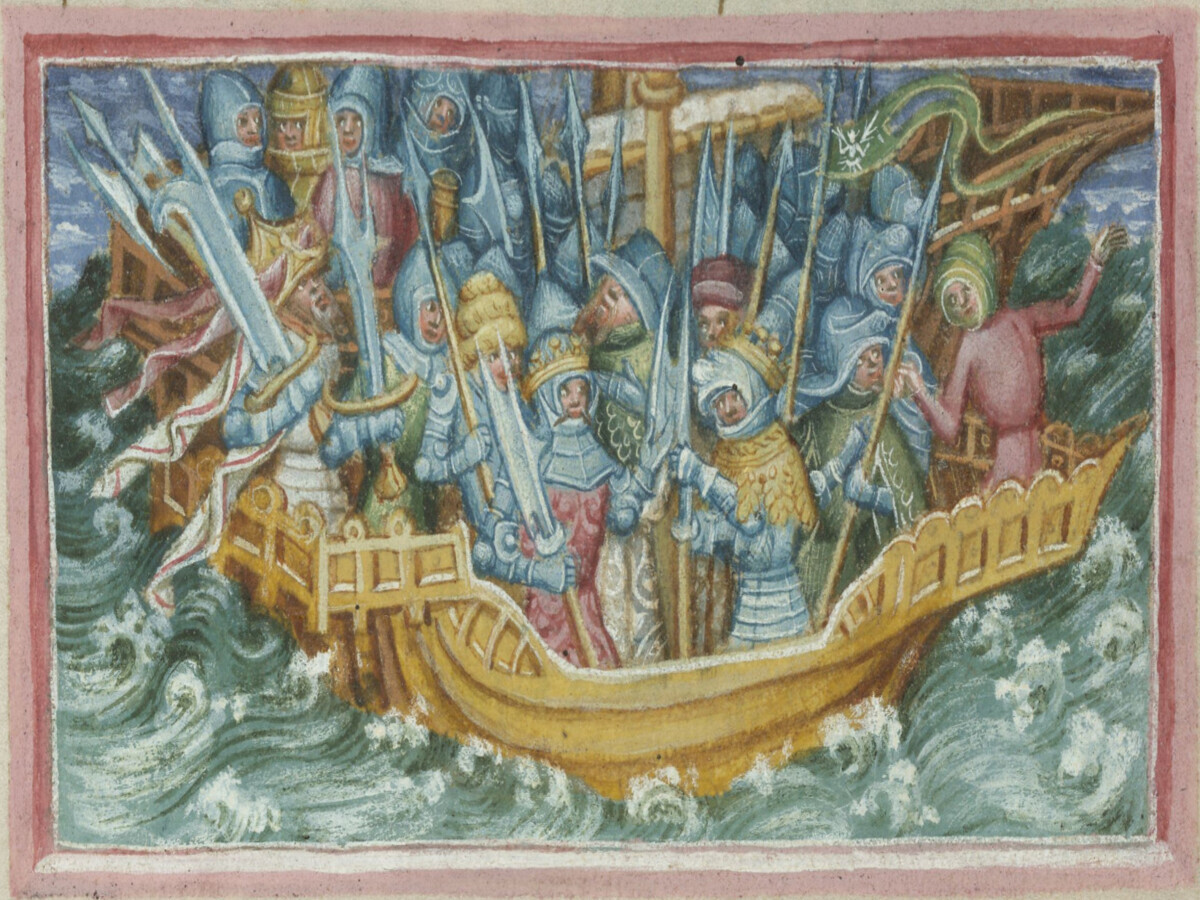
Ubbe Ragnarson depicted travelling towards England. Source: Wikimedia
A strategic location and a burial mound
Much of the research in the book has been compiled by Nick Arnold, who has put forward Castle Hill as the most likely location for this early medieval brawl. The Battle of Cynwit saw an Anglo-Saxon army outnumbered fight back and defeated a Viking force said to be led by Ubbe Ragnarsson.
It should be noted that medieval accounts can be notoriously problematic. The records indicate, however, that as many as 1,200 Vikings lay dead that day in 878. This battle was later seen by medieval sources as a turning point in the Viking invasion of Anglo-Saxon England that helped secured the Kingdom of Wessex and allowed Alfred the Great to go on the counterattack in the years ahead.
Not only did the Vikings lose this battle but also their leader, Ubbe. Like all good Vikings, he was cremated, and his ashes said to have been scattered in a burial mound. Castle Hill matches later medieval descriptions of the battleground including ancient fortifications and strategically poised as medieval armies moved through this region.
The site’s strategic location is one thing but Mr. Arnold also pointed to the presence of a burial mound near the site more than 8 feet / 2.5 meters high. It was these two factors that made Castle Hill the likely location of this famed battle.
The Norse sagas and hordes of tourists?
The Norse sagas have much to say about the supposed leader of the Viking force at Cynwit. Ubbe, as his surname suggests, was said to one of the five sons of Ragnar, the legendary Viking warrior, scourge of Paris and possible progenitor of the Swedish monarchy.
Following his father’s demise in a snake pit, Ubbe and his brothers set sail with a huge force to seek revenge – the traditional origin of the Viking invasions of Anglo-Saxon England by the Great Heathen Army.
Historians tend to view the Norse sagas with a healthy deal of skepticism, given that they contain more historical flavor than fact. However, if Castle Hill is indeed the location of this early medieval battle, and the final resting place of Ubbe, then expect more tourists to flood to this idyll part of Devon in the years ahead.
More information can be found about Castle Hill and Ubbe Ragnarsson in Paul Harper’s new book, The Sons of Ragnar: Viking Warriors who Terrorized Britain and Ireland, available to purchase on Amazon.
We get to provide readers with original coverage thanks to our loyal supporters. Do you enjoy our work? You can become a PATRON here or via our Patreon page. You'll get access to exclusive content and early access.
Feel free to reach out to discuss potential stories that may be in the public interest. You can reach us via email at hello@thevikingherald.com with the understanding that the information you provide might be used in our reporting and stories.