

Given the recent popularity of series like Vikings and Vikings: Valhalla, you'd be forgiven for thinking that early medieval Scandinavia and its surrounds were nothing but places full of violence, sex, and death.
Viking warriors, who were only ever a small segment of the societies that produced them, expanded outward from the mid-8th century onwards.
Their reputation as fierce opponents and harbingers of death and destruction preceded them. Yet, this is only a small glimpse into these societies.
Despite possessing a martial overtone and a strong warrior ethos, Viking societies were also responsible for creating some of the most brilliant and striking pieces of artwork and design in the early medieval period.
Modern historians have organized the artistic expression of Viking societies into six styles that often overlap in terms of chronology and aesthetics.
As Albert G. Smith wrote in his 1999 book Viking Designs (available to purchase on Amazon here), these six styles run the gamut of the Viking Age, with the first style emerging around the 8th century and the last Viking artistic style straddling the beginning of the 12th century.
Every good story has a beginning, and for Viking art, that is the Oseberg style.
This style, which formed around the turn of the 8th century, is significant in Scandinavian history as it marks the first time an independent and unique artistic style was developed by the Norse.

The Oseberg style, which gets its name from the ship discovered in 1904, is depicted in Saga Oseberg, a faithful and detailed replica. Photo: Wolfmann (CC BY-SA 4.0)
What exactly is the Oseberg style?
What art historians have dubbed the "Oseberg style" derives its name from one of the most important archeological finds of the 20th century.
A team of archeologists uncovered the Oseberg ship in a burial mound in 1904. Unlike other Viking ship discoveries, the Oseberg ship was intact, well-preserved, and housed a range of grave goods.
The ship's intricate wooden carvings feature elaborate patterns and animal motifs, providing modern historians with a name for the style and its defining features.
Symmetry and repetition are also hallmarks of this early style of Viking art.
Despite the violent and often insecure environment in Viking societies, the use of symmetry and repetition allowed a degree of balance and harmony to be achieved, at least in an artistic sense.
Patterns are often repeated and mirrored, as in the intricate carvings on the prow of the Oseberg ship.

"Gripping beast" and animal motifs are important features of the Oseberg style, present in various types of woodwork. Photo: National Library of Norway (Public domain)
Gripping beasts and animal motifs
The most striking feature of the Oseberg style relates to the animal kingdom.
If you scour the rich tapestry of Norse sagas or view any of the grave goods buried alongside the rich and powerful, you will see the prominent role that animals played in the psyche of people in Viking societies.
As Deborah Mazza wrote in her 2015 article in the Journal of Ethnology and Folkloristics, the companionship and labor of animals made them highly revered figures in Norse legend and lore.
This practical yet deeply spiritual relationship made its way into the artistic style and form.
This relationship is best summed up in what modern art historians have labeled the "gripping beast" motif.
Several "gripping beasts" were carved on the prow and stern of the ship, as well as on sleds that were uncovered among the grave goods.
These feature their bodies and limbs interwoven with the structure of each object, showcasing the artisan's skills and creating a visually memorable design.
Significant skill, time, and labor must have been used to carve these "gripping beasts," highlighting the importance of artistic design and flair for people in Viking societies.
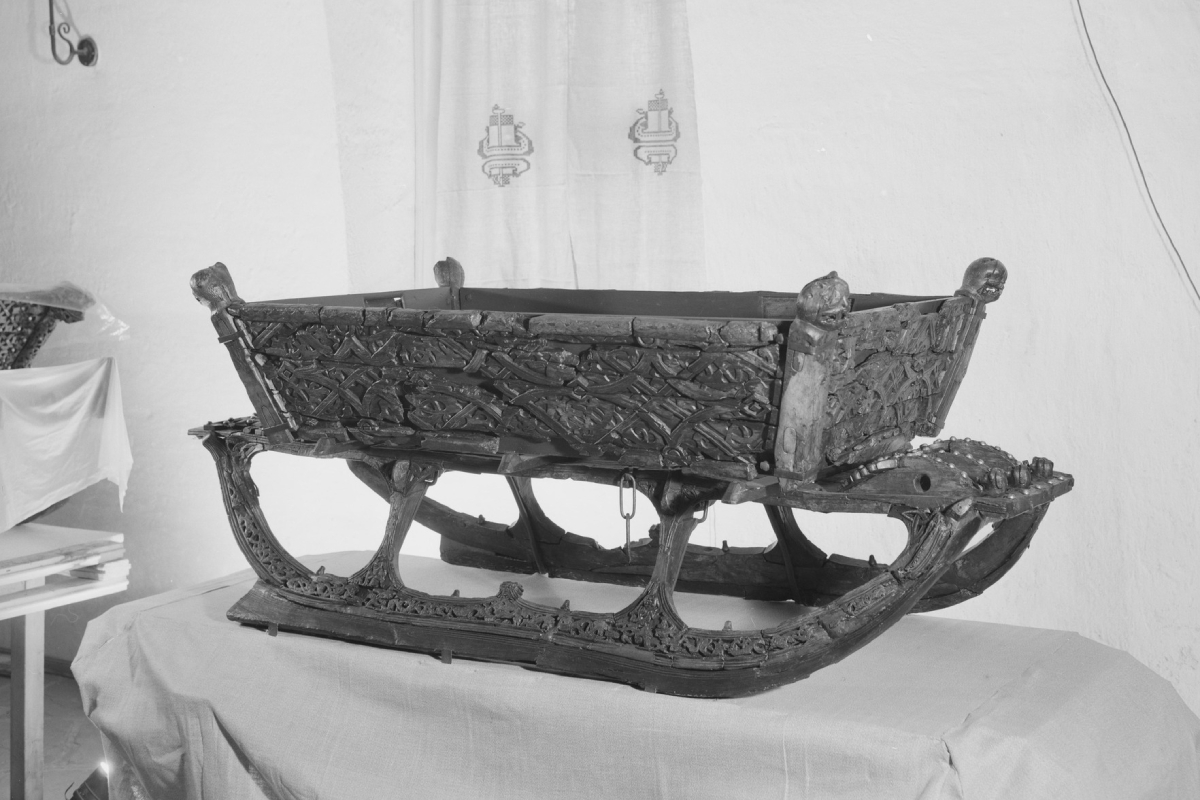
The Oseberg burial included four sleighs, each adorned with intricate carvings of animals and mythological figures, showcasing the Oseberg style. Photo: Jac Brun / National Library of Norway (Public domain)
Inspiration and influence
Art never occurs in a vacuum. The development of the Oseberg style drew on earlier artistic styles and designs that developed in proto-Viking societies throughout the first half of the first millennium CE.
Additionally, foreign influences, especially from Gothic and Germanic societies bordering Scandinavia and the Roman world further south, played a significant role.
As late antiquity morphed into the early medieval period – a distinction that only later historians would make – and people from Viking societies expanded outward into Europe and its surrounds, they soon became influenced by other forms of art.
As they crossed the Norwegian Sea to the British Isles, they encountered Celtic art, which would heavily influence later styles of Viking art.
Conversely, Viking artistic styles, from Oseberg onwards, would also influence the artistic styles and designs of the regions that Norse explorers and settlers interacted with, both violently and peacefully.
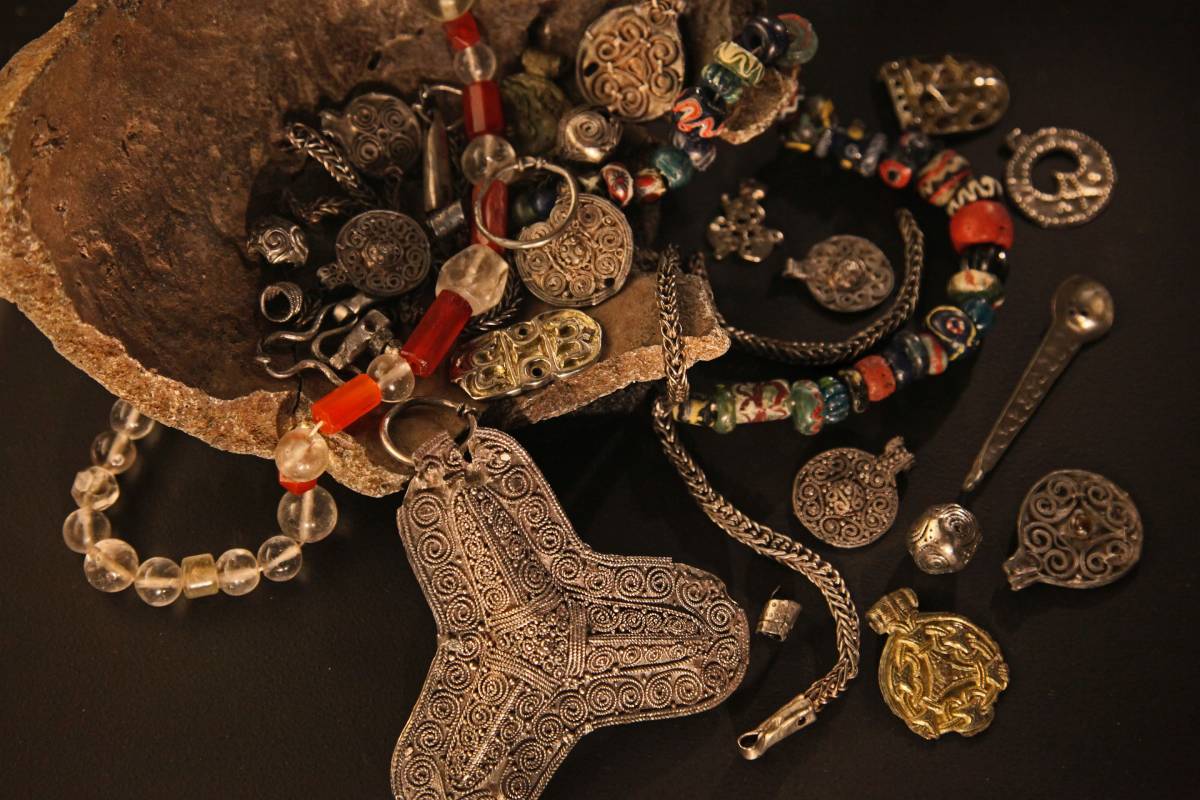
Jewelry uncovered in the Viking settlements of York and Dublin was crafted in the Oseberg style, whilst several Viking-era monuments in England have been found bearing some features of this style.
As Norse people expanded eastward across the Baltic Sea and into Eastern Europe, they brought this unique artistic style with them.
They were instrumental in the development of the Kievan Rus, a huge multiethnic, multireligious and polyglot empire to which Belarus, Russia, and Ukraine all trace their ancestry.
Viking artifacts uncovered in these three modern nations, particularly weapons and jewelry, have been found bearing the Oseberg style.
Important development
The Oseberg style of art eventually morphed into the next phase, the Borre, sometime in the late 9th to early 10th century.
Compared to earlier artistic styles and phases in Scandinavia, this new style represented a noticeable increase in both the skill and craftsmanship of Viking-era artisans.
Whilst the Oseberg ship may be the most well-known example of this early style of Viking art, the style influenced works beyond wood, including metalwork, jewelry, and textiles.
It also reflected the foreign influences that the Norse were becoming accustomed to, thanks to their outward expansion from Scandinavia from the mid-8th century onwards.
Nowadays, the Oseberg ship, and thus this artistic style, has become a visual symbol for the entire Viking Age, a testament to the skilled artisans that helped forge this initial phase of Viking art.
For more visual examples of Viking art, head to the website of The Metropolitan Museum of Art here.
We get to provide readers with original coverage thanks to our loyal supporters. Do you enjoy our work? You can become a PATRON here or via our Patreon page. You'll get access to exclusive content and early access.
Feel free to reach out to discuss potential stories that may be in the public interest. You can reach us via email at hello@thevikingherald.com with the understanding that the information you provide might be used in our reporting and stories.