

One September morning in 2006, Reidar Marstein, an early explorer of Nordic landscapes around retreating icefields, found a shoe.
While historical artifacts had long been spotted around Innlandet County in Central Norway, this was a shoe with a difference – as would be later proved by painstaking analysis.
After its discovery, Reidar soon hooked up with similar-minded, professional researchers whose work aligned with climate change and its effects on the surroundings, revealing more of what had lain unseen for thousands of years.
Lars Holger Pilø, of the group formed at this time, Secrets of the Ice, speaks to The Viking Herald about Reidar's spectacular discovery, while the modest local hobby archaeologist describes how he came across the artifact in question.
Memorable September
Familiar with this terrain all his life, Reidar Marstein had been an assistant to a local historian 20 years before his amateur wanderings.
He had long noticed that the ice patches in the northeastern part of the Jotunheimen Mountains were getting smaller, prompting him to explore the area in more depth.
He takes up the story: "2006 was a special year for ice patches and glaciers in our high mountains. The summer was warm, and autumn continued with high temperatures into October. We had never witnessed a melt like that.
"I hiked up to the ice patches every week that autumn. It was my visit on September 17 that became the greatest adventure. I started early in the morning and reached the Langfonne ice patch around 9 AM. It was unbelievable how much the ice patch had melted just during the last week. With great excitement, I started my survey around the ice. It had to have been a long time since the last human set foot here.
"After a while, a hunting blind appeared. About 25 meters above the hunting blind, I noticed something lying on the ground. I got my camera and GPS ready, as I had to note the location of the find and take a picture of it.
"After lifting the object with great care and gently removing some glacial silt, I realized that I was holding a shoe in my hand. Not a regular shoe, but a shoe that had to be incredibly old. I felt confident that it was a reindeer hunter with a bow-and-arrow who had once used it. It was a strange feeling standing at the edge of the ice holding the ancient shoe.
"It was clear to me that I was holding a treasure from the past in my hand. The shoe had to be treated with great care. I wrapped it in plastic and paper and put it into a plastic box.
"Back home, I put the shoe in the freezer. The next day, I called county archaeologist Espen Finstad, who visited me and collected the find."
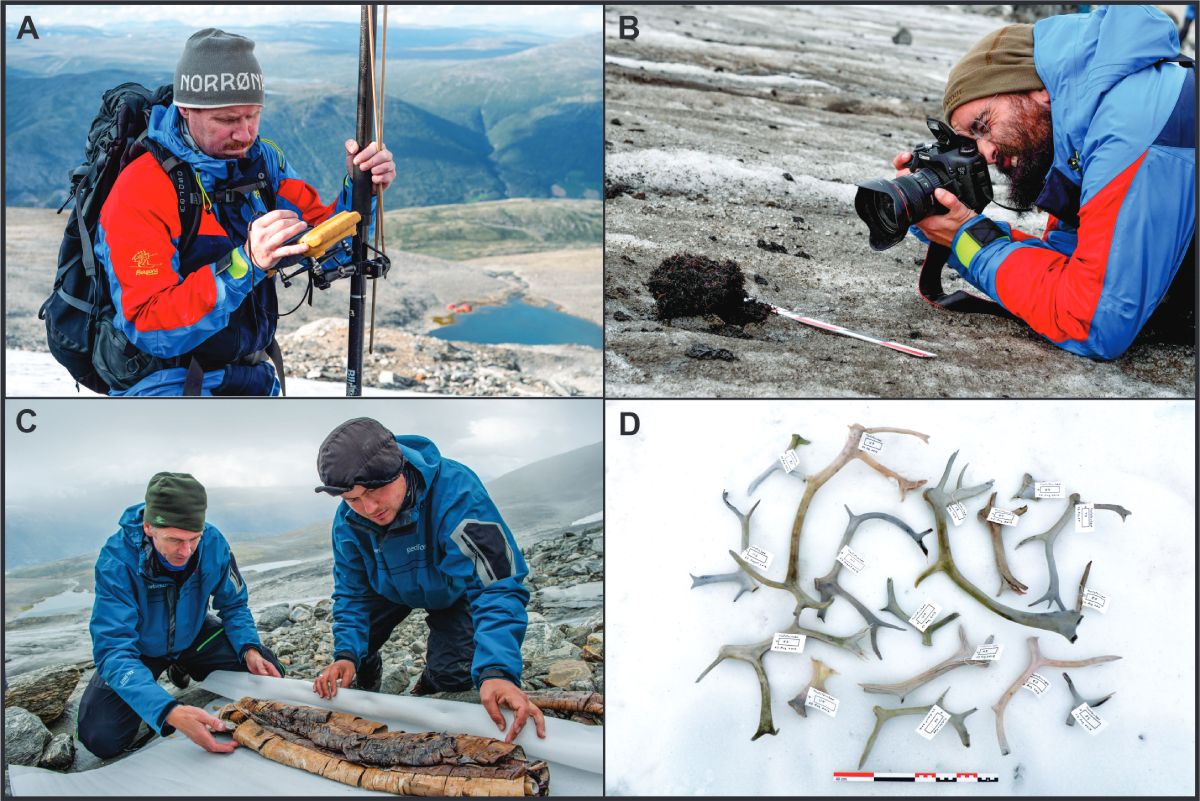
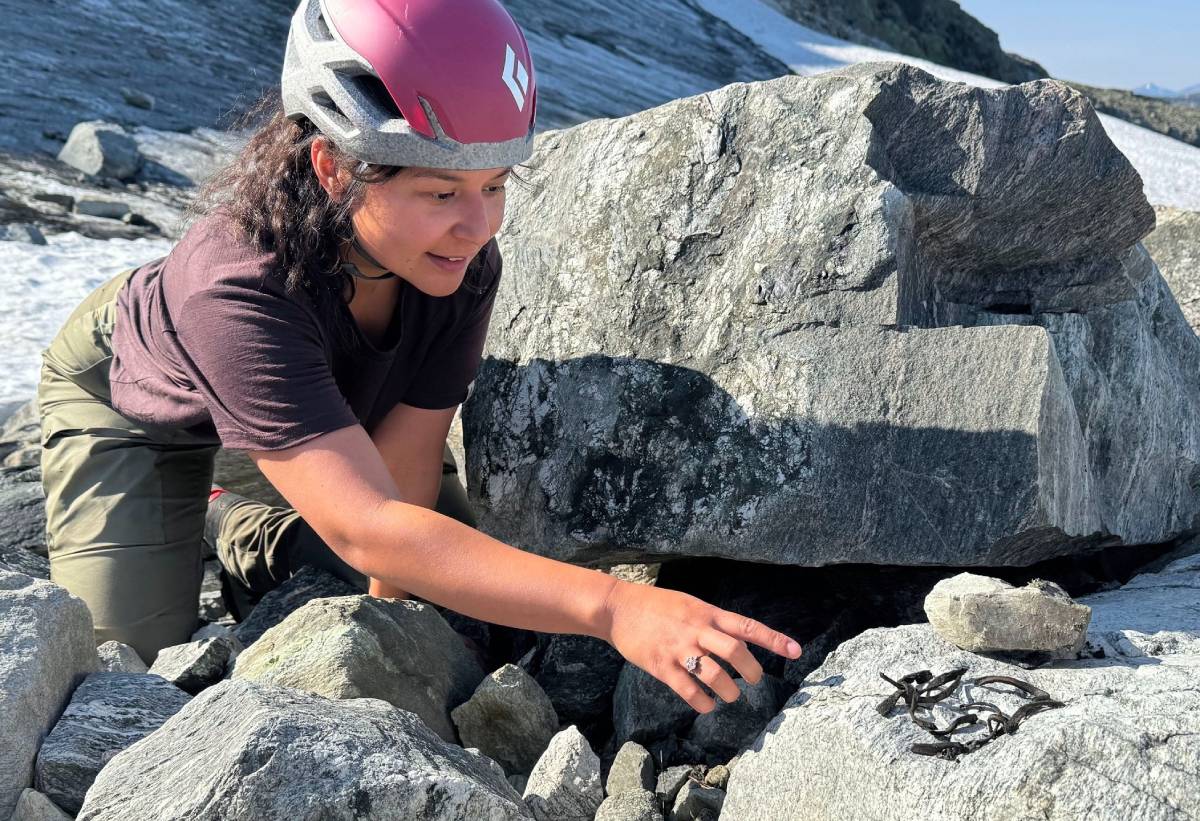
Documentation of finds. A) Measuring the location of a find at Lendbreen, using a high-precision GPS. B) Photographing a find on the ice at Lendbreen. C) Packing a container of birch bark, found at Lendbreen. D) Reindeer antler found at the unnamed ice patch at Trollsteinhøe, marked with find labels. Photos: A–B) Glacier Archaeology Program; C) Johan Wildhagen/Palookaville; and, D) James H. Barrett.
Deeper into the past
Lars Holger Pilø had not long joined the Secrets of the Ice team when the shoe was still being analyzed:
"We initially believed that the shoe could be up to 1,000 years old. This was mainly based on other finds from the site."
"I had first became involved in the program from 2007 onwards, but my colleague Espen Finstad, who was in charge at the time (and still co-directs the program with me), was very surprised. Until 2006, most of the datable finds from the ice had been 1,000-2,000 years old."
"Back in 2006, the radiocarbon dates were done in Trondheim at the only radiocarbon lab in Norway, and it could take months before dates came back. I do not have exact information on how long it took for the date of the shoe to come back."
When it did, it turned out that the shoe was from earlier – much, much earlier:
"From the Early Bronze Age," says Lars. "So 3,300 years old. That really opened our eyes to what was going on in the high mountains. I often refer to the shoe as the find that kick-started glacial archaeology in Innlandet County."
"The discovery of the ancient shoe became the starting gun for glacial archaeology here," says Reidar.
"That same autumn, many other finds melted out as well, but the shoe was the oldest and most interesting find. More than anything else, it made us realize that something both exciting and disturbing was happening in the high mountains."
For Lars and his Secrets of the Ice colleagues, this would be the first of several items footwear the retreating ice has unveiled:
"When the shoe was found, it was a huge surprise for us, but subsequent investigations of the find spot, the Langfonne Ice Patch, have revealed that there was a lot of Bronze-Age hunting activity going on there.
"We have found a number of arrows belonging to more or less the same period as the shoe. We also now have shoe finds from other sites, especially the lost mountain pass at Lendbreen, but they are Iron Age.
"We do not know a lot about the people that lived in the area in the Bronze Age, so the shoe is a very important piece of evidence. We know from pollen analysis that they used the high mountains for grazing their animals, and evidently, they also hunted."

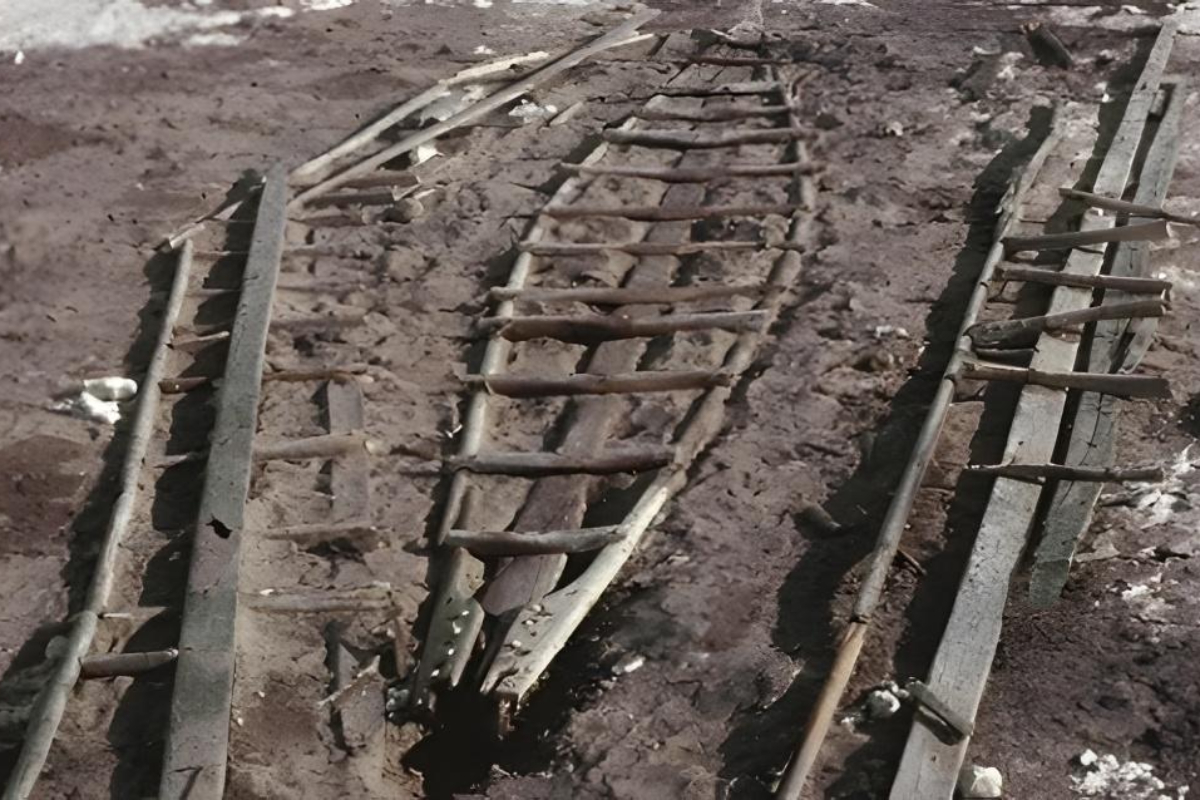
The "Secrets of the Ice" glacial archaeology program has generated international interest in their work in recent years. Pictured is a pre-Viking-era pair of skis from Digervarden. Source: Secrets of the Ice
Bound in partnership
For Reidar, born and raised on a small farm Lom, in the heart of the Oppland mountains, the happenings around the memorable summer of 2006 were not only the peak of his life-long pursuit of the past.
From then on, they bound him closer to the professional experts who come out every September in search of such rare treasures.
It's a collaboration that also resulted in his book on the history of the Jotunheimen Mountains, co-written in 2011 with Espen Finstad and Lars Pilø from Secrets of the Ice, Arne Brimi, and featuring amazing photography by Jan Stokstad.
"Reidar became a natural part of the program from the beginning," says Lars. "
"He has been with us on all our major sites. Reidar does reconnaissance work to check for new sites and evaluate the melting status of known sites.
"He hikes up to the ice to collect artifacts that have been reported by mountain hikers. In addition, he handles some of our practical issues through his local network. Not least, Reidar is a vital discussion partner when exploring the local history, which provides a background for past use of the mountains."
Lars sums up their long-term collaboration in this way: "One member of the Secrets of the Ice team is not a professional archaeologist. Why is Reidar Marstein, a hobby archaeologist from Lom, a core member of the team? Well, there are a number of reasons for that, but the main reason is that without him, glacier archaeology here in Oppland would have looked very different".
We get to provide readers with original coverage thanks to the support of subscribers to The Viking Herald's Facebook page. Do you enjoy our work? You can SUBSCRIBE here or via our Facebook page. You'll get access to exclusive content and behind-the-scenes access.
Feel free to reach out to discuss potential stories that may be in the public interest. You can reach us via email at hello@thevikingherald.com with the understanding that the information you provide might be used in our reporting and stories.