

When I first watched a demonstration of Glima – Iceland's traditional wrestling – something felt remarkably familiar. As someone who has practiced Tai Chi for decades, I recognized the principles immediately: upright posture, circular movement, using an opponent's momentum rather than meeting force with force, the emphasis on balance and timing over brute strength. Here was a Viking martial art operating on surprisingly similar principles to ancient Chinese martial arts – and as I would discover, the parallels extended far beyond Tai Chi into Kung Fu's striking traditions as well.
This wasn't random chance. It's evidence of something profound: that effective combat systems, developed independently across cultures, often discover the same fundamental truths about human movement, balance, and leverage.
Recent research into ancient migration patterns suggests connections between Nordic peoples and earlier populations from the Caucasus region – a historical crossroads where knowledge and technology flowed both east to India and China, and west to Europe. If such connections existed, they might help explain why we see similar martial principles across such distant cultures.

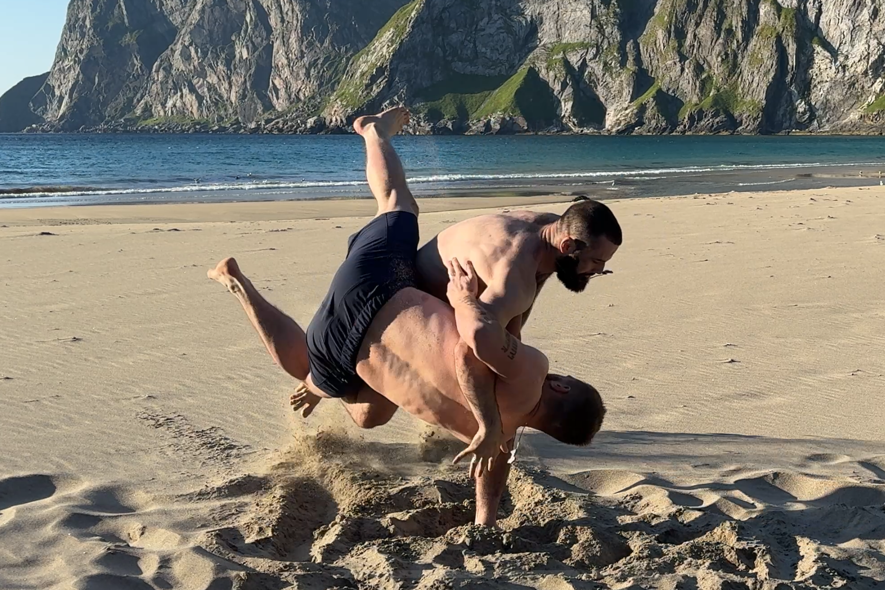
Glima practiced in the snows of Iceland. Photo: JonÞór Gunnar Þórðarson Gunnarskólinn / The School of Combat The School of Wilderness / The School of Oceans
From the Viking Age to modern Iceland
No one knows exactly how far back Glima's roots extend, but the tradition clearly stretches back centuries, with evidence of its practice during the Viking Age settlement of Iceland. The word itself may derive from Old Norse "glimt" (flash or glimpse), describing the art's quick, efficient movements. Unlike the violent imagery we associate with Vikings, Glima emphasizes skill, technique, and honor. The medieval Jónsbók law code from 1281 indicates some form of regulation and respect by that time – suggesting the tradition was well-established long before.
When Norse settlers arrived from Norway, Denmark, and Sweden in the 9th century, they brought their grappling traditions with them. The Icelandic sagas frequently mention wrestling matches held at gatherings and festivals, where it served both as entertainment and as a way to settle disputes without bloodshed. Wrestling was so important to Viking society that Thor, the god of thunder, was also revered as the god of wrestling.
Three styles, one philosophy
Glima exists in three distinct forms, each serving different purposes:
Brókartök (Trouser-Grip Wrestling) is Iceland's national sport and the most widely practiced form. Wrestlers wear special belts around the waist and thighs, gripping their opponent with one hand on the belt and the other on the trouser at thigh height. From this fixed position, they use throws, trips, and leverage to unbalance their opponent. Victory comes when any part of the body above the knee touches the ground. The emphasis is entirely on technique – there's no advantage to being bigger or stronger, only more skilled.
Hryggspenna (Back-Hold Wrestling) involves wrestlers standing chest-to-chest, gripping each other around the back and over the shoulders. Like Brókartök, it focuses on throws and trips from a set position. This style is often practiced by beginners as it teaches fundamental principles of balance and leverage.
Lausatök (Loose-Grip Wrestling) – the most aggressive and complete form, originally practiced for combat and self-defense. Here, any holds are permitted – but Lausatök goes well beyond wrestling. Combat Lausatök includes strikes, kicks, chokes, joint locks, pain techniques, and even defense against weapons. The Norse were expected to fight both armed and unarmed, so Lausatök trained warriors to survive on the battlefield when weapons were lost. In sport versions, light striking and slapping are permitted to simulate real combat, though techniques aimed at actual injury are discouraged. So complete is the combat system that many martial arts experts consider it comparable to the best complete martial arts systems in the world – and it was actually banned in Iceland in 1916, before being revived more recently by practitioners like Grandmaster Lars Magnar Enoksen.
This is where Glima's parallels to Chinese martial arts become even more striking. While Sport Glima echoes Tai Chi's emphasis on balance, technique, and redirecting force, Combat Lausatök shares remarkable similarities with Kung Fu's striking traditions – both are complete systems integrating strikes, kicks, locks, and throws into a unified combat philosophy built on the same core principles of efficiency and technique over brute force.
The eight principles: Viking wisdom meets Eastern philosophy
Glima is built on eight fundamental principles that any Tai Chi practitioner would immediately recognize:
1. Upright Posture – Wrestlers maintain vertical alignment at all times. Leaning forward or backward creates vulnerability. This mirrors Tai Chi's emphasis on maintaining one's central axis and the principle of "suspend the head from above."
2. Stillness of the Feet – Rather than dancing around, Glima practitioners remain rooted, making minimal foot movements. Like Tai Chi's standing meditation practices, this develops deep stability and the ability to generate power from the ground.
3. Balance and Grounding – Every movement maintains equilibrium. Practitioners learn to sense their own balance and exploit any imbalance in their opponent – exactly as in Tai Chi push hands practice.
4. Using Momentum – Never meet force with force. Instead, redirect your opponent's energy, adding just enough of your own to complete the technique. This is pure Tai Chi philosophy: "Four ounces deflects a thousand pounds."
5. Softness and Fluidity – Tension creates rigidity and slowness. Glima emphasizes relaxed, flowing movements that can adapt instantly – the concept of "sung" (relaxed power) in Tai Chi.
6. Courage – Not recklessness, but the willingness to commit fully to technique even against a stronger opponent. This mental quality transcends physical training.
7. Tactical Awareness – Reading your opponent's intentions, anticipating movements, staying several steps ahead mentally. This is "listening energy" (ting jin) in Tai Chi.
8. Glíma itself – The art's namesake principle: that flash of insight where technique, timing, and opportunity align perfectly. In Japanese martial arts, this might be called "kime" – the decisive moment.
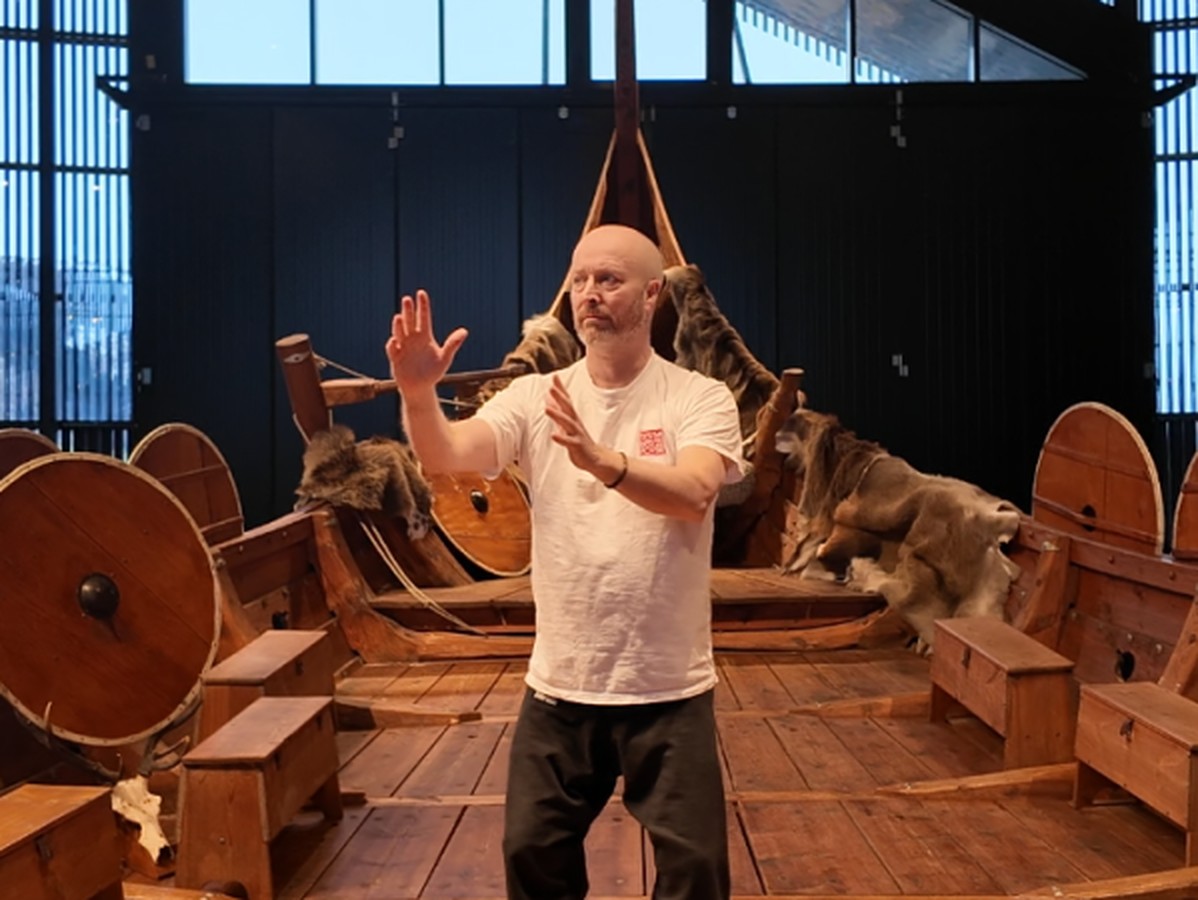
Author Brynjulf Haugan practices Tai Chi on board the Myklebust Viking ship in Norway. Photo: Sagastad Viking Center
Why independent cultures discover the same truths
The parallels between Glima and Tai Chi aren't coincidental. They emerge from the same fundamental realities of human biomechanics and combat effectiveness.
Upright posture works because it optimizes balance, protects the spine, and allows free movement in all directions. Circular movements are more efficient than linear ones because they redirect force rather than blocking it. Using an opponent's momentum requires less energy than creating your own force from scratch. Relaxation enables faster reflexes than tension.
These aren't cultural preferences. Instead, they are mechanical advantages discovered by any martial tradition that values efficiency over brute force. Chinese internal arts found these principles. Norse wrestling found them. Japanese Aikido found them. Filipino martial arts found them.
The Code of Drengskapur: Martial ethics across cultures
Beyond technique, Glima preserved something equally valuable: an ethical framework called "drengskapur" – roughly translated as "honorable conduct" or "gentleman's code."
The principles of drengskapur include:
• Never hurt your training partner deliberately
• Help your opponent up after a throw
• Acknowledge when you've been fairly beaten
• Show respect to all wrestlers regardless of skill level
• Use your skills only for legitimate defense, never aggression
• Teach younger students patiently
Sound familiar? These mirror the ethical codes embedded in traditional Chinese martial arts, Japanese Bushido, and martial traditions worldwide. The recognition that martial skills carry moral responsibility – that physical power must be balanced with ethical restraint – appears across cultures.
This suggests something profound: that serious martial training naturally leads to ethical reflection. When you develop the ability to harm, you're forced to confront questions about when and whether you should use that ability.
Lessons for modern martial artists
As someone who teaches Tai Chi, studying Glima has reinforced several insights:
First, that the principles underlying effective martial arts are universal. If you truly understand Tai Chi's principles, you can recognize them in Glima, Aikido, Brazilian Jiu-Jitsu, or any other system built on efficiency rather than force.
Second, that cultural preservation matters. Iceland maintained Glima through centuries when it served no practical combat purpose, simply because it connected them to their ancestors. This allowed those ancient insights to survive into the modern era where we can study and learn from them.
Third, that grappling and striking arts share more than we often recognize. Glima's throwing techniques operate on the same principles as Tai Chi's push hands, while Combat Lausatök's integration of strikes echoes Kung Fu's completeness – both demonstrating that the fundamental principles apply whether you're throwing, striking, or controlling joints.
Finally, that traditional martial arts offer something beyond self-defense techniques. The drengskapur code – demanding honor, fairness, and care for training partners – transforms physical practice into character development. Whether you're practicing Glima, Tai Chi, or Kung Fu, these ethical foundations are what elevate martial arts above mere fighting.
A living tradition
Today, Glima is experiencing a renaissance. Organizations like Glíma Scotland and the Scandinavian Glima Association are teaching these ancient techniques to new generations. Modern practitioners compete in international tournaments while maintaining the traditional emphasis on honor and sportsmanship.
For those interested in experiencing these principles firsthand, Glima clubs are growing across Scandinavia and beyond. The art welcomes practitioners of all sizes and ages – true to its principle that technique defeats strength.
What the Vikings understood – and what Glima preserved – was that the most sophisticated combat systems aren't built on aggression and power, but on balance, timing, and the intelligent use of biomechanics. These insights transcend culture and era. They're as relevant in a modern training hall as they were in a Viking longhouse.
The flash of recognition I felt watching Glima wasn't imagining connections that didn't exist. It was recognizing truth in a different form – ancient wisdom speaking across cultures, preserved through different traditions but ultimately pointing toward the same fundamental understanding of movement, balance, and the art of turning force against itself.
We get to provide readers with original coverage thanks to our loyal supporters. Do you enjoy our work? You can become a PATRON here or via our Patreon page. You'll get access to exclusive content and early access.
Feel free to reach out to discuss potential stories that may be in the public interest. You can reach us via email at hello@thevikingherald.com with the understanding that the information you provide might be used in our reporting and stories.