


A maritime museum like no other, Sweden’s most popular attraction sits on the island of Djurgården, close to Stockholm's city center.
Named after the 17th-century warship that sank nearby on her maiden voyage in 1628, the Vasa Museum sits close to the Viking Museum and several other historical landmarks.
Its location is no coincidence. The Vasa was first discovered in the late 1950s, some 330 years after it went down, and her salvage in 1961 was remarkable in that her hull was almost intact.
Not only had it not been seen for a third of a millennium, but the site is also one of the busiest shipping lanes in the region, around Stockholm harbor.
For 27 years until 1988, the ship sat at what was known as Wasavarvet, the Vasa Shipyard, while experts worked on her restoration.
In between, in 1981, Swedish architects Marianne Dahlbäck and Göran Månsson won a Scandinavia-wide competition to design a proper museum for the Vasa.
Prince Bertil laid the foundation stone in 1987.
In a scene similar to the one yet to be played out at the upcoming Museum of the Viking Age in Oslo, fragile, historic ships being transported from one site to a more protective one nearby, the Vasa was conveyed by pontoon to a dry dock where the museum was built around her.
Still partially uncovered, it was put on public view in 1989. In June 1990, King Carl XVI Gustaf inaugurated the Vasa Museum, rebuilt with a new exhibition hall in 2013.
By 2019, it was the most popular museum in Scandinavia.
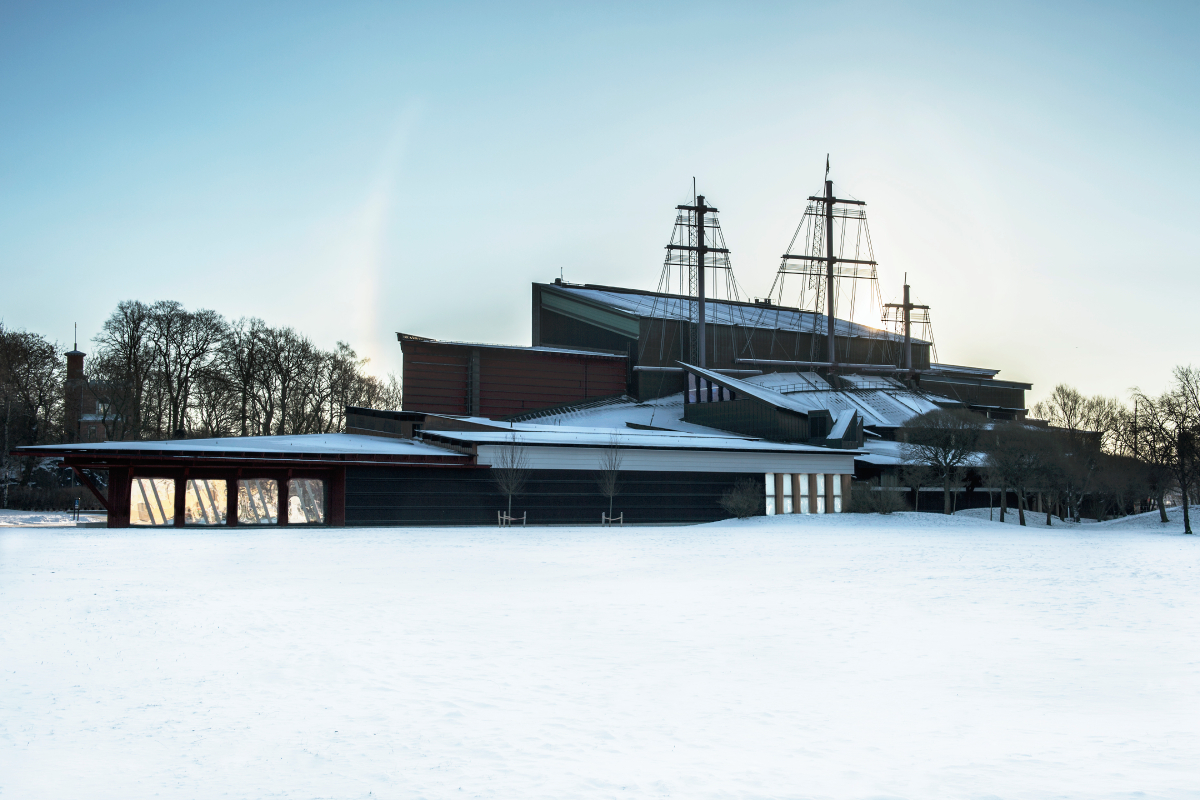
The Vasa Museum, designed by Marianne Dahlbäck and Göran Månsson, stands on Stockholm's Djurgården island, a modern structure built specifically to house and showcase the historic Vasa ship. Photo: Anneli Karlsson, the Vasa Museum / SMTM
What was the Vasa?
The Vasa was commissioned by Gustavus Adolphus, the powerful monarch who made Sweden a formidable European power.
A skilled military commander, he oversaw the lucrative plundering of Germany during the devastating Thirty Years’ War.
In a bid to galvanize his strength, the so-called Lion of the North had Dutch master shipwright Henrik Hybertsson and his business partner, Arendt de Groote, build four new ships.
One of them, the Vasa, was to be the most powerful warship in the Baltic, if not the world.
In an ominous sign, Hybertsson fell ill before he could supervise much of its construction. That duty fell to his Swedish assistant, Hein Jakobsson.
When the Vasa was ready to sail in 1628, it was huge, and hundreds of craftsmen had worked all summer to finish the hull and rigging.
Its specifications show just what a massive machine of war this was: 69 meters long and around 52 meters tall from the keel to the top of the main mast, the Vasa weighed over 1,200 tonnes once outfitted with ten sails and carried 64 cannons and 120 tonnes of ballast.
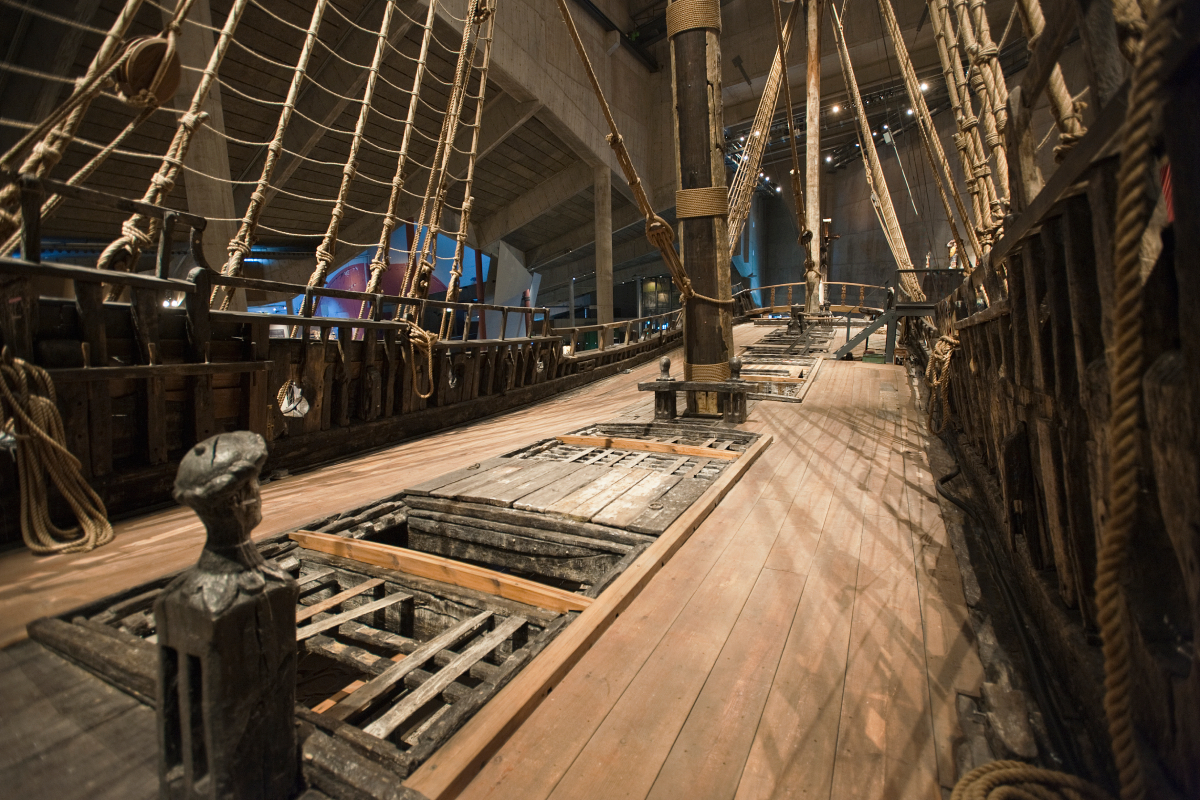
With a length of 69 meters and a height of approximately 52 meters from its keel to the main mast's peak, the Vasa was a formidable warship of its time, equipped with 64 cannons and weighing more than 1,200 tonnes. Photo: Anneli Karlsson, the Vasa Museum / SMTM
Why did the Vasa sink?
A few months before the Vasa was due to sail, the worried captain overseeing her construction, Söfring Hansson, summoned Vice Admiral Klas Fleming to the ship, moored at the Royal Palace, to point out her failings.
He had 30 of his men run up and down the deck to show Fleming how it simply wasn’t seaworthy, the ship rolling from side to side.
The Vice Admiral duly stopped the demonstration for fear of the ship sinking there and then, and plucked up the courage to advise his superior on the matter.
To no avail. The king ordered Hansson to set sail in August 1628.
Watched by a crowd of locals and dignitaries on shore, the Vasa pulled out of the dock where she had been built and made it as far as 1,300 meters before strong gusts toppled her over.
She sank to the sea bed 32 meters below, with the loss of around 30 sailors, to the horror of the many onlookers.
Experts later pointed out that with her two full gun decks and a plethora of statues, the Vasa was too heavy, with her center of gravity too high.
The inquest, however, did not need to look too far into the matter, as Dutch shipwright Hybertsson could not protest beyond the grave.
Decades later, the Vasa’s cannons were salvaged, an early example of using a diving bell.

Led by Anders Franzén in the 1950s, the salvage operation of the Vasa entailed intricate planning and execution, successfully retrieving the historic ship from its watery grave and preserving it for future generations. Photo: Vasa Museum (Public domain)
From the depths
While the Vasa’s wood, cloth, and leather, made of organic material, survived over the centuries, much of the iron and all the sculptures decomposed.
There was talk of a recovery in the 1920s, mainly to use the wood, but it wasn’t until the 1950s that amateur archaeologist Anders Franzén surmised that the Baltic waters would not encourage the presence of shipworm, and so much of the Vasa would be preserved.
This is how it turned out when he found it in 1956. He then participated in her salvage between 1959 and 1961.
By his side was diver Per Edvin Fälting, and the pair became celebrities as various pieces of the Vasa were brought to the surface.
Lifting the vessel was done in many stages, involving tunnels, cables, and floating pontoons so that the ship was raised to a depth of 17 meters off the island of Kastellholmen.
From there, it was hoisted to the surface and gently transported to the Vasa Shipyard, where a massive conservation effort began.
Waiting for the wood to dry as slowly as possible and humidity to lower took a further 27 years until the ship was ready to be seen by the public.
The Vasa became one of Sweden’s prime visitor attractions in no time.
An upgrade in the climate-control system in 2004 reduced the effect of humidity caused by the increasing number of visitors.
Much of the Vasa is intact, about 98%, and lighter new bolts fitted in 2019 have reduced its weight by eight tons.
Chemical research and monitoring of the wood continue to this day.
There have also been studies of the skeletons found on board of 17, possibly 19 people, nearly all men but with two women and a small child among them.
DNA analysis has shown most of them have enjoyed a balanced diet of meat and fish but with the deficiency of vitamin C typical of sailors.
An average height of 1.66 meters is also much shorter than today, again down to a poor diet in childhood.
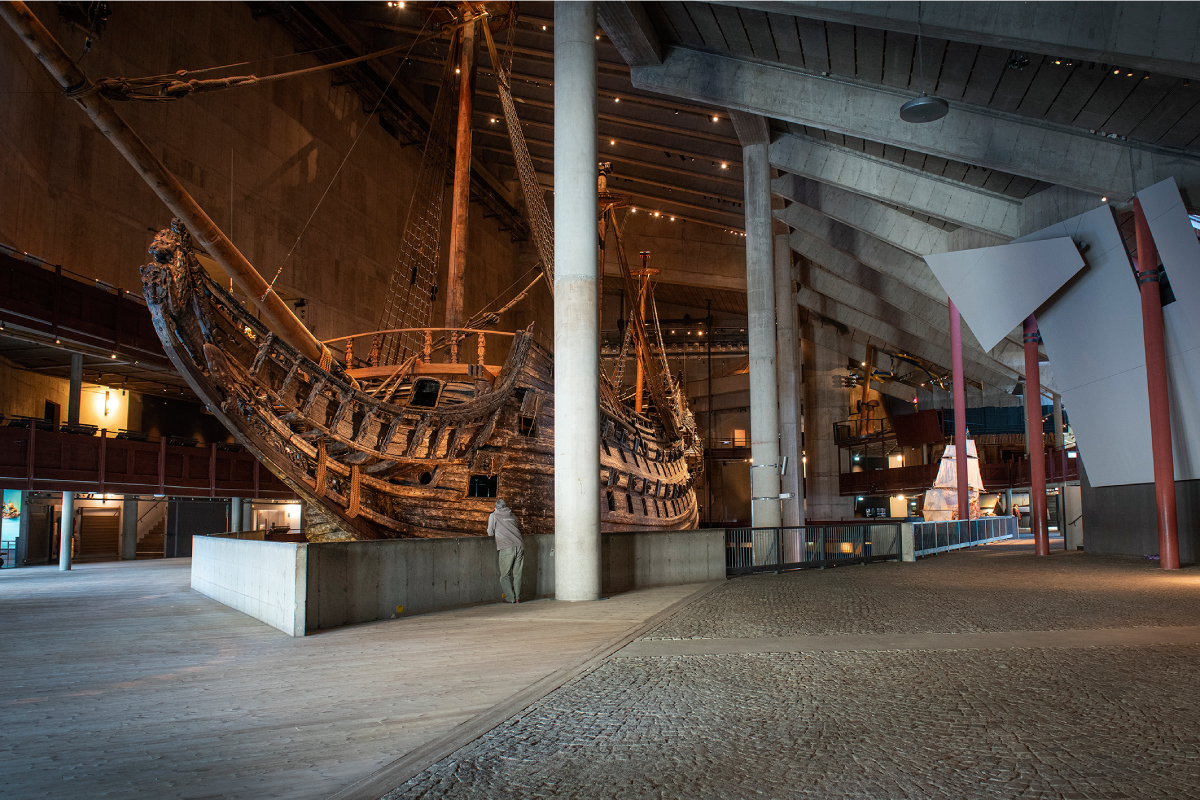
The salvaged Vasa, displayed in the main hall of the museum, retains its original, darker wood, left untreated to highlight its historical authenticity, and is fitted with three masts, demonstrating its impressive size. Photo: Anneli Karlsson, the Vasa Museum / SMTM
Visiting the Vasa today
A large, colorful model of the original Vasa at a 10:1 scale greets visitors upon arrival – note the 500 sculptures, illustrating that the vanity of the monarch who commissioned the ship may have contributed to its downfall.
The figurehead is a lion three meters long, a symbol of the Swedish monarchy.
The sinking and the salvage are also the focus of the display on the ground floor.
Two of the original 64 cannons can be viewed on the fifth floor, again evidence of the weight the Vasa had to carry.
The oak carriage upon which each of these cannons rested weighs 300 kg.
You can also see how the crew, some 450 people, lived in semi-darkness, living, eating, and sleeping on top of each other.
The ship itself can be found in the main hall, its replacement deliberately untreated and not painted so that the far darker material of the original vessel stands out.
It has been fitted with three masts, the roof depicting how tall the Vasa would have been when fully rigged. Alongside, an English-friendly film describes its delicate salvage.
Looking ahead, the research carried out by the Vasa team should help their counterparts in years to come when trying to counteract the process of decomposition.
If you would like to explore the Vasa but can’t make it to Sweden, its website offers a virtual tour.
Address: Vasa Museum, Galärvarvsvägen 14, Stockholm.
Open: Sept-May daily 10 am-5 pm (Wed until 8 pm); June-Aug daily 8.30 am-6 pm.
Admission: 170-220 Skr, varying according to the time of year. Under-18s are free. The price includes a 25-minute guided tour in English.
We get to provide readers with original coverage thanks to our loyal supporters. Do you enjoy our work? You can become a PATRON here or via our Patreon page. You'll get access to exclusive content and early access.
Feel free to reach out to discuss potential stories that may be in the public interest. You can reach us via email at hello@thevikingherald.com with the understanding that the information you provide might be used in our reporting and stories.


