

Viking activity in North America has been of such perennial interest that there is practically a cottage industry in books and articles covering the subject.
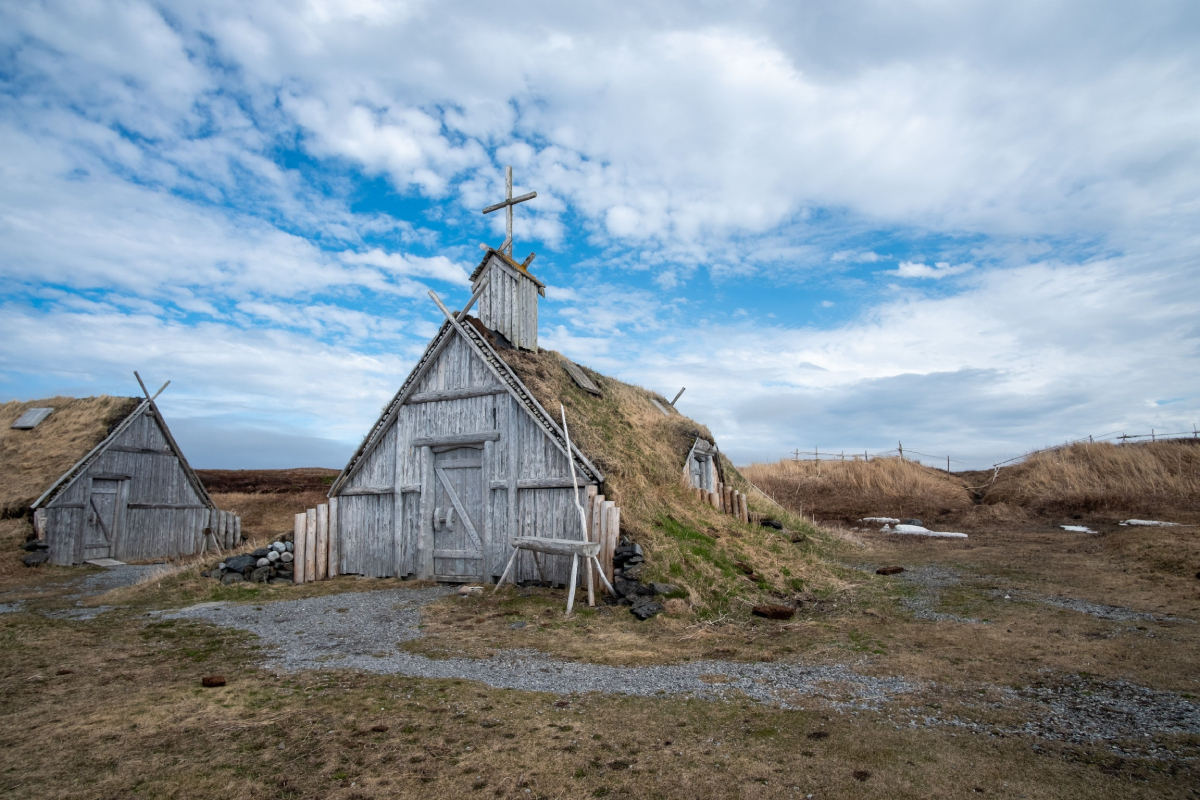
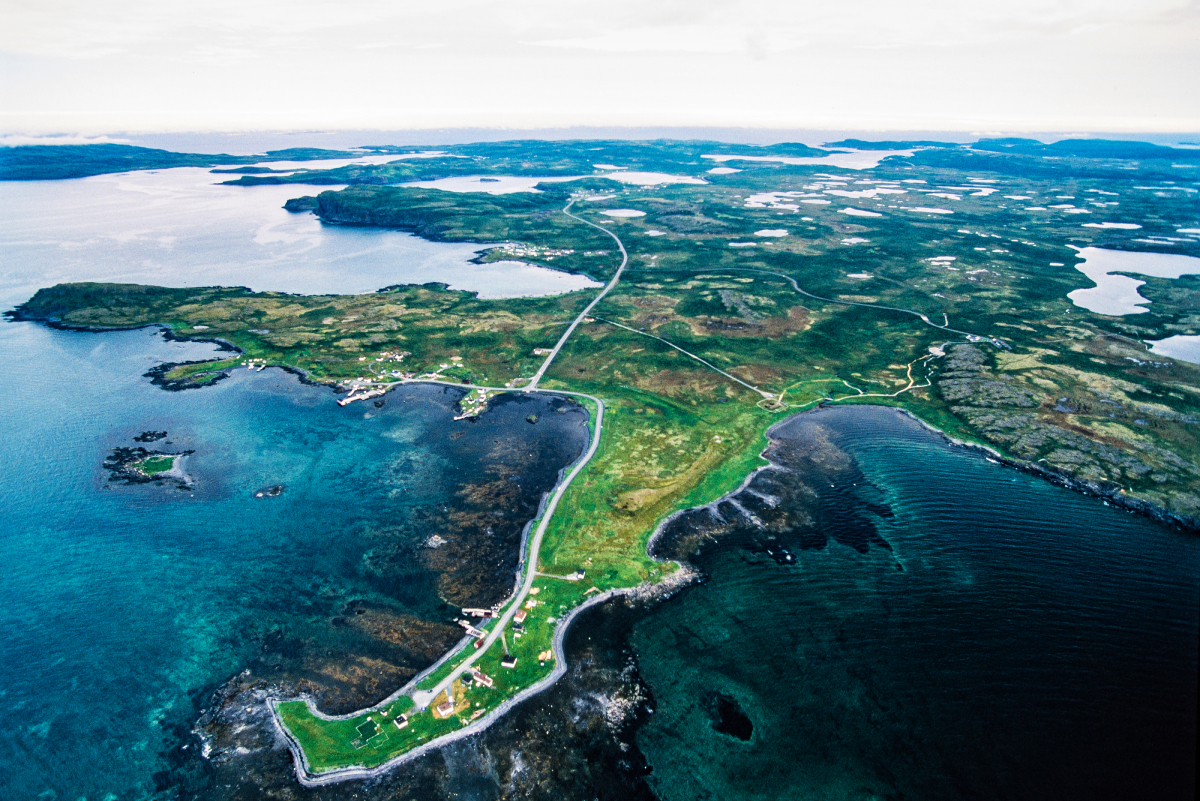
Yet apart from the archeological site of L'Anse aux Meadows in Newfoundland, there is no other widely accepted evidence of a Norse presence in pre-Columbian North America, although a handful of additional sites have been proposed in recent years and remain under debate.
There have, however, been plenty of rumors. Some of these, like the Kensington Runestone and the Yale Vinland Map forgery, are generally considered to be outright hoaxes. There are other instances whose validity is in question, such as the Maine Penny and the Narragansett Rune Stone.
A third category encompasses controversial findings that are not specifically hoaxes as such, but rather of uncertain origin. Dighton Rock is one such example.
The Massachusetts monument
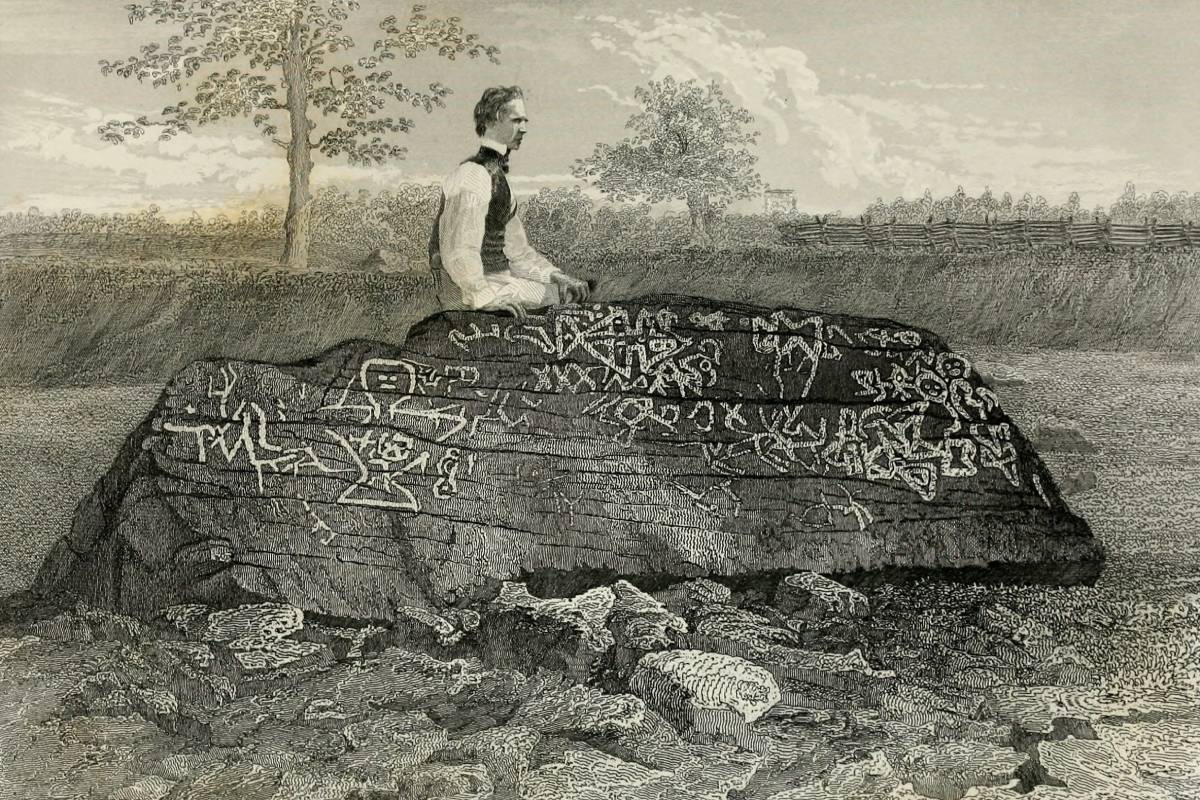
Dighton Rock is a 40-ton, glacially deposited sandstone boulder known for its mysterious petroglyphs. At approximately 1.5 meters (5 feet) in height, 2.9 meters (9.5 feet) in width, and 3.4 meters (11 feet) in length, it is now located as a sightseeing curiosity in Dighton Rock State Park in Berkley, Massachusetts.
Dighton Rock was originally located in the Taunton River riverbed. The carved inscriptions faced out toward the Atlantic Ocean, though it was partially covered by tidal waters much of the time.
This exposure led to considerable weathering and erosion over the years. When the first known photograph of the rock was taken in 1853, the inscriptions were so faint that the carvings were filled in with chalk to make them more clearly visible.
The first record of Dighton Rock, however, dates back to 1680, when it was first documented with a sketch drawn by the Reverend John Danforth. There has been an abundance of interest and diverse claims concerning the origins of the engravings ever since.
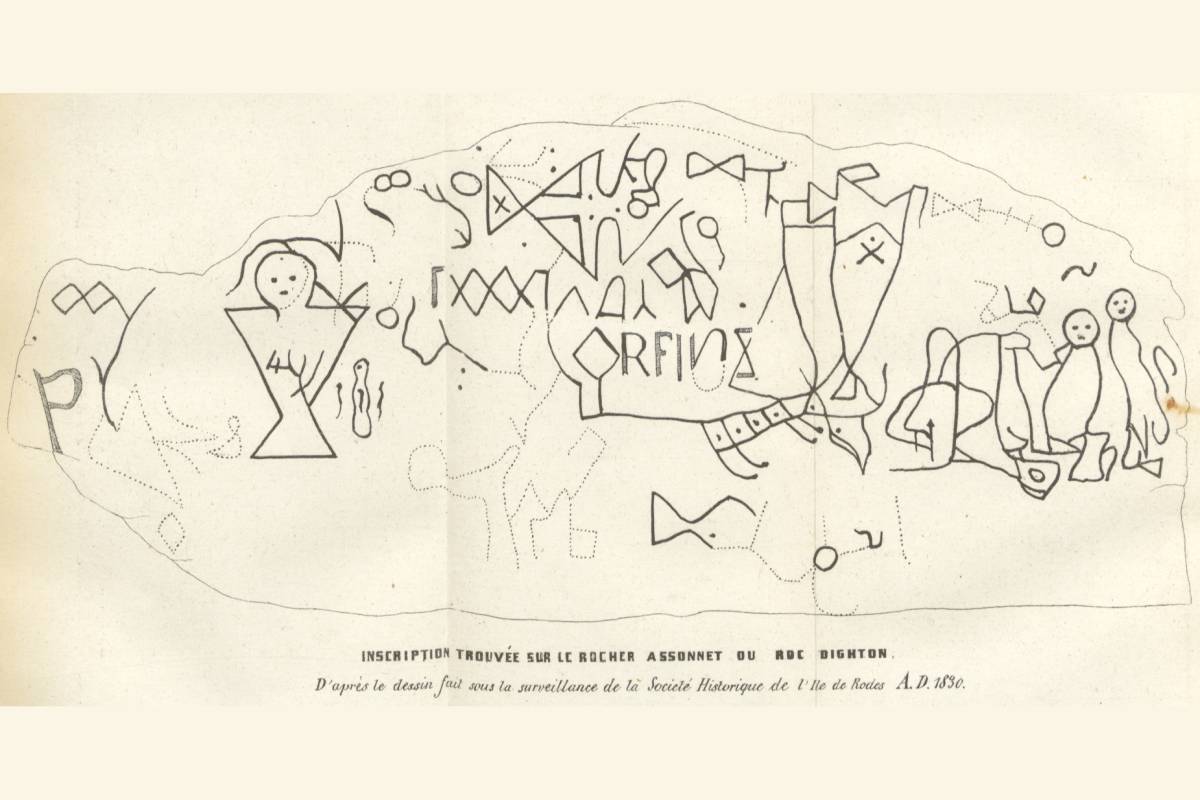
A detailed 1830 rendition of the Dighton Rock petroglyphs, commissioned by the Rhode Island Historical Society. Source: British Library
One theory after another
Reverend Cotton Mather, the Puritan clergyman of Salem witch trial fame, commented on Dighton Rock in his 1689 sermon The Wonderful Works of God Commemorated:
"Among the other Curiosities of New-England, one is that of a mighty Rock… filled with strange Characters: which would suggest as odd Thoughts about them that were here before us, as there are odd Shapes in that Elaborate Monument."
In 1781, Parisian Count Antoine Court de Gebelin revealed he had solved the mystery of Dighton Rock. De Gebelin maintained that Carthaginian sailors, who had befriended the local inhabitants, had carved the inscriptions "in very ancient times" to depict expedition leaders visiting an oracle, in order to learn of a favorable date to set sail for the return trip to Carthage.
Other suggestions include that of Ezra Stiles, the seventh president of Yale College, who believed the inscriptions were made by descendants of Noah's son Japheth from the Book of Genesis.
In 1807, Harvard scholar Samuel Harris, Jr., stated that he had deciphered three ancient Hebrew words – "king," "priest," and "idol" – written on the rock in Phoenician characters.
More recently, MG Boutet concluded in his academic 2024 paper, Dighton Rock – A Testimony to the Templars in America Before Columbus?, that the petroglyphs were mystic and cryptic symbols used by medieval orders such as the Templar Knights.
Perhaps one of the most interesting theories about the Dighton Rock inscriptions, however, was postulated by Carl Christian Rafn (1795–1864), a Danish historian, translator, and antiquarian.
Rafn was a serious academic, one of the founders of the Royal Norse Ancient Writings Society and a member of the Royal Danish Society for History. His work in Antiquitates Americanæ, published in 1837, is considered the first scholarly discourse on pre-Columbian Norse exploration.
The Viking explorers
At this time, most historians believed that the Norse sagas pertaining to Vinland were only legends or myths. Rafn, on the other hand, who made the first modern translation of the Vinland Sagas, was a strong proponent of the idea that Leif Erikson's North American explorations were historical fact.
Rafn also argued that Erikson's journey had brought him as far south as the Gulf of Saint Lawrence and maybe even New England.
To a certain extent, the later discovery of Norse activity at L'Anse aux Meadows in Newfoundland vindicates Rafn's belief that Norse sailors had indeed visited Eastern North America around the timeframe of the sagas.
Furthermore, Rafn believed that Krossaness, the place where, according to the Saga of the Greenlanders, Leif's brother Thorvald was buried after being killed in a skirmish with Native Americans, was probably located in Massachusetts.
Rafn was also interested in another person from the Vinland Sagas: Icelandic merchant Thorfinn Karlsefni.
According to the sagas, Leif Erikson explored some of the northern areas of the North Atlantic coast of North America, naming three specific locations – Helluland, Markland, and Vinland. Seven years later, Thorfinn Karlsefni supposedly sailed further south of Vinland to a place he called Hop.
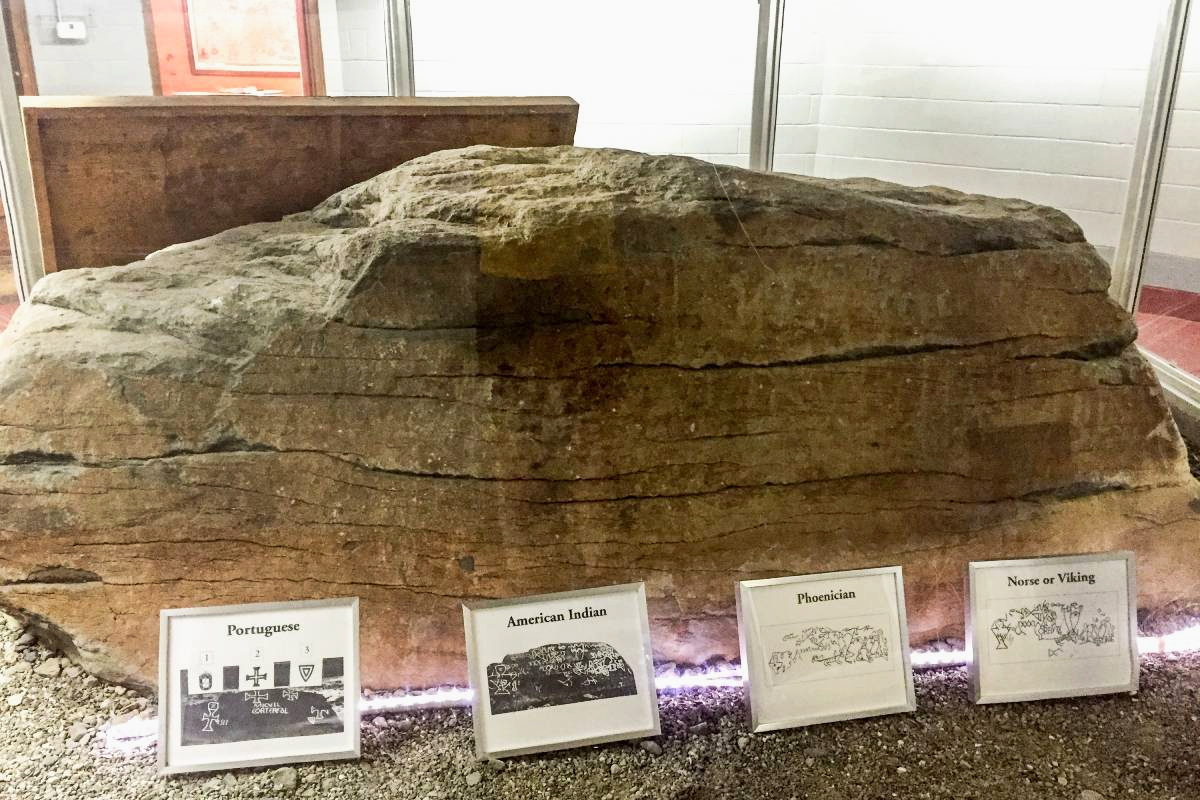
Dighton Rock and its museum are located in Dighton Rock State Park in the town of Berkley, Massachusetts. Photo: Kenneth C. Zirkel (CC BY-SA 4.0)
Investigating Dighton Rock
Seen in the light of Rafn's research and beliefs, it is understandable he was excited when he heard about the strange markings carved into the so-called Dighton Rock.
Were they perhaps a message left by Norse sailors? To gather more information, he sent out letters of inquiry to several New England historical institutions, finally awakening the interest of the Rhode Island Historical Society.
A committee was formed to liaise with Rafn and his associate, Finn Magnusen. Expeditions were organized, and a detailed drawing of the petroglyphs was sent off to Rafn in Denmark.
After studying the petroglyphs, Rafn came to the conclusion that Dighton Rock described Thorfinn Karlsefni's landing at Hop, where he and his company were later attacked by the natives. For proof of his theory, Rafn claimed to have identified from the engravings runes that spelled out "NAM THORFINS," as well as the Roman numerals "CXXXI."
Rafn and Magnusen interpreted the Roman numerals to refer to the number of Karlsefni's companions, 151, the same number described in the sagas. The only problem was that CXXXI stands for 131, not 151.
Rafn, however, maintained that the "C," which usually means 100, could stand for a Norse "long hundred" (Old Norse: hundrað, meaning a count of 120), thereby making 120+30+1=151.
Despite these uncertainties, Rafn's theory about a Viking message detailing Thorfinn Karlsefni's North American explorations etched into the surface of Dighton Rock was soon accepted as proof of pre-Columbian Viking voyages to North America, as described by the Norse sagas.
A theory demolished
Carl Christian Rafn's fascinating explanation about the Dighton Rock petroglyphs was in place for approximately 70 years before it was torn apart in 1916 by Edmund B. Delabarre.
A Brown University psychologist, Delabarre had moved near Dighton Rock in 1912 and dedicated the next 33 years to studying it. Delabarre decided to make an in-depth study of Rafn's explanations and ordered copies of the original drawings from the Royal Library of Denmark in Copenhagen.
To his surprise, the original drawings differed significantly from the illustrations in Rafn's book. Delabarre wrote,
"On the drawing as he presented it, Rafn attempted to distinguish his own additions by drawing them with shaded lines. Unfortunately, the shadings are not very distinct, and are easily overlooked."
In other words, Rafn had cheated, drawing in additional lines to help validate his theory. This revelation caused the whole theory to fall apart.
Delabarre had his own theories and proposed that the markings were, in fact, abbreviated Latin. He suggested that Miguel Corte-Real, a Portuguese explorer who had charted stretches of the Labrador coast, had in fact sailed down as far as New England. He translated the text as:
"I, Miguel Cortereal, 1511. In this place, by the will of God, I became a chief of the Indians."
Delabarre later distanced himself from this idea, however, and instead concluded that the markings were, in fact, probably what they seemed to be – another case of petroglyphs etched into the rocks by local Native Americans.
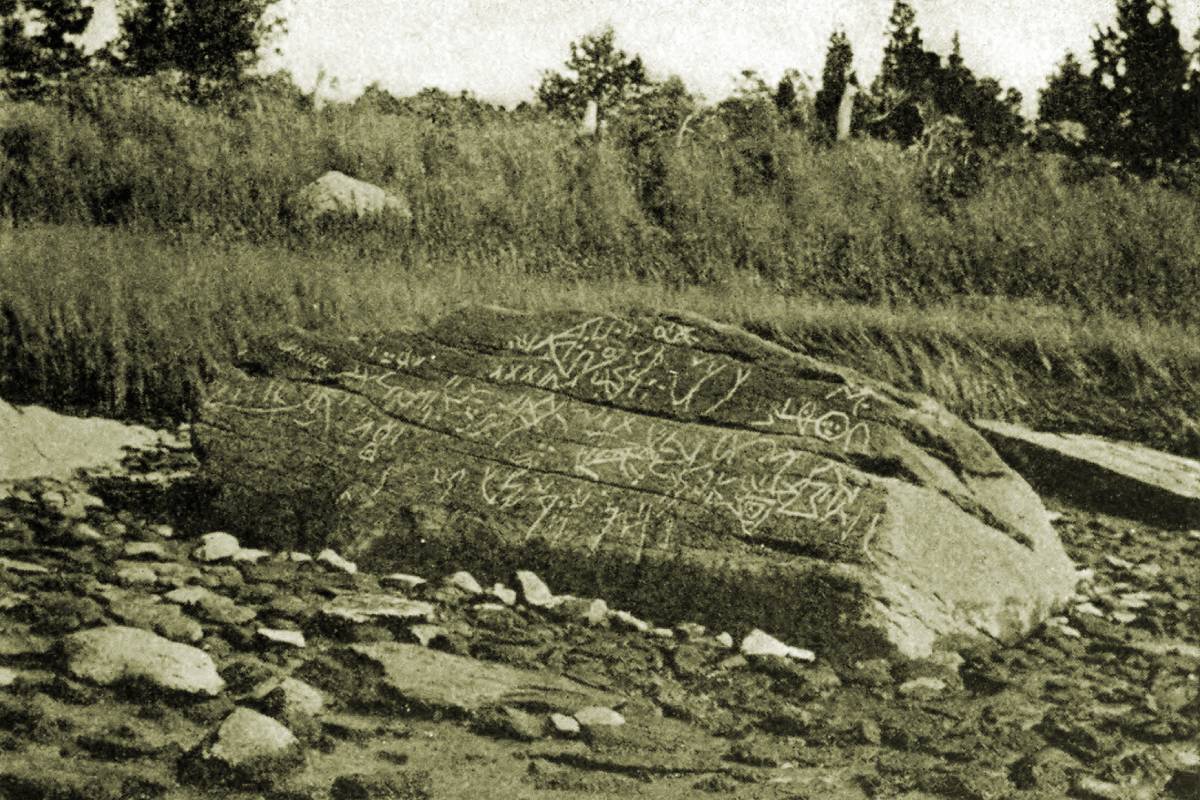
Photograph of Dighton Rock in its original Taunton River location, September 11, 1893. Photo: Frank S. Davis
The prevailing view
Rafn's ideas nevertheless had their impact on the history of Dighton Rock. In 1857, virtuoso Norwegian concert violinist Ole Bull, a strong supporter of Rafn's Viking exploration theories, is said to have convinced Norwegian businessman Niels Arnzen of Fall River to purchase Dighton Rock and the acre of tideland on which it stood.
In 1860, Arnzen gifted both to the Royal Society of Antiquarians in Copenhagen, who subsequently returned them to the Old Colony Historical Society of Taunton, Massachusetts, in 1889.
In 1955, the society deeded Dighton Rock to the Commonwealth of Massachusetts, and in 1963, it was lifted out of the Taunton River and installed in the nearby Dighton Rock State Park, where it can be seen today.
Currently, the general consensus among most modern scholars is that the Dighton Rock petroglyphs are probably of Native American origin. There are several examples of similar rocks inscribed with petroglyphs by the indigenous peoples living in Massachusetts and Rhode Island that support this idea.
Given the lack of methods to definitively identify who made the inscriptions, however, the mystery will probably never be solved with absolute certainty.
We get to provide readers with original coverage thanks to our loyal supporters. Do you enjoy our work? You can become a PATRON here or via our Patreon page. You'll get access to exclusive content and early access.
Feel free to reach out to discuss potential stories that may be in the public interest. You can reach us via email at hello@thevikingherald.com with the understanding that the information you provide might be used in our reporting and stories.