


Catlin has been investigating small dwellings on the edges of larger farmsteads for years in an attempt to improve our understanding of how early Viking settlers lived.
She also focused on how their relationship to the environment changed over time. However, in a press release published in June, Catlin stated that these settlers are not the Vikings of legend and lore that people often picture.
"I always hesitate to use that word – Viking – which to many people means going out raiding and pillaging. The people whose lives we're excavating weren't really doing that.
"These are farmers or fishermen – ordinary people who likely never left Iceland once they got there. I've trained myself to say Norseman, or Icelanders, rather than Vikings," Catlin stated.
For a long time, experts believed that these farmers lived in one of the larger centralized farmsteads. However, the materials Catlin and her colleagues have discovered point to a different conclusion.
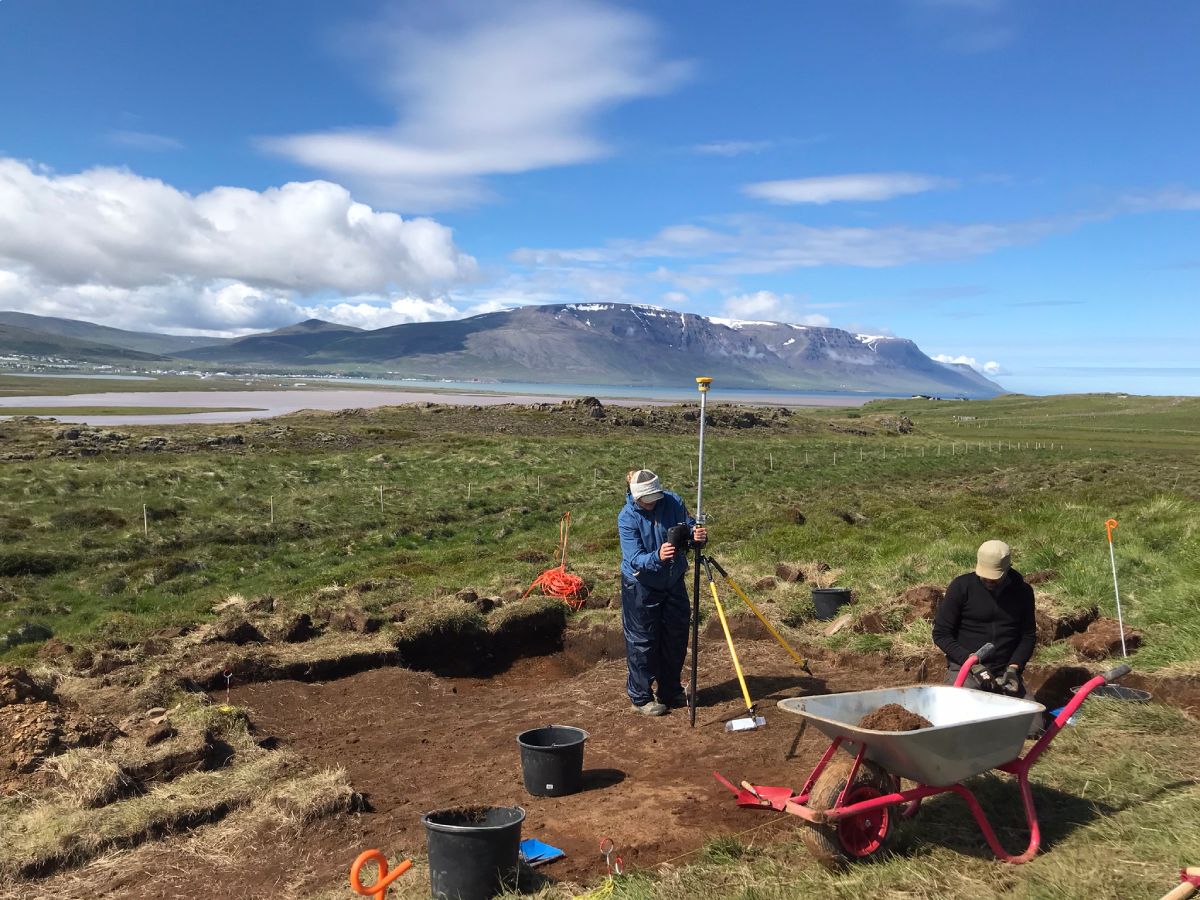
Part of the crew at work in Iceland early in the summer. Photo: Kathryn Catlin
The Viking Herald reached out to Kathryn Catlin to get the latest updates on her work in Iceland. Along with sharing valuable information on the project's findings, she also said that the researchers discovered a bone pin - the most exciting find from this year's work.
TVH: Could you shortly introduce the project to our readers? What are its main research ambitions?
KC: Our main goal for this summer was to locate the building (the dwelling house) where the people lived who created one of the smallest and oldest middens known from Iceland. A midden is an archaeological term for a pile of trash - in this case, mostly consisting of ash and charcoal sweeping from the hearth, animal bones, old turf (construction material), and the occasional artifact.
To give you some background here, a few years ago, I surveyed all of the small outlying places on Hegranes, a region in Skagafjörður in North Iceland. These are sites that today consist of ruined animal pens that date to the 17th-19th centuries.
It turned out that almost all of these places had buried midden that dated to the late 9th or early 10th century - right around the settlement of Iceland. People lived at these sites for a very short period of time and then left. The land was converted to livestock and agricultural infrastructure.
This is a big deal because, generally, we have assumed that the earliest settlers of Iceland all lived on large farmsteads with big households. But these findings showed that some people were living in much smaller places, places that probably did not have access to enough land to be a good farm, and they were doing a wide range of activities there.
Some of those activities aren't typical for a farm - for example, although they definitely had the full range of livestock there, they were also involved with drying fish, something that usually happened only at dedicated fishing stations much closer to the sea.
So we wanted to know why people were out there, who they were, their relationship to the large nearby farmsteads, etc. We chose to focus on Kotið because it's one of the smallest sites with the least access to quality farmland, and it's also the site with a radiocarbon date solidly in the late 9th century. We were prepared to find anything from a few post-holes (indicative of a very short-term encampment) to a big longhouse (suggesting someone really might have tried to start a farm there.)
To spoil the ending: We did find a building that appears to date to the late 9th or early 10th century at Kotið, and it's more substantial than post-holes. We still have a lot more analysis to do. We will be back next year to complete the excavation, so we'll be finding out quite a lot more about what this means over the next couple of years.
TVH: Could you tell us more about the team joining you?
KC: The team this year consisted of myself, my colleague Dr. Douglas Bolender from the University of Massachusetts Boston, two undergraduates and a grad student from JSU, and a grad student from Memorial University.
We're working together with Byggðasafn Skagfirðinga (the Skagafjörður Heritage Museum) on the project. I have partners at a few other institutions in the US, Iceland, and the UK. They will be performing specialized analysis on soil samples, macrobotanicals, micromorphology, wood, radiocarbon, and faunal remains from the site.
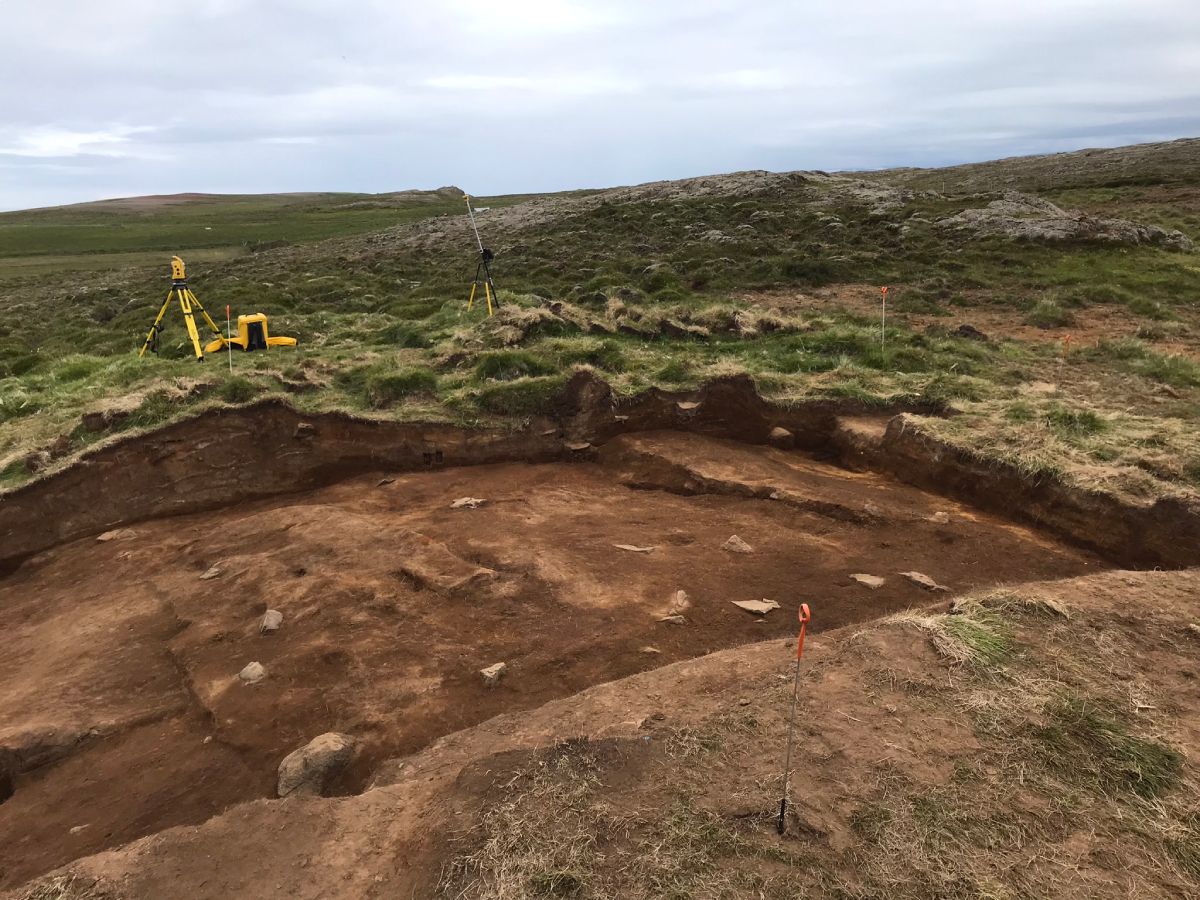
The research site on the last day before it was closed up for the year. Photo: Kathryn Catlin
TVH: In your expert opinion, why is it important to get a better understanding of the settlers played in the colonization of Iceland?
KC: Several reasons, but I will try to restrain myself to just a few! Iceland is one of the very few places around the world that was settled by humans relatively recently, just about 1100 years ago. That means we have an opportunity to compare the environment before and after settlement: the human impact on the land is much clearer in Iceland than in almost any other place on Earth.
It also gives us a chance to study how humans move into new landscapes and how we organize ourselves into social systems when we're not constrained by the economic choices made by untold generations into the past (or at least, how this one particular group of humans did that on this specific island).
My particular interest is in how these two ideas come together: how did the social organization of the settlement contribute to the landscape changes (especially deforestation) that took place during the settlement? And how did these dynamics change over time: how were the depopulation of the small sites and concurrent changes to economic systems related to the long-term consequences of human-caused environmental change?
Understanding how the environment and society interacted in the past may lead to better ways to address those dynamics in planning for present and future environmental challenges. But we can't reach that larger goal until we have a more detailed understanding of what life was like for the people at these very small sites - hence, this project.
TVH: This is not your first trip to the area. What would you say are the key takeaways from your previous trips?
KC: The key takeaway from previous work is: hey, guess what, the settlement of Iceland was much more complicated than we thought!
-
The project is funded by a grant from the National Science Foundation, which was awarded to Catlin two years ago.
We get to provide readers with original coverage thanks to our loyal supporters. Do you enjoy our work? You can become a PATRON here or via our Patreon page. You'll get access to exclusive content and early access.
Feel free to reach out to discuss potential stories that may be in the public interest. You can reach us via email at hello@thevikingherald.com with the understanding that the information you provide might be used in our reporting and stories.